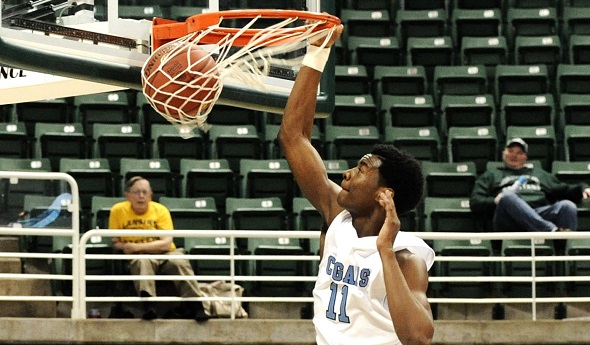
Breslin Bound: Boys District Preview
March 3, 2014
By Geoff Kimmerly
Second Half editor
Picking the teams to beat in the MHSAA Boys Basketball Tournament has been particularly difficult this winter. It appears there are plenty of favorites to go around.
We’ll begin to find out if that’s true when Districts begin tonight all over the state – and know for sure when we see which teams end up at Michigan State’s Breslin Center for Finals weekend on March 20.
Follow as the teams advance on MHSAA.com. Below are some that could reach the final 16 lines of those brackets.
Class A
Detroit Pershing (18-2) – It’s hard to believe Pershing hasn’t won Class A since 2009 since the Doughboys always seem to be in the mix. They came back from a two-point loss to Detroit Southeastern at the end of January to beat Southeastern – the reigning Class A runner-up – 57-56 in the Detroit Public School League Tournament Final. Pershing also has impressive wins over Ypsilanti, Detroit Douglass (twice) and Illinois’ Chicago Orr and Morgan Park. Center Justin Tillman, a 6-foot-7 force in the paint, is a Mr. Basketball candidate.
Detroit U-D Jesuit (17-2) – The Cubs tied for the Detroit Catholic League regular-season championship but cruised through the tournament with wins of 50, 28 and 16 points, respectively. They followed with a 10-point win over reigning Class A champion Romulus. U-D Jesuit would win its first Regional title and Quarterfinal on the way if it makes it to Breslin. Considering that could mean defeating both Pershing and Southeastern, it's a tall task that would be considered an even more impressive accomplishment.
Muskegon (20-0) – This is a football school, right? Not entirely anymore given the Big Reds’ basketball success over the last two seasons. Muskegon has improved from 11-11 in 2011-12 in 19-7 and a Quarterfinal run last season to perfection heading into this tournament. Guard Deshaun Thrower, the quarterback that led the football team back to Ford Field this fall, is a Mr. Basketball candidate. Teammate Deyonta Davis could be in 2015. Aside from winning the O-K Black title, the Big Reds have impressive wins over Saginaw Arthur Hill, Mount Clemens and Illinois’ Chicago Curie among others.
Ypsilanti (18-2) – The Grizzlies' only Southeastern Conference loss came to rival Ypsilanti Lincoln in mid-January and was avenged with a 12-point win a month later. Ypsilanti also fell to Pershing by three in December, but owns an eight-point win over a strong Detroit Southeastern team. Ypsilanti won its first Regional title last winter since 1981, but looks to have a good shot at making it two in a row, although the road could include Lincoln again plus Romulus and tough Westland John Glenn among others. Senior center Jaylen Johnson is a mobile 6-9 force and Mr. Basketball candidate.
Class B
Detroit Country Day (13-7) – It’s nearly impossible to not mention the reigning Class B champion, even if the Yellowjackets’ record is a bit down from the usual at the end of the regular season. But consider that Country Day is on an 8-1 run, its losses are against some strong opponents including Detroit Consortium and Class A Romulus and Walled Lake Western, and it features Mr. Basketball candidate Edmond Sumner, a 6-5 guard and scorer. Oh, and Country Day avenged that Consortium loss with a one-point win three weeks later.
Grand Rapids South Christian (19-1) – The Sailors have been MHSAA title contenders in seemingly every sport lately, and that’s grown to include boys hoops. After finishing 13-9 a year ago, South Christian fell this year only once, by three points, to O-K Gold runner-up Wayland. South Christian then won the rematch by 10 and also owns nice wins over Holland Christian and East Kentwood – although undefeated Wyoming Godwin Heights (see below) is a likely District opponent this week.
Jackson Lumen Christi (19-1) – The Titans have been building toward a run at their first Semifinals appearance since 1975 after reaching the Quarterfinal last season and falling in that game by only three points. Their only loss this winter was by five two weeks ago to Class A Lansing Waverly, a team Lumen Christi beat by seven earlier this season. The Titans also this season avenged 2012-13 losses to Flint Powers Catholic and rival Jackson, beating the latter twice.
Wyoming Godwin Heights (20-0) – The Wolverines haven’t lost since last season’s Class B Semifinals at Breslin Center. They beat solid Holland to cap the regular season after romping through the O-K Silver with only three of 14 games decided by single digits. But any potential run will have to go through Grand Rapids South Christian (see above) in the District.
Class C
Boyne City (18-1) – The Ramblers haven’t advanced to the season’s final week since 1990, but have looked up the challenge cruising through the Lake Michigan Conference undefeated after finishing 11-11 overall a year ago. The tough part this week likely will come in leading off the District tonight against league rival Elk Rapids, which Boyne City beat by three and then 12 earlier this season. Charlevoix also could be a tough out despite its 6-13 record – the Ramblers beat the Rayders by only four and six (in overtime) during the regular season.
Detroit Consortium (16-2) – Consortium has won Regional titles two of the last three seasons and just missed making it farther a year ago, falling by two in the Quarterfinal to eventual Class C champion Flint Beecher. The Cougars’ slate of wins this season includes many of the best from the Detroit PSL, including Southeastern and Douglass, plus wins over Class A Saginaw, Romulus, Saginaw Arthur Hill, and Class B Country Day. The lone losses were in a rematch against Country Day, by a point, and by two to Class A contender Pershing.
Mount Clemens (19-1) – It’s fair to call the Battling Bathers the favorites since the start of this season, or at least one of a few, and they haven’t fallen below that expectation. Mount Clemens won the Macomb Area Conference Gold title by four games after taking on a number of Class A schools including Detroit Martin Luther King and Grand Rapids Ottawa Hills during the season's first month. Only undefeated Class A Muskegon was able to give the Bathers a loss this winter.
Negaunee (19-1) – The Miners have reached at least the Quarterfinals the last three seasons and fell to Laingsburg in last season’s Semifinal by only two points. The only loss this season came in December to Class A Marquette, and was avenged with a six-point win three weeks ago. Negaunee played the biggest and many of the best in the Upper Peninsula and handed rival Ishpeming its only two losses in the Mid-Peninsula Athletic Conference – which Negaunee won.
Class D
Bellaire (20-0) – The Eagles faced only a few bumps in rolling to a flawless regular season record, needing a two-point win over second-place Mancelona and a three-pointer over third-place Onaway on Thursday to claim the Ski Valley Conference title outright. But perfection is nothing new to this bunch; Bellaire’s only loss last season came to Frankfort in the Regional Final, and the Eagles were perfect until the Quarterfinal in 2011-12.
Peck (18-0) – The Pirates’ success during their 8-player football championship run apparently is carrying over to basketball. Or maybe it was the basketball team’s success that carried over to football – the Pirates’ hoops team made its Regional Final last season before falling to eventual MHSAA Semifinalist Lansing Christian. Peck’s three single-digit games this winter came against rival Kingston and Class B Armada and Richmond.
Powers North Central (20-0) – Coming off its first MHSAA Semifinal appearance since 1985, North Central has crushed most of its competition this winter with 11 wins by 30 or more points. Only Skyline Conference foe Carney-Nadeau and Munising got within single digits of the Jets, and no opponent did so before February. Carney-Nadeau does also play in the same District, however, after falling to North Central by only a point in their rematch.
Southfield Christian (19-1) – The back-to-back reigning champion looks good to go for three, losing only to Class A contender Saginaw Arthur Hill this season while beating Walled Lake Western and Detroit Community among solid bigger opponents. The Eagles haven’t allowed an opponent within single digits since Allen Park Inter-City Baptist (14-6) on Jan. 10.
PHOTO: Detroit Consortium found the rim plenty during a 66-38 win over Jenison at the Breslin Center in December, and hopes to return to East Lansing at the end of this month. (Click to see more fromHigh School Sports Scene.)
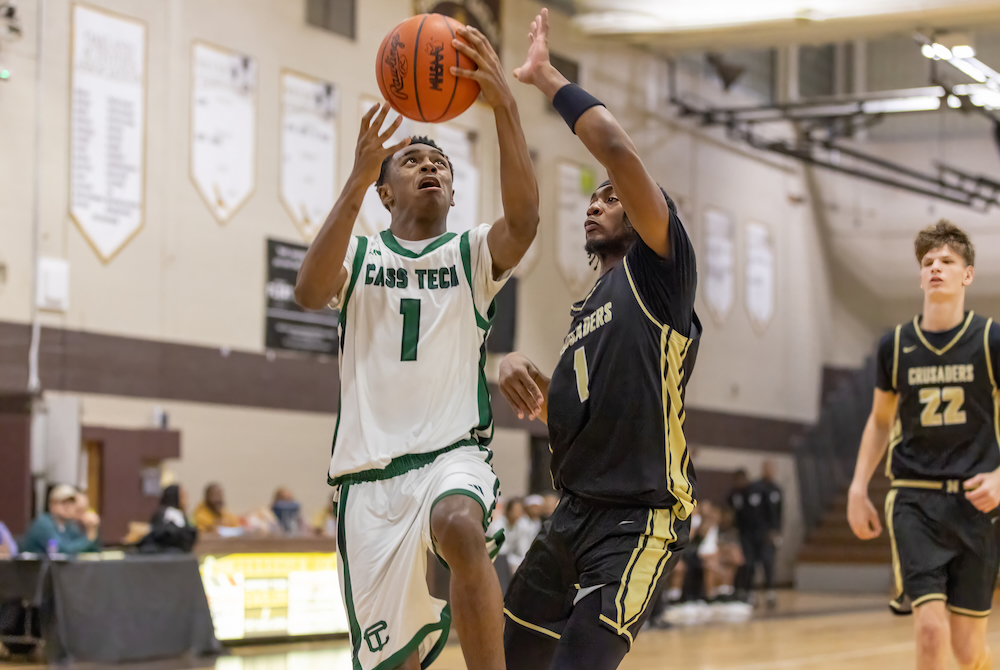
Century of School Sports: Boys Basketball's Best 1st To Earn MHSAA Finals Titles
By
Ron Pesch
MHSAA historian
March 11, 2025
Administratively, the world changed when the present Michigan High School Athletic Association was formed in the fall of 1924. That October, Battle Creek High School’s Alden W. ‘Tommy’ Thompson was hired on a full-time basis as state director.
“This position, which is a new one in Michigan, has for its purpose the centralizing of authority over all secondary school athletics in the state, including public high schools, and all private and parochial institutions,” noted the Battle Creek Enquirer at the time of his hiring. “It will take the place of the old Michigan Interscholastic Athletic Association, which was composed of the principals of the high schools of the state.”
Coach and director of athletics at Battle Creek since 1919, Thompson moved to Lansing following the close of Battle Creek’s football season and began his new position on November 17. While the job included full management of tournaments, there was little time to alter processes and procedures for the winter season. So, the 1925 basketball tournament – now celebrating its 100th year under guidance from the MHSAA – really did not look much different from the year previous.
Tournaments to name Michigan boys basketball champions date back to 1916. A recent enlargement of Waterman Gymnasium at the University of Michigan prompted the school to host a tournament in 1917. With four available courts, it was felt that the tournament could handle more than 60 teams and still be run in three days.
In 1920, the Michigan Interscholastic Athletic Association took control of prep athletics and the tournament. Among its first actions was to split the finals between Ann Arbor and East Lansing each year. That year, Class A final-round games were played at U of M in Ann Arbor, while Class B games were hosted at Michigan Agricultural College (M.A.C.) – now Michigan State University – in East Lansing. Sites were reversed in 1921. The addition of Class C, segmenting the tournament further, came in 1922, and those games were played in the same city as Class B. (The pattern was followed until 1926, when Thompson and staff added a championship round for Class D to the mix.)
The Mechanics of a Tournament
In January, Director Thompson announced that District tournaments (sometimes referred to as sectional) would be held at six locations across the state, designed to reduce the field of contenders to 24 teams for the final three rounds of the tournament. They would be held at Central Normal in Mount Pleasant (two teams advancing each from Class A, B, and C), Western State Normal in Kalamazoo (two teams each from Class A, B, and C), Michigan State Normal in Ypsilanti (two teams each from Class A, B, and C), the Detroit public schools (two from Class A), Petoskey (one from Class B and two from Class C), and Northern State Normal at Marquette in the Upper Peninsula (one regardless of Class to play in Class B) in mid-March.
The final rounds of the 1925 games were scheduled for March 26–28. Continuing the set-up of rotating sites, winners and runners-up in the Class A Districts received invitations to the playoff at M.A.C. while the Class B and C pairs were invited to the tourney at U of M.
Class A was defined as schools with enrollments of 500 or more students, Class B – 175 to 499, and Class C – 100 to 174. Schools with enrollments of fewer than 100 students comprised Class D and had the option to play in the Class C tournaments. Those hard and fast enrollment numbers meant an imbalance of teams in each class. Simply put, there were fewer schools in Class A and Class B than there were in Class C, and hence, fewer games needed to establish a final field of teams.
This method for setting the field for the final rounds certainly fashioned some stellar matchups. Sampled news from the time – sometimes conflicting in the account – gives a feel for the coverage by sports reporters from the daily and weekly newspapers.
Narrowing the Field
The seventh annual District Basketball Tournament hosted at Central Michigan Normal School – now Central Michigan University – featured a whopping 76 teams! Due to the number of schools of small enrollment competing, officials split opponents across six classifications: A (4), B (11), C (16), D (20), E (16), and F (9), with only A, B, and C eligible for the upcoming M.A.C. and U of M events. Games kicked off on Wednesday evening, March 18, with five Class B games. According to media coverage, this was the largest of any high school District tournament ever held in Michigan, with games played across four floors. A total of 66 contests were played during the two days and three evenings of the tournament.
“The city was almost taxed to capacity by the big crowd of players and rooters,” stated the Isabella County Enterprise in coverage of the games. “The athletic department wishes to thank the citizens who co-operated by renting their rooms at a very reasonable price to our guests.”
“Between 700 and 800 boys were entertained in Mt. Pleasant homes. From all parts of the district came scores of automobiles bringing rooters from the home towns,” recalled the 1925 Central Normal yearbook in its two-page remembrance of the event. “Effervescent high school youth was in its glory. … The large gymnasium was packed with spectators hours before the principal games started, and crowds filled three other floors where elimination contests were in progress. Cheer after cheer echoed through the Normal gymnasium from eight o’clock in the morning until after eleven o’clock at night. The court became a kaleidoscope of colors as new teams arrayed in brilliant hues followed each other in quick succession.”
Class B was declared as the most exciting series of the Central Michigan tourney. Among the entries was Reed City, state champions among the Class C teams in 1924. With enrollment just slightly above the limit, they bumped into Class B but still finished the regular season unbeaten. In the opening round that Wednesday evening, the team “celebrated its advent into faster company by defeating Lapeer, 36-8,” according to special coverage of the tourney in the Saginaw News Courier.
On Thursday evening, the Red and Black found themselves in a front-to-back thriller with Alma. Trailing 10-9, Reed City nailed a field goal just as the timekeeper’s final whistle blew marking the game’s end. The crowd rushed the floor in victory. But simultaneous to the shot, a referee had called a foul. After the two officials consulted with the timekeeper, it was determined the foul occurred before the attempt, so the basket was waved off. The court was cleared, the teams called back, and Reed City was awarded two shots from the line. The celebration was dramatically short-lived. “Due to the extreme nervous tension attending such a situation, neither of the free throws was successful,” detailed a sympathetic writer in the Osceola County Herald.
The “Southwestern Michigan Sectional Tournament” held at Western Normal – today’s Western Michigan University – featured 60 schools: nine in Class A, 16 in Class B, and 35 in Class C. Grand Haven, the defending Class B champion, and St. Joesph, runner-up to the 1924 title, were again expected to emerge as representatives in 1925. To the surprise of many, Sturgis topped St. Joseph in the semifinals, 19-11, then downed Grand Haven, 21-16, in the final round of the ‘B’ games. Front page news in the Grand Haven Tribune noted disappointment. “The Havenites took the floor in foot-weary condition and couldn’t get started until the final half when they outscored Sturgis. … The entire Grand Haven team was tired from their three hard preceding games and the effects of (a) hard season of basketball were easily seen.” Still, as runner-up, the team would have a chance for redemption in Ann Arbor.
Jackson, the defending Class A champion, again emerged from a field of eight Class A schools in the District tournament at Michigan State Normal College in Ypsilanti.
At Northern Normal, Lake Linden – located about 30 miles from the northern-most point of Michigan – beat Negaunee, 33-26, for the right to play in the downstate tourney.
At Detroit, the city league championship tournament established Southeastern with clear claim to the metropolitan crown, but Detroit Northwestern and Detroit Southwestern tied for second place in the final league standings. Time would not allow a playoff between the two teams to determine a logical second representative.
Owen. A. Emmons, supervisor of athletics of Detroit high schools, initially pitched the idea of sending the three Detroit schools to the M.A.C. tournament. Thompson rejected the idea stating each District could send no more than two teams. Emmons countered with sending the schools that tied for second to East Lansing and giving Southeastern an automatic berth to the era’s prestigious annual National Cage tournament hosted by the University of Chicago, entering its eighth year that April. Thompson volleyed back that “only a state championship team which had won its title on the playing floor was eligible to represent Michigan at Chicago.”
Forced by Thompson to decide, Emmons chose Southwestern as the second representative based on a better overall showing in the regular season, and a point differential displayed in the league championship series.
With that determined, the field was set for the championships.
The bigger task for the MHSAA and their director still lay ahead.
“There has been some fault found by the schools in the manner of conducting the district tournaments in basketball,” noted the Detroit Free Press. “It is claimed that 60 or 75 teams cannot (properly) decide a district champion in the space of two or three days. Teams that are up in the running for the honors must play two and sometimes three games a day, and the district tourney gradually develops into an endurance contest with the title depending more upon brawn than upon skill and cleverness of play.”
Thompson recognized this and stated he was working on a new plan with the state’s athletic council, with a goal of determining a new approach following the 1925 tournament.
The 1925 Championships
According to the Lansing State Journal, “permanent trophies will be awarded the winner and the runner-up, while individual medals will be given members of the two teams.” Drawings for first-round matchups took place during the afternoon of Thursday, March 26, once coaches arrived. A consolation tournament was scheduled for Class B and Class C teams defeated in the opening round. There would be no such tournament for Class A.
Jackson and Kalamazoo again went head-to-head in the first-round quarterfinals at M.A.C. Kalamazoo had entered the postseason with a dismal 4-9 regular-season record. Among its losses was an 18-11 defeat by Jackson in January during which Kalamazoo led 9-5 at the half, shutting down Jackson star Jessie Drain, who was 0-9 shooting before the break. But Jackson tied the game in the third quarter, 10-10, then cracked the visitors’ defense in the fourth for a convincing win.
Minus their captain, Bruce Masselink, Kalamazoo put up a major fight in the rematch. “Jackson had anything but a walkaway when if defeated Kalamazoo Central 29 to 21 in an overtime game,” stated the Jackson News. “Time and again Kalamazoo had opportunities to put the game on ice in the last quarter, but missed easy shots and kept Jackson in the race for the state championship …”
Jackson held a 13-7 lead at the half, but watched it rapidly evaporate. The deficit cut to 17-13 at the end of three quarters, Kalamazoo tied the game, 19-19, with a minute to play. A shot by Kalamazoo with 30 seconds remaining would have likely won the contest, but it missed the mark, forcing the five-minute extra frame. The Orange and Black “in the overtime period showed some of the fastest basketball displayed during the entire first round … working the ball down the floor for five easy baskets …”
The State Journal estimated that “about 700 saw the four” Class A Quarterfinal games at M.A.C.
In Class B at Waterman Gymnasium, Grand Haven and Sturgis were rematched in the Quarterfinals. C.O. Reed covered the game from the “historic floor” in a special report to the Tribune.
“Battling fiercely and with an even chance to win until the final whistle blew, Grand Haven High School lost to Sturgis 19-16. “Both played in whirl-wind fashion (and) were exchanging score for score with rapidity and the guarding was terrific.” Tied 16-16, a free throw by captain Laurence ‘PeeWee’ Clemmons and a hook shot field goal by Don Grove allowed Sturgis to advance.
Jackson St. Mary’s had grabbed a Regional title in Class C with a “bitterly contested” triumph over Farmington, which had been a semifinalist in 1924. In that game, the Blue Devils were led by “flashy little forward” Lawrence ‘Lorry’ Heuman. Trailing 9-7 late in the game, St. Mary’s broke up a Farmington stall, allowing Heuman to nail “a sensational side shot from near the center of the court” for an 11-9 victory. Heuman finished with 10 points.
The teams met again in the Quarterfinals, this time with late heroics by St. Mary’s Donald Tobin, who, sent to the foul line with less than 20 seconds to play, sank a free throw to break a deadlock, giving the Blue Devils a dramatic 15-14 win.
In yet another rematch, this time in the Class C Semifinals hosted Friday at Ann Arbor, Three Oaks and Bridgman – county rivals and final-round opponents at the Southwestern Regional – squared off. A quarterfinalist at the 1924 Finals, Bridgman had topped Three Oaks, 14-10, at Western. “Coach F.C. Reed’s (Bridgman) youngsters did not exhibit a brand of basketball that would set the world afire but was good enough to win five rounds of games during the last two days,” stated the Kalamazoo Gazette. Three Oaks flipped the script at U-M, defeating Bridgman 22-20 to advance to the title game with Jackson St. Mary's.
For the first time, a play-by-play account of Friday’s Class A Semifinal round games at East Lansing was broadcast by a radio station – Michigan Agricultural College’s recently-created AM station, WKAR. There, Detroit Southeastern trounced Grand Rapids Union 31-20, while Jackson dumped Detroit Southwestern 25-18. This set-up a rematch for the Class A title, won the year prior by Jackson, 17-11.
The Finals
That rematch, also broadcast on WKAR, sadly was a letdown as Southeastern crushed Jackson, 44-22. Jackson outplayed the Detroit squad in the opening quarter, leading 11-7, before its game collapsed. From that point on, Southeastern’s defense forced Jackson to shots near mid-court, and grabbed a 20-11 lead at the half, then a 28-15 edge after three quarters. “So effective was the Southeastern five man defense,” stated the State Journal, “that it appeared to the spectators as though a fence had been stretched across the floor.” Detroit’s Harold Hendricks and Norman Daniels led all scorers with 17 and 15 points, respectively, while captain Nolen Putnam added eight. Hendricks and Putnam were praised for their defense. Drain and Walter Hodgboom each connected on four field goals for Jackson.
The win brought the Class A title back to the metropolitan district for the first time in five years, when Northwestern defeated Northern, 17-13, in an all-Detroit showdown in 1920. With the win, Southeastern earned the trip to Chicago for a spot in the National Cage tournament.
In Class B at Waterman, Sturgis and Lake Linden, both 20-plus point margin winners in the Semifinals, skirmished. In a tight ballgame into halftime, with the U.P. representatives leading 15-14 at the break, coach Andy Carrigan’s Sturgis squad proved “too fast for the Lake Linden quintet and slowly but consistently piled up” a 36-25 triumph. Clemmons led Sturgis with 10 points followed by the Grove brothers, Roger and Don, with nine points apiece. Senior center Wayne Nestor led Lake Linden with 12 points.
The Sturgis squad returned home to huge acclaim, with University of Michigan basketball coach Edwin J. Mather speaking to the team at their postseason banquet. Mather picked a Class B and Class C all-tournament team following the games.
Interestingly, after graduation Roger Grove earned All-America honors in football and basketball at Michigan State, then played five seasons in the NFL for Green Bay. Nestor went on to letter in baseball and basketball at Western Normal, then taught and coached at, ironically, Detroit Southeastern. In 2020, the estate of Lester and his wife June left a $2.5 million endowment to Lake Linden-Hubbell Public Schools, with investment returns funding annual scholarships for graduating seniors.
“Without a doubt, the most thrilling encounter of the afternoon was the final game of Class C,” noted U-M’s newspaper, The Michigan Daily. Once again, St. Mary’s forward, Heuman, was the star of the game. “A see-saw battle throughout, with less than two minutes to play,” according to the Jackson News, “Three Oaks was up 20-19, when “standing alone in mid-floor (Heuman) shot the ball through the net, without even touching the rim” to give St. Mary’s the lead. A pair of free throws by Saroldi gave Three Oaks back the advantage 22-21, with 50 seconds to play.
“Keen passwork brought the ball to the basket,” wrote a “staff correspondent” from the Citizen Patriot, one of two papers in Jackson recapping the game for readers. “(Fred) Smith, pivot man, cut across court at the opposite side,” stated the News. Heuman shot a pass to Smith “standing unnoticed about six feet to the left of the loop,” said the Citizen-Patriot report. “Smith jumped, caught the sphere,” according to the News, “and heaved it through the hoop to complete one of the greatest plays of the entire tournament.”
“Excellent stalling … was enacted by the Blue Devils for the final eight seconds of the game,” continued the Citizen-Patriot.
“The gun sounded and St. Mary stood crowned the Class ‘C’ champions of Michigan. … For the first time in the history of interscholastic athletics in Michigan, a parochial team won a championship sanctioned by the state high school league,” concluded the News.
Heuman led all scoring with 11 points, while Robbie Decker paced Three Oaks with eight, followed by Joe Savoldi and Richard Potts, each with seven. Smith added six points for St. Mary's.
Earlier that school year, St. Mary’s laid claim to a Michigan parochial football title. Struggling financially, parish members and alumni used the success of the athletic teams to rally support.
In total, Heuman scored 30 of the team’s 58 points during the trip to Ann Arbor. The 5-foot-5 all-around athlete was a back on the football team, then attended Michigan State Normal for two years before signing a minor league baseball contract. An arm injury sent him back to Jackson to coach and play baseball in the city’s recreational Twilight Leagues. Switching to the infield, he was remembered as one of Jackson’s all-time finest.
Previous "Century of School Sports" Spotlights
March 5: Everything We Do Begins with Participation - Read
Feb. 25: Slogans & Logos Remain Unforgettable Parts of MHSAA History - Read
Feb. 19: MHSAA Tickets Continue to Provide Fan-Friendly Value - Read
Feb. 11: We Recognize Those Who Make Our Games Go - Read
Feb. 4: WISL Conference Continues to Inspire Aspiring Leaders - Read
Jan. 28: Michigan's National Impact Begins at NFHS' Start - Read
Jan. 21: Awards Celebrate Well-Rounded Educational Experience - Read
Jan. 14: Predecessors Laid Foundation for MHSAA's Formation - Read
Jan. 9: MHSAA Blazes Trail Into Cyberspace - Read
Dec. 31: State's Storytellers Share Winter Memories - Read
Dec. 17: MHSAA Over Time - Read
Dec. 10: On This Day, December 13, We Will Celebrate - Read
Dec. 3: MHSAA Work Guided by Representative Council - Read
Nov. 26: Finals Provide Future Pros Early Ford Field Glory - Read
Nov. 19: Connection at Heart of Coaches Advancement Program - Read
Nov. 12: Good Sports are Winners Then, Now & Always - Read
Nov. 5: MHSAA's Home Sweet Home - Read
Oct. 29: MHSAA Summits Draw Thousands to Promote Sportsmanship - Read
Oct. 23: Cross Country Finals Among MHSAA's Longest Running - Read
Oct. 15: State's Storytellers Share Fall Memories - Read
Oct. 8: Guided by 4 S's of Educational Athletics - Read
Oct. 1: Michigan Sends 10 to National Hall of Fame - Read
Sept. 25: MHSAA Record Books Filled with 1000s of Achievements - Read
Sept. 18: Why Does the MHSAA Have These Rules? - Read
Sept. 10: Special Medals, Patches to Commemorate Special Year - Read
Sept. 4: Fall to Finish with 50th Football Championships - Read
Aug. 28: Let the Celebration Begin - Read
PHOTOS (Top) At top, the 1925 Sturgis boys basketball team. Bottom left: Detroit Southeastern. Bottom right: Jackson St. Mary's. (Middle) A newspaper clipping announces 1925 championship games will be broadcast. (Below) This set of portraits celebrates the 1925 Southeastern team and its accomplishments. (Photos courtesy of Detroit Southeastern High School and MHSAA archives.)