

Breslin Bound: Boys District Review
March 16, 2015
By Geoff Kimmerly
Second Half editor
District week turned into rematch week during some of the most intriguing tournaments of the first round of this season's MHSAA Boys Basketball Tournament.
See below for four champions in each class that stuck out, including a number that did so by beating one last time an opponent it had seen a few more over the course of this winter.
Class A
Grand Rapids Ottawa Hills (20-3) – The Bengals added a District title to their Ottawa-Kent Conference Gold championship. Ottawa Hills won 59-56 in the Final over East Kentwood (21-1), the only team to beat reigning Class A champion Muskegon this season, and opened in the Semifinal with a 54-51 edging of Grand Rapids Christian (12-10).
Lansing Everett (21-2) – The Vikings advanced to Regionals for the first time since 2005 after ending the runs of some familiar opponents. Everett beat Capital Area Activities Conference Blue rival and runner-up Grand Ledge (20-3) in the Final, 57-51 – the teams split during the regular season as Everett won the league title. The Vikings beat Blue third-place finisher East Lansing (12-9) in the Semifinal, 59-39, and CAAC Red champion DeWitt (11-10) in the opener 50-43.
Traverse City West (18-5) – The Titans, runners-up in the Big North Conference, eliminated two league champions. They opened with a 58-54 win over Marquette (16-4), the Great Northern U.P. Conference winner, then beat rival Traverse City Central (5-16) in the Semifinal before eliminating Big North champion Alpena (19-3) in the Final, 66-63.
Walled Lake Central (18-5) – The Vikings tied Walled Lake Western (21-2) for the Kensington Lakes Activities Association North title, but moved on to this week by edging Western 40-39 in the District Final. Central set up that opportunity by beating West Bloomfield (18-3) in the Semifinal, 54-52, and Walled Lake Northern (8-13) in the opener.
Class B
Benton Harbor (17-6) – The Tigers again emerged from this strong group of Class B teams in the Lower Peninsula’s southwest corner. They opened with a 74-55 win over Coloma (7-14), then downed Wolverine Conference West champion Dowagiac (15-5) in the Semifinal, 78-74. Benton Harbor then defeated Buchanan (13-9) in the Final, 53-42.
Eaton Rapids (15-8) – The home of the reigning Class B girls champion can cheer on a boys run this time after the Greyhounds beat Jackson Northwest (13-8), Leslie (16-5) and then Olivet (11-11) to win their District title. Eaton Rapids won the last two games both by double digits.
Frankenmuth (18-4) – Remember the name Mario Whitley; the Eagles’ 6-foot-3 freshman guard had 28 points and 10 rebounds in a District Semifinal 63-52 win over Flint Northwestern (16-4). Frankenmuth’s veterans took over in a 48-44 victory over Caro (10-13) in the Final.
Yale (21-2) – The Bulldogs split the Blue Water Area Conference championship with Imlay City (19-4) and Richmond (16-5), and lost to the former twice during the regular season. But Yale beat Imlay City 59-43 in the District Final after downing Richmond 45-41 in the Semifinal and Armada (3-18) in the opener, 37-36.
Class C
Boyne City (18-5) – The Ramblers edged East Jordan by a game to win the Lake Michigan Conference title despite falling to East Jordan during the opening week in December. Boyne City put an end to their series this season with a 48-45 win over the Red Devils (17-6) in the District Final, after defeating Harbor Springs (2-19) in the Semifinal and Charlevoix (12-9) in the opener.
Hanover-Horton (21-1) – The Comets’ lone loss this season came to Jackson Lumen Christi, by 14, on Dec. 20. But Hanover-Horton got the win when it counted more, downing the Titans (19-3) in the Semifinal 63-61 before clinching the championship 54-47 over Vandercook Lake (17-6), which also finished runner-up to Hanover-Horton in the Cascades Conference race.
Hillsdale (22-0) – There generally aren’t a lot of 20-win teams facing against each other during the tournament’s first week, but Hillsdale emerged from such a matchup, 78-60 over Quincy (21-2) in their District Final. Hillsdale also beat Union City (17-5) in the Semifinal, 77-53.
North Muskegon (16-7) – The Norsemen have more than doubled last season’s seven wins, and moved on to Regionals with a 67-63 District Final win over annual power Muskegon Heights (13-6). North Muskegon also edged Western Michigan Christian (14-7) in the Semifinal, 54-52, and beat Ravenna (4-16) in the opener.
Class D
Boyne Falls (20-2) – The Loggers have followed up losing to Bellaire in the 2013 District by beating the Eagles in the last two Finals – this time 48-41. Boyne Falls also won the Northern Lakes Conference championship, while Bellaire was the champ in the Ski Valley Conference. The Loggers advanced last week by beating league foe Ellsworth (11-10) by 15 in their Semifinal.
Covert (8-4) – The Bulldogs played an abbreviated regular-season schedule but didn’t look a step behind last week beating Lawrence (21-2) in the District Final, 60-59. Covert also beat St. Joseph Lake Michigan Catholic (12-10) in the Semifinal and Michigan Lutheran (4-16) in the opener.
Frankfort (20-2) – The Northwest Conference-winning Panthers also had to take on another 20-win team last week, and bested West Michigan D League winner Onekama (20-2) in the District Final, 64-25. Frankfort advanced with a 71-53 win over Buckley in the Semifinal (11-11).
Kalamazoo Heritage Christian (10-12) – After winning only three games in 2013-14 and finishing this winter sub-.500 for the regular season, Heritage Christian was one of last week’s stunners beating Climax-Scotts (17-5) in the Semifinal 54-51 and then Martin (11-11) in the District Final, 45-39 in overtime.
PHOTO: Grand Rapids Forest Hills Central advanced to this week's Regionals with a win over Grand Rapids Northview in their District Final. (Click to see more at HighSchoolSportsScene.com.)
Breslin Bound: Boys Report Week 12
February 29, 2016
By Geoff Kimmerly
Second Half
We’re only a week away from the start of the MHSAA Tournament, and it’s tough to not look a few days ahead to the matchups on the way – but we must to recognize a few more of the successes so far.
Most weeks during the season, we check in with four teams from each class that have been especially impressive. Here’s a look at 16 more that could ignite a run when Districts begin next week.
Class A
Clarkston (15-2) – After splitting with North Farmington, the Wolvers must defeat sixth-place Tory Athens on Tuesday to clinch a shared Oakland Activities Association Red championship. It would be at least the fifth straight league title for Clarkston, which made the Class A Quarterfinals last season and looks poised again with its only other loss to undefeated Macomb Dakota in December.
Grand Rapids Christian (17-1) – The Eagles clinched an outright Ottawa-Kent Conference White championship with a 52-40 win over second-place Lowell on Friday and have won 13 straight since falling to Hudsonville over holiday break. A matchup with reigning Class B champion Wyoming Godwin Heights on Tuesday is intriguing.
Grosse Pointe South (16-3) – The Blue Devils already are two wins better than last season and have clinched the Macomb Area Conference Blue championship with a game to play. They open District play next week against Detroit Martin Luther King, looking to avenge a 54-45 loss to the Crusaders on Jan. 18.
Muskegon (16-3) – The Big Reds have won nine straight and clinched the O-K Black title with two games to play in the league, adding a 72-71 win over second-place Zeeland East on Friday to finish a perfect run in the conference. They haven’t lost since falling to Detroit East English and Wayland (which are a combined 32-5) in back-to-back games in mid-January.
Class B
Allendale (16-2) – The Falcons have won 16 straight and finished an outright O-K Blue title run Friday with a 52-50 win over second-place Coopersville. Allendale was second in the league but only 12-8 overall a season ago.
Benton Harbor (14-4) – Despite an overtime loss Friday to Portage Northern, Benton Harbor has clinched the Southwestern Michigan Athletic Conference West championship after finishing second last season on the way to the Regional Finals. A matchup with SMAC East champion Kalamazoo Central (15-3) could be telling of a run to come.
River Rouge (15-3) – The Panthers are closing in on another nice finish following up last year’s league and District titles, with a defeat to Detroit Allen in mid-January the only one in the Michigan Metro Athletic Conference this winter. River Rouge fell to Romulus and Flint Beecher over a 10-day period earlier this month, but came back to beat Saginaw Arthur Hill by a basket and can close the regular season with six straight wins.
Williamston (16-3) – The Hornets have taken on and beaten most of the best in the Lansing area, with losses only to Lansing Catholic (17-1) in overtime, East Lansing (18-0) and DeWitt (15-3). They came back to beat co-leader Lansing Catholic by three in the rematch and beat Portland on Friday to secure a shared Capital Area Activities Conference White championship.
Class C
Adrian Madison (17-2) – The Trojans finished a perfect 14-0 in the Tri-County Conference to win the league title by three wins after finishing a win behind Morenci in 2014-15. The next big test comes Tuesday with Class B Hillsdale (16-2).
Ithaca (17-2) – After sharing the Tri-Valley Conference West title last season, Ithaca has won it outright with a game to play against seventh-place St. Charles. The Yellowjackets’ only losses were to Class B Alma and Frankenmuth, which are a combined 32-4.
Monroe St. Mary Catholic Central (17-1) – The Huron League title belongs to the Falcons again after three straight second-place finishes; they finished a perfect league run with a 64-59 win over Milan on Friday and have won 15 straight since falling in overtime to Adrian Lenawee Christian on Jan. 8.
St. Ignace (17-2) – It’s always easy to forget about the Saints because the school’s girls program is so strong. But St. Ignace’s boys are led by Gage Kreski, who set the Upper Peninsula scoring record with more than 2,000 career points Saturday, and they finished a perfect run through the Straits Area Conference.
Class D
Boyne Falls (17-2) – The Loggers finished off a pair of league opponents last week to earn a share of the Northern Lakes Conference championship with Alanson, which it lost to Jan. 5 but then beat Jan. 29. The title was at least the fifth straight for Boyne Falls.
Marshall Academy (18-2) – The Griffons closed the regular season with 10 straight wins and their only losses to Bellevue and Vestaburg. Those two losses and a five-point win over Camden-Frontier were the only games this season that didn’t result in double-digit wins for the Mid-South Conference champ.
Morenci (13-6) – Last season’s Class D runner-up went through a bit of a tough stretch during the first half of February, losing three of five games. But the Bulldogs have since won three straight and finished second to Adrian Madison in the TCC.
Waterford Our Lady (15-3) – Despite a loss to Class C Royal Oak Shrine in the Detroit Catholic League C-D Tournament Final, the Lakers did sweep Shine to win their division title and look good to make another run after reaching the Class D Semifinals last season.
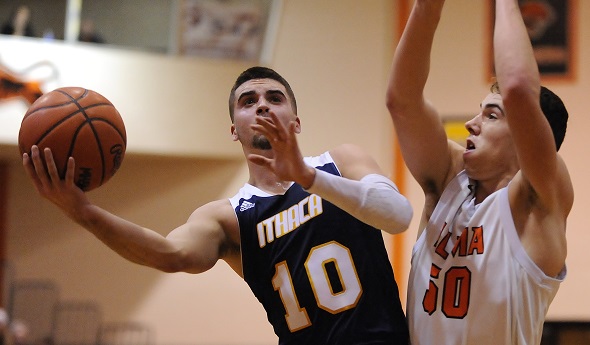
PHOTO: Ithaca’s Jake Smith works to get around an Alma defender in their game earlier this season. (Click for more from HighSchoolSportsScene.com.)