


Breslin Bound: Boys Districts in Review
March 11, 2013
By Geoff Kimmerly
Second Half editor
Two weeks remain in the MHSAA boys basketball season. And after last week's District tournaments, some contenders have survived what may end up their scariest game of a championship run – while others remain alive that probably many didn't expect.
Below are four District champs from each class who especially stuck out last week.
Class A
Bloomfield Hills Lahser (17-6) – The Oakland Activities Association Blue co-champ claimed a District title as well with a 55-52 win over Orchard Lake St. Mary’s in last week’s championship game.
Detroit Pershing (23-0) – The Doughboys had beaten Detroit Cass Tech by 19 in the Detroit Public School League tournament final only three weeks before, but had to survive a 78-76 thriller in the rematch for the District title.
Saginaw (21-3) – The reigning Class A champion is still alive after winning perhaps the biggest game in the state Friday. The Trojans, who split with rival Saginaw Arthur Hill during the regular season, won the tie-breaker 86-76 in the District Final.
Ypsilanti (18-4) – Avenged a nine-point loss to Ann Arbor Pioneer from only a month ago by beating Pioneer 66-43 in the opener, and then eliminated Skyline and Huron en route to a sweep of the Phoenix’s Class A neighbors.
Class B
Bay City John Glenn (12-11) – The Bobcats lost twice to Standish-Sterling during the regular season, including by 18 on Feb. 22. But they avenged those losses in the District opener and then edged Essexville-Garber 51-50 in overtime to win the title.
Flint Powers Catholic (12-11) – A 3-8 start to this season wasn't pretty, and although Powers battled back it still entered last week with a sub-.500 record. But two and three-point wins over Flint Northwestern and Millington, respectively, kept the Chargers alive and put them on the plus side.
Saginaw Swan Valley (12-11) – The Vikings were 2-6 over the last eight games heading into the District tournament. But their 56-37 win over then 14-7 Bridgeport in the Final was at least a slight upset.
Sparta (17-5) – The Spartans finished a solid second in the O-K Blue this winter and then survived a 61-59 test against Fremont in last week’s championship game to move on.
Class C
Baldwin (18-4) – Came close twice to beating West Michigan D League champion Manistee Catholic Central, but fell once by three in overtime and in their second meeting by eight. That surely made a 38-35 District Final win over MCC that much better.
Harbor Beach (22-1) – Coming off the football MHSAA championship in the fall, the Pirates just keep cruising with only a loss to Marlette momentarily stopping them this winter. Harbor Beach outlasted Unionville-Sebewaing 61-60 in the District Final.
Montrose (18-5) – The Rams finished only third in the Genesee Area Conference Blue, but beat formerly 17-5 Reese 67-52 in the District championship game.
White Pigeon (14-8) – It’s amazing how much of a difference six weeks can make. White Pigeon lost to Cassopolis by 30 on Jan. 18, but won the rematch by 15 in the District opener and survived Decatur 44-41 in the championship game.
Class D
Bloomfield Hills Roeper (8-14) – Roeper closed the regular season with a 1-8 run, so it was tough to expect a District title. But the Roughriders prevailed by beating then 12-8 Waterford Our Lady 51-44 in the championship game.
Covert (16-6) – The Bulldogs are hardly strangers to Breslin Center, and like the teams that had success in the past this Covert team took its losses against much larger opponents this season. Back in Class D, it won three games by a total of 40 points last week.
Fowler (13-9) – The Eagles finished three wins behind Fulton for fourth place in the Central Michigan Athletic Conference. But after being swept by the Pirates during the regular season, Fowler won the most significant matchup of the three, 65-53 in the District Final.
Hillman (16-5) – The Tigers have improved from 12 to 13 to 16 wins over the last three seasons and won last week’s games by a combined 31 points.
PHOTO: Detroit Pershing players celebrate last week's Class A District Final win over Detroit Cass Tech. (Photo courtesy of the Detroit Public School League.)
Sweet-Shooting Briggs, Talented Teammates have Muskegon Dreaming Big Again
By
Tom Kendra
Special for MHSAA.com
January 10, 2023
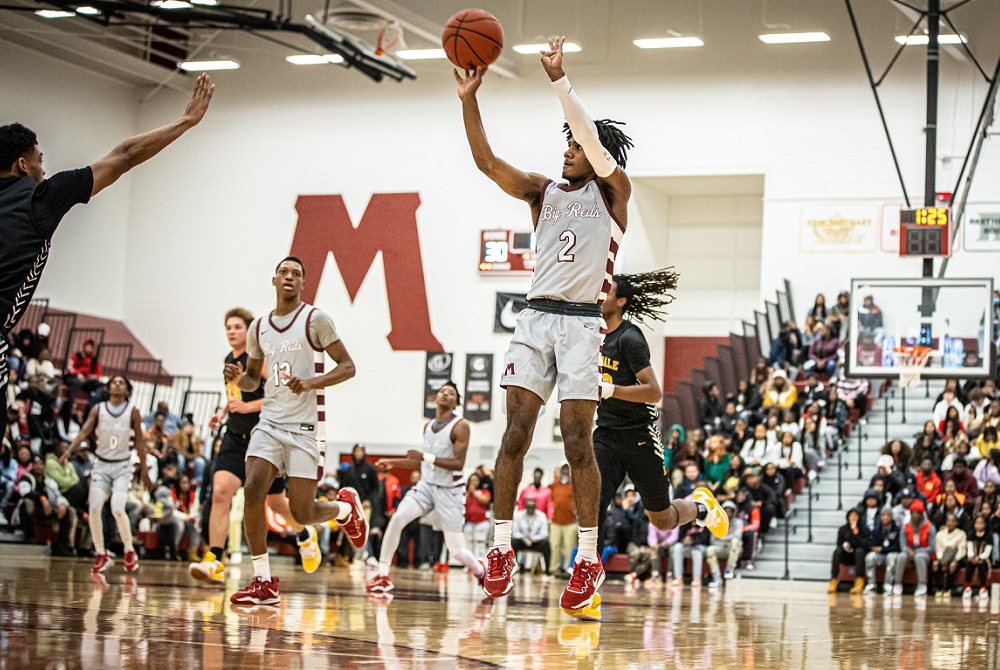
Jordan Briggs put on another shooting clinic Saturday night in front of a packed house at Muskegon’s historic Redmond-Potter Gymnasium, repeatedly elevating and hitting 3-pointers and mid-range jumpers, making it look effortless.
 While the Muskegon senior has certainly been blessed with plenty of God-given ability, there is so much more to his story.
To fully understand Briggs’ emergence as one of the state’s best pure shooters, you had to be in the gym this summer when there was no crowd, no opposing team, no coaches and no media – just Briggs and the school’s shooting machine.
The only sounds on those days were the squeaks of his shoes echoing off the walls, followed up repeatedly by the swish of a leather ball through nylon. Five-hundred made shots every day. No exceptions. No excuses.
“I love to shoot,” said Briggs, a 6-foot-1 senior who scored a team-high 24 points Saturday to keep Muskegon undefeated with a 62-51 victory over Ferndale in the finale of the three-game Muskegon Basketball Showcase.
“I never get bored, and I could do it all day. That work I’ve put in gives me and my coaches confidence to take those shots in games. I pretty much have the green light.”
He’s not kidding.
Late in the first half Saturday, Briggs had the ball on a 2-on-1 fastbreak when he suddenly pulled up and fired a 3-pointer, which just rimmed out. Muskegon coach Keith Guy, who loves his team to constantly attack the rim, clapped his approval.
“Jordan is a pure shooter,” explained Guy, whose team is 5-0 and 1-0 in the Ottawa-Kent Conference Green. “But he’s also crafty with the basketball. He can get other guys involved and he’s got it on a string, so that’s a nightmare for other teams.
“A lot of great shooters can’t hurt you off the dribble, but he can do both.”
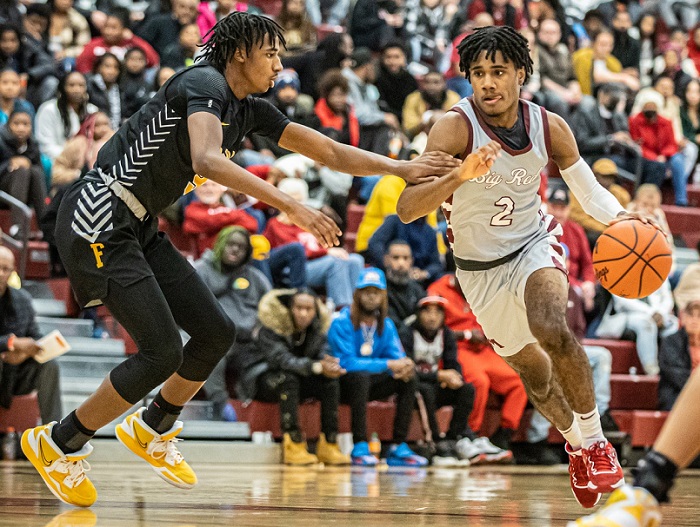 Muskegon’s win Saturday was the 400th career victory for Guy as a head coach – with 191 in nine years at Muskegon Heights and 209 wins in 11 years at Muskegon.
Guy, whose tenure at Muskegon is highlighted by a Class A title in 2014 and two Mr. Basketball winners in DeShaun Thrower (2014) and Deyonta Davis (2015), has another team with the makings of a championship run and another Mr. Basketball candidate in Briggs.
Muskegon features two floor general-type point guards in senior David Day III and junior M’Khi Guy, along with a loaded front court with seven players standing 6-4 or taller, led by starting juniors Terrance Davis (6-6) and Stanley Cunningham (6-5).
A pure shooter like Briggs – a three-year starter who has committed to Wayne State – is something that Guy hasn’t always had, and might be what makes the difference in March.
Briggs had his best game of the season back on Dec. 28 at the Muskegon Area Sports Hall of Fame Classic at Reeths-Puffer High School. Michigan State coach Tom Izzo was there to get a close look at recruiting target Durral Brooks of Grand Rapids Catholic Central, but it was Briggs who stole the show.
Briggs scored a game-high 35 points, including the winning bucket in overtime in an 81-79 victory.
“I just happened to catch fire that night,” said Briggs, who is a 4.0-GPA student and a National Honor Society member. “That was a great win for us and we’re rolling to start the season, which is great. But we want to keep it going and play our best basketball in March, when it really counts.”
In the Big Reds’ first league game Friday night at cross-town rival Muskegon Reeths-Puffer, Briggs got in foul trouble and didn’t score in the first half. He made amends by scoring his team’s first 12 points of the second half (on four 3-pointers), as Muskegon pulled away for a 51-26 victory.
He followed that up with his 24-point performance against Ferndale and is now averaging 24 points, six rebounds and five assists per game.
Guy hopes that, led by Briggs, this year’s team is ready for a long run – literally.
Guy made all of his varsity players that were not on the football team run cross country this fall, and not just for conditioning reasons.
“It put them out of their comfort zones, which is a good thing,” explained Guy, who is also Muskegon’s athletic director. “Take Jordan, for example. Basketball is comfortable for him. I wanted to put him in situations that weren’t as comfortable for him so that he would learn how to adapt and handle being uncomfortable a little better.”
 Tom Kendra worked 23 years at The Muskegon Chronicle, including five as assistant sports editor and the final six as sports editor through 2011. E-mail him at [email protected] with story ideas for Muskegon, Oceana, Mason, Lake, Oceola, Mecosta and Newaygo counties.
PHOTOS (Top) Muskegon’s Jordan Briggs (2) pulls up for a shot at the 3-point arc during his team’s win Saturday over Ferndale. (Middle) Briggs makes his move toward the basket. (Photos by Tim Reilly.)