

Breslin Bound: Boys Quarterfinal Preview
March 18, 2014
By Geoff Kimmerly
Second Half editor
1927. 1948. 1953. 1955. 1968.
A number of boys basketball teams playing in MHSAA Quarterfinals tonight are celebrating returns to the final week of the season for the first time in seemingly forever. And for a few others, tonight will mark the first time, ever, they've advanced this far.
See below for brief previews of all 16 Quarterfinal games, and click for brackets and more to be updated as scores are reported tonight.
(NOTE: ppg=point per game, rpg=rebounds per game, apg=assists per game, spg=steals per game, bpg=blocks per game.)
Class A
Howell (19-5) vs. Mount Pleasant (21-4) at Davison
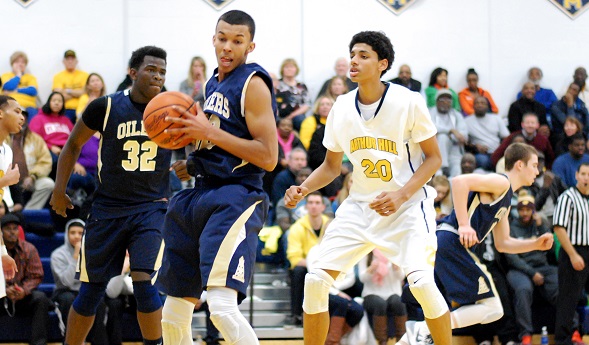
Howell is playing in its first Quarterfinal since 1927 and advanced by avenging two regular-season losses to Kensington Lakes Activities Association West champion Grand Blanc by winning in the Regional Final. Senior 6-foot-3 guard Tyler Johnson leads with 15.9 points, 4.4 rebounds and 3.4 assists per game. Mount Pleasant also is back after a shorter but still lengthy absence, playing in its first Quarterfinal since 1982. Senior 6-6 forward Jaleel Hogan averages 16.5 points and 11.4 rebounds per game.
Ann Arbor Skyline (17-7) vs. Muskegon (25-0) at Lansing Eastern
Skyline has improved from 10-11 each of the last two seasons and stunned Kalamazoo Central in the Regional Final to advance. The task is tall again though in Muskegon, led by recently-named Mr. Basketball Award winner and senior guard Deshaun Thrower (18.6 ppg) and 6-9 junior center Deyonta Davis (14.2 ppg, 13.6 rpg). Skyline is in its first Quarterfinal; Muskegon missed the Semifinals by falling to Grand Rapids Christian by three in this game a year ago.
Romulus (21-4) vs. Detroit U-D Jesuit (21-2) at Detroit Mercy
U-D Jesuit won the regular-season matchup between these two 67-57 three weeks ago, but reigning Class A champion Romulus surely won’t go quietly. Sophomore guard Cassius Winston leads three Jesuit scorers averaging double figures with 18.4 ppg along with 7.2 rpg. The Eagles are directed by first-year coach Jerret Smith, a standout on the 2005 Class A runner-up team who went on to play at the University of Michigan and Grand Valley State University.
Warren Mott (21-4) vs. Bloomfield Hills (22-3) at Detroit Mercy
Both are playing in their first Quarterfinal; Mott despite opening this season 2-3 and Bloomfield Hills because it is a first-year school, although the schools that merged to form it – Lahser and Andover – also had never advanced past Regionals. Mott is scoring a school-record 73.2 points per game, led by 6-8 senior forward Kenny Goins (21.1 ppg, 14.8 rpg, 5.4 bpg).
Class B
Benton Harbor (15-9) vs. Wyoming Godwin Heights (25-0) at Middleville Thornapple Kellogg
Longtime power Benton Harbor is back in the Quarterfinals for the first time since 2001 thanks in part to a three-point win over Stevensville Lakeshore in the District opener and an overtime win over Otsego in the Regional Final. Senior 6-6 forward Cortez Moore leads with 21 points and 12 rebounds per game. Godwin Heights reached the Semifinals a year ago and is a combined 72-4 over the last three. Senior 6-4 center Markese Mayfield and 6-3 junior forward Delaney Blaylock both average 17 points per game.
Big Rapids (20-4) vs. Cadillac (18-6) at Ferris State University
This is a rematch from last season’s Quarterfinal round, when Cadillac won 41-29. Senior forward Quinn Tyson has keyed Big Rapids’ return with 23.3 points, 4.9 rebounds and 3.4 assists per game. Cadillac will play in its fourth straight Quarterfinal after surviving three straight tournament games decided by five points or fewer. Senior forward Jalen Brooks is averaging 17.6 points and 7.8 rebounds per game to lead the Vikings.
Detroit Douglass (16-9) vs. Goodrich (20-5) at Marysville
Douglass is in its second Quarterfinal ever and seeking its first Semifinal appearance, and has suffered eight of its losses to Class A or Chicago-area teams. The Hurricanes have won District titles in eight of 10 seasons under coach Nkwane Young. Goodrich tied for second in the Genesee Area Conference Red with Class C Regional finalist Montrose and behind reigning Class C champion Flint Beecher.
Milan (22-3) vs. Wayland (21-4) at Chelsea
Milan has won 17 straight going back to mid-January to reach its first Quarterfinal since 1948. Junior guard Latin Davis (15.9 ppg) and junior 6-7 center Nick Perkins (15 ppg) key an offense that has won all but one of its tournament games by at least 14 points. Wayland is in a Quarterfinal for the first time since 1955. The Wildcats advanced with an overtime win over No. 2-ranked Jackson Lumen Christi in the Regional Final and get a big boost from a pair of juniors, 6-6 center Lacey James (14.1 ppg, 9.0 rpg) and guard Dilon Aten (18.5 ppg).
Class C
Flint Beecher (22-3) vs. Pewamo-Westphalia (21-2) at Owosso
Reigning Class C champion Beecher has five new starters this season including three underclassmen, but the Buccaneers have won 17 straight since their last loss Jan. 18 to Class A Detroit Cass Tech. A strong group of nine seniors has been building for this Pewamo-Westphalia run, especially after the Pirates suffered their only 2011-12 loss in the Quarterfinal. Senior guard Nick Spitzley has led a balanced lineup with 18.7 points per game.
Muskegon Heights (19-3) vs. Hillsdale (24-1) at Vicksburg
Muskegon Heights has one of the longest traditions of success in MHSAA boys basketball history, and that has continued through its closing and re-opening as a public school academy two years ago. The Tigers are making their fourth Quarterfinal appearance in five seasons. Hillsdale is back in the Quarterfinals for the first time since 2005 and hasn’t lost since falling to P-W in its opener. Senior guard Brandon Bisher scores 18 points per game for the Hornets.
Detroit Consortium (22-2) vs. Mount Clemens (24-1) at West Bloomfield
Consortium has fallen only to annual powers Detroit Pershing and Country Day and defeated a number of strong, larger teams including Saginaw, Detroit Southeastern, Detroit Douglass and Saginaw Arthur Hill. Sophomore 6-8 forward Joshua Jackson has been a big part averaging 25 points and 14.7 rebounds per game. Mount Clemens’ lone loss came just last month to Class A favorite Muskegon, and the Battling Bathers have won all of their tournament games by at least 13 points. They are in their first Quarterfinal since 1985.
East Jordan (19-4) vs. Negaunee (23-1) at Petoskey
East Jordan last played in a Regional Final in 1953, but bounced back from two losses to end the regular season to return to the final week – thanks also to an overtime win over Beaverton in the Regional Final. Neguanee is much more familiar with this spot; this is the Miners’ fourth straight Quarterfinal, and they missed last season’s championship game by falling just two points short in the Semifinal. Standout senior guards Tyler Jandron and Eric Lori average 17.5 and 16.6 points per game, respectively.
Class D
Mount Pleasant Sacred Heart (20-3) vs. Frankfort (19-6) at Cadillac
Sacred Heart advanced with a nationally-replayed buzzer-beater over Fulton-Middleton and hopes to follow its girls team to an MHSAA title. Senior 6-6 forward Kevin Gamble, son of the former NBA player by the same name and brother to the girls team’s standout center Averi, averages 15 points and 8.5 rebounds per game. Frankfort finished second in the Northwest Conference thanks to two losses to Suttons Bay, but beat Suttons Bay by 19 on the way to reaching the final week for the second straight season. Senior 6-3 center David Loney averages 20.1 points and 11.2 rebounds per game.
Southfield Christian (23-1) vs. Peck (22-0) at Burton Bendle
Peck is back in the Quarterfinals for the first time since 1968 and led by a pair of standouts from its 8-player football MHSAA championship team – 6-4 junior Kyle Abrego (15.1 ppg) and 6-3 senior Tristen Haener (10.9 ppg). The Pirates must next defeat two-time reigning champion Southfield Christian, which has a new coach in promoted assistant Clennie Brundidge and returning standouts in senior forward Lindsey Hunter IV (14.8 ppg), junior guard Bakari Evelyn (16 ppg) and sophomore guard Eugene Brown (11.4). The Eagles’ only loss was to Class A Saginaw Arthur Hill.
Cedarville (22-2) vs. Powers North Central (25-0) at Marquette
This too is a rematch of a 2013 Quarterfinal, which North Central won 71-57. The Jets were virtually untouchable during the regular season with only Carney-Nadeau and Munising getting within single digits – although those two and Crystal Falls Forest Park all got within eight or fewer points of North Central during the last two weeks. Senior forward Travis Vincent (15.1 ppg) leads four Jets averaging double-figure scoring. Cedarville’s only losses were to a pair of solid Class C teams, and the Trojans are more than capable of taking the next step; they’ve won Regional titles eight of the last nine seasons and beat Quarterfinalist Frankfort earlier this winter.
Battle Creek St. Philip (24-1) vs. Adrian Lenawee Christian (19-4) at Battle Creek Central
St. Philip is back in a Quarterfinal for the first time since 1984 and with 10 straight wins by 15 or more points. Senior guard Tyler Hubbard-Neil leads four Tigers averaging double-figure points with 13.9 per game. Lenawee Christian is making its second Quarterfinal appearance in four seasons and thanks in part to surviving a two-point scare against Morenci in the District Final after losing two of its final three regular-season games.
PHOTO: Mount Pleasant, here against Saginaw Arthur Hill, advanced to the MHSAA Quarterfinals for the first time since 1982. (Click to see more from High School Sports Scene.)
Country Day Will Play for 9th Title
March 22, 2013
By Geoff Kimmerly
Second Half editor
EAST LANSING – Detroit Country Day coach Kurt Keener said he doesn’t get hung up on numbers, like the ninth MHSAA title his team could claim Saturday.
For this group of Yellowjackets, it would be the first. And that’s what counts most of all.
Country Day has come to Breslin Center and left without a championship the last two seasons. But for the first time since winning Class B in 2010, the Yellowjackets will play in the championship game – thanks to a 73-42 Semifinal win Friday over Cadillac.
“It would mean everything to me,” Country Day senior Austin Price said. “The last two years we came up here expecting to win and fell short. It would be great to end on a high note and win my last game as a high school basketball player.”
Top-ranked Country Day will face either Wyoming Godwin Heights or Detroit Community for the title at 6:30 p.m. Saturday.
In terms of Finals experience, few programs could sit on further ends of the spectrum.
 While Country Day is a Breslin regular, Cadillac (21-5) made its first appearance in an MHSAA Semifinal.
Country Day’s last two Finals weekend visits ended with Semifinals losses to eventual champion
Lansing Sexton. But these Yellowjackets have a different look than some of their most recent teams, with a smaller lineup and a style Keener tells his players should be more track meet than golf match.
That speed became tough for Cadillac to handle immediately, as Country Day (24-3) jumped to a 22-10 lead by the end of the first quarter. The Vikings committed nine turnovers during the first eight minutes.
But they wouldn’t be run off. Cadillac pulled within 26-20 midway through the second quarter.
“At 26-20 we had the game where we wanted it,” Cadillac coach Jeff McDonald said. “We wanted it to be close and give ourselves a puncher’s chance.”
But they ran out of punches soon after, as Country Day went on a 14-2 run and never led by fewer than 10 points over the final 18 minutes.
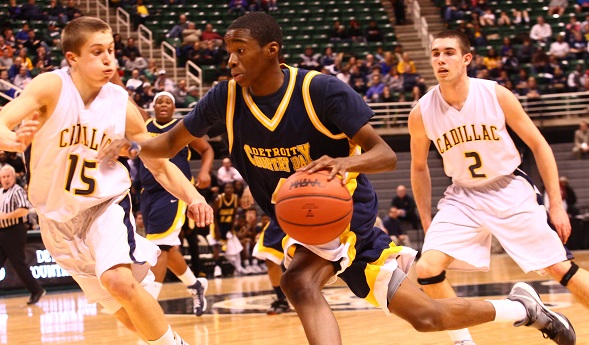
Junior Edmond Sumner led the Yellowjackets with 30 points on 9 of 15 shooting, and also had six steals. Senior Mory Diane added 11 points.
Of Cadillac’s 26 turnovers, 21 were Country Day steals.
“Defensively, they don’t make mistakes. And obviously they like an uptempo game. They like to gamble on defense,” Vikings senior Nick Paquet said. “We like to slow it down, make it a halfcourt game. We allowed ourselves to play a little faster than we wanted to, and that hurt us.”
Paquet led Cadillac with 18 points and four steals. Junior Jalen Brooks added 15 points and a game-high seven rebounds.
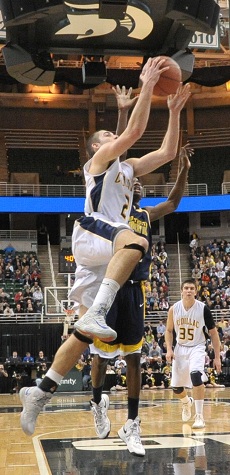
PHOTOS: (Top) Detroit Country Day's Edmond Sumner pushes the ball upcourt Friday while Cadillac's Jalen Brooks (2) and Lewis Finch (15) give chase. (Middle) Brooks makes a strong move to the basket during the Semifinal. (Photos by Hockey Weekly Action Photos.)