


Breslin Bound: Boys Report Week 1
December 15, 2014
By Geoff Kimmerly
Second Half editor
A handful of the 16 teams we've glanced at during this week's first Breslin Bound report of the 2014-15 boys season got off the slow starts a year ago.
They aren't making that mistake again.
Each week, we’ll look at four teams from each class that stuck out over the previous seven days or the season to that point as we point toward the start of the MHSAA District tournaments March 9.
For schedules of each day’s games statewide and results as we receive them, plus links to each team’s full schedule, results and league standings, click here – and please help us by filling in missing scores or emailing them to [email protected].
Class A
Ann Arbor Skyline (2-0) – The Eagles came back from a 1-3 start last season to make the Class A Quarterfinals, and that’s carried into this winter as they opened by beating Salem 62-56 and then reigning Class D runner-up Adrian Lenawee Christian 57-49.
Canton (2-0) – The Chiefs were solid last season with 15 wins, but a win over Detroit Country Day (54-49 on Friday) generally is a sign a team is capable of bigger things.
Detroit Western International (2-0) – The Cowboys never recovered from a 1-6 start last season in finishing 4-14, but got a jump on this winter opening with a 64-36 win over Chicago Marshall at the Derrick Coleman Classic and following with a 69-57 victory over Saginaw Arthur Hill at the Horatio Williams Classic.
North Farmington (2-0) – The Raiders also got off to a big start in 2013-14 with seven straight wins, and are on the way again after two big wins last week – by 41 over Detroit Collegiate Prep and then 28 over reigning Class D champion Southfield Christian.
Class B
Battle Creek Pennfield (2-0) – The Panthers also were among those who started slowly at 1-3 a year ago; last week’s successful run included a 14-point win over rival Olivet.
Escanaba (2-0) – They Eskymos have improved from five to eight to 17 wins over the last three seasons, respectively, and a 52-50 opening-night win over last season Class C semifinalist Negaunee could be a sign of another jump to come this winter.
Freeland (2-0) – The Falcons’ .500 season a year ago started with a 31-point loss to Carrollton on opening night; a year later, Freeland opened with a 63-47 win over the Cavaliers and a 48-pointer over Pinconning.
Southfield Bradford (3-0) – The Bulldogs won 19 games last season, and opened their return to Class B this winter with three wins including 57-44 over annual power Detroit Douglass, a Class B semifinalist in 2013-14.
Class C
Blissfield (2-1) – The Royals’ positive start not only provided a serious dent toward surpassing last season’s seven wins, but included a 61-48 victory over Ottawa Lake Whiteford, which beat Blissfield by 22 on opening night of 2013-14.
East Jackson (2-0) – The Trojans went from 17 wins in 2012-13 to two a year ago, but have at least equaled that latter total thanks to a one-point victory over Brooklyn Columbia Central and a seven-pointer against Whitmore Lake.
Houghton Lake (1-0) – The Bobcats didn’t win last season until January and only four times total, so they’re surely happy to get off on a winning foot with two more Jack Pine Conference opponents on the schedule before the new year.
Vassar (2-0) – The Vulcans opened last season with a pair of losses but finished a solid 13-8; they avenged one of those defeats by beating a strong Marlette team 55-53 on Wednesday.
Class D
Marcellus Howardsville Christian (2-1) – The Eagles have had a nice run over the last few seasons and appear off on another, coming back after an opening night loss to Centreville to win the St. Joseph Michigan Lutheran Tip-Off with a 55-10 win over Watervliet Grace Christian and a 71-40 victory over the tournament host.
Mendon (2-0) – The Tigers celebrated their return to Class D last week with a 58-53 win over 2013-14 quarterfinalist Battle Creek St. Philip and then a Berrien-Cass-St. Joseph Conference East-opening win over White Pigeon.
Rudyard (2-0) – The Bulldogs doubled their wins from 2012-13 to 2013-14; they may not be able to do that this winter coming off 13 victories, but got off to a quick start with 59 and 28-point wins last week.
Wyoming Potter’s House Christian (1-1) – Sure, Potter’s House did lose its second game last week, in overtime to annual Class D power Tri-unity Christian (which Potter’s House beat in a District Semifinal last season). But more impressively, the Pumas opened with a 47-46 win over reigning Class C runner-up Pewamo-Westphalia.
PHOTO: River Rouge edged Detroit Cass Tech at the Horatio Williams Classic in one of the top matchups of the first weekend of boys basketball season. (Photo courtesy of the Detroit Public School League.)
Breslin Bound: Boys Report Week 7
January 23, 2017
By Geoff Kimmerly
Second Half editor
This week is expected to see the first MHSAA record fall during a history-making season in Michigan boys basketball.
 Powers North Central can both tie and then surpass the 65-game winning streak built by Chassell’s teams from 1956-58. Barring the unexpected, the two-time reigning Class D champion would win its 66th straight on Friday – and then start work on pushing the newly-set record even farther out of reach.
Friday's game will be broadcast live on MHSAA.tv, and we'll report more on the streak's significance next week. And of course, it's only one of a number of games and teams highlighted in this week’s Breslin Bound report powered by MI Student Aid.
Week in Review
The countdown of last week’s five most intriguing results:
1. Detroit East English 71, Detroit Martin Luther King 57 – While its loss to Detroit Osborn on Jan. 13 remains a bit of a shocker, East English has bounced all the way back and with this win improved to 9-1 and moved into a first-place tie with King atop the Detroit Public School League East Division 1.
2. Buckley 50, Frankfort 38 – The Bears earned the upper hand both in the Northwest Conference and among the north’s Class D elite by remaining undefeated in handing Frankfort its first loss this season.
3. Hillsdale 74, Dundee 54 – This also was a meeting of undefeated teams, with Hillsdale prevailing to keep the top spot alone in the Lenawee County Athletic Association while making a nice statement in Class B as well.
4. Mount Pleasant 68, Saginaw 60 – The Oilers took a couple of tough losses early in the Saginaw Valley League North season, but they’re back in second place with this first win over league leader Saginaw since 2010.
5. Benton Harbor 62, Muskegon Heights Academy 60 – Coming off an overtime win over Stevensville Lakeshore, Benton Harbor passed another tough test edging a Heights team that is 8-4.
Watch List
With an eye toward March, here are two teams in each class making sparks:
CLASS A
Marquette (9-1) – Since falling to Petoskey on opening night, Marquette is unbeaten. The Redmen handed Negaunee its first loss, 57-53, to start last week, and have a two-win lead on the rest of the Great Northern U.P. Conference after finishing second and only 11-9 overall last winter.
Romulus (7-2) – Somewhat quietly, Romulus has re-established itself in the Class A hunt. The Eagles always load their schedule with tough opponents, and although losses came to Clarkston and Detroit U-D Jesuit (combined 18-2), Romulus put up wins last week against Saginaw Arthur Hill, Dearborn Fordson and rival Belleville.
CLASS B
Ludington (8-0) – Counting the end of last season, Ludington has won 15 of its last 16 games, including handing Muskegon Heights Academy (mentioned above) one of its two losses this winter. That win has the Orioles sitting in first place alone in the rebuilt Lakes 8 Athletic Conference.
New Haven (9-1) – Coming off last season’s Quarterfinal march, New Haven is the team to chase in the Macomb Area Conference Blue with its last eight wins all by at least 22 points. That lone loss came by six to Macomb Dakota, a likely contender again after making the Class A Semifinals a year ago.
CLASS C
Norway (10-0) – With the school’s girls team also 10-0, it’s a great time to play basketball at Norway. The boys’ success has included handing Iron Mountain its only loss (48-44) on Dec. 16 and winning the rest of its games this winter by double digits – including 56-44 last week over reigning Mid-Peninsula Athletic Conference co-champ Negaunee.
Kalamazoo Hackett (8-0) – A 53-50 win over rival Kalamazoo Christian on Friday was the latest highlight to a perfect start that has Hackett atop the Southwestern Athletic Conference Valley standings. Going back to last season’s Quarterfinal run, Hackett has won 32 of its last 33 games.
CLASS D
Carney-Nadeau (6-3) – Life could be easier than playing in the same league as undefeated Powers North Central and one-loss Bark River-Harris, but the Wolves deserve some credit as well for upping the reputation of the Skyline Central Conference West after last week handing Munising its only loss, 59-46. Carney-Nadeau’s losses were to those league frontrunners and Friday at the Milwaukee Academy of Science.
Jackson Christian (6-3) – After opening 2-3 with those losses all to Class C teams with winning records, Jackson Christian has won four straight to take the lead in the Southern Central Athletic Association East. All of the wins have been by 10 or more points, and two of those three losses were by a combined five points.
Can't-Miss Contests
Be on the lookout for results of these games coming up:
Tuesday – Wayne Memorial (7-2) at Clarkston (10-0) – Much-improved Wayne can tie last season’s win total with an upset of the Class A-contending Wolves.
Tuesday – Sand Creek (9-0) at Ottawa Lake Whiteford (8-1) – This sounds like a great football matchup, but the boys basketball teams too are tied for first in the Tri-County Conference; Whiteford did beat Sand Creek in football to win the league title in that sport.
Tuesday – St. Johns (8-2) at East Lansing (10-0) – Both are leaders of Capital Area Activities Conference divisions, St. Johns in the Red and East Lansing in the Blue, but this could be a mighty upset for a Redwings team that has won two more games already than all of last season.
Wednesday – Michigan Center (8-0) at Napoleon (8-1) – These two are both undefeated in the Cascades Conference and also part of the same Class C District, making this the first of three possible matchups.
Friday – Bark River-Harris (8-1) at Powers North Central (9-0) – If the Jets beat Rock Mid-Peninsula on Tuesday, this matchup of the leaders in the Skyline Central Conference West could see North Central set the MHSAA boys hoops record with a 66th consecutive victory.
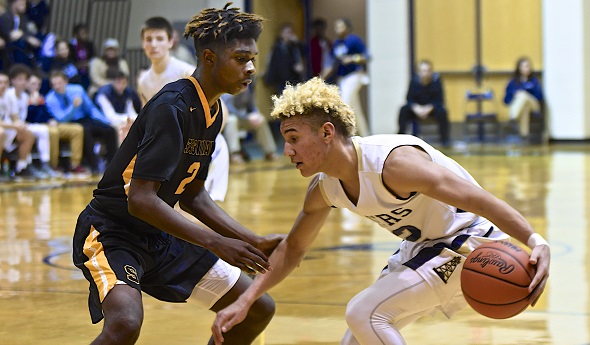
PHOTO: Mount Pleasant downed Saginaw last week for the first time since 2010. (Click for more from HighSchoolSportsScene.com.)