

Breslin Bound: Boys Report Week 1
December 15, 2014
By Geoff Kimmerly
Second Half editor
A handful of the 16 teams we've glanced at during this week's first Breslin Bound report of the 2014-15 boys season got off the slow starts a year ago.
They aren't making that mistake again.
Each week, we’ll look at four teams from each class that stuck out over the previous seven days or the season to that point as we point toward the start of the MHSAA District tournaments March 9.
For schedules of each day’s games statewide and results as we receive them, plus links to each team’s full schedule, results and league standings, click here – and please help us by filling in missing scores or emailing them to [email protected].
Class A
Ann Arbor Skyline (2-0) – The Eagles came back from a 1-3 start last season to make the Class A Quarterfinals, and that’s carried into this winter as they opened by beating Salem 62-56 and then reigning Class D runner-up Adrian Lenawee Christian 57-49.
Canton (2-0) – The Chiefs were solid last season with 15 wins, but a win over Detroit Country Day (54-49 on Friday) generally is a sign a team is capable of bigger things.
Detroit Western International (2-0) – The Cowboys never recovered from a 1-6 start last season in finishing 4-14, but got a jump on this winter opening with a 64-36 win over Chicago Marshall at the Derrick Coleman Classic and following with a 69-57 victory over Saginaw Arthur Hill at the Horatio Williams Classic.
North Farmington (2-0) – The Raiders also got off to a big start in 2013-14 with seven straight wins, and are on the way again after two big wins last week – by 41 over Detroit Collegiate Prep and then 28 over reigning Class D champion Southfield Christian.
Class B
Battle Creek Pennfield (2-0) – The Panthers also were among those who started slowly at 1-3 a year ago; last week’s successful run included a 14-point win over rival Olivet.
Escanaba (2-0) – They Eskymos have improved from five to eight to 17 wins over the last three seasons, respectively, and a 52-50 opening-night win over last season Class C semifinalist Negaunee could be a sign of another jump to come this winter.
Freeland (2-0) – The Falcons’ .500 season a year ago started with a 31-point loss to Carrollton on opening night; a year later, Freeland opened with a 63-47 win over the Cavaliers and a 48-pointer over Pinconning.
Southfield Bradford (3-0) – The Bulldogs won 19 games last season, and opened their return to Class B this winter with three wins including 57-44 over annual power Detroit Douglass, a Class B semifinalist in 2013-14.
Class C
Blissfield (2-1) – The Royals’ positive start not only provided a serious dent toward surpassing last season’s seven wins, but included a 61-48 victory over Ottawa Lake Whiteford, which beat Blissfield by 22 on opening night of 2013-14.
East Jackson (2-0) – The Trojans went from 17 wins in 2012-13 to two a year ago, but have at least equaled that latter total thanks to a one-point victory over Brooklyn Columbia Central and a seven-pointer against Whitmore Lake.
Houghton Lake (1-0) – The Bobcats didn’t win last season until January and only four times total, so they’re surely happy to get off on a winning foot with two more Jack Pine Conference opponents on the schedule before the new year.
Vassar (2-0) – The Vulcans opened last season with a pair of losses but finished a solid 13-8; they avenged one of those defeats by beating a strong Marlette team 55-53 on Wednesday.
Class D
Marcellus Howardsville Christian (2-1) – The Eagles have had a nice run over the last few seasons and appear off on another, coming back after an opening night loss to Centreville to win the St. Joseph Michigan Lutheran Tip-Off with a 55-10 win over Watervliet Grace Christian and a 71-40 victory over the tournament host.
Mendon (2-0) – The Tigers celebrated their return to Class D last week with a 58-53 win over 2013-14 quarterfinalist Battle Creek St. Philip and then a Berrien-Cass-St. Joseph Conference East-opening win over White Pigeon.
Rudyard (2-0) – The Bulldogs doubled their wins from 2012-13 to 2013-14; they may not be able to do that this winter coming off 13 victories, but got off to a quick start with 59 and 28-point wins last week.
Wyoming Potter’s House Christian (1-1) – Sure, Potter’s House did lose its second game last week, in overtime to annual Class D power Tri-unity Christian (which Potter’s House beat in a District Semifinal last season). But more impressively, the Pumas opened with a 47-46 win over reigning Class C runner-up Pewamo-Westphalia.
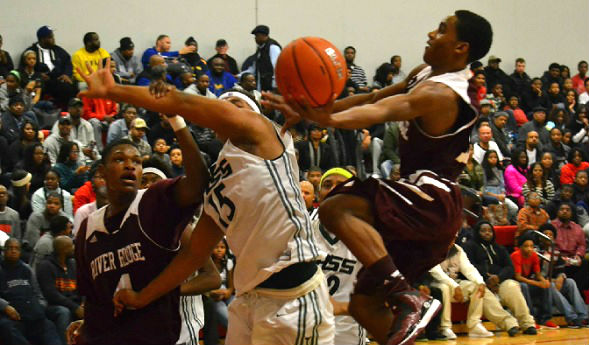
PHOTO: River Rouge edged Detroit Cass Tech at the Horatio Williams Classic in one of the top matchups of the first weekend of boys basketball season. (Photo courtesy of the Detroit Public School League.)
Breslin Bound: Boys Report Week 6
January 15, 2013
By Geoff Kimmerly
Second Half editor
Undefeated teams quickly are becoming few as boys basketball season heads into mid-January.
But this week's list of teams making noise includes a handful that remain perfect – although a few more will face their toughest challenges soon.
Records and scores below are based on those submitted to the MHSAA.com Score Center.
1. New Haven (6-0) – Coming off 21 wins last season, the Rockets had high expectations – and made great on a good start with a 101-98 double-overtime win over Mount Clemens on Friday; Mount Clemens hadn’t lost.
2. Detroit Pershing (9-0) – The Doughboys just keep proving their status as Detroit's best, downing Detroit Martin Luther King 78-64 and then Detroit Douglass 73-67 in overtime last week.
3. Stevensville Lakeshore (7-0) – A Class B Semifinalist a year ago, Lakeshore is surging again with only one win by fewer than 11 points this season – and that was against South Bend St. Joseph of Indiana.
4. Holt (10-1) – The Rams further cemented themselves as the class of Greater Lansing this season by beating reigning Class B champion Lansing Sexton 50-46 on Friday.
5. Frankenmuth (8-0) – This week’s “Battle of the Fans” contestant will need all the support against rival and top Tri-Valley Conference East competitor Bridgeport on Friday, but the Eagles survived a 50-46 win over Essexville Garber a week ago.
6. Climax-Scotts (8-0) – The Panthers got their first test this season in a 51-42 win over Bellevue on Friday, but no other opponent has come within 14 points.
7. Muskegon Western Michigan Christian (7-3) – After opening 1-3, the Warriors have won six straight and handed Spring Lake its first loss, 49-47, on Saturday.
8. Ithaca (7-0) – The Yellowjackets know how to play football, but they’ve long had a strong hoops program as well and have an early lead in the TVC West.
9. Lake Linden-Hubbell (7-0) – The Lakes had to survive overtime against Hancock and then three more against Calumet in December, but have won four straight by at least 18 points.
10. DeWitt (6-2) – A relative newcomer to Class A, the Panthers shocked the local competition with a 56-54 win last week over Okemos, and also own a five-point victory over improved Grand Ledge.
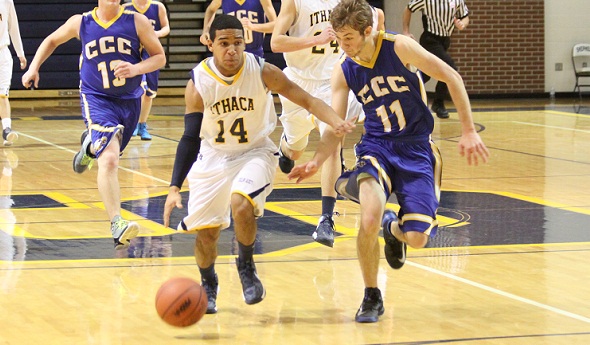
PHOTO: Ithaca's Markes Gadlen (14) pushes the ball upcourt against Carson City-Crystal this season. (Click to see more at HighSchoolSportsScene.com.)