

Breslin Bound: Boys Report Week 10
February 13, 2017
By Geoff Kimmerly
Second Half editor
Three previously-perfect boys basketball teams suffered their first losses last week, leaving only 15 undefeated in Michigan with the start of the MHSAA Tournament only three weeks away.
 What might this mean?
There are still at least two teams in every class that have yet to leave the floor unhappy this winter – but also many more teams that have tasted a loss or two (or more) but still can be expected to contend in what is looking like some wide-open brackets in at least three classes (with two-time reigning Class D champion Powers North Central the clear team to chase in the fourth). We highlighted a few more of the contenders in this week's Breslin Bound report, powered by MI Student Aid.
Week in Review
The countdown of last week’s five most intriguing results:
1. Frankenmuth 63, Bridgeport 53 – The Eagles’ only loss this season was by 10 to Bridgeport in Frankenmuth’s first game this season, and claiming this rematch to hand the Bearcats their first defeat also created a tie between them at the top of the Tri-Valley Conference East.
2. Iron Mountain 54, Norway 43 – The Mountaineers still need another Norway loss to move into a first-place tie in the Mid-Peninsula Athletic Conference, but got in position by handing the Knights this first defeat of the season.
3. Carson City-Crystal 42, Pewamo-Westphalia 37 (OT) – The Eagles handed P-W its first and only loss this season and also this school year for a number of Pirates who also played on the undefeated Division 7 champion football team.
4. Muskegon 70, Ypsilanti Community 56 – The undefeated Big Reds broke Ypsilanti Community’s 10-game winning streak as they continue to take on the best from all over the Lower Peninsula.
5. Clarkston 73, Wayne Memorial 68 – The Wolves, holding down first place in the Oakland Activities Association Red, earned an impressive win but didn’t knock Wayne off-track; the Zebras finished the week by beating Westland John Glenn to win the Kensington Lakes Activities Association South.
Watch List
With an eye toward March, here are two teams in each class making sparks:
CLASS A
Holt (11-3) – The Rams are three losses by a total of 11 points from a perfect record this season, and gave undefeated East Lansing its closest game in a four-point defeat Jan. 13. They face each other again Friday with first place in the Capital Area Activities Conference Blue on the line.
Holland West Ottawa (14-1) – The Panthers have built a two-win lead in the Ottawa-Kent Conference Red with four league games to play and can finish a sweep of second-place Grand Haven on Tuesday. Those two tied for the league title last season, and West Ottawa went 6-15 only two years ago.
CLASS B
Paw Paw (13-3) – The Redskins have won eight straight and Feb. 3 handed leader South Haven its first loss in the Wolverine Conference North. Paw Paw still trails South Haven in the league standings and will have a hard time catching up, but already has surpassed last season’s 11-12 finish.
Grayling (11-3) – The Vikings – who went 10-12 a year ago – have won 10 of their last 11 as they eye a rematch with Traverse City St. Francis and a possible share of the Lake Michigan Conference title. Grayling’s only league loss was by five to the Gladiators on Jan. 24, and it will get that opportunity to avenge Feb. 21.
CLASS C
Breckenridge (12-1) – The Huskies, coming off a turnaround football season, are in first in the Mid-State Activities Conference with their only loss to second-place Carson City-Crystal. The Huskies were only 6-14 a year ago; they see the Eagles again Wednesday.
Monroe St. Mary Catholic Central (14-0) – These Eagles own a two-win lead in the Huron League with four conference games to play and have swept second-place Milan. In fact, they’ve won 24 straight league games since falling to Milan in the final Huron game of 2014-15.
CLASS D
Bay City All Saints (12-2) – The Cougars have secured a share of the Michigan Summit League championship and have won seven straight games, adding to a District title they won to cap last season. All Saints also already has equaled last year’s 12 wins.
Northport (11-3) – The Wildcats can clinch the Cherryland Conference title against second-place Traverse City Christian on Tuesday after sharing the championship last season. Five more wins over the final six regular-season games and postseason would give Northport its best record this decade.
Can't-Miss Contests
Be on the lookout for results of these games coming up:
Tuesday – Battle Creek Central (13-2) at Kalamazoo Central (13-1) – The Maroons opened their season with a 12-point win over the Bearcats, but a BCC win would make the Southwestern Michigan Athletic Conference East title pursuit a two-team race again.
Tuesday – Romulus (12-2) at Belleville (13-2) – The Eagles have a one-win lead over Belleville in the Western Wayne Athletic Conference Blue thanks to a one-point win over the Tigers in their first matchup Jan. 20.
Friday – East Lansing (14-0) at Holt (11-3) – As noted above, the CAAC Blue lead could be altered with a Holt win, which also would break the Trojans’ 27-game league winning streak.
Friday – Saline (12-3) at Ann Arbor Skyline (11-4) – These two are tied for first in the Southeastern Conference Red with three league games to play heading into this week; Skyline won their first matchup by 11.
Saturday – Detroit Public School League Final at University of Detroit Mercy – Detroit Martin Luther King, Collegiate Prep, East English and Cass Tech will play in semifinals Tuesday to decide the title matchup.
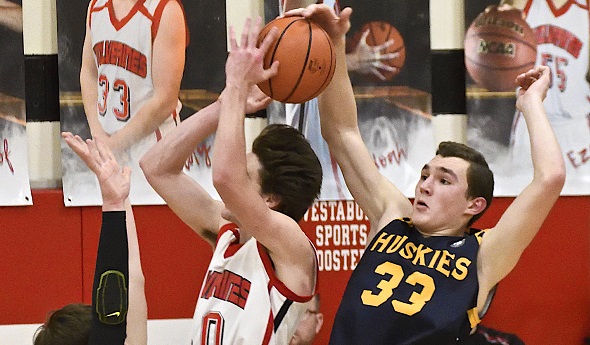
PHOTO: Breckenridge defeated Vestaburg 65-46 on Feb. 3 and is 12-1 this season after winning six games in 2015-16. (Click for more from HighSchoolSportsScene.com.)

Breslin Bound: Boys Report Week 5
January 9, 2017
By Geoff Kimmerly
Second Half editor
How quickly can a lackluster season become a distant memory?
Ask a few of the teams we’ve highlighted in this week’s Breslin Bound Boys Report, powered by MI Student Aid.
Two of the eight on our “Watch List” this week have already won more games this winter than in all of 2015-16, and a third team could equal last season’s total by the end of this week.
Week in Review
The countdown of last week’s five most intriguing results:
1. Clarkston 60, Flint Carman-Ainsworth 47 – The Wolves remain undefeated at 8-0 after handing Carman-Ainsworth its first loss (and later in the week doing the same to Walled Lake Western).
2. Detroit U-D Jesuit 71, Romulus 58 – The Cubs finished nonleague play at 5-2 and with one more solid win over a Class A power heading into the Detroit Catholic League schedule.
3. Ann Arbor Skyline 74, Belleville 71 – Skyline is tied for the lead in the Southeastern Conference Red, but handing Belleville its first loss may have surprised a few even though Skyline has broken 70 points five of the last six games.
4. Grand Rapids Forest Hills Central 55, Grand Rapids Forest Hills Northern 51 – This neighborly rivalry game hadn’t meant this much in a while, with both now in the Ottawa-Kent Conference White and Central handing Northern its first loss of the season.
5. Holt 59, Okemos 49 – This gave the Rams an early co-lead with East Lansing in the Capital Area Activities Conference Blue and added to a 4-2 start with those losses by a combined seven points.
Watch List
With an eye toward March, here are two teams in each class making sparks:
CLASS A
Davison (6-1) – After watching the football team make a nice jump in the fall, the basketball team is doing the same coming off a 5-16 finish. The only defeat was to one-loss Carman-Ainsworth.
Bloomfield Hills (6-1) – The Black Hawks are two wins better than at this point a year ago, with their only loss to Orchard Lake St. Mary’s. They should provide a nice challenge to Clarkston in the Oakland Activities Association Red.
CLASS B
Hillsdale (6-0) – The Hornets are always in the mix, and got off to another fast start this winter after ending last year’s 18-win campaign with a three-point loss in their first District game. Last week’s double-overtime win over Onsted might be the best so far.
Wyoming Kelloggsville (5-0) – The Rockets could be in the midst of another of the most significant turnarounds in the state this winter, going 7-15 a year ago but most recently handing a one-point loss to reigning Class C runner-up Grandville Calvin Christian.
CLASS C
Maple City Glen Lake (5-0) – The Lakers opened this season by avenging last year’s season-ending loss to Traverse City St. Francis, and since they’ve played to a first-place tie in the Northwest Conference with rival Frankfort. Thursday opponent Buckley will provide another major test.
Munising (6-0) – After finishing 11-10 and falling in its first postseason game last winter, Munising is more than halfway to a better finish. This start included an avenging of that season-ending loss to Rock Mid-Peninsula and three victories total by five or fewer points.
CLASS D
Bellevue (4-0) – The Broncos have been riding a nice run the last few seasons, winning 18 games a year ago. They already own a win over Climax-Scotts, the team with which they shared the Southern Central Athletic Association West title last winter.
Marcellus (4-1) – The Wildcats also are on the rebound, having already surpassed last season’s three wins. The lone loss was a three-pointer to Constantine during the season’s first week.
Can't-Miss Contests
Be on the lookout for results of these games coming up:
Tuesday – Grand Rapids Christian (4-0) at Wayland (4-1) – These two and Wyoming look like the contenders in the O-K Gold, with Christian one to chase both in the league and Class A statewide.
Tuesday – Bellaire (5-1) at Gaylord St. Mary (5-1) – These two are contenders in the Ski Valley Conference, but also stand to be among Class D’s best from just below the bridge.
Friday – Saginaw (6-1) at Saginaw Arthur Hill (4-2) – One of the oldest rivalries in state history remains one of the best, with this and the Feb. 3 matchup likely to decide the Saginaw Valley League North title winner.
Friday – Holt (4-2) at East Lansing (6-0) – The Trojans have high hopes in Class A this season, but first comes taking care of the CAAC Blue and a strong field including the Rams (also mentioned above).
Saturday – Detroit East English (5-0) vs. Kalamazoo Central (5-0) at Grand Rapids Ottawa Hills – Arguably the top matchup of the Floyd Mayweather Classic, this one pits two of the best in Class A.
PHOTO: Grand Rapids Christian, driving to the basket, downed Holland West Ottawa on Dec. 28 as part of its 4-0 start. (Photo by Tim Reilly.)