

Breslin Bound: Boys Report Week 8
January 30, 2017
By Geoff Kimmerly
Second Half editor
A record nearly 60 years old was toppled last week by Powers North Central. Now Beaverton is readying to celebrate a new winningest coach in MHSAA basketball history.
 Those have been the headline grabbers in boys hoops over the last few weeks, and of course we touch on both below in this week’s Breslin Bound report powered by MI Student Aid. But there was plenty else to discuss too as we came out of halftime of this boys basketball season into a final dash full of exciting possibilities.
Week in Review
The countdown of last week’s five most intriguing results:
1. Powers North Central 76, Bark River-Harris 29 – The Jets have brought a lot of attention to their small community and Upper Peninsula basketball as a whole thanks to what this win earned them – an MHSAA record with 66 straight victories going back more than two seasons and including two Class D title runs.
2. Detroit Catholic Central 52, Detroit U-D Jesuit 51 – This was the first of two banner wins last week for the Shamrocks (who also downed Orchard Lake St. Mary’s 70-54); last season, DCC fell to the eventual Class A champion Cubs by 21 and 35.
3. Flint Carman-Ainsworth 52, Saginaw 45 – The Saginaw Valley League North-leading Cavaliers handed the South-leading Trojans this loss, avenging last season’s 20-point Regional defeat.
4. Detroit Edison PSA 99, Detroit East English 81 – After losing to East English by 20 on Jan. 10, DEPSA stunned the 10-2 Bulldogs to improve to only 5-7 but with three wins over its last four games.
5. Lansing Catholic 76, Williamston 72 – These two split the Capital Area Activities Conference White championship last season, but this counts as an upset after the Hornets (10-2) beat Lansing Catholic by 21 during the first week of this winter.
Watch List
With an eye toward March, here are two teams in each class making sparks:
CLASS A
Melvindale (9-2) – The Cardinals have won seven straight since opening 2-2 and downed Brownstown Woodhaven 73-66 on Friday in a matchup of teams that entered undefeated in Downriver League play. Woodhaven is the reigning league champ, but Melvindale has an upper hand with this their only meeting of the season.
Sterling Heights (10-1) – The Stallions have taken major strides this winter after going 6-15 last season and winning a combined 13 games over the last three. That lone loss this run was in double overtime to Marysville, which they trail in the Macomb Area Conference Silver but face again Wednesday.
CLASS B
Fennville (9-2) – A three-point win over Gobles on Dec. 13 has kept Fennville atop the Southwestern Athletic Conference Lakeshore, and the Blackhawks can stretch the lead as they face the Tigers again Tuesday. Fennville is playing this season for a third straight league title, and the only losses were by one to Grand Rapids Covenant Christian and nine to Class A Byron Center.
Onsted (9-2) – The Wildcats sent 6-foot-10 Austin Davis to University of Michigan after last season’s league and District title runs. But after opening 2-2, they’re in position again to make things interesting in the Lenawee County Athletic Association; those losses came to Dundee and Hillsdale, and Onsted beat Dundee last week and sees Hillsdale again Tuesday.
CLASS C
Iron Mountain (11-1) – Last season’s Mid-Peninsula Athletic Conference co-champion (with Negaunee) has been chasing all season after falling to current leader Norway by four on Dec. 16. The Mountaineers – which beat Negaunee by four last week – get Norway again Feb. 10.
Sand Creek (11-0) – The Aggies downed second-place Ottawa Lake Whiteford 70-53 on Tuesday to move into first place alone in the Tri-County Conference. Those teams tied for fourth in the league last season when Sand Creek finished 11-11 overall, but it’s allowed only one opponent to get within 10 points this winter.
CLASS D
Bellaire (9-1) – The reigning Ski Valley Conference champion already has a two-game lead on the field after handing Pellston a 64-57 defeat on Jan. 19. The Eagles took a loss on opening night to Harbor Springs 40-37, but have looked more since like the team that made last season’s Quarterfinals.
Southfield Christian (8-2) – After playing, and winning a pair of District titles, in Class C the last two seasons, Southfield Christian is back in Class D. The two losses came during the season’s first three games to Class A Ann Arbor Pioneer and U-D Jesuit, and the Eagles beat Class A West Bloomfield by 10 on Tuesday.
Can't-Miss Contests
Be on the lookout for results of these games coming up:
Tuesday – Romulus (8-2) at Dearborn Heights Crestwood (10-2) – The Western Wayne Athletic Conference Blue has three teams with only two losses, and Crestwood sees the other two this week starting with the league leader.
Wednesday – Farwell (2-7) at Beaverton (10-1) – A win would give Beavers coach Roy Johnston 729 for his career, breaking the Michigan high school record set by River Rouge’s Lofton Greene from 1942-84.
Wednesday – Cornerstone Health/Technology (7-2) at River Rouge (12-0) – Cornerstone has played some tough competition and could be a challenger in Class C, and we expect to know more from this matchup.
Friday – Detroit East English (10-2) at Detroit Martin Luther King (10-2) – East English can still claim a share of the Detroit PSL East Division 1 title from the Crusaders and won the first meeting 71-57.
Saturday – Flint Beecher (9-3) vs. Ypsilanti Community (9-3) at Delta College – This matchup of teams with high aspirations is the most intriguing of the Delta College Showcase.
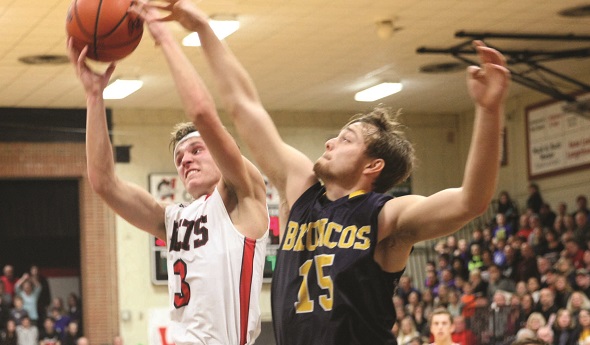
PHOTO: North Central's Marcus Krachinski (3) battles with Bark River-Harris defender Nick Lippens in the paint during the first half Friday night at Powers. (Photo by Keith Shelton.)
Breslin Bound: Boys Report Post-Break
January 3, 2017
By Geoff Kimmerly
Second Half editor
This week, Michigan’s high school boys basketball teams will begin focusing most of their energies on winning league championships and doing their best against competition closest to home.
But before we dive in to that always-intense chapter of each season, our Breslin Bound report – powered by MI Student Aid – reviews the best from two weeks of holiday break, including matchups of some expected MHSAA title contenders in Class A and B.
Week in Review
The countdown of holiday break's five most intriguing results:
1. Detroit U-D Jesuit 69, Macomb Dakota 61 – Dakota was missing a standout and lost another near the end of this one, but regardless this rematch of last season’s Class A Semifinal finished with the Cubs on top while sandwiched between their overtime losses to Flint Beecher and Indianapolis Lawrence North (Ind.).
2. North Farmington 53, Detroit Henry Ford 49 – The Raiders bounced back from three losses to open this season, including a 65-58 defeat to Farmington, to beat Dearborn Divine Child and then the Class B reigning champ at the Motor City Roundball Classic.
3. McBain 73, Boyne City 62 – In a matchup of expected Class C contenders from the northern Lower Peninsula, McBain emerged with a fourth double-digit win in four tries this winter while handing Boyne City its first loss.
4. Wyoming Godwin Heights 69, Wayland 67 – They are in different Districts this season after meeting in the first round a year ago, and both could emerge as Class B contenders after meeting in this Cornerstone Invitational title game.
5. Frankfort 72, Traverse City St. Francis 65 – The Panthers avenged one of only two regular-season losses from last season, when they fell to St. Francis 69-68.
Watch List
With an eye toward March, here are two teams in each class making sparks:
CLASS A
Detroit East English (5-0) – The Bulldogs may have graduated a Mr. Basketball finalist off last season’s 17-win team, but they likely have another and could finish even better this winter with wins so far over Flint Beecher, Macomb Dakota and most recently Wayne Memorial 92-77.
Battle Creek Central (5-1) – That lone loss came early to Kalamazoo Central, and Battle Creek Central has stormed back with the latest a sweep at its holiday tournament, 60-50 over Otsego and 61-46 over Muskegon Heights Academy.
CLASS B
St. Clair (5-0) – The Saints, winners of 12 and 14 games, respectively, over the last two seasons, downed St. Clair Shores Lakeview 54-53 in overtime and then host Clinton Township Chippewa Valley 58-57 at the latter’s holiday tournament to finish off 2016.
Wyoming Lee (5-0) – A 3-17 finisher just last season, Lee is in the midst of a sizable turnaround highlighted over the break by wins over Gobles (in overtime) and host Allegan to win the Tigers’ holiday tournament.
CLASS C
Harbor Springs (3-0) – After also going only 3-17 a year ago, Harbor Springs has equaled that win total while handing the only losses this season to Bellaire (40-37) and Pickford (67-65).
Michigan Center (6-0) – The Cardinals will embark next on at least matching last season’s shared title in the Cascades Conference, and will do so after dominating Williamston’s holiday event with wins over Dansville (66-47) and Class A DeWitt (86-75).
CLASS D
Bark River-Harris (4-0) – Eventually, the Broncos will get to test themselves against Powers North Central (Jan. 27) in the Skyline Central Conference West. So far, they look good to top last season’s 10-11 finish.
Frankfort (3-0) – Expectations are high as always coming off a second straight Northwest Conference title and fourth straight season with 20 or more wins – and so far so good; see note above on avenging last season’s loss to Traverse City St. Francis.
Can't-Miss Contests
Be on the lookout for results of these games coming up:
Tuesday – Clarkston (5-0) at Flint Carman-Ainsworth (6-0) – The Wolves have earned a reputation as Class A contender with another strong start, and Carman-Ainsworth could cement that status as well with a win.
Tuesday – Maple City Glen Lake (3-0) at Elk Rapids (5-0) – In addition to both being undefeated this week, Glen Lake beat Elk Rapids twice last season including in the District.
Friday – Beaverton (4-1) at Clare (3-1) – Although both have a loss, both also are undefeated in early Jack Pine Conference play; Beaverton’s only defeat was in its last game, to Class A Midland Dow by two.
Friday – Detroit U-D Jesuit (4-2) at Romulus (2-1) – Another week, another impressive foe lined up for reigning Class A champion Jesuit; Romulus’ lone loss was by six to Clarkston.
Friday – Holt (3-2) at Okemos (3-1) – This longtime rivalry means something again, as both are seeking to rise in a Capital Area Activities Conference Blue that also features East Lansing, Lansing Everett and Jackson.
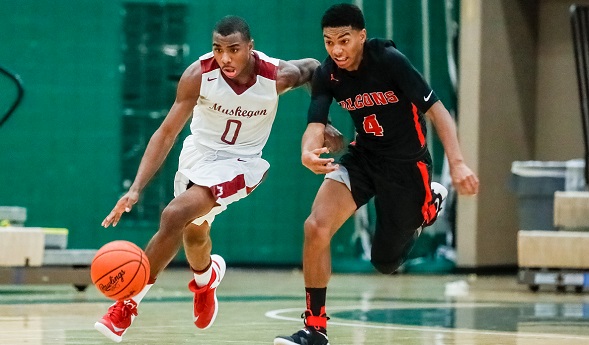
PHOTO: Muskegon pushes the ball upcourt during a 68-45 win over East Kentwood during the Muskegon Hall of Fame Classic on Dec. 28 at Reeths-Puffer High School. (Photo by Tim Reilly.)