

Broken Wrist Doesn't Break Season
March 29, 2018
By Geoff Kimmerly
Second Half editor
Never has a basketball player looked forward this much to shooting an airball.
 That’s what Carson Vincent is expecting two months from now, when he gets to fire with his right hand again, just like he has most of his life – until breaking a bone in his right wrist during a 7 on 7 football drill at the end of last summer.
It’s incredible how much would’ve been lost if the Ovid-Elsie senior hadn’t been unknowingly tough and uncommonly flexible.
Vincent played a full season of football not knowing how badly he’d injured his wrist. Once he learned of the break in late November, he decided to play on – learning to shoot with his left hand and finishing his career as the Marauders’ second-leading score all-time while leading them to their best season in 25 years.
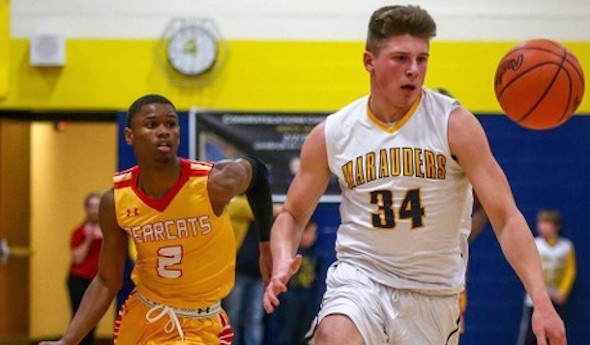
And the 6-foot-5 forward saw a clear parallel in the shared team and individual successes.
“It’s the same answer for both,” Vincent said. “Individually I wasn’t doing it for me; I was doing it for the team. I knew they wanted me out there, my family wanted me to be out there, and I wanted to be part of everything.
“The reason the team did well is we all wanted each other to be successful, to win a championship, to see each other happy.”
Ovid-Elsie finished 18-5 this winter, first in the Tri-Valley Conference West and as a Class B District champion. The league title was the program’s first since 1984, and the District its first since 1994.
Individually, Vincent began the winter coming off an all-state season as a junior, when he averaged 17.7 points and eight rebounds per game and set a school record for field goal percentage at 60.8.
With only 20 percent mobility in his dominant right hand, he was forced to become ambidextrous. “Amazingly” – to agree with coach Josh Latz’ description – Vincent upped his scoring to 20.4 points per game, grabbed 7.7 rebounds and added 2.1 assists, a block and a steal per game – and broke his school record by making 62 percent of his shots from the floor.
Vincent learned to shoot free throws left handed and became a better ball handler as well. Despite being able to throw up only an occasional floater right-handed, he became the third 1,000-point scorer in school history and finished with 1,026 points, 441 rebounds, 86 blocks, 74 assists and 60 steals over a three-year varsity career.
“Carson's toughness and resiliency this season was incredible. To be able to accomplish the things he did individually, with the hand he was dealt is remarkable,” Latz said.
“His biggest growth was as a teammate with his unselfishness to put teammates and team success ahead of his health and well-being. That being said, the successes we had as a team were in direct correlation with Carson's leadership and the example of physical and mental toughness he set for us.”
Vincent knew exactly when he was injured. He caught a touchdown pass running backward during that 7 on 7 about a week before the start of practice at the end of summer, and he fell – catching himself by falling directly on the wrist.
 Despite some pain, he started football practice and did all the drills. A receiver and cornerback, he noticed when he dropped some passes he’d otherwise pull in – but he still helped the football team to a 7-3 playoff season.
On the day of the basketball team’s preseason scrimmage, he had the wrist checked out by a doctor who helps out with the Marauders. Diagnosis: broken and shifted bones. But Vincent already had made it through football season and decided to put off surgery until he could no longer manage the pain. He played in the scrimmage that day, although he couldn’t bend the wrist. He tried taping for a while, but gave up on that quickly because it just didn’t feel right.
And the difficulties didn’t come just at practice. Writing was doable but made his arm tired. Eating, even out of a bowl with a spoon, was not as easy as it would seem. Driving was a challenge for a bit. Sometimes he couldn’t open a door. He couldn’t shake people’s hands.
“Sometimes I’d get down on myself. Sometimes it’s frustrating,” Vincent said. “Before I went to the doctor’s office, I knew something was wrong with it – I wasn’t numb to the fact. Once I got told, obviously it was upsetting. All the what-ifs happen – what happens if I fall on it, will I be able to play, what if the pain is too much one day? It was really sad, but I got through it. I took it one day at a time. I wasn’t thinking about a week from now. I just got through what I could.”
He did sit out some parts of practice. Latz would pull him out of games to be cautious, but Vincent would ask right back in. A few opponents knew because they were Vincent’s friends, but mostly the team kept the injury an internal secret.
The Marauders’ season ended in a Regional Semifinal loss to Bridgeport on March 12, and three days later Vincent had surgery that included inserting bone from elsewhere in his arm and putting in a screw to hold everything together.
He’s wearing a cast now, and will switch to a splint in four weeks. He’s missing his track team’s first three meets, but will return after spring break next week – he runs the 200, 400 and on the 800 and 1,600 relays.
He’s planning to play college basketball. He has Division III opportunities and could also play at the junior college level to start out. Wherever he ends up, he’ll bring a much more well-rounded game – a lot of good that came out of what could’ve been a sad situation.
“First of all, (even without hurting) my wrist, if someone would’ve asked me if my team would do this, I would’ve told them I honestly don’t know,” Vincent said. “That alone surprised me. … It’s all shocking to me, to be able to do as good as a team, and I was able to do good individually also.
“Before this I was good left-handed, but I easily could say right-handed I was better. Now, honestly, my left hand is better than my right hand. I’ve learned new moves, I can do right and left hand now. Obviously I wish I hadn’t broken my wrist. But there were a lot of benefits to my game. I’ll take the good things and move on from it.”
 Geoff Kimmerly joined the MHSAA as its Media & Content Coordinator in Sept. 2011 after 12 years as Prep Sports Editor of the Lansing State Journal. He has served as Editor of Second Half since its creation in Jan. 2012. Contact him at [email protected] with story ideas for the Barry, Eaton, Ingham, Livingston, Ionia, Clinton, Shiawassee, Gratiot, Isabella, Clare and Montcalm counties.
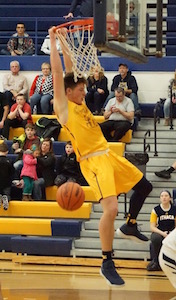
PHOTOS: (Top) Carson Vincent chases down a loose ball against Bridgeport this season. (Middle) Vincent throws down a dunk against Ithaca. (Photos courtesy of the Ovid-Elsie boys basketball program.)
Data Dig Continues for Hoops Histories
March 7, 2017
By Ron Pesch
Special for Second Half
There is a list – well actually two – that sit, unfinished, among the “1,001 Projects I’d Like to Complete Before I Die.”
I became the caretaker of these lists back when I inherited the title “Historian for the MHSAA” in 1993.
The original lists contained the scores of all MHSAA Quarterfinal, Semifinal and Final round games for the MHSAA boys and girls basketball tournaments since their origin.
From the 1930s into the late 1960s, the MHSAA tournament game-day program was generally nothing more than a single sheet document, containing tournament brackets and team rosters for the qualifiers.
 In 1969, the program saw a redesign by Lansing sports personality Tim Staudt and premiered at the MHSAA Tournament. Sold for 50 cents, it included a list of “Past Michigan State Champions” containing the names of the winning teams and those schools’ basketball coaches for each of the four classes. The publication also included a couple of articles from Dick Kishpaugh, the author of the champions list. Kishpaugh was identified as “Sports Information Director at Kalamazoo College and … perhaps the most knowledgeable historian on Michigan high school basketball.”
With the start of the Girls Basketball Tournament in 1973, a similar program design was followed.
Those lists were faithfully updated and published in the game-day programs in the same format until the 1987-88 school year, when the souvenir publications were expanded. For the first time, a list containing opponents and final scores of the boys and girls championship games was now available to the general public.
Among the first tasks I chose to approach when I assumed the duties of MHSAA historian was to chase more information.
Since Kishpaugh’s lists had game scores for the three final rounds of the tournament, and names of the championship coaches, I thought I would try to leave my mark. I began chasing down the names of coaches for the runner-up, as well as final win-loss records for both schools. And while I was at it, I decided to see what I could find for teams that made the Quarterfinals and Semifinals.
Hundreds of hours have gone into adding to and maintaining the lists, and much progress has been made. Yet, some 20+ years later, I’m still trying to fill holes in the data.
The Basketball Coaches Association of Michigan helped spread the word, notifying its membership of the project. Web pages were created for both the boys and girls to show teams still missing information.
 The pursuit has led to friendships, and fascinating stories, documents and images. The late Walter Michael, who had attended the MHSAA Finals for more than 60 years, donated a cache of MHSAA tournament programs from the 1940s through the 1960s that filled in the names of many high school coaches. Del Newell, a sports writer from the Kalamazoo Gazette, knocked out most of the Kalamazoo schools early in my search. Bill Khan, then of the Flint Journal sports department, filled in a large number of missing names and records from the Flint area. The recently retired “Son of Swami,” better known as Mick McCabe, contributed by including the win-loss records of the quarterfinalists in his annual tournament prognostication columns for the Detroit Free Press.
Numerous coaches around the state sent e-mails and letters with the names and records for their predecessors. Prep basketball fans and former players sent along offerings. Rob Madsen from Mt. Pleasant became a huge contributor, and sent regular updates to both lists. He focused on some of the state’s smallest schools, including many from the Upper Peninsula.
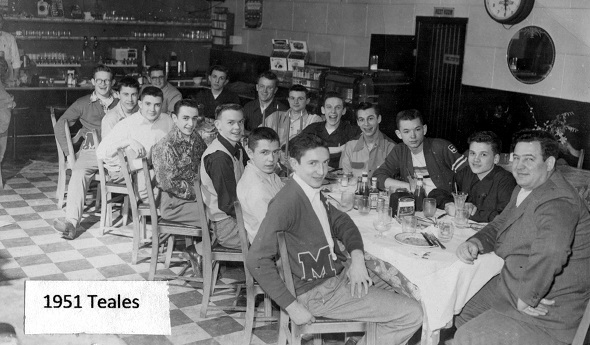
Leon Westover sent the win-loss record for little Marlette, 1951 Class C runner-up, as well as one of my favorite photos from that golden era of prep sports. Marlette had “waltzed through the Mid-Thumb League and district, regional and quarter-final tournament games,” wrote Fred J. Vincent of the Port Huron Times-Herald. Marlette slipped past Stanton 41-37 to advance to the Class C title game against unbeaten Detroit St. Andrew.
“Just one game too many …,” continued Vincent, writing from East Lansing’s Jenison Field House following the title game. “That just about explains the one-sided beating Marlette absorbed in the state class C high school basketball final here Saturday afternoon. The final score was 52-26. … One of the smallest teams, physically, in the tournament, it seemed that the Raiders were just worn out.”
Yet, that night, the team was celebrated like the hometown heroes they really were.
 Westover’s photo shows the Red Raiders on the night of the Final, gathered at Teale’s Restaurant in Marlette. The clock indicates its 11:30. The owner, George Teale, has opened up his restaurant for the team to cook them steaks in honor of their achievement. Coach Nieland "Tommy" Thompson and his 22-2 squad look happy, ready to celebrate a long season.
At tournament time, these lists help answer media requests that arise.
Question: When was the last time two undefeated teams met for an MHSAA Finals championship?
Answer: 2003-Class A for the girls. Detroit Martin Luther King topped Flint Northern 58-53. 1971-Class C for the boys. Shelby downed Stockbridge 71-57.
Question: What coach had the longest span between championship game appearances?
Answer: Eddie Powers, coach of Detroit Northern, went 34 years between his Class A championship team in 1930 and his runner-up squad in 1964. The mark is asterisked, however, as the Detroit Public School League chose to stop participation in the annual state tournament from 1931 through 1961. Saginaw’s Larry Laeding went 20 years between winning the 1942 Class A championship and his squad’s 1962 Class A title. Maple City Glen Lake coach Don Miller went 19 seasons between the school’s 1977 Class D title and its 1996 runner-up finish, also in Class D.
For the girls, both Mary Cicerone at Bloomfield Hills Marian and Carl Wayer at Ashley went 16 seasons between appearances. While Cicerone’s Marian teams have made seven visits to the Finals and have won six Class A titles, 16 years elapsed between Marian’s 1998 and 2014 Class A championships. Marian then captured a second consecutive title in 2015. Coach Wayer advance two teams to the title game. Ashley finished as runner-up in Class D in 1980 and again in Class D in 1996. The loss in 1996 came in overtime, and was the only defeat for Ashley that season.
Michigan’s high school basketball tournaments are an experience shared, mostly unchanged, since their beginnings. At the end of the regular season, everyone qualifies for the madness. Yet in the end, only four teams finish as champions. The path mimics the magical trail taken by fathers, grandfathers and great grandfathers, mothers and grandmothers. Qualifying for the Quarterfinals is still a huge triumph, as the round brings together only 32 teams from a field of more than 700 boys teams and more than 650 girls teams.
In my eyes, these lists emphasize that remarkable, undiluted achievement. In a world consumed with trophies and the number “1,” perhaps it is time to step back and celebrate this rare journey.
Click for Ron Pesch's data "Needs Lists" for girls basketball and boys basketball.
 Ron Pesch has taken an active role in researching the history of MHSAA events since 1985 and began writing for MHSAA Finals programs in 1986, adding additional features and "flashbacks" in 1992. He inherited the title of MHSAA historian from the late Dick Kishpaugh following the 1993-94 school year, and resides in Muskegon. Contact him at [email protected] with ideas for historical articles.
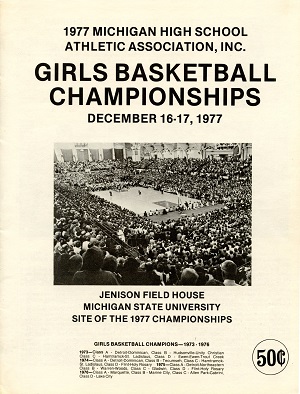
PHOTOS: (Top) Marlette's 1951 boys basketball team gathers for dinner at a local restaurant after the Class C Final. (Middle top) The 1969 Boys Finals saw the addition of updated tournament programs. (Middle below) The 1977 Girls Finals program told of the teams that would meet at Jenison Field House. (Below) The 1947 Boys Finals program was among many that helped fill in data gaps from the early years of the tournament. (Photos provided by Ron Pesch.)