

Cass Tech Continuing Rise to Hoops Elite
By
Tom Markowski
Special for Second Half
January 4, 2018
DETROIT – When you think of Detroit Cass Tech, one would probably think of its football program.
 Why not? The program coach Thomas Wilcher has built there has been arguably the best in the state the past dozen years.
That fact doesn’t bother Steve Hall, the head coach of the Technicians’ boys basketball team. On the contrary, Hall, a 1988 Cass Tech graduate and co-athletic director (along with Wilcher), takes pride in it.
It also serves as motivation.
Hall is in his third season at Cass Tech, and when the next rankings are released his Technicians will be ranked No. 1 in Class A by at least one news service, State Champs Network, and likely others.
Cass Tech is 7-0 overall and 2-0 in the Detroit Public School League. The Technicians are currently on winter break and scheduled to play next against Detroit Henry Ford on Jan. 12.
That a PSL team is ranked No. 1 is common. Teams like Detroit Cooley, Detroit Pershing, Detroit Renaissance, Detroit Southwestern and, most recently, Detroit Western, all have been ranked No. 1 over the past many years.
But for Cass Tech, it is unusual. In fact, it is believed that a top ranking for a Cass Tech boys basketball team would be the program’s first.
Hall is careful not to boast or gloat. After all, it’s early in the season and nobody awards MHSAA championship trophies in January.
“It’s hard to feel great about being No. 1,” Hall said. “The last thing you want to do is exhale.”
The program has achieved success in the past but, truthfully, it’s been awhile. Before Hall took over, Cass Tech most recently had won two PSL titles under coach Robert Shannon, the last coming in 1998. During the late 1980s, when Hall was one of the state’s top players, Cass Tech reached the 1988 Class A Quarterfinals before losing to the eventual champion, Cooley. Cass Tech had defeated Cooley that season in the PSL quarterfinals. The 1993 team that won the PSL title made it all the way to a Class A Semifinals.
During the 1950s Cass Tech was a powerhouse in the city winning three PSL titles over the decade. As one might surmise, Cass Tech has never won a state title. And just once has it reached an MHSAA Final, as the Technicians lost to Birmingham Brother Rice, 60-56 in overtime, in the 1974 Class A championship game.
Since 1998, Cass Tech had reached a PSL final just once (2013). That is, before Hall came aboard.
Last season Cass Tech defeated Detroit Martin Luther King, 59-47, to capture the school’s eighth PSL title. The Technicians won a District title for the first time since 2014 and finished 20-5, a vast improvement from the 11-10 record they posted in Hall’s first season.
As good as last season was for the program, it was just one step forward. Hall has set loftier goals.
His three-year plan included becoming regarded at the state level and nationally. That plan is on schedule.
“There were some dynamics that first year,” Hall said. “I was hired late and I didn’t have the kids during the summer. We beat (Detroit) Western, Benton Harbor and Orchard Lake St. Mary’s that season. It’s a tough league. The stable programs had upperclassmen leading them. It was a year of growth. I wouldn’t have the same appreciation (for the success) if we had won that first year. ”
 Though Hall is in just his third season at Cass Tech, he’s built a strong resume as a coach, within the PSL and at the collegiate level. High school basketball fans will remember the great Detroit Rogers teams in the early 2000s that won three consecutive Class D titles (2003-05) with Hall as head coach. When that school closed in 2005, Hall went to Detroit Northwestern and guided the Colts to the PSL title in 2008, Northwestern’s first league championship in 30 years. That season Northwestern reached a Class A Regional Final before losing to Pershing.
Hall then left Michigan and became an assistant coach at Duquesne University in Pennsylvania. He stayed there four seasons before he was hired by Youngstown State in Ohio as an assistant. Hall remained there for four seasons before returning to Detroit.
This team has talent, but is void of any one superstar. None of the four seniors are Division I recruits. Hall returned six players who started at least one game last season and the top senior is Randy Gilbert, a 6-foot-6 forward who signed with Ferris State.
There are Division I recruits coming up, however, including 6-3 sophomore Tyson Acuff and 6-5 juniors Kalil Whitehead and Tyland Tate.
Gilbert, who alternates between forward and center, is in his fourth season as a starter. He may not have made the varsity so early or with such an immediate impact playing at one of the city’s established basketball powers.
“Even going into my sophomore year people started to say things like I should transfer somewhere else,” Gilbert said. “I didn’t think about that at all. I thought we had potential.
“Coach Hall has been great to us players. He’s opened up a lot of doors. He takes us to a lot of team camps during the summer to different level of schools like Division I, Division II and NAIA so everybody gets a shot and to see where they can play (in college).
“I don’t look at Cass Tech being a football school now. We changed that.”
In the long run, that’s been one of Hall’s goals. Hall is a basketball coach, but he’s also a fan of all sports, in particular those at Cass Tech. He wants to see all of the athletic programs enjoy success, not just his team.
“When you’re a coach, it’s a way of life,” Hall said. “When I went to Cass our girls (basketball team) won the Class A title. I’ve been to Ford Field to watch the football team. I’ve been to their practices. I grew up around the school. My father (Ferd Hall) was an assistant principal here when I was growing up in the mid-70s. Cass Tech has always meant so much to me.”
 Tom Markowski is a columnist and directs website coverage for the State Champs! Sports Network. He previously covered primarily high school sports for the The Detroit News from 1984-2014, focusing on the Detroit area and contributing to statewide coverage of football and basketball. Contact him at [email protected] with story ideas for Oakland, Macomb and Wayne counties.
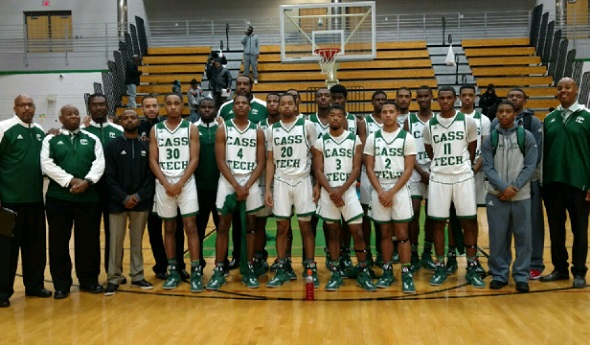
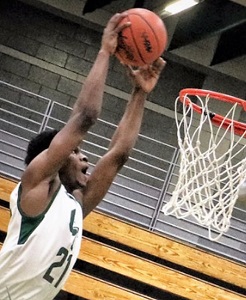
PHOTOS: (Top) The Cass Tech boys basketball team including head coach Steve Hall (far right) stands together at a game this season. (Middle) Randy Gilbert prepares to throw down a dunk. (Photos courtesy of the Cass Tech boys basketball program.
Bingham's Game Grows with Size, Skills
December 20, 2017
By Dean Holzwarth
Special for Second Half
GRAND RAPIDS – Standing 6-foot-10, Grand Rapids Catholic Central’s Marcus Bingham, Jr., has a rare combination of size, length and skill.
 However, another asset in his overall game has come to the surface during the early weeks of this season.
“He’s leading our team in 3-point percentage,” Catholic Central coach TJ Meerman said.
For Bingham, who has averaged 27 points and 16 rebounds during the Cougars’ 3-0 start, the improved range has come through his time in the gym.
“It all ties in with the work I’ve put in on my shot,” Bingham said. “And I’m just going to keep getting better and better, so why not? I can shoot, so why not use it, and Coach likes it when I shoot it.”
Meerman has no qualms about Bingham hoisting up 3-pointers, especially when he makes the commitment away from practice.
“He loves to be in the gym, and on our days off he’s still in the gym working on his handles, working on his shot,” Meerman said. “You don’t get to shoot it that well without putting in a lot of time outside of practice time, and he does that. It’s exciting for me, and it’s exciting I’m sure for Coach (Tom) Izzo and the Michigan State staff as well.”
Bingham, who recently signed with the Spartans, also possesses abilities that sets him apart from other high school players.
“He handles it well, he passes well and then he has a seven-foot reach to go with that height,” Meerman said. “With his skill and length, he’s capable of doing things that not a lot of people can do in basketball.”
It’s been an incredible rise. Bingham didn’t play high school basketball at all as a freshman. He played only half a season last year after transferring to Catholic Central, but averaged 16 points and 10 rebounds per game. That was followed by a successful AAU season, and the Division I college offers began rolling in.
A growth spurt didn’t hurt either. He sprouted up eight inches over the past two years.
 “I’ve grown, but I’ve also gotten a lot stronger and bigger,” Bingham said. “I’ve just been working, and being bigger I can do things easier. It has been a blessing.”
Meerman has seen a big difference in Bingham from a year ago, and admitted that the end of a frenzied recruiting process also has helped.
“I think he’s more comfortable playing structured basketball,” Meerman said. “He hadn’t played a lot of basketball in his life outside of his sophomore year, and the distraction with the mass recruiting wave that came his way toward the end of the season is gone. It has been a nice relief for him to just focus on school and ball.”
Bingham also added 12 pounds of muscle to his frame.
“He has a ways to go with that, but you can see the difference in his play and with his pace of play,” Meerman said. “He’s understanding the system and the way we want to play, and becoming a senior he understands he has to play at a higher level that he did last year.”
The Cougars claimed conference and District titles a year ago, but are striving for more with a talented nucleus surrounding Bingham.
Senior Jacob Polakovich, along with junior guards Austin Braun and Darrell Belcher, and sophomore guard Devon Boyd are main contributors, too.
“We have a great group of guys, and they like to share the ball,” Meerman said. “I like how dynamic we are, and we have good guard play and very good bigs.”
Catholic Central recorded 25 assists in its season-opening win over Detroit Country Day – a positive early sign.
“We’ve been playing good and sharing the ball more than we did last year,” Bingham said. “We’re just working hard as a team to do what we have to do to get wins.”
Meerman scheduled an early-season gauntlet of the top teams to help measure where the Cougars stand.
Three of their first five games included or will include teams that competed in last year’s MHSAA Finals, and the first two were on the road. Catholic Central downed reigning Class A runner-up Grand Rapids Christian 73-49 on Dec. 12, reigning Class C runner-up Grand Rapids Covenant Christian 62-58 on Friday, and hosts reigning Class B runner-up Ludington on Dec. 29 as part of its invitational.
“We wanted to find out right away who we are and what we need to work on,” Meerman said. “That’s what we’re working on right now, and we have our last early test on the road against one of the best teams in the state.”
Catholic Central will travel to Wyoming Godwin Heights tonight for a highly-anticipated showdown between elite teams.
The undefeated Wolverines feature Division I recruits Lamar Norman and Markeese Hastings.
Tickets sold out Monday afternoon.
“It’s going to be exciting to be a part of that, and gyms don’t sell out like that unless players have put in a lot of time in the gym,” Meerman said. “It’s an opportunity for us to compete against the best and see where we’re at, and it’s going to be fun. It will be a game and crowd they will remember their whole lives.”
Bingham is looking forward to matching skills against Hastings, who has committed to Butler, and Norman, who recently reopened his recruitment after previously committing to Texas-El Paso.
“I’m really excited just knowing that everyone is going to be there to see Catholic Central and Godwin play,” he said. “Godwin is a good team, and we’re just going to go out and fight and do what we have to do to win.”
 Dean Holzwarth covered primarily high school sports for the Grand Rapids Press and MLive for 16 years and more recently served as sports editor of the Ionia Sentinel and as a sports photojournalist for WZZM. Contact him at [email protected] with story ideas for Allegan, Kent and Ottawa counties.
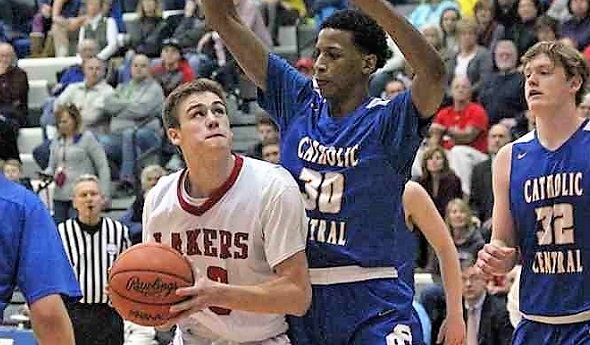
PHOTOS: (Top) Grand Rapids Catholic Central's Marcus Bingham (30) defends in the post against Spring Lake last season. (Top photo courtesy of the Grand Haven Tribune; middle photo courtesy of the Grand Rapids Catholic Central boys basketball program.)