

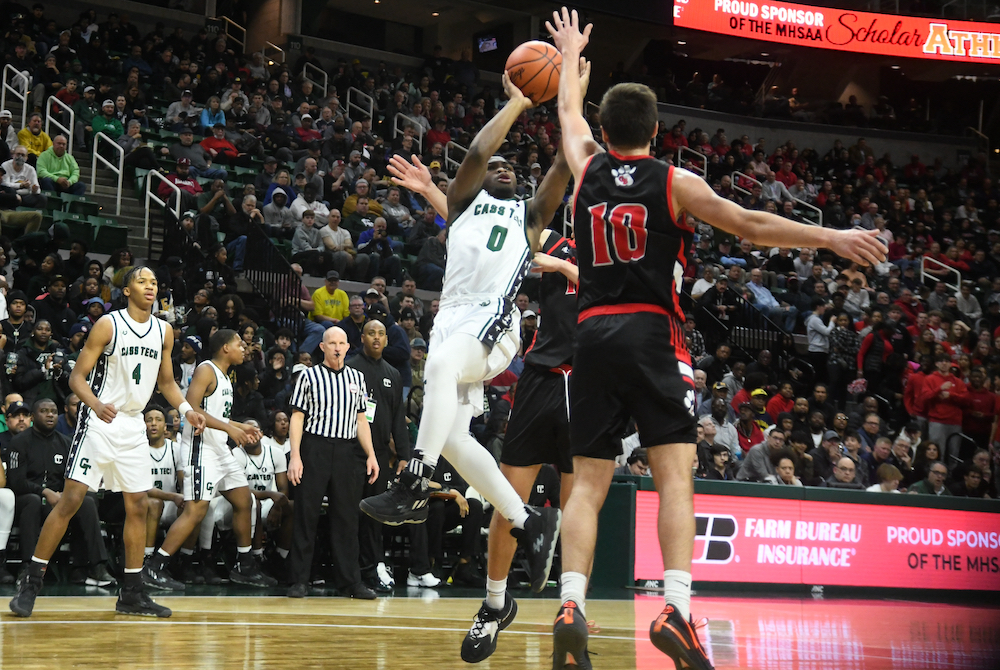
Cass Tech 'Gamers' Force OT, Finish Surge to Reach 1st Final Since 1974
By
Dean Holzwarth
Special for MHSAA.com
March 24, 2023
EAST LANSING – Detroit Cass Tech’s Darius Acuff was held in check for a majority of the second half Friday by Grand Blanc’s defense.
The talented sophomore, however, came up clutch in a pivotal moment.
The 6-foot-2 guard forced overtime with a 3-pointer and then scored four points in the extra period to help lift the Technicians to a thrilling 62-56 win in a Division 1 Semifinal at Breslin Center.
Cass Tech (27-1) will play Muskegon in Saturday’s Division 1 Final.
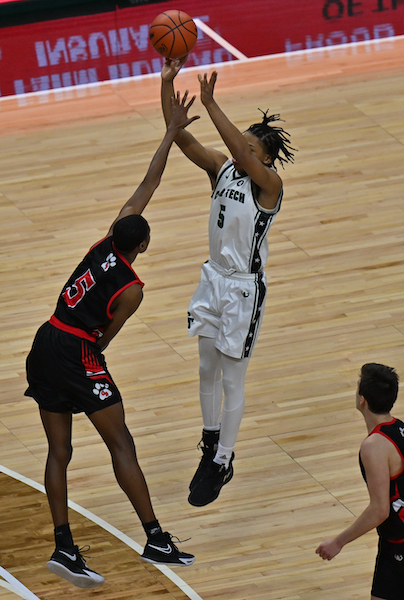
After Grand Blanc senior Robert Williams made two free throws with 9.1 seconds left in regulation to put his team ahead 54-51, Acuff banked in a 3-pointer in the waning seconds.
It was only his second field goal of the second half after tallying 10 first-half points.
“Once I got open, I called for the ball and I knew I was going to shoot it,” said Acuff, who finished with a game-high 19 points, five assists and three steals. “I knew it was going in.”
The Technicians took control in the extra session.
A breakaway layup by Acuff pushed the Cass Tech lead to 59-56 with 55 seconds to play. He followed with a pair of free throws to make it 61-56.
“We have some gamers on this team, and he doesn’t practice to my liking a lot of times, but when those lights come on I can count on him,” Technicians coach Steven Hall said of his standout sophomore. “The last play out of the timeout that we got a 3 on, they executed it to the T.”
Cass Tech was making its first Semifinal appearance since 1993, and will play in its first Final since 1974, when it finished Class A runner-up.
Hall guided Detroit Rogers to three straight Class D titles (2003-05) and returned to his alma mater in 2015-16.
“It’s a wide range of emotions right now,” Hall said. “I’m happy to still be living to fight another day.
“For me, it’s my sixth time here but the first time with my school, and it's a dream of mine. It was a dream of mine for these guys. We came so close last year, and sitting here last year and watching the Semifinals was painful, but I’ve been dreaming of getting here with my school.”
Cass Tech ended a 22-game winning streak by Grand Blanc, which was denied a third-straight appearance in the Division 1 Final.
The Bobcats (25-3) rallied from an early deficit, but committed 18 turnovers for the game and were held to one field goal in overtime.
“We didn’t handle the pressure, and one of the keys of our offensive game plan was limiting turnovers,” first-year Grand Blanc coach Tory Jackson said. “You can't beat great teams like that with 18 turnovers, and we just didn’t handle the pressure like we were supposed to.
“Hats off to Acuff. He’s a tough player and by far one of the best players we've played all year. We got undisciplined at the end, and it’s frustrating because this was supposed to be ours. We left money on the table.”
Cass Tech jumped out to an early 11-4 lead as Acuff scored six quick points.
The Bobcats, however, trimmed the deficit to 17-15 in the second quarter with a 3-pointer in the corner from sophomore Donnie Huddleston.
The Technicians took a slim 26-25 lead into halftime.
Grand Blanc took its first lead, 35-34, midway through the third quarter on an offensive rebound and put-back by junior Anthony Perdue.
Cass Tech has become accustomed to close games.
“That’s us being tough and scrappy,” Acuff said. “It’s always going to come down to one possession, and it came down to that. Once we went to overtime we knew we were going to win, but we knew we had to fight for it.”
Senior Tae Boyd led the Bobcats with 16 points and 10 rebounds, while senior RJ Taylor had nine points.
Senior Kenneth Robertson added 15 points for Cass Tech, and freshman Corey Sadler Jr. added 14 points.
PHOTOS (Top) Detroit Cass Tech’s Corey Sadler Jr. (0) gets up a shot during his team’s Division 1 Semifinal overtime win Friday. (Middle) The Technicians’ Darius Acuff shoots the game-tying 3-pointer at the end of regulation despite the defense of Grand Blanc’s Anthony Perdue (5).
Guards Answer Call for Country Day
March 23, 2013
By Geoff Kimmerly
Second Half editor
EAST LANSING – Before Saturday’s MHSAA Class B Final, Kurt Keener challenged guards Edmond Sumner, Mory Diane and Austin Price to carry Detroit Country Day to one more win.
In the recent past, Keener might’ve asked something similar of guys like 6-foot-11 Amir Williams or 7-0 Da’Shonte Riley. But this was not like most teams Keener has coached to 678 wins over the last 35 seasons.
Of course, Country Day has had outstanding guards lately as well – Ray McCallum and Kenny Knight keyed the 2010 title run – but it’s been a while since a Yellowjackets team has been this guard-driven.
But as they’ve done all season, the trio was ready to answer. Price had 15 points, Sumner 13 and an ill Diane seven in just 16 minutes as Country Day survived its closest game of the tournament to defeat Detroit Community 57-49 and earn its ninth MHSAA championship.
“We’re used to it. With our hard work in practice, we knew what to do when we came down the stretch,” Edmond said. “It was nothing new to us.”
But a title is to this group. Although Price played in Semifinals the last two seasons and Diane joined him in the starting lineup in 2012, none had played in a championship game before facing Community, located just 10 miles south of the Yellowjackets’ campus.
Country Day (25-3) was the favorite coming in to the tournament as the top-ranked team in the final Associated Press poll. But Community (18-10) proved to be much closer in ability than the teams’ records indicated.
 Much has been mentioned during the tournament of the tough schedules both played during the regular season, and particularly of the ranked Class A teams that handed Community a few losses but also pointed the Hurricanes down the path toward their first championship game.
Although Country Day led by a handful of points for most of the final three quarters, Community tied the score 36 seconds into the fourth.
“Sports at times, you’ve got to just dig deep and make a stop. I just kept saying, ‘one more,’” Keener said. “I asked Mory at one point at halftime, ‘Can you give us one or two plays?’ One or two plays in a game like this make all the difference in the world.”
Diane made the jumper that put Country Day back ahead 46-44 with 7:09 to play. Price hit six free throws and Sumner a pair down the stretch as the Yellowjackets finally pulled away for good.
But not until the final minute did it feel like Community had run out of comeback opportunities.
Country Day broke 100 points twice but scored fewer than 62 points only once before Saturday. The Hurricanes outshot the Yellowjackets 41 percent to 39 and had only one fewer rebound. The difference came in part at the free throw line, where Country Day made 20 of 26 tries and Community made only 9 of 16.
“The pressure bothered us a little bit. … If we made some free throws and layups, I think we’re right there,” Community coach Venias Jordan, Jr., said. “This is right where we wanted it. Going into the game, I told (my players) if we keep them 55ish, we had a chance to win.”
But Country Day and especially 6-foot-4 sophomore Deshawn Thomas also did well in limiting South Florida recruit Byron Zeigler. The 6-6 senior had 17 points Friday, but only nine on five shots in the Final.
“They made it pretty hard for us to get in our spots on offense, made it tough for us in the post,” Zeigler said. “They fronted us, double-teamed us, trapped us. They did everything possible to make us uncomfortable so we couldn’t get into our sweet spots.”
Senior forward Jerrell Martin led Community with 13 points and eight rebounds.
Thomas had six points and eight rebounds in 18 minutes off the bench for the Yellowjackets.
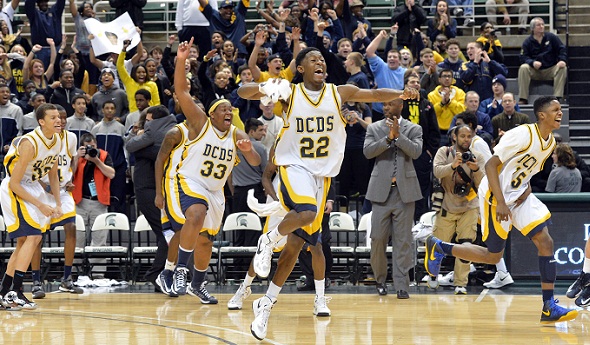
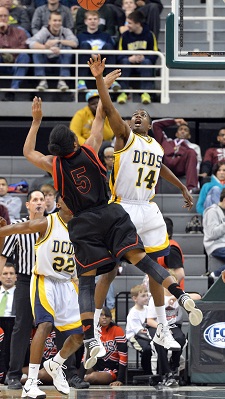
PHOTOS: (Top) Detroit Country Day's Maurice Ways (22) and his teammates rush the floor after the Yellowjackets clinched the Class B title Saturday. (Middle) Country Day's Austin Price (14) and Community's Landie Davis go for a loose ball during the championship game. (Click to see more at HighSchoolSportsScene.com.)