


Championship Memories Still Resonate with St. Thomas Star Lillard
By
Doug Donnelly
Special for MHSAA.com
July 21, 2022
It took about four decades, but a couple of years ago, Len Lillard finally got to watch the 1974 Class D Boys Basketball Final.
The outcome, of course, was the same as when Lillard, a star 6-foot-7 center from Ann Arbor St. Thomas, dominated the game and led the Irish to the championship that March. But it was just as fun to watch it once more.
“It was great fun to watch,” Lillard said. “It was interesting, to say the least.”
Lillard had a sensational athletic career at St. Thomas, now known as Father Gabriel Richard. Not only was he an outstanding basketball player, but he also won Lower Peninsula Class D Finals high jump and shot put championships.
He earned a scholarship to the University of Michigan and played four years for the Wolverines, including the season they made it to the Final Four and faced undefeated and eventual national champion Indiana.
“Their top seven guys played professionally,” Lillard recalled. “That team was outstanding.”
Today, 50 years later, Lillard is a successful investment banker living just outside of Chicago. He hasn’t lived in Michigan since 1987, but still has close ties to teammates from the University of Michigan – and St. Thomas. He plans this month, in fact, to attend a Michigan basketball alumni function in Ann Arbor.
“We stay in touch,” he said.
Lillard said playing for the Michigan Wolverines opened a lot of doors for him professionally.
“It was a very good ice-breaker,” he said. “In the financial world I was in, you had to talk to people about tens of millions, sometimes hundreds of millions of dollars in investments. You have to prove yourself and be competent very quickly. But, the basketball, the Final Four … it was a good conversation starter.”
Lillard was part of an outstanding group of athletes that happened to attend St. Thomas during the same time frame.
“I think it was a case of the stars lining up,” Lillard said. “It was just a couple of really good classes that happened to be at the same school at the same time.”
St. Thomas moved from the Catholic High School League to the Tri-County Conference when Lillard was a senior. The TCC was a new conference and, ultimately, offered little competition for the Irish in almost any sport.
St. Thomas was heads and shoulders better than the rest of the league and easily went 10-0 to claim the first boys basketball league title under coach Mike Ramker. Lillard averaged 23.6 points a game in league play. In one of the most dominating performances in league history, Lillard scored 42 points and pulled down 31 rebounds in a win over Whitmore Lake.
In the Class D Semifinals he scored 31 points and had 13 rebounds. In the 68-53 win over Harbor Springs to clinch the title, Lillard scored 18 points and added 18 rebounds and six blocked shots.
Word around the MHSAA Tournament was Lillard was headed to Notre Dame. Instead, he accepted a scholarship from Michigan, which was located just a couple miles from the gym where St. Thomas played.
“He was a tremendous athlete for his time,” Ramker said.
Lillard was a member of the 1975-76 University of Michigan men’s basketball team that played in the Final Four and was defeated in the national championship game by the undefeated Indiana Hoosiers.
“It was a great experience,” said Lillard. “Our basketball fans, and some football fans as well, were very excited and a lot of them made the trip to Philadelphia, so we had a loud cheering section.”
The Final Four was a bit different during that era, but it still was a big deal.
“This was pre-ESPN, so there was not hourly coverage, but even though players and coaches try to be low key, it was a big deal to make it to the finals,” Lillard said.
Lillard could have gone to a smaller school and received more playing time, or perhaps another Big Ten school. Getting an education from the University of Michigan, however, was worth it. Lillard said making the transition from Class D to Division I college basketball wasn’t easy.
“It was difficult. I knew the competition would be much harder which it was, but there were other issues that I was not as prepared for,” he said. “At the end of the day, I was not going to play professional basketball, and playing for a highly-ranked University of Michigan team and earning a degree from Michigan was a great accomplishment.”
Lillard appeared in five games in 1975-76. He came back to the Wolverines in 1976-77 and appeared in 11 games, making 8 of his 12 field goal attempts, both of his free throws and pulling down 14 rebounds. Coached by Johnny Orr, the Wolverines were ranked No. 1 in the country, won the Big Ten championship and advanced to the Elite 8.
Lillard graduated from Michigan in 1978 and joined his family’s contracting business. At the same time, he started night school in pursuit of a Master of Business Administration degree. He got married and moved away from the Ann Arbor area.
He has more than 30 years of experience working in finance and capital markets as part of such well-respected firms as Merit Capital Partners, Banc One Capital Partners and The Prudential Capital Group. Today, at 66, he is managing partner with Glaucon Capital Partners.
He and his wife Karen raised three sons, now aged 29, 26 and 24. The middle child, Grant, was Big Ten Freshman of the Year and Defensive Player of the Year while playing soccer at the University of Indiana. He now plays professionally in Major League Soccer.
“He was a much better athlete than me,” Lillard said.
Basketball and sports in Michigan are never too far from Lillard’s mind. He checks in with old teammates on occasion and once had coffee with an opponent who he battled in the Final from Harbor Springs who was a sheriff in a town where he vacationed.
“He was a great guy,” Lillard said. “We had a lot of fun with it.”
It was a former St. Thomas teammate who rediscovered the film of the championship game. He had the film converted to a DVD and gave copies to team members. Those Finals were played at Jenison Field House at Michigan State University – one of several interesting places St. Thomas played at during Lillard’s career.
“Some of my fondest memories are playing in some of the old Catholic League gymnasiums,” Lillard said. “Some of the second-floor gyms with a running track around them were so amazing, such tiny little gyms. Some of them had clocks that still wound. You never really knew how much time was left in the quarter. We had some great times, that’s for sure.”
2021-22 Made in Michigan
July 14: Portage Central Champ Rolls to Vanderbilt, Writing Next Chapter in Alabama - Read
July 12: Coaching Couple Passing On Knowledge, Providing Opportunities for Frankfort Wrestlers - Read
June 30: Hrynewich's Star Continuing to Rise with Olympic, Pro Sports Arrivals - Read
PHOTOS (Top) At left, Len Lillard as the standout on the Ann Arbor St. Thomas boys basketball team in 1974; at right, Lillard today as a father of three and successful investment banker. (Action photo courtesy of Doug Donnelly, current photo courtesy of Glaucon Capital Partners).
Breslin Bound: Boys Report Week 1
December 12, 2012
By Geoff Kimmerly
Second Half editor
Michigan’s top boys basketball teams traditionally waste little time each December seeing how they match up against the rest of the elite.
And last week proved no different, as major matchups and a few upsets in the Detroit and Grand Rapids areas no doubt caused some re-ranking in those regional pecking orders.
Below is a look at 10 teams who stuck out with their play last week. It isn't a state ranking – merely one of the week's notable performances.
Records and results are based on what has been reported to the MHSAA.com Score Center.
1. Detroit Pershing (2-0) – The Doughboys have been considered by most one of the top two teams heading into the season, along with Romulus. Pershing beat Romulus 83-76 and also downed River Rouge – another elite team – 68-48 during opening week.
2. Muskegon Heights (2-0) – Heights may have gone through a number of changes over the last year, but it remains elite on the court. The Tigers opened with a 74-50 win over Way Point, then defeated reigning Class A runner-up Rockford 60-59.
3. Grand Rapids South Christian (2-0) – The Sailors opened with a 54-42 win over Wyoming before notching a solid upset of 2012 Class A Quarterfinalist Grand Rapids Christian, 69-63.
4. Romulus (1-1) – The Eagles may have fallen to Pershing already. But they also opened with a 69-67 win over Dearborn Heights Robichaud – which earlier in the week beat Westland John Glenn, another considered among the elite heading into the season.
5. Holt (2-0) – The Rams have been more spoiler than contender of late in the powerful Capital Area Activities Conference Blue, but they could be back in the hunt. Holt opened with a 54-51 win over Lansing Waverly and followed by beating Lansing Eastern 69-60.
6. St. Joseph (2-0) – The Bears were a middling 11-10 last season, but opened this winter with two solid victories. They beat usual power Kalamazoo Central 73-65 and followed with a 53-37 win over Portage Northern.
7. Brown City (2-0) – Dan Blemaster was the point guard on the DeWitt team that made a surprise run to the 2004 Class B Final, and he has opened his coaching career with a pair of wins. Brown City beat Peck 37-33 and Armada 70-56.
8. Bloomfield Hills Andover (2-0) – Andover is playing its final season before merging with Lahser next fall. And after finishing 10-11 last season, the Barons got it going right last week with a 51-46 win over Farmington and a 78-48 victory over Cranbrook-Kingswood.
9. Muskegon (2-0) – The Big Reds are expected to do big things under coach Keith Guy, who came over from Heights this fall. So far, so good, with a 60-45 win over Holland West Ottawa and a 70-67 victory over Benton Harbor.
10. Grand Rapids Catholic Central (1-1) – The Eagles lost a tough one at the end of the week, 69-66 to Zeeland West. But they opened with a 77-67 win over Grand Rapids Christian.
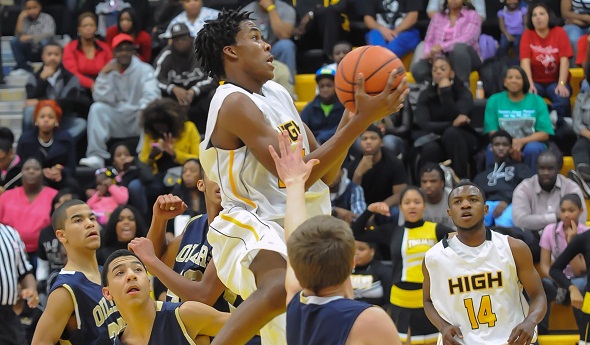
PHOTO: Saginaw, last season’s Class A champion, opened last week with a 78-60 win over Mount Pleasant. (Click to see more at HighSchoolSportsScene.com.)