

Changing of the Capital Guard
August 16, 2012
By Geoff Kimmerly
Second Half editor
Who would I pick to coach a Lansing area boys basketball Dream Team? Sportswriters get a lot of questions like that, from radio hosts or fans, or roommates who grew up nearby.
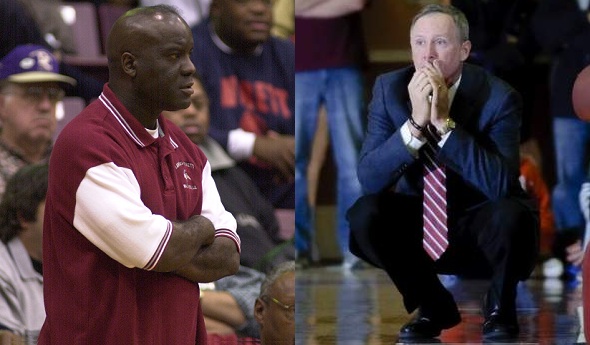
To not offend the other coaching friends I’d made in my decade-plus in Lansing, I kept that answer within the roommate circle for a long time – until I decided Okemos' Dan Stolz and Lansing Everett's Johnny Jones were so incredible their colleagues would understand my choice.
 I could’ve never picked between them. Their styles different, the results were the same. Both had stars over their decades, but I also saw both do more with less and in ways that regularly went unmatched during the 13 years I was a twice-weekly watcher of high school hoops for the Lansing State Journal.
It’s only a coincidence that both decided to retire from coaching during this same summer. But it’s certainly a double loss for mid-Michigan specifically and the statewide basketball community as a whole.
So why were these guys my Dream Team combo?
- Of course, they won a lot.
According to a report from local HOMTV, Stolz finished with a record of 428-99 at Williamston and then Okemos, where he took over for his father Stan in 1994-95. That win total is only eight more than Dad's, giving the family 828 wins over roughly four decades.
Tracking down Jones’ record wasn’t as easy. But based on the paper trail I’ve been running since I got my start in Lansing, he had 334 wins after the 2003-04 season, which likely means he too finished right around 400 – with a few hundred more leading the Vikings girls.
And they were the kind of standout high school players too whose stories had become legend – Jones for Battle Creek Central once taking down a top-ranked team by himself, while it was said Stolz could still dunk into his 40s after playing for his dad and the Chieftains back in his day.
- They won at the highest levels.
Jones is one of only a handful who has won MHSAA championships with both girls and boys teams – his girls teams won Class A in 2000 and 2001 and his boys won Class A in 2004. Everett’s girls program, by the way, was near-winless just a few years before Jones took over and led it to its first run to a Final in 1999.
Stolz never got his MHSAA title, his Chieftains falling to Saginaw Arthur Hill 85-84 in the 2006 Class A Final – the only MHSAA boys title game ever to go two extra periods. But against what many locals considered long odds, Stolz led Okemos from the cozy Class B-dominated Capital Circuit into the highest division of the Capital Area Activities Conference, where the Chieftains continued to win against the likes of Everett, Lansing Sexton, Lansing Eastern, Holt, Grand Ledge, East Lansing and Jackson in what is arguably the toughest league in the state.
Another interesting “by the way:” Stolz did lead Okemos’ softball (1999) and girls tennis teams (1993) to MHSAA championships.
- They won by doing the things others weren’t.
Jones’ girls teams were loaded with talent – a number of players went on to major college programs – but they were unstoppable because of a fullcourt press that handcuffed opponents and set a trend that others like Lansing Waverly and East Lansing also used to win Class A titles. Jones' best boys teams had an all-state post combo of Derick Nelson and Goran Suton, but still had to contend with Grand Ledge’s Al Horford (now of the Atlanta Hawks) two and three times a season.
And, it must be noted that Jones was one of fewer than 20 coaches who continued coaching both the boys and girls teams even after the girls season was moved from fall to winter for 2007-08.
Stolz similarly had his share of good players – Johnathon Jones maybe the best of all. But again, playing in a league with a number of other similarly-talented players (and in the postseason against Orchard Lake St. Mary’s Kalin Lucas and others), Stolz was unmatched in Greater Lansing when it came to gameday strategy. His teams always had a plan, and frequently made it work when the odds seemed stacked against -- which made apparent upsets hardly surprises at all.
Stolz has been replaced by Jeff Wonch, who led Bath to the MHSAA Class C title in 2007. He most recently coached at Potterville. Jones' replacement is former Everett star Desmond Ferguson, who played briefly in the NBA with the Portland Trail Blazers and was a volunteer assistant for the Vikings last season.
After Leading Glen Lake Girls to Title, Bradford Brings Boys Into Final Week
By
Tom Spencer
Special for MHSAA.com
March 15, 2024
Eight is Enough.
 Or is it?
For Jason Bradford growing up on the farm of Arden and Lynn Bradford as one of their eight children, it probably was enough. Bradford’s upbringing may have been slightly similar to “Eight Is Enough,” a comedy-drama television series about a family with eight children that aired on ABC from March of 1977 to May of 1981.
But the show didn’t depict pick-up basketball being played in the barn like it was for Bradford and his siblings. And surely eight would not be enough Regional basketball championships for Jason Bradford, nor enough District titles either.
After leading Maple City Glen Lake to the Division 4 girls basketball championship last year, Bradford stepped down from coaching. At the time his teams had won five Regional and six District titles.
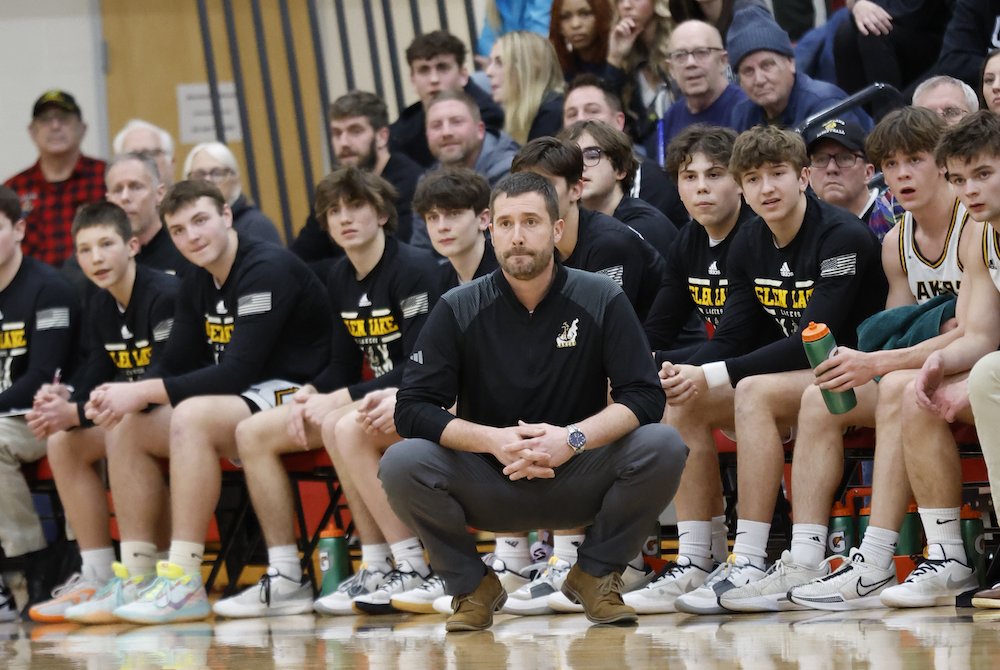
Now his teams have won six Regional and seven District championships. He took over Glen Lake’s boys program during the holiday break this winter as the Lakers were off to a 4-2 start. They finished the season 22-5.
It was the Lakers boys’ first 20-win campaign since the 2018-19 season, and they clinched their first Regional title since 2018.
Glen Lake went 19-5 last year losing to Traverse City St. Francis in the District Final. The season before that ended with a first-round loss to Elk Rapids and 15-6 record.
Bradford led his girls teams four times to the MHSAA Semifinals and almost got their a fifth time this year with the boys. Their run ended Tuesday with a tough loss in the Division 4 Quarterfinals to Mount Pleasant Sacred Heart, 63-51.
“We’re licking the wounds of that one,” he said. “We’ve got to remember to look at the big picture – they are young men becoming men.”
 But Bradford already has turned his thoughts to next season and is making plans for summer basketball.
“Having the summer with them if it goes the way we want is going to be huge,” Bradford said. “There are a few things going through my head I can change or adjust.
“We want to continue to build on what our philosophy of what Glen Lake is and my philosophy of what Glen Lake is.”
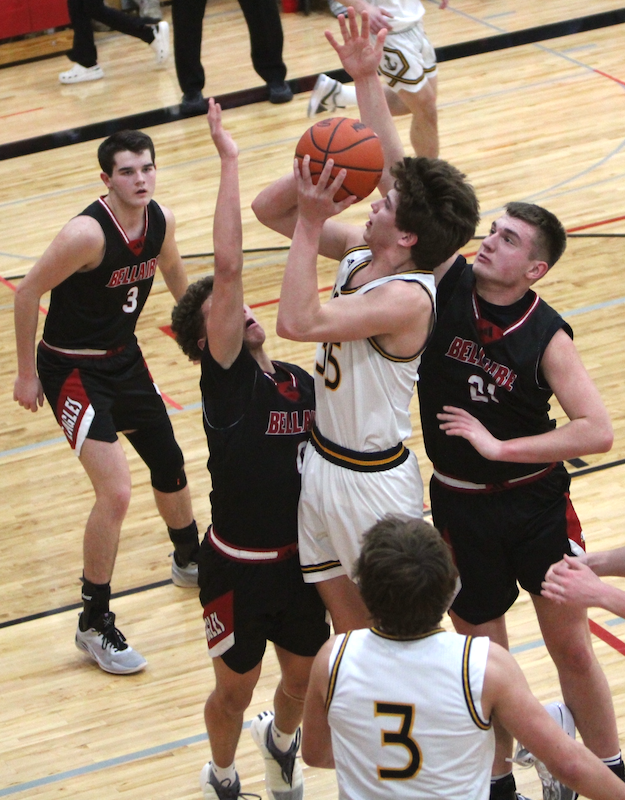
The Lakers will graduate Cooper Bufalini, Gage Baker, Dylan Cundiff, Tyler Bixby and Jamie Blondia. But they’ll have their top two scorers back, sophomore Jacob Plamondon and junior Benji Allen. Plamondon kicked in almost 20 points per game and led the team in rebounding with more than 10 per contest. Allen averaged more than 11 points per game and led the team in assists.
Glen Lake finished second in the Northwest Conference behind Benzie Central, which was undefeated in league play. The Lakers knocked off league opponents Frankfort in the Division 4 District title match and Buckley in the Regional Semifinal.
The battles with Benzie for the conference title may have been the highlights of the season, Bradford noted. Those were Glen Lake’s only losses in league play, and a share of the title was within their grasp late in the second game with the Huskies.
The Lakers lost 60-51 on their home court in the first meeting but took Benzie to the limit in the rematch before falling, 41-39, on the road.
“We had a lot of great games and a lot of great memories,” Bradford said. “Going for conference it pretty much came down to the last few seconds with lead changes.
“We were up by one point with less than 30 second lefts, and that was the high point,” he continued. “We came up short, but we learned from that game.”
Also among highlights for Bradford this year was the chance to coach against his brother Nathan for the first time in their careers.
 The Bradfords started coaching girls varsity basketball 16 years ago, but their teams were in different conferences at the time. Nathan coached the Onekama girls but moved to the boys program before Onekama and Glen Lake had a chance to compete against each other in the Northwest Conference.
The Bradford coaches often talk after their games and learn from one another. They have also seen their parents frequently in the bleachers as they rotate home game sites to see their grandchildren play and their sons coach.
When Onekama and Glen Lake played this year, eight Bradfords were on the rosters as players or coaches. Jason’s son Toby, a freshman, played on the Glen Lake junior varsity team, as Nathan’s son Carson played for the Portagers’ JV squad. The Onekama JV team is coached by another Bradford, Jason and Nathan’s brother Nick. And there were three more Bradfords on the varsity – Nathan’s son Caden and his cousins Luke and Arden.
Glen Lake won both varsity games, 38-36 at Onekama and 61-33 at home.
Jason and his wife Jackie have five children. Their youngest son, Drew, is now a sixth grader at Glen Lake. His oldest son, J.J., is at Michigan Tech and has begun officiating basketball after his senior season at Glen Lake cut short by the pandemic while the Lakers were preparing to play in a 2020 District Final. Daughters Maddie and Grace are playing basketball for Lake Superior State University.
Maddie and Grace were big parts of Glen Lake’s deep postseason runs with Jason as girls coach. With many games played on Saturdays and not conflicting with coaching, Jason, Jackie and the younger boys were able to travel to see the Upper Peninsula’s Lakers play regularly.
This season, the Glen Lake girls – under first-year head coach Brad Fosmore – went 16-8 and won Northwest Conference and District titles before losing a nail-biter, 45-42, to league rival Frankfort in the Regional Semifinal.
“Jason did a good job, and it felt good to carry on the tradition,” said Fosmore, who previously served as a Lakers JV coach. “We took it one game at a time.
“Jason worked hard to build a great girls program,” he continued. “It made it pretty simple because they had that winning tradition and kind of kept it rolling.”
 Tom Spencer is a longtime MHSAA-registered basketball and soccer official, and former softball and baseball official, and he also has coached in the northern Lower Peninsula area. He previously has written for the Saginaw News, Bay County Sports Page and Midland Daily News. He can be reached at [email protected] with story ideas for Manistee, Wexford, Missaukee, Roscommon, Ogemaw, Iosco, Alcona, Oscoda, Crawford, Kalkaska, Grand Traverse, Benzie, Leelanau, Antrim, Otsego, Montmorency, Alpena, Presque Isle, Cheboygan, Charlevoix and Emmet counties.
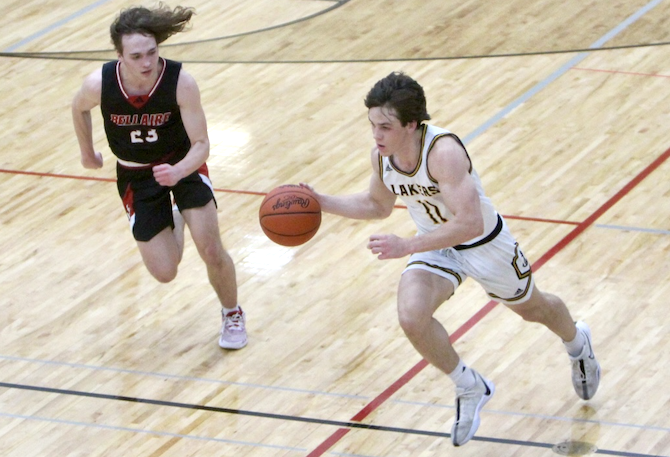
PHOTOS (Top) Jason Bradford, kneeling, coaches the Maple City Glen Lake boys varsity after taking over the program earlier this season. (Middle) Glen Lake’s Cooper Bufalini (11) pushes the ball upcourt during a 65-49 District Final win over Bellaire. (Below) The Lakers’ Jacob Plamondon (35) makes a strong move to the basket. (Top photo by RD Sports Photo/Rob DeForge, additional photos by Nicole Bixby.)