

Clarkston's Loyer Leaves All-Time Legacy with 25 Record Book Listings
By
Geoff Kimmerly
MHSAA.com senior editor
September 22, 2023
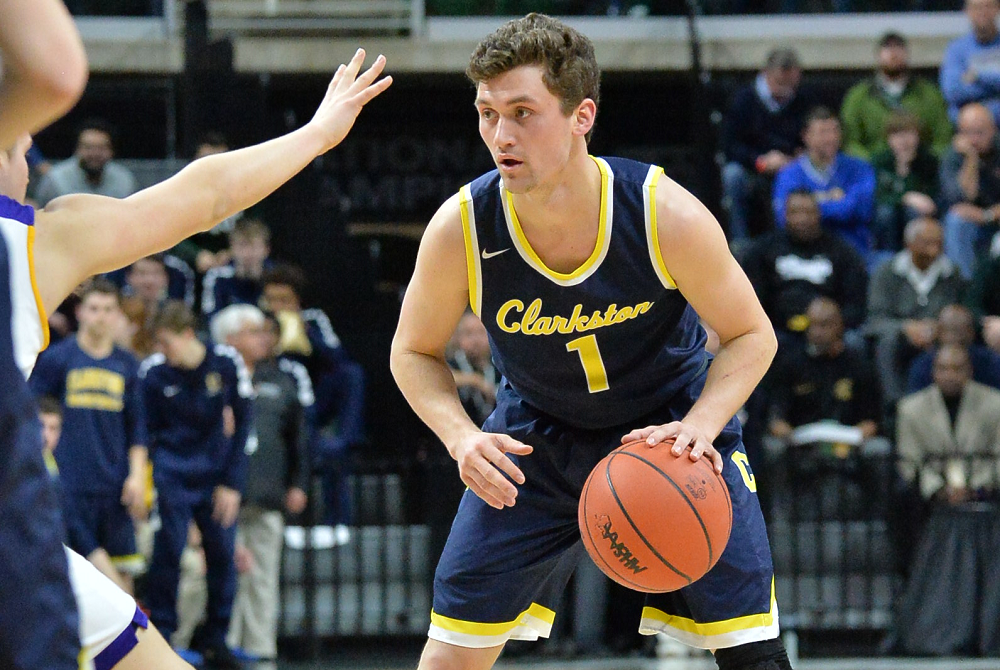
Foster Loyer’s four-season career at Clarkston from 2014-15 through 2017-18 certainly must be considered among the most accomplished in state history as he led the Wolves to back-to-back Class A championships in 2017 and 2018 and is listed in the record book 25 times.
Among Loyer’s most notable entries were 2,325 career points (12th most), 272 career 3-pointers (tied for ninth), records of 119 consecutive free throws and 634 career free throws, a .921 free-throw percentage as a junior (tied for fourth) and .900 career percentage (second), 589 career assists (sixth), 278 career steals (15th) and 102 games played (tied for sixth).
Loyer went on to play at Michigan State and then Davidson.
See below for more recent record book entries for boys basketball.
Boys Basketball
Four Onaway standouts were added for single-season and/or career records. Jager Mix, who graduated in 2022, was added for 92 steals last season and 225 over his four-season career. Kevin Pearson, a 2021 grad, was added for 81 steals as a senior and 247 over his career. Joe Sigsby, a 2016 grad, was added for 127 steals, and Jadin Mix was added for 124 in 2021-22. Their totals rank ninth and tied for 10th, respectively, on that all-time list. Jager Mix also was added for 967 career rebounds, and Onaway as a team was added for tying the record for most points in a quarter with 49 during the first quarter of a win over Fife Lake Forest Area on Feb. 3, 2022. Jager Mix is playing at Alpena Community College, and Jadin Mix is a senior this school year.
Uchenna Amene was added for 11 steals in a March 7, 2022, game against West Bloomfield Frankel Jewish Academy and for 97 steals total over 25 games. He was a sophomore at Southfield Christian that season and now is a senior at Detroit Catholic Central.
Owen Franklin graduated from Oscoda in 2021 as the school’s all-time leading scorer, and nearly 44 percent of those 1,477 points came on 3-pointers. Franklin made the state career 3-pointers list with 216 over four seasons. He’s playing baseball at Northwood.
Traverse City Christian sophomore Reece Broderick became one of the state’s most accomplished long-distance shooters in just his second year of high school this past winter, drilling 104 3-pointers – good for third-most for one season all-time – over 23 games. He connected on 42 percent of his attempts from beyond the arc.
A pair of Rudyard four-year varsity standouts entered the record book after their graduations in 2022. Tate Besteman made the career rebounds list with 762 over 89 games, and EJ Suggitt made the career 3-pointers list with 215 over the same 89 contests. Besteman played this past season for Mid Michigan College, and Suggitt is playing baseball at Spring Arbor.
Success from 3-point range played a significant role in Mesick finishing 21-1 in 2021-22, as the team made 195 of its 578 attempts – with game highs of 15 twice in wins over Baldwin and Pentwater.
Then-senior Tristan McFolley earned the first listing under single-game rebounds since 2013 with 30 in Detroit Cesar Chavez Academy’s game with Hope of Detroit Academy on Dec. 8, 2022.
Tawas found its groove from long range Jan. 10 against Oscoda, drilling 22 3-pointers in an 86-31 win. The total tied for fifth-most in one game.
Although Norway felt just short, 40-37, in its District loss to Crystal Falls Forest Park on March 8, Alex Ortman kept the Knights close scoring 20 of his team-high 25 points in the fourth quarter to make the single-quarter scoring list. He’s now a senior.
Kobe Clark has listings in two MHSAA record books, with three for boys basketball joining those he earned for football during his Schoolcraft career. He was added in hoops for 531 career assists and 290 career steals over 94 games from 2016-17 through 2019-20, and also for 82 steals as a senior. Tyler DeGroote also was added to the record book, for scoring 20 points during the first quarter against Delton Kellogg during Schoolcraft’s Jan. 11, 2022, victory. Clark began at Saginaw Valley State for football and now plays basketball and Kalamazoo Valley Community College, and DeGroote is continuing at Rockhurst (Mo.).
Past Detroit Cooley star Larry Fogle has added a seventh record book listing a half-century later. Fogle grabbed 33 rebounds on Jan. 18, 1972, during a win over Detroit Mackenzie. He went on to play at Louisiana and Canisius, and then briefly with the New York Knicks.
Trevon Gunter scored 42 points in Kalamazoo Central’s 84-56 win over Richland Gull Lake on Jan. 17, 2020, including 31 during the third quarter – second-most and just one shy of the record for points during one period. A senior that season, Gunter plays currently at Grand Valley State.
Mark Wittbrodt held the record for consecutive free throws at 70 until 2008, and that entry in the record book has been joined by several others from the Bay City Western star. He was added for his 192 3-pointers, 436 free throws, .842 free-throw percentage and 266 career steals over three seasons from 1991-93, as well as for six single-season accomplishments. He went on to play at Michigan Tech.
Ellsworth’s Jacob Jenuwine tied for 12th on the single-game 3-pointers list when he connected on 11 as part of scoring 39 points total in his team’s Feb. 14 win over Alanson. Jenuwine graduated this spring.
Bellevue senior Dawson Wing capped his three-season varsity career last winter with three entries in the record. He was added for 12 blocked shots in a 2021-22 game against Colon, 107 for the season last winter and 203 blocks over his career. Teammate Caleb Betz, a senior this fall, was added for 12 steals in a game against Athens.
Logan Mansfield capped his Morenci career in a big way last winter. The senior drilled 90 3-pointers over 24 games to earn his school’s first individual record book entry in boys hoops since the 1987-88 season, when John Craig had 132 blocked shots that would have been the second-most recorded at that time. They currently rank 13th.
New Haven earned a pair of record book entries during its March 10 win over Memphis. The Rockets bested their previous single-quarter school record with 41 points during the opening period, and they also made the statewide single-game 3-pointers list with 16.
Whitehall’s Camden Thompson, a junior this fall, earned his first record book entry last winter – and the first for his school in boys basketball. He grabbed 303 rebounds over 21 games.
Grand Rapids Wellspring Prep junior Zeekeal Jackson earned his school's first boys basketball record book entry this past season as well. He made the single-season steals list with 106, over 22 games, and just missed the single-game list with a high of 10.
Jonesville’s Brady Wright was among his team’s leading scorers during his three varsity seasons ending this past winter, but he also was a major contributor defensively. He made the records with a season-high 101 steals over 25 games as a senior, and made the career list with 232 steals over 61 games.
Sophomore Christopher McLavish Jr. made a memorable impact last season with a pair of record book entries. He made the single-quarter points list with 20 in a Feb. 21 game against Flint Powers Catholic, but even more memorable were his 97 3-pointers over 25 games for the season – tying him for 11th all-time on that list.
PHOTO Foster Loyer directs Clarkston's offense during its 2018 Class A Semifinal.
Breslin Bound: 2025-26 Boys District Preview
By
Geoff Kimmerly
MHSAA.com senior editor
February 23, 2026
The march to Breslin Center ramps up significantly this week as more than 700 boys basketball teams across Michigan begin a journey they hope will end in East Lansing.

We always switch up our “Breslin Bound” format once the MHSAA Tournament starts, as last week’s most intriguing results below are followed this time by glances at three District brackets of note in each division. Host sites are bolded, and teams playing in those brackets are listed by seed as determined by Michigan Power Ratings (MPR).
Everything you could want to know this week about tickets, brackets and more can be found on the Boys Basketball page. To watch any of several games online, visit the NFHS Network.
“Breslin Bound” is powered by MI Student Aid and based on results and schedules posted for each school at MHSAA.com.
Week in Review
The countdown of last week’s five most intriguing results:
1. Saginaw Heritage 73, Grand Blanc 60 The Hawks (18-4) avenged a 28-point loss to Grand Blanc (17-4) from December in this matchup of Saginaw Valley League division champions.
2. Detroit Catholic Central 64, Detroit Martin Luther King 54 The Shamrocks (15-6) won the annual Operation Friendship championship game matching the winners from the Catholic High School League and Detroit Public School League, and adding to a 54-46 overtime win over King (17-5) from December.
3. Gladwin 49, Beaverton 46 Gladwin (21-1) claimed the overall Jack Pine Conference championship with its second win this month over Beaverton (17-5).
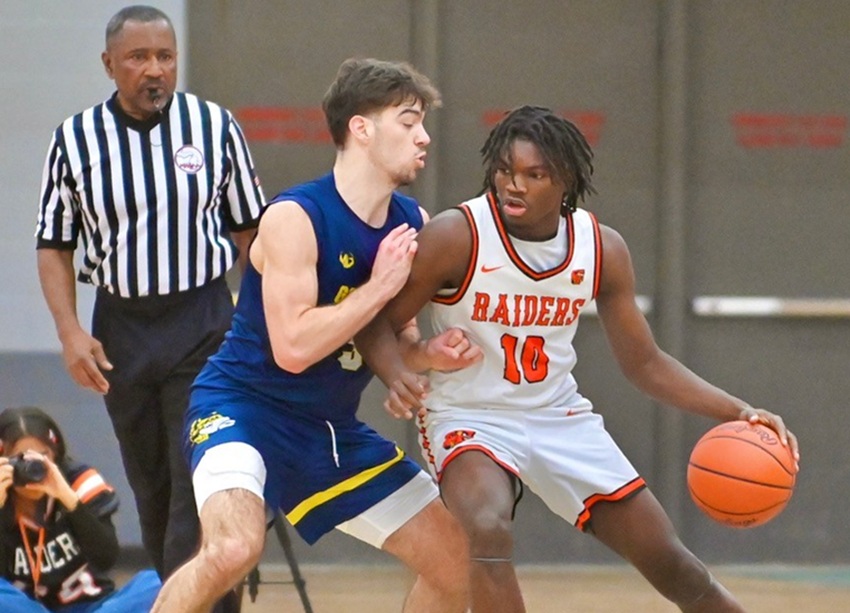
4. Flushing 52, Goodrich 51 Flushing (18-4) held on for a second close win over Goodrich, this time in the Flint Metro League championship game, after winning their Jan. 27 meeting by four.
5. Wayne Memorial 61, Hartland 48 The Zebras (19-3) capped off their regular season by defeating the Eagles (18-4) in the Kensington Lakes Activities Association title game.
Districts at a Glance
These could be among our most competitive brackets. Host sites are in bold, and teams are listed by seed:
DIVISION 1
Detroit Cass Tech
1. Detroit Martin Luther King (17-5), 2. Detroit Cass Tech (16-6), 3. Detroit Western (19-2), 4. Grosse Pointe South (11-11), 5. Grosse Pointe North (10-12).
King and Cass Tech have met twice this season – King won the Jan. 21 matchup 60-53 that helped decide the PSL Blue title, and then 68-63 in the PSL Tournament city championship game Feb. 15. King also defeated Western, 56-36, in a league tournament semifinal, while Cass Tech and Western didn’t face each other during this regular season. Grosse Pointe North has won seven of its last nine games and defeated Cass Tech by a point in their District matchup last season, and South owns a big early win over North.
Flushing
1. Saginaw Heritage (18-4), 2. Flushing (18-4), 3. Saginaw United (13-8), 4. Flint Carman-Ainsworth (8-14), 5. Swartz Creek (11-11).
As noted by the results above, Heritage and Flushing emerged at the end of last week as the top teams from the Saginaw Valley League and Flint Metro League, respectively. Saginaw United finished second in the SVL South and split with SVL North runner-up Mount Pleasant this season, and despite losing to Heritage early should also be considered a contender. Flushing has only one loss this calendar year, to Pontiac Notre Dame Prep in overtime, and Heritage has lost only twice since Jan. 1 and defeated Mount Pleasant twice by 20 or more points to win the SVL North.
Muskegon
1. Rockford (18-3), 2. Muskegon (19-2), 3. Greenville (20-2), 4. Muskegon Mona Shores (10-10), 5. Muskegon Reeths-Puffer (6-16), 6. Cedar Springs (7-15).
Rockford and Muskegon are the anticipated matchup to decide this bracket, and they met in last season’s District Final with the Rams winning 64-62. Rockford has victories over Bloomfield Hills Brother Rice and East Kentwood but finished second to the latter in the O-K Red. Muskegon has downed Wayne Memorial and Lansing Waverly and won the O-K Green. And definitely don’t count out River Cities Alliance champion Greenville, which has two losses by a combined six points and introduced itself loudly with a December win over Grand Rapids Northview.
DIVISION 2
Comstock Park
1. Grand Rapids Catholic Central (16-6), 2. Grand Rapids Christian (16-5), 3. Grand Rapids NorthPointe Christian (17-5), 4. Wyoming Kelloggsville (14-7), 5. Comstock Park (5-17), 6. Ada Forest Hills Eastern (2-20).
Grand Rapids Christian claimed the O-K White title outright last week in part thanks to a 51-43 win over Grand Rapids Catholic Central, and they split their regular-season series as the Cougars won their Jan. 20 meeting by five. NorthPointe was second in the O-K Silver and Kelloggsville fourth, and on opposite sides of this bracket certainly could provide obstacles as the Cougars and Eagles pursue a third round.
Ludington
1. Ludington (20-2), 2. Hart (19-3), 3. Reed City (10-12), 4. Manistee (12-10), 5. Big Rapids (9-13).
Ludington finished undefeated in the West Michigan Conference Lakes and has reached Regional Finals the last two seasons. Hart was second in the WMC Rivers and is seeking a first District title since 2019. They have key mutual opponents; both lost to North Muskegon this winter, and Hart also took a loss from Fremont while Ludington swept the Packers. Manistee and Ludington played Thursday – Ludington winning 68-55 – and they could meet again in a District Semifinal if Manistee gets past Big Rapids tonight.
Yale
1. Yale (20-2), 2. Croswell-Lexington (17-5), 3. Imlay City (16-6), 4. Almont (10-10), 5. North Branch (7-15).
All five of these teams are from the Blue Water Area Conference and finished among the top six, with Yale and Croswell-Lexington sharing the championship and splitting their matchups – the Pioneers won Jan. 20 in overtime, 64-57, while Yale won the rematch Friday 60-41. Imlay City finished third in the BWAC and despite losing both games against both champs took Croswell-Lexington to overtime the second time they played.
DIVISION 3
Kent City
1. Blanchard Montabella (15-7), 2. Kent City (14-8), 3. Morley Stanwood (13-9), 4. Ravenna (13-9), 5. Lakeview (7-15), 6. White Cloud (3-19).
The top four seeds all finished second or third in their respective leagues and will look to add a trophy winning what could be one of the most tightly-contested brackets in any division. Montabella tied for second in the Mid-State Activities Conference West and has won six of its last seven games since falling to Ravenna 43-39 on Jan. 28. Ravenna, which tied for third in the WMC Rivers, has bounced back from a late rough stretch and opened this season with a win over Morley Stanwood – which finished second in the Central State Activities Association White while splitting with third-place Kent City, which won their Friday matchup by 20.
Mancelona
1. Mancelona (20-2), 2. East Jordan (20-2), 3. Indian River Inland Lakes (14-8), 4. Harbor Springs (11-11), 5. Boyne City (9-12), 6. Charlevoix (6-15).
By the numbers, Mancelona and East Jordan has been so close at the top of this District that East Jordan actually passed Mancelona in MPR during the week after seeding. East Jordan also won the Ski Valley Conference by game over Mancelona, claiming their matchups 48-38 and 45-36. Inland Lakes finished third in the Ski Valley, losing to both league title contenders twice, and Harbor Springs is coming over after finishing third in the Northern Shores Conference and losing to East Jordan by only six points, 45-39, on Thursday.
Unionville-Sebewaing
1. Harbor Beach (19-3), 2. Elkton-Pigeon-Bay Port Laker (18-3), 3. Cass City (16-6), 4. Unionville-Sebewaing (11-11), 5. Bad Axe (6-15).
There is a great deal of familiarity in this bracket as well, as Harbor Beach won the Big Thumb Conference Black and Laker and Cass City were first and second, respectively, in the BTC White. Harbor Beach saw both during the first half of the regular season, defeating Cass City by seven and Laker by three. Laker defeated Cass City by seven and nine to win their league. USA tied for fifth in the BTC White – with an eight-point win over Cass City and a four-point loss to Laker in February rematches.
DIVISION 4
Lake Linden-Hubbell
1. Dollar Bay (19-2), 2. L’Anse (15-6), 3. Baraga (15-6), 4. Lake-Linden-Hubbell (7-15), 5. Chassell (5-16).
Dollar Bay won the Copper Mountain Conference championship and L’Anse and Baraga both finished among the upper half among a strong group – in fact, Baraga defeated Dollar Bay by 11 just 10 days ago. Dollar Bay did defeat Baraga in last season’s District Final, and the Blue Bolts’ only other loss this season was to Division 1 Marquette. L’Anse is enjoying its first winning season since 2018-19 and swept Baraga during the regular season.
Rogers City
1. Hillman (19-2), 2. Posen (15-5), 3. Gaylord St. Mary (13-9), 4. Rogers City (12-9), 5. Onaway (5-17), 6. Atlanta (4-13).
Hillman and Posen shared the North Star League Little Dipper championship, splitting the regular-season series with Posen and winning their most recent matchup 57-50 on Jan. 27. They may meet again, but Hillman also took a loss from potential Wednesday opponent Rogers City before winning their rematch by 20. Rogers City also defeated Posen twice. Gaylord St. Mary is intriguing after finishing fourth in the Ski Valley Conference but, as noted above, defeating that league’s champion East Jordan earlier this month.
Three Oaks River Valley
1. St. Joseph Michigan Lutheran (17-4), 2. St. Joseph Our Lady of the Lake Catholic (13-7), 3. New Buffalo (14-8), 4. Eau Claire (11-11), 5. Three Oaks River Valley (3-17).
Michigan Lutheran finished first, Our Lady and New Buffalo tied for second, and Eau Claire finished fourth in the Berrien-Cass-St. Joseph League. New Buffalo handed Michigan Lutheran its only conference defeat in their second of two games – winning by a point – and New Buffalo and Our Lady split their two games, decided by five and two points. Michigan Lutheran also defeated New Buffalo to clinch a District championship a year ago.
MHSAA.com's weekly “Breslin Bound” reports are powered by MI Student Aid, a division within the Department of Lifelong Education, Advancement, and Potential (MiLEAP). MI Student Aid encourages students to pursue postsecondary education by providing access to student financial resources and information. MI Student Aid administers the state’s scholarship and grant programs that help make college Accessible, Affordable and Attainable for you. Click to connect with MI Student Aid and find more information on Facebook and X @mistudentaid.
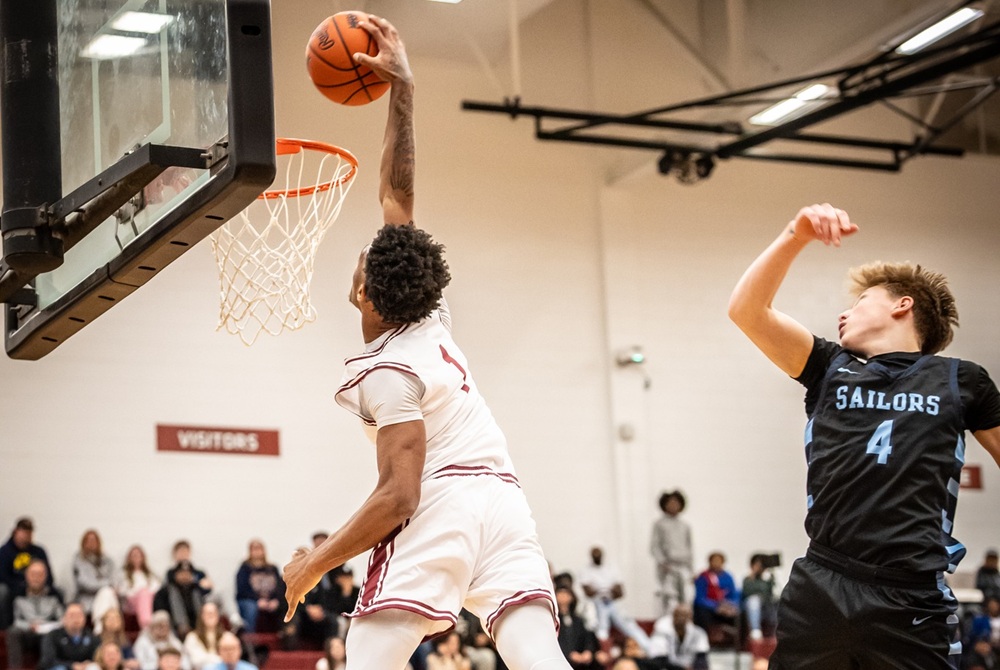
PHOTOS (Top) Muskegon’s James Martin throws down a dunk against Muskegon Mona Shores during a Jan. 30 win. (Middle) Flushing’s Raymond Neither (10) works for post position against Goodrich’s Jensen LePla during the Raiders’ 52-51 Metro League title clincher. (Muskegon/Mona Shores photo by Tim Reilly. Flushing/Goodrich photo by Terry Lyons.)