

Class C-D Preview: Wait Over for Contenders
March 25, 2015
By Geoff Kimmerly
Second Half editor
The majority of teams playing in this weekend’s Class C and D Semifinals have been waiting decades for this opportunity.
Six are seeking their first MHSAA titles. Three are playing for their first Finals berths, and two hope to appear in championship games for the first time since separate champions were awarded by peninsula in Class B, C and D during the 1930s and 40s.
All four Class C and D Semifinals will be played Thursday, with all four championship games Saturday.
Semifinals - Thursday
Class C
Boyne City (21-5) vs Grand Rapids NorthPointe Christian (20-5), 1 p.m.
Hanover-Horton (24-1) vs Flint Beecher (24-1), 2:50 p.m.
Class D
Morenci (23-2) vs Waterford Our Lady (25-0), 6 p.m.
Fulton (21-4) vs Powers North Central (25-0), 7:50 p.m.
Finals - Saturday
Class A - Noon
Class B - 6:30 p.m.
Class C - 4:30 p.m.
Class D - 10 a.m.
Tickets cost $8 per pair of Semifinals and $10 per two-game Finals session. All Semifinals will be streamed live on MHSAA.TV on a pay-per-view basis. All four Finals will be broadcast live on Fox Sports Detroit, the Class D and A title games on FOX Sports Detroit's primary channel and the Class C and B games on FOX Sports Detroit-PLUS. Free radio broadcasts of all weekend games will be available on MHSAANetwork.com.
And now, a look at the semifinalists in Class C and D. Click on the name of the school to see that team’s full schedule and results from this season. (Statistics are through teams' Regional Finals.)
Class C
BOYNE CITY
Record/rank: 21-5, unranked.
League finish: First in Lake Michigan Conference.
Coach: Nick Redman, sixth season (82-57).
Championship history: Lower Peninsula Class C runner-up 1933.
Best wins: 54-51 over No. 5 Iron Mountain in the Regional Final, 55-48 over honorable mention McBain in the Quarterfinal, 48-45 (District Final) and 57-42 over East Jordan.
Players to watch: Corey Redman, 6-5 sr. F (16.4 ppg, 5.9 rpg, 2.5 apg); Zach Napont, sr. G (10.7 ppg, 4.0 rpg, 2.6 apg, 3.0 spg).
Outlook: The Ramblers started this season 0-2 and then lost their final two regular-season games, but bounced right back to made their first MHSAA Semifinal since 1977. Boyne City proved itself winning a tight league race with three teams within two wins of the title, then beat Iron Mountain in the closing seconds to advance to this week. Redman has committed to play at Central Michigan University next season and leads a lineup starting four seniors.
FLINT BEECHER
Record/rank: 24-1, No. 1.
League finish: First in Genesee Area Conference Red.
Coach: Mike Williams, 11th season (207-69).
Championship history: Five MHSAA titles (most recent 2013), four runner-up finishes.
Best wins: 78-60 over honorable mention Southfield Christian in the Regional Final, 60-50 and 60-48 over Class B No. 4 Goodrich, 53-37 over Class B No. 7 Flint Northwestern.
Players to watch: Cedric Moten, 6-2 sr. F (15.1 ppg, 8.3 rpg, 2.2 spg); Samuel Toins, 5-9 sr. G (11.9 ppg, 51 3-pointers).
Outlook: The back-to-back champion in 2012 and 2013, Beecher just missed returning to Finals weekend in 2014, losing in its Quarterfinal. The Buccaneers stormed back this winter, in addition to the above-mentioned opponents defeating reigning Class C champion Detroit Consortium and solid Class A River Rouge. Moten and Toins are two of only three seniors; guard Malik Ellison is one of five sophomores and adds 12.8 points per game.
GRAND RAPIDS NORTHPOINTE CHRISTIAN
Record/rank: 20-5, unranked.
League finish: Second in Ottawa-Kent Conference Silver.
Coach: Jared Redell, third season (47-23).
Championship history: Has never played in an MHSAA Final.
Best wins: 48-36 over No. 3 Shelby in the Quarterfinal, 82-52 over Fennville in the District Final, 58-55 over Class B No. 3 Wyoming Godwin Heights, 93-53 over Class D honorable mention Baldwin.
Players to watch: Preston Huckaby, 5-11 sr. G (15 ppg, 3.3 apg); Kual Nhial, 6-6 sr. F (12.4 ppg, 6.0 rpg).
Outlook: NorthPointe is another team that enjoyed a fresh start in the tournament after losing three of its final four regular-season games – although the Mustangs did finish second to Class B semifinalist Godwin Heights in their league and are the only team to beat the Wolverines this season. This will be NorthPointe’s first Semifinal, and it’s a tough matchup for opponents in part because of its balance offensively; junior 6-5 guard Tyler Baker (11.3) and senior 6-5 guard Andrew Holesinger (10.1) also score in double figures, and Baker and Huckaby both have made more than 40 3-pointers this season.
HANOVER-HORTON
Record/rank: 24-1, No. 8.
League finish: First in Cascades Conference.
Coach: Chad Mortimer, 17th season (327-82).
Championship history: Lower Peninsula Class D runner-up 1941.
Best wins: 50-48 over No. 9 Monroe St. Mary Catholic Central in the Quarterfinal, 58-48 over No. 4 Hillsdale in the Regional Semifinal, 63-61 over No. 6 Jackson Lumen Christi in the District Semifinal,
Players to watch: Stefan Young, 5-9 sr. G (13.2 ppg, 4.3 apg); Brock Spink, 6-4 sr. F (11.3 ppg, 4.1 rpg, 2.5 apg).
Outlook: Hanover-Horton will play in its third Semifinal and first in since 2003 and after winning its 14th straight District title. The Comets have advanced with a pair of two-point wins over ranked opponents, avenging their lone loss by beating Lumen Christi. Senior 6-2 forward Preston Reiff (9.4 ppg, 7.1 rpg), junior 6-5 forward Preston Laketa (8.5/4.5) and senior 6-5 forward Lucas Crisanti (8.7/7.0) fill out a balanced lineup.
Class D
FULTON
Record/rank: 21-4, unranked.
League finish: Second in Central Michigan Athletic Conference.
Coach: Todd Walden, 18th season (231-172).
Championship history: Class D runner-up 2011.
Best wins: 72-67 OT over honorable mention Frankfort in the Quarterfinal, 64-60 over Mount Pleasant Sacred Heart in the Regional Final, 55-53 over Pewamo-Westphalia, 75-71 over Class C honorable mention Ithaca.
Players to watch: Gregg Jones, 6-0 sr. G (16.9 ppg, 3.6 apg, 2.5 spg, 54 3-pointers); Colton Antes, 5-11 jr. G (13.9 ppg, 2.7 apg, 74 3-pointers).
Outlook: The Pirates have won two straight close calls to return to the Semifinals, but no doubt benefited from playing against mostly Class C teams all season – all four losses were to Class C programs including two to No. 7 Laingsburg. Fulton is dangerous from the perimeter, making 209 3-pointers entering this week at nearly 38 percent success – sophomore guard Zach Walden had made 47 3-pointers heading into Tuesday. Fulton has won at least 20 games five the last six seasons.
MORENCI
Record/rank: 23-2, unranked.
League finish: First in Tri-County Conference.
Coach: Jim Bauer, 10th season (141-84).
Championship history: Has never played in an MHSAA Final.
Best wins: 60-43 over Wyoming Tri-unity Christian in the Quarterfinal, 48-36 over Hillsdale Academy in the Regional Semifinal, 60-51 over Adrian Madison, 58-49 over Clinton.
Players to watch: Austin Sandusky, 5-5 sr. G (14.1 ppg, 4.1 rpg, 4.0 apg); Alex Thomas, 6-3, jr. G (10.8 ppg, 4.6 rpg).
Outlook: Morenci is playing in its first Semifinal after winning in its first Quarterfinal appearance since 1954. The Bulldogs avenged both of their losses this season, and Tuesday extended a run to eight straight wins by at least 12 points by beating perennial power Tri-unity Christian. The team has 10 players, and all contribute with seven averaging at least five points per game. They also can shoot; seniors Tucker Stover and Hunter Borton both make better than 42 percent of their 3-point attempts, and Sandusky strikes at 39 percent success.
POWERS NORTH CENTRAL
Record/rank: 25-0, No. 1.
League finish: First in Skyline Central Conference West.
Coach: Adam Mercier, ninth season (130-78).
Championship history: Class D champion 1984.
Best wins: 63-51 over No. 6 Hillman in the Quarterfinal, 69-53 over No. 7 Lake Linden-Hubbell in the Regional Final, 48-44 (Regional Semifinal) and 45-43 over No. 5 Munising, 46-41 and 84-50 over No. 8 Crystal Falls Forest Park.
Players to watch: Jason Whitens, 6-4 soph. G (16.4 ppg, 6.7 rpg, 6.1 apg, 3.2 spg, 1.1 bpg); Rob Granquist, Jr., 6-1 sr. F (14.2 ppg, 4.2 rpg, 4.1 apg).
Outlook: North Central has made three straight Quarterfinals and now two Semifinals in three seasons, with a combined record of 73-5 in that time. The Jets average nearly 72 points per game despite a schedule that has included six against top-10 teams. The team has only two seniors, and Granquist starts alongside a junior and three sophomores. Sophomore Dawson Bilski adds another 13.9 points per game.
WATERFORD OUR LADY
Record/rank: 25-0, No. 3.
League finish: First in Detroit Catholic League Intersectional 1.
Coach: Paul Robak, second season (42-6).
Championship history: Has never played in an MHSAA Final.
Best wins: 58-29 over No. 4 Allen Park Inter-City Baptist in the Quarterfinal, 52-35 over Southfield Bradford, 58-45 over Harbor Beach.
Players to watch: Nick Robak, 6-4 sr. G (23.6 ppg, 7.3 rpg, 63 3-pointers); Andrew Kline, 6-4 jr. G (13.2 ppg, 5.8 rpg, 6.6 apg, 3.2 spg, 42 3-pointers).
Outlook: Our Lady has advanced to its third Semifinal and first since 1993 keyed by a sizable and sharp-shooting backcourt. Nick Robak scores the most but also makes 47 percent of his shots from the floor, 38 percent from 3-point range and 86 percent from the free-throw line. Although the list of opponents might not impress in terms of state rankings, Our Lady went undefeated in a league that also includes three Class B and a Class C team and then won the Catholic’s League’s Class C-D Tournament. Only three wins were closer than 10 points.
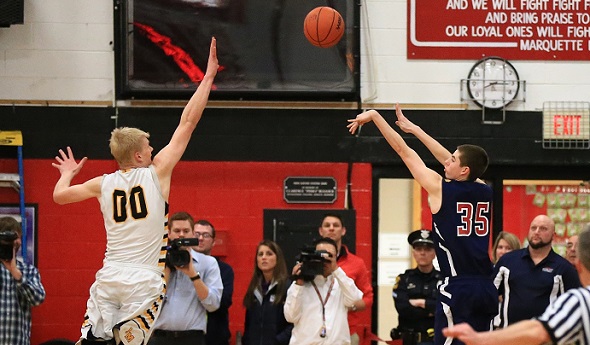
PHOTO: Boyne City's Derek Willis launches the game-winning shot against Iron Mountain during last week's Regional. (Click for more from Jarvinen Photos.)

Breslin Bound: Boys Report Week 5
January 9, 2017
By Geoff Kimmerly
Second Half editor
How quickly can a lackluster season become a distant memory?
 Ask a few of the teams we’ve highlighted in this week’s Breslin Bound Boys Report, powered by MI Student Aid.
Two of the eight on our “Watch List” this week have already won more games this winter than in all of 2015-16, and a third team could equal last season’s total by the end of this week.
Week in Review
The countdown of last week’s five most intriguing results:
1. Clarkston 60, Flint Carman-Ainsworth 47 – The Wolves remain undefeated at 8-0 after handing Carman-Ainsworth its first loss (and later in the week doing the same to Walled Lake Western).
2. Detroit U-D Jesuit 71, Romulus 58 – The Cubs finished nonleague play at 5-2 and with one more solid win over a Class A power heading into the Detroit Catholic League schedule.
3. Ann Arbor Skyline 74, Belleville 71 – Skyline is tied for the lead in the Southeastern Conference Red, but handing Belleville its first loss may have surprised a few even though Skyline has broken 70 points five of the last six games.
4. Grand Rapids Forest Hills Central 55, Grand Rapids Forest Hills Northern 51 – This neighborly rivalry game hadn’t meant this much in a while, with both now in the Ottawa-Kent Conference White and Central handing Northern its first loss of the season.
5. Holt 59, Okemos 49 – This gave the Rams an early co-lead with East Lansing in the Capital Area Activities Conference Blue and added to a 4-2 start with those losses by a combined seven points.
Watch List
With an eye toward March, here are two teams in each class making sparks:
CLASS A
Davison (6-1) – After watching the football team make a nice jump in the fall, the basketball team is doing the same coming off a 5-16 finish. The only defeat was to one-loss Carman-Ainsworth.
Bloomfield Hills (6-1) – The Black Hawks are two wins better than at this point a year ago, with their only loss to Orchard Lake St. Mary’s. They should provide a nice challenge to Clarkston in the Oakland Activities Association Red.
CLASS B
Hillsdale (6-0) – The Hornets are always in the mix, and got off to another fast start this winter after ending last year’s 18-win campaign with a three-point loss in their first District game. Last week’s double-overtime win over Onsted might be the best so far.
Wyoming Kelloggsville (5-0) – The Rockets could be in the midst of another of the most significant turnarounds in the state this winter, going 7-15 a year ago but most recently handing a one-point loss to reigning Class C runner-up Grandville Calvin Christian.
CLASS C
Maple City Glen Lake (5-0) – The Lakers opened this season by avenging last year’s season-ending loss to Traverse City St. Francis, and since they’ve played to a first-place tie in the Northwest Conference with rival Frankfort. Thursday opponent Buckley will provide another major test.
Munising (6-0) – After finishing 11-10 and falling in its first postseason game last winter, Munising is more than halfway to a better finish. This start included an avenging of that season-ending loss to Rock Mid-Peninsula and three victories total by five or fewer points.
CLASS D
Bellevue (4-0) – The Broncos have been riding a nice run the last few seasons, winning 18 games a year ago. They already own a win over Climax-Scotts, the team with which they shared the Southern Central Athletic Association West title last winter.
Marcellus (4-1) – The Wildcats also are on the rebound, having already surpassed last season’s three wins. The lone loss was a three-pointer to Constantine during the season’s first week.
Can't-Miss Contests
Be on the lookout for results of these games coming up:
Tuesday – Grand Rapids Christian (4-0) at Wayland (4-1) – These two and Wyoming look like the contenders in the O-K Gold, with Christian one to chase both in the league and Class A statewide.
Tuesday – Bellaire (5-1) at Gaylord St. Mary (5-1) – These two are contenders in the Ski Valley Conference, but also stand to be among Class D’s best from just below the bridge.
Friday – Saginaw (6-1) at Saginaw Arthur Hill (4-2) – One of the oldest rivalries in state history remains one of the best, with this and the Feb. 3 matchup likely to decide the Saginaw Valley League North title winner.
Friday – Holt (4-2) at East Lansing (6-0) – The Trojans have high hopes in Class A this season, but first comes taking care of the CAAC Blue and a strong field including the Rams (also mentioned above).
Saturday – Detroit East English (5-0) vs. Kalamazoo Central (5-0) at Grand Rapids Ottawa Hills – Arguably the top matchup of the Floyd Mayweather Classic, this one pits two of the best in Class A.
PHOTO: Grand Rapids Christian, driving to the basket, downed Holland West Ottawa on Dec. 28 as part of its 4-0 start. (Photo by Tim Reilly.)