

Class A Final: Trojans ring up a title
March 24, 2012
EAST LANSING – Every time Draymond Green visited a Saginaw basketball practice this season, he reminded the current Trojans of the same thing:
The Michigan State and former Saginaw star has two Class A championship rings. They had none.
And he brought that up one more time when he went to dinner with the team Friday night.
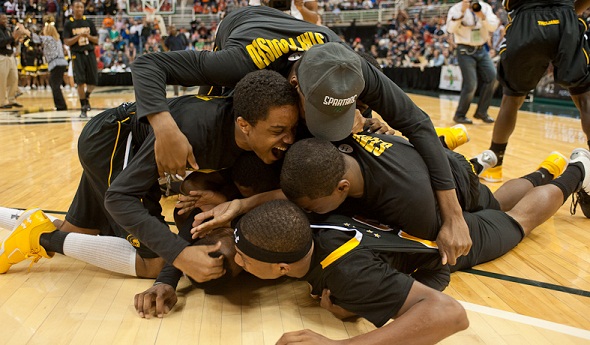
He can’t tease them anymore. Saginaw – top-ranked entering the tournament – ended it that way with a 54-42 win over Rockford in Saturday’s Class A Final.
“Now I don’t gotta hear Draymond Green’s mouth saying we don’t have a ring. Now I can take my ring to his face and say, ‘Yes, now we do,’” Saginaw senior Davario Gaines said. “He said (Friday), ‘You’re happy just to be here,’ since we won yesterday. We said, ‘No, we’re not happy to be here.’ We hadn’t won anything yet.
“So now we won.”
The championship is Saginaw’s sixth, and first since 2008, when Green led the Trojans to their second straight. But this title-winner had a different look from those that won under previous Saginaw coaches Lou Dawkins and Marshall Thomas.
Those two sat behind the Trojans’ bench Saturday as first-year coach Julian Taylor guided a team that didn’t have a Green-esque star, but a number of contributors who didn’t get down during the streakiest play of the weekend.
 Saginaw jumped out to a 7-0 lead. Rockford countered with 18 straight points. The Trojans came back from that with an 18-6 run to lead 25-24 at halftime.
The score was knotted 40-40 with 5:01 to play. But Saginaw finished on a 14-2 run, scoring the final 11 points of the game.
“You try to control runs and limit them,” Rockford coach Nick Allen said. “Saginaw is a very good team, and obviously we didn’t do a very good job of it.”
The Rams did hit 10 3-pointers, tying for fourth-most in MHSAA boys basketball championship game history. They made 55 percent of their first-half tries from beyond the arc.
But the Trojans turned up the pressure to full-court, and limited mistakes at a level rarely seen. Saginaw had just five turnovers and only nine fouls – and Rockford didn’t get to shoot a free throw.
Senior guard Travontis Richardson led the Trojans with 13 points and junior Julian Henderson had 12. But seven players scored at least four points and six grabbed at least six rebounds.
“We don’t have to have a big player. As long as we have parts to the team, they balance out the floor,” Gaines said. “We played D that they haven’t seen before, probably. We fought hard.”
So did Rockford, just to reach Breslin. Allen also was in his first season coaching after taking over for longtime coach Steve Majerle, who is battling Parkinson’s disease. The Rams entered the postseason unranked, but won seven games to finish 22-6.
Junior Chase Fairchild scored 14 points off the bench Saturday to lead the team for the second straight game. He’s one of seven juniors who won’t be nearly as big a surprise if they make a run again in 2013.
“No one expected us to go all the way to the state championship game,” Rockford junior guard Chad Carlson said. “We got here and played together as a team. It was a great season for us. We just couldn’t get it done.”
Click for box score or to watch the game and press conferences at MHSAA.tv.
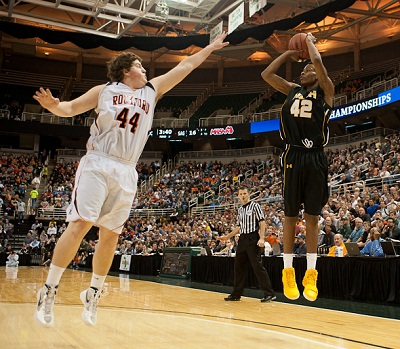
PHOTOS: (Top) Saginaw players embrace each other at midcourt after clinching the 2011-12 Class A championship. (Middle) Saginaw sophomore Joseph Williams-Powell (42) sends up a shot above the reach of Rockford senior Ivy Johnson. (See more at Terry McNamara Photography.)
Cass Tech 'Gamers' Force OT, Finish Surge to Reach 1st Final Since 1974
By
Dean Holzwarth
Special for MHSAA.com
March 24, 2023
EAST LANSING – Detroit Cass Tech’s Darius Acuff was held in check for a majority of the second half Friday by Grand Blanc’s defense.
The talented sophomore, however, came up clutch in a pivotal moment.
The 6-foot-2 guard forced overtime with a 3-pointer and then scored four points in the extra period to help lift the Technicians to a thrilling 62-56 win in a Division 1 Semifinal at Breslin Center.
Cass Tech (27-1) will play Muskegon in Saturday’s Division 1 Final.
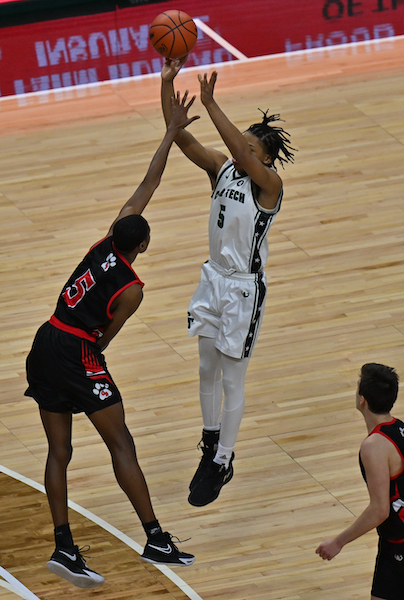
After Grand Blanc senior Robert Williams made two free throws with 9.1 seconds left in regulation to put his team ahead 54-51, Acuff banked in a 3-pointer in the waning seconds.
It was only his second field goal of the second half after tallying 10 first-half points.
“Once I got open, I called for the ball and I knew I was going to shoot it,” said Acuff, who finished with a game-high 19 points, five assists and three steals. “I knew it was going in.”
The Technicians took control in the extra session.
A breakaway layup by Acuff pushed the Cass Tech lead to 59-56 with 55 seconds to play. He followed with a pair of free throws to make it 61-56.
“We have some gamers on this team, and he doesn’t practice to my liking a lot of times, but when those lights come on I can count on him,” Technicians coach Steven Hall said of his standout sophomore. “The last play out of the timeout that we got a 3 on, they executed it to the T.”
Cass Tech was making its first Semifinal appearance since 1993, and will play in its first Final since 1974, when it finished Class A runner-up.
Hall guided Detroit Rogers to three straight Class D titles (2003-05) and returned to his alma mater in 2015-16.
“It’s a wide range of emotions right now,” Hall said. “I’m happy to still be living to fight another day.
“For me, it’s my sixth time here but the first time with my school, and it's a dream of mine. It was a dream of mine for these guys. We came so close last year, and sitting here last year and watching the Semifinals was painful, but I’ve been dreaming of getting here with my school.”
Cass Tech ended a 22-game winning streak by Grand Blanc, which was denied a third-straight appearance in the Division 1 Final.
The Bobcats (25-3) rallied from an early deficit, but committed 18 turnovers for the game and were held to one field goal in overtime.
“We didn’t handle the pressure, and one of the keys of our offensive game plan was limiting turnovers,” first-year Grand Blanc coach Tory Jackson said. “You can't beat great teams like that with 18 turnovers, and we just didn’t handle the pressure like we were supposed to.
“Hats off to Acuff. He’s a tough player and by far one of the best players we've played all year. We got undisciplined at the end, and it’s frustrating because this was supposed to be ours. We left money on the table.”
Cass Tech jumped out to an early 11-4 lead as Acuff scored six quick points.
The Bobcats, however, trimmed the deficit to 17-15 in the second quarter with a 3-pointer in the corner from sophomore Donnie Huddleston.
The Technicians took a slim 26-25 lead into halftime.
Grand Blanc took its first lead, 35-34, midway through the third quarter on an offensive rebound and put-back by junior Anthony Perdue.
Cass Tech has become accustomed to close games.
“That’s us being tough and scrappy,” Acuff said. “It’s always going to come down to one possession, and it came down to that. Once we went to overtime we knew we were going to win, but we knew we had to fight for it.”
Senior Tae Boyd led the Bobcats with 16 points and 10 rebounds, while senior RJ Taylor had nine points.
Senior Kenneth Robertson added 15 points for Cass Tech, and freshman Corey Sadler Jr. added 14 points.
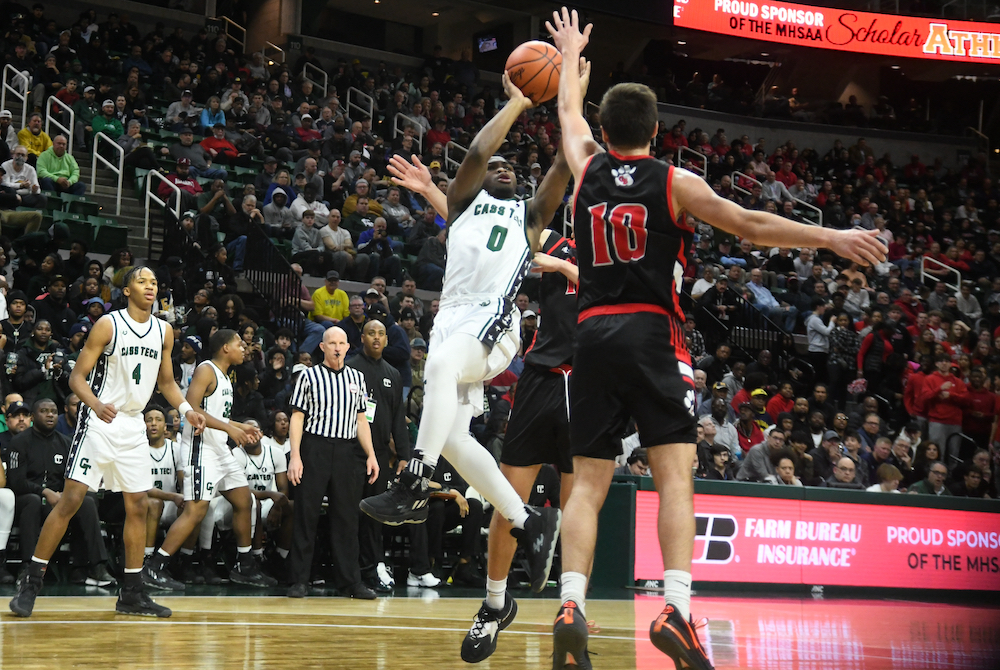
PHOTOS (Top) Detroit Cass Tech’s Corey Sadler Jr. (0) gets up a shot during his team’s Division 1 Semifinal overtime win Friday. (Middle) The Technicians’ Darius Acuff shoots the game-tying 3-pointer at the end of regulation despite the defense of Grand Blanc’s Anthony Perdue (5).