

Class A: Ram Nation Books Return
March 23, 2012
EAST LANSING – The final buzzer sounded before Romulus’ last-gasp 3-point shot reached the rim Friday at the Breslin Center.
As Rockford’s Mark Pearson watched the ball complete its arc, he figured good or not, it wouldn’t take away from the incredible run his unranked Rams made this postseason.
“We’ve worked so hard this year, and to just see that shot go up … all our practices, all our summer stuff we’ve done, and all through the year, it’s all been worth it,” Pearson said. “If it would’ve gone in, we wouldn’t have been satisfied. But by the same token, it (would’ve been) a good year.
“But we’ve got one more now.”
When that final shot caromed off the rim, the Rams celebrated a 62-61 victory and their first championship game berth since winning the Class A title in 2003.
Rockford will face top-ranked Saginaw in the Final at 4 p.m. Saturday. The Eagles, ranked No. 2 at the start of the tournament, finished 22-4.
The Rams (22-5) split the O-K Red title with both Hudsonville and East Kentwood this season, and needed to make some key plays to get to Breslin – especially after trailing Okemos by 10 in Tuesday’s Quarterfinal.
Rockford gave up its most points Friday since opening night – but also scored its second-most this season.
“Maybe people were underestimating them. We were being a little bit too laid back on defense,” Romulus senior Ray Lee said.
And the Rams showed plenty of guts again when it counted in the Semifinal.
After the teams come out of halftime tied, Romulus began breaking away in the third quarter and went up 49-44 with a period to play. The Eagles’ lead stood at six with 5:50 to play. It seemed their time to secure a Finals bid had come.
Not so.
Rockford went on an 11-0 run that included all four of standout junior guard Chad Carlson’s points, plus five of junior Chase Fairfield’s game-high 17. With 1:43 to play, Romulus suddenly found itself down five, 59-54.
“You hope and you wish and you pray, but making those expectations is tough,” Rockford coach Nick Allen said. “We hoped and wished, and maybe prayed a little bit too.”
Seniors Mitch Caywood and Ivy Johnson would provide a few more answers.
Johnson hit two free throws to give the Rams a 61-57 lead with 1:16 to play, but Romulus knotted the score again with 31 seconds left. Johnson, a 6-foot-6 sub, was fouled again with 7.6 seconds to play.
His first free throws went off the back of the rim. He second fell to give Rockford a 62-61 lead. But Romulus still had hope – until Caywood dashed it a bit by stealing the inbounds pass.
Rockford did miss two more free throws after that. But with only 3.4 seconds left, the Eagles couldn’t set up much more than the final 3-point try.
Johnson and Caywood both finished with 11 points, while senior guard Scott Nikodemski had 12. Junioe Elbert Matthews and senior Aveon Simmons led Romulus with 15 apiece, and Lee added 13.
The Eagles have now made at least the Semifinals in four of the last eight seasons – but Friday’s loss was the latest in a frustrating run. Romulus lost by one point in its 2009 Semifinal and by two in overtime in 2008. The Eagles made the Class A Final in 2005, but lost by three.
“It’s hard to do. I can say that, because we were ranked No. 1 in the state the last two years and didn’t make it here,” Romulus coach Nate Oats said. “So I’m happy we got here this year, but it’s not real satisfying anymore to get here. … I’m a little bit tired of getting here and not getting it done.”
Click for box score or to watch the game and press conferences at MHSAA.tv.
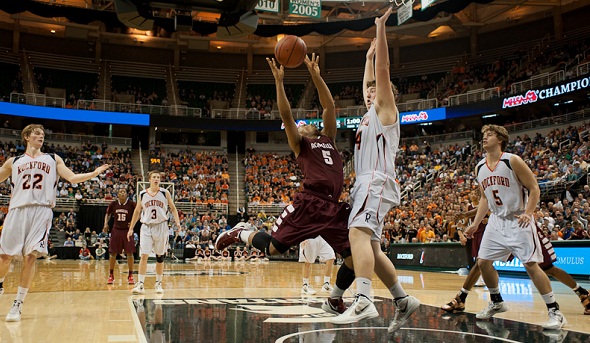
PHOTO: Rockford center Ivy Johnson (44) blocks the path of Romulus senior Aveon Simmons (5) during Friday's Semifinal. (Photo courtesy of Terry McNamara Photography.)

Beecher Seniors Lead 3-Peat Attempt
March 23, 2017
By Geoff Kimmerly
Second Half editor
EAST LANSING – The day after Flint Beecher won the Class C boys basketball championship in 2013, coach Mike Williams went to watch an eighth-grade game.
He saw Levane Blake get a steal and a dunk, Malik Ellison pull up for a 3-pointer. “I just remember seeing the chemistry between them,” Williams said. “And I thought to myself, I think we’ll be going back down to Lansing a few more times.”
Now seniors, Blake, Ellison and Jordan Roland have a chance to finish their Beecher careers among the most successful players in the program’s storied history.
The Bucs have won seven MHSAA titles, and those three captains have been part of two straight – and earned an opportunity to three-peat with a 76-68 victory over Detroit Edison Public School Academy in Thursday’s first Semifinal at the Breslin Center.
“We feel more poised this year. It’s our senior year, and we want to go out with a bang,” Roland said.
“It’s our senior year, and I won’t be able to wear this jersey anymore,” Blake added, “or play on the court with my team, or lead the young guys. So we work every day in practice, go hard, hard, hard, and Coach Mike pushes us.”
Beecher (22-5) will play Grand Rapids Covenant Christian in Saturday’s 4:30 p.m. Final. The Bucs not only have won the last two Class C titles, but four of the last five.
After watching these seniors star as eighth graders that day in 2013, Williams knew they’d be on varsity as freshmen. Ellison, Roland and Blake all joined the varsity that next winter; Ellison and Blake started as sophomores in the 2015 championship win, and all three started in last year’s title game.
 Ellison scored a game-high 28 points and added seven rebounds and seven assists Thursday, while Roland and Blake both scored 10 points, Roland also grabbing seven rebounds and the 6-foot-7 Blake blocking six shots.
Edison (14-12), in its first Semifinal after winning its first Regional title last week, fought back-and-forth for the lead through the first five minutes of the second quarter until Beecher took a one-point lead on a Roland bucket with 3:17 to go in the first half, and never gave up the advantage again.
“We know Malik is a tough little guard, and I think the thing you never can put a hand on is a guy coming up here playing in three state championships games,” DEPSA coach Brandon Neely said. “I think the advantage he had is he just understood how the game would go. … You know that those guys are never going to get rattled. They’ve been in so many wars that when they come to battle, they’re just loose; it’s just another game for them."
Senior guard Jamal Keesee led the Pioneers with 21 points and 12 rebounds, while junior center Deante Johnson had 17 points and nine rebounds. Junior guard Gary Solomon added 15 points, six rebounds and four assists, and junior guard Pierre Mitchell, Jr., had 10 points and also six rebounds and four assists.
Beecher freshman guard Jalen Terry had 15 points as his team’s second-leading scorer, something that spoke to what Williams has emphasized to his successful seniors this winter. He put it on them to play major roles in bringing along the next generation, to work at both continuing the Bucs’ legacy and setting it up for the future as well, just as others did to assist them at the start of their careers.
“I’m just going to go out there and play hard for them,” Terry said. “They gave me everything they’ve got. I’m going to give them everything I’ve got.”
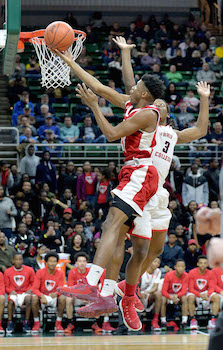
PHOTOS: (Top) Flint Beecher’s Malik Ellison drives hard to the basket during Thursday’s first Class C Semifinal. (Middle) The Bucs score two more on the way to earning their third straight championship game berth.