

Coaches Return With College Knowledge
By
Tom Markowski
Special for Second Half
February 24, 2016
North Farmington boys basketball coach Todd Negoshian is not so vain to believe he’s at the top of his profession.
 After all, he’s nearing just his fifth season running what is considered one of the top programs in the Oakland Activities Association.
What Negoshian is certain of is that he is a better coach now than he was during the early 2000s when he entered the profession as an assistant at North Farmington under his father, Tom Negoshian.
In addition to Todd Negoshian’s years as a high school coach, he spent three seasons (2004-07) as an assistant coach at Oakland University under coach Greg Kampe. Having worked at the college level has not only added to his knowledge as a coach but also given him an opportunity to work with different people under different circumstances but with similar goals.
“I learned a lot from Kampe,” Negoshian said. “I learned a lot about relationships. He has the uncanny ability to (scold) a kid and then 30 seconds later have your arms around him. It’s about building relationships.
“It’s his approach to coaching. There’s so many things you learned outside of coaching.”
This brief stint at the collegiate level gave Negoshian, 35, a whole new perspective on how to coach and how to be a coach. Building relationships takes time, and to those committed to being a coach who cares about his or her players, it’s paramount to allow for that time.
Some coaches, like John Beilein at University of Michigan, start out coaching at the high school level, move on to college and remain there. A number of others statewide have taken paths similar to that of Negoshian.
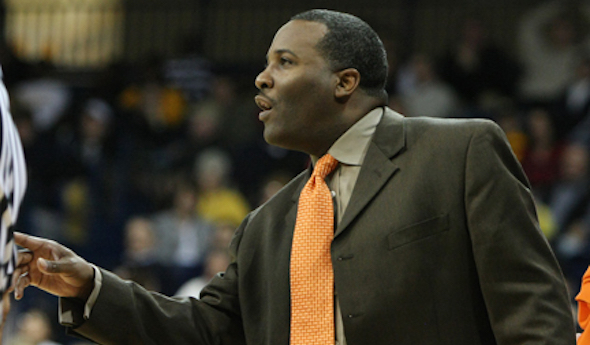
LaMonta Stone at River Rouge and Steve Hall at Detroit Cass Tech started coaching at the high school level and have recently returned to their roots after each spent several years as a college coach.
Stone played for the legendary Lofton Greene at River Rouge and then coached the Panthers to a Class B title in 1999. Stone ambitiously sought a position at the next level and was quite successful. He spent two seasons at Eastern Michigan, two at Ohio State and 10 at Bowling Green before returning to River Rouge last season as head coach.
And he has no regrets.
“At that point, I had goals,” Stone said of making the jump to college. “There were things I wanted to do. I still have goals. People ask me, would I go back to college? I don’t know. If the situation was right, I might.”
Stone, 49, returned for two reasons: family and community. Last season he was able to coach his oldest son, LaMonta, Jr., his senior year. Stone also has two other sons, ages 6 and 9.
 Basketball is king in River Rouge. Greene won a record 12 MHSAA titles and the program has won two more since his departure. But the Panthers relinquished their claim as a state power soon after Stone left and haven’t been much of a factor in the tournament since. Stone intends on changing that.
“It’s a situation where, I’d been (coaching in college) for 14 years,” he said. “I’d reached all my goals. The only one I didn’t was to become a head coach. But you’re an assistant in the Big Ten. You can’t get much higher than that.
“The opportunity to come back to that community, I just couldn’t pass up. I get to be more of a part of my sons’ lives.”
In addition to the high school season, Stone said he enjoys coaching during the summer, in camps and individually.
“I can, within the (Michigan High School Athletic Association) rules, work with kids outside of Rouge,” he said. “I get calls all the time saying can you work with my son. I work with them but they can’t come to Rouge. I like it that way. There’s no pressure on me or them.”
Hall, 45, was one of the state’s top players when he graduated from Cass Tech in 1988. He played four years in college (Washington, Virginia Tech) before playing professionally overseas. In 1996 he became the head coach at Detroit Rogers, an all-boys school in the Detroit Public School League. Hall spent nine seasons there and won three MHSAA titles before the school closed.
Hall went to Detroit Northwestern in 2005 and spent three seasons there, winning one PSL title, before accepting a position as an assistant coach at Duquesne University in Pittsburgh. He spent four seasons there before becoming an assistant coach at Youngstown State. On Aug. 25, Hall officially came back to Detroit as athletic director and boys basketball coach at Cass Tech.
Like Stone, Hall was looking for a more stable lifestyle. Family came first, and the opportunity to coach his alma mater was too good to pass up.
“A lot had to do with my life at this stage,” he said. “I have two young boys (ages 7 and 4) and to be more a part of their lives is important. If I wanted to spend time with them, we’d go to a game where I was recruiting a kid and that would be our time together on that given day.
“And I have a passion for this school. This whole year has been learning on the fly. At Rogers there was a lack of numbers. Here football is huge. We didn’t have a football team at Rogers. And here I have a surplus of numbers. It’s a different dynamic. Rogers was the smallest school in the PSL by enrollment. Cass is the biggest.”
Hall said he doesn’t miss the hours of travelling on the road, going into countless gymnasiums recruiting players and trying to convince them and their coaches that his university was the right one. It’s not that his responsibilities as athletic director and coach are less demanding. But being able to go home every night and see his children and sleep in his bed has its rewards.
Hall said he had more than a few conversations with Stone on returning home.
All three coaches agree that experience has its benefits. It’s not that coaching is any easier at this time. The challenges are still there and in many ways demand different approaches.
“Every stop makes you better,” Negoshian said. “Anytime you coach kids, the more you are around them, it helps.
“The game has changed. Society changed. Kids don’t want to fight through tough times. That’s why you see so many transfers. Everybody wants to be the hero. They want the focus on them. And it’s just not them. It’s the family. I’m not sure all of the parents are committed. They don’t want to go to A, B and C to get to D.”
Hall said the expectations for incoming freshmen and their parents are so different than it was when he was in high school. Then students went to a certain school, whether it was a power like Detroit Southwestern or a neighborhood school like Detroit Mumford, to be a part of an established program.
“It’s a trickle down from college,” Hall said. “It’s not, ‘I want to send my kid to a great program.’ There’s the attitude that if my son isn’t a part of it as a freshman, I’ll go somewhere else instead of being part of the process.”
 Tom Markowski is a columnist and directs website coverage for the State Champs! Sports Network. He previously covered primarily high school sports for the The Detroit News from 1984-2014, focusing on the Detroit area and contributing to statewide coverage of football and basketball. Contact him at [email protected] with story ideas for Oakland, Macomb and Wayne counties.
PHOTOS: (Top) Current River Rouge boys basketball coach LaMonta Stone returned to his alma mater after serving as a college assistant including at Bowling Green. (Middle) Todd Negoshian, LaMonta Stone, Steve Hall. (Top photo courtesy of LaMonta Stone.)
Before the Bridge: Class E & the UP
By
Ron Pesch
MHSAA historian
July 31, 2017
This is the final part in a series on MHSAA tournament classification, past and present, that has been published over the last two weeks and originally ran in this spring's edition of MHSAA benchmarks.
The stories are worthy of the silver screen.
Long lost legends of lore, forgotten by most in the Lower Peninsula of the state of Michigan.
Absurd anecdotes of basketball played behind glass, and out-of-bounds lines painted on walls.
Tales of overlooked places like Trenary and Champion and Doelle and Watersmeet.
This is the story of MHSAA Class E basketball.
From 1932 to 1947, Michigan's Upper Peninsula did not compete in the state-sponsored basketball tournament. Instead, the U.P. held a separate basketball tournament, crowning champions in Classes B, C and D. In 1941, the state added a fifth classification – Class E, comprised of schools with a student body numbering 75 or fewer. A fourth bracket was added to the U.P. tourney.
Following the 1948 season, the Upper Peninsula returned to the state tournament. Winners of the traditional U.P. tourney were pronounced regional champions, and advanced to the state quarterfinals in Classes B, C and D. However, since there were no Class E schools with basketball teams in the Lower Peninsula, the winner of the U.P. tournament crown was proclaimed Class E state champion. This arrangement continued through the spring of the 1960 season.
Since they were the state's smallest high schools, the gymnasiums came in all shapes and sizes. Some sported a center circle that intersected with the top of the key. Basketball courts that doubled as a stage required netting to keep the kids and the ball on the court and away from the audience seated below.
Fred Boddy, a former coach at Champion, recalled his first visit to Doelle. Located in copper country near Houghton, the hosts were the proud owners of “the smallest” gym in U.P.
“I couldn't believe my eyes. ... Here on the second floor were windows and bleachers all around filled with fans. The gym, of course, was located on the first floor, but to get into the gym one had to go around to the back of the school to enter through the boiler room to the locker rooms, which opened onto the gym floor much like a dugout on a baseball field. The players sat on a bench under the wall and could look out and see the game in this manner. The free throw lines intersected and there were no out of bounds lines... the wall itself was ‘out of bounds.’ On the floor during the game were 10 players and two referees. There were no sounds as all the fans were up on the second floor, glassed in.
The cheerleaders tried valiantly to fire up the fans up on the second floor, but the teams couldn't hear in the quiet below. The score clock and statistician personnel were placed in a corner box high over the floor in one corner of the gym. They attained this lofty perch by a ladder that was removed from the trap door after all three were in position and the game could thus commence. The timer then tied a rope around his ankle. To send a sub into the game the coach would send the player along the wall heading for this rope. He would pull the rope causing the timer to look down through the trap door and at next opportunity would ring the buzzer and admit this substitute”
Regardless of the challenges presented by these cracker-box gyms, the fans loved their basketball. “The enthusiasm was just the same, if not bigger, than schools twice and 10 times their size,” noted longtime U.P. historian, Jay Soderberg.
Coach Joseph Miheve's 1941 Palmer squad captured the state's first Class E title with a 39-28 win over Hulbert at Ironwood. A graduate of Wakefield High School, Miheve had never played high school basketball, serving as the team's manager.
The 1942 tournament, scheduled for March 19-21, was postponed one week because the city of Marquette was more or less taken over “by nearly 1,000 selective service registrants from every county in the Upper Peninsula” who had another and more serious battle in mind – World War II.
Palmer, this time coached by Elvin Niemi, repeated in Class E with a 37-31 victory over Bergland. It was Palmer's 32nd consecutive victory.
No tournament was held in 1943 due to the involvement of the United States in the war. In the 1944 championship game, Cedarville jumped out to a 19-14 first quarter lead but was held to 24 points in the remaining periods and fell to Amasa, 51-43 at Ishpeming.
Trenary made its lone Class E finals appearance in 1945, losing to Bergland 49-39 at Ishpeming, while the Alpha Mastodons won their first U.P. title since 1934 with a 48-28 win over Champion in 1946. It was the second of five Class E titles for Alpha coach Gerhardt “Gary” Gollakner, one of the finest coaches to come out of the U.P. Gollakner had coached at Amasa two years earlier, and his Mastodons would earn three additional titles during the 19-year run of the Class E championships.
Bergland became the tourney's second two-time winner in 1947, with a 40-37 win over the Perkins Yellowjackets. Perkins made four trips to the Class E finals over the years, including an appearance in the final year of the tournament, but came away empty-handed each time.
The Nahma Arrows made their first appearance in the championship in 1951, losing to Michigamme. Led by coach Harold “Babe” Anderson, a cage star at Northern Michigan College during the early 1940s, the Arrows returned to the finals in 1952. Nahma finished the year with a 21-0 mark and a 64-44 win over Marenisco for the crown.
 The two teams met again in a finals rematch the following year. The scored was tied six times, while the lead changed hands seven times in this barnburner. With 15 seconds to play, Nahma led 64-60. Marenisco's Robert Prosser hit a jump shot, then teammate Bill Blodgett stole a pass and scored to knot the game at 64. With two seconds remaining, Nahma's Bernard Newhouse was fouled. Newhouse hit the first free throw, but missed on the second. Teammate Wendell Roddy tipped in the rebound, and the Arrows had their second title.
Alpha returned to the championship circle in 1954 with a 52-48 win over Perkins.
The 1955 title game matched a pair of the finest teams in Class E history. Trout Creek, making its first championship appearance, downed Alpha 84-83 in another Class E thriller. Don Mackey led the winners with 39 points. Tony Hoholek paced Alpha with 31, while junior John Kocinski added 21-points for the Mastodons.
Kocinski, a four-year starter at Alpha, scored 1,782 points during his career, then an all-time U.P. record. He once scored 51 points against Amasa, and could have scored more according to teammate Walter “Slip” Ball. “He refused to shoot in the fourth quarter, and passed up one shot after another,” Ball said.
Without question, Trout Creek was one of the powerhouse squads during the final years of the tourney. The Anglers, coached by Bruce “Pinky” Warren, a former captain of Purdue's football team, made four trips to the finals during the last six years of the Class E tourney. The defending champions downed Alpha in the semifinals of the 1956 tournament, then knocked off Hermansville 86-68 in the finals to repeat. It was a year of celebration for fans of U.P. basketball, as four of the state's five champions – Stephenson (B), Crystal Falls (C), Chassell (D) and Trout Creek (E) – came from Michigan's northern peninsula.
Hermansville returned to the finals in the spring of 1957 and earned its second Class E title with a 77-51 win over Michigamme at Escanaba. Trout Creek downed Perkins 61-41 for their third crown in 1958.
The 1959 championship, hosted at Northern Michigan College's fieldhouse, was a showdown of the U.P.’s only undefeated squads, Trout Creek and Nahma. Trout Creek was riding a 24-game winning streak that dated back to the 1958 season. A scoring machine, Warren's Anglers averaged 81.7 points per contest. Nahma, 19-0 on the season, boasted the U.P.'s strongest defense. Still coached by “Babe” Anderson, the Arrows had allowed an average of 38.2 points per game. Led by senior Warren Groleau, Nahma had been last defeated by Trout Creek in the semifinals of the 1958 tourney.
Leading 25-15 at the intermission, Nahma matched Trout Creek point for point in the second half for a 55-45 victory.
Hermansville, behind Richard Polazzo's 29 points and Irwin Scholtz's 27, downed surprise finalist Perkins 72-50 in the 1960 finale, to end this chapter in MHSAA history.
Today, most of the former Class E high schools are long gone. Many have closed their doors and consolidated with other area schools. Amasa and Alpha merged with Crystal Falls to form Forest Park. Palmer is now part of the Negaunee school system. Bergland and Trout Creek joined forces with Class D Ewen to form Ewen-Trout Creek. Hermansville combined with Powers to form North Central, to name but a few. A few remain: Dollar Bay, Marenisco (now Wakefield-Marenisco) and Watersmeet, and their enrollments are much the same as in the glory days of the state's fifth classification.
Author’s note: Special thanks to Jay Soderberg and Roger Finlan, who assisted in gathering statistics and quotes used in this article. Thanks also to Dick Kishpaugh, Bob Whitens, Walter “Slip” Ball, Dennis Grall, Fred Boddy, Bruce Warren, Gene Maki, Harold “Babe” Anderson and the various personnel at U.P. high schools for their contributions to this story.
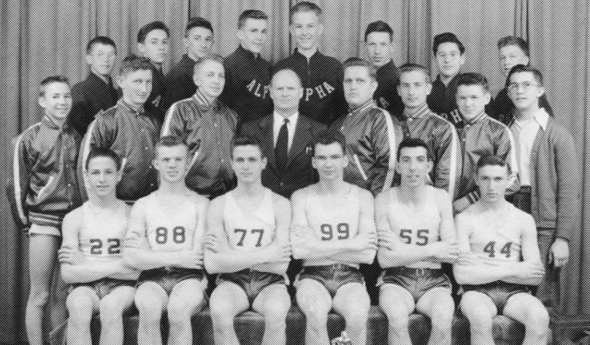
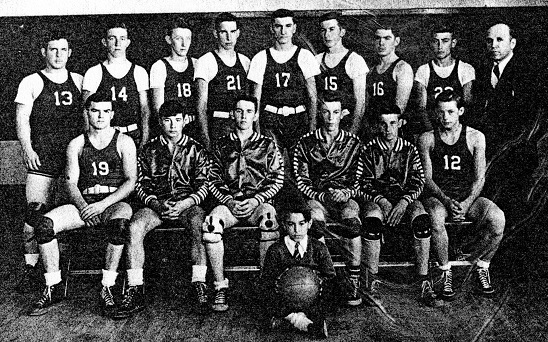
PHOTOS: (Top) The Alpha boys basketball team won the 1950 Class E title by nearly doubling up Michigamme, 52-28. (Middle) Hermansville claimed the 1948 title with a 58-38 win over Rockland.