

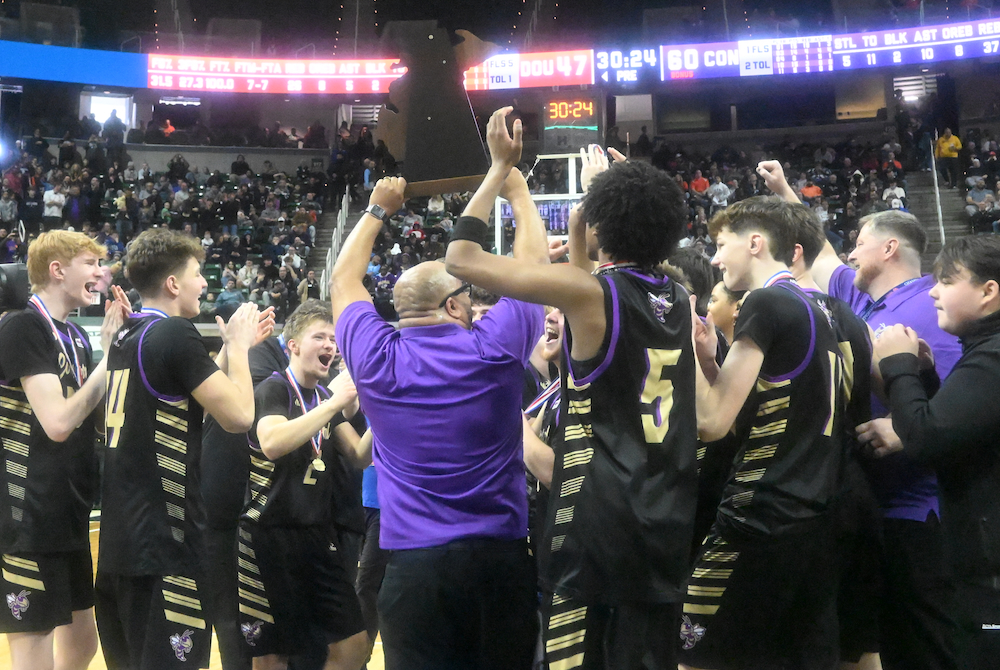
Concord Finishes Strong to End Longest Playoff Run in 40 Years as 1st-Time Champ
By
Paul Costanzo
Special for MHSAA.com
March 14, 2026
EAST LANSING – As his teammate Connor Stevens strode to the free throw line to put the finishing touches on Concord’s 60-47 win over Detroit Douglass in the Division 4 Boys Basketball Final on Saturday, Brady Garrett pulled his jersey over his face.
The Yellowjackets senior shook his head, almost in disbelief before looking up to the massive Concord crowd assembled at the Breslin Center and screaming, “Let’s go!”
“First of all, I love basketball and I love the group of guys that I’m with,” Garrett said. “As time was winding down, it was hitting me. I’m a senior, this is it. This was everything I played for my whole life. To capture it with a state championship, it meant so much to me. I wouldn’t ask for a better group of guys to do it with.”
Garrett and his teammates brought Concord its first Finals title in boys basketball, finishing off the school’s first “final four” appearance since 1986.
“They’ve been waiting on it,” Stevens said. “All season they’ve been riding with us, and there’s no other way I’d want to go out than this. We all looked at each other and knew that’s what we had to do.”
Concord did it for its city and fans, as well as for Fred Garland, who had passed away in a car crash after leaving a Concord practice in December of 2024. Garland was a standout college basketball player who played for Concord coach Marcus Gill Sr. at Albion and was a former club coach of Stevens.
“We did this for Fred Garland,” Gill said. “(His death) rocked our heart and soul, and he wanted this bad. We did this for Fred.”
The Yellowjackets were able to channel all that emotion into an incredible fourth quarter, which broke open a game that was tied after three.
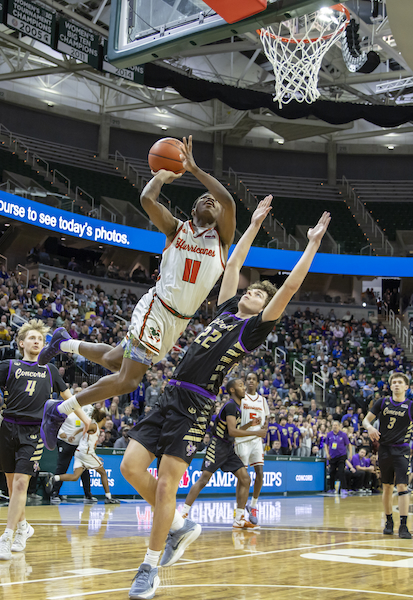 They outscored Douglass 19-6 in the fourth, holding the Hurricanes to 2-of-16 (12.5 percent) shooting from the field, while hitting 60 percent of their shots and not committing a turnover.
Much of that success hinged on a switch during the quarter to a zone defense, which caught Douglass off guard.
“We are primarily a man-to-man team, but we have our (3-2 zone) in,” Gill said. “We knew we wanted to save it a little bit for the second half today, because they’re a really good driving team, and we knew (Douglass guard Damani Oliver) can really shoot it, so we wanted to wait for the right time to try and get them out of their rhythm. We got into it, it was working and we were making stops, so we just stayed in it.”
Douglass coach Pierre Brooks Sr. credited that zone for slowing his team, but thought it was Concord’s senior-led roster that made the difference down the stretch.
“I think Concord’s experience kind of got the best of us in the second half,” Brooks said. “They’ve got seniors that were pretty hungry, and we just didn’t convert.”
The late push from Concord came despite not having star guard Jett Smith on the court for half of the fourth quarter, as he picked up his fourth foul during the final seconds of the third.
With him out, though, the Yellowjackets jumped ahead, leading by five when he re-entered the game with 4 minutes, 26 seconds to play.
“It was huge, but that’s why we’re a championship team, because we’ve got other guys,” Gill said. “Just like (in the Semifinal against Wyoming Tri-Unity Christian), they did a good job of taking (Smith) out of the game, but we’ve got a lot of good ball handlers. Yesterday it was Darrell (Dean) with the ball in his hands, today it was Brady Garrett. I thought he ran our team unbelievably.”
Smith still finished with 14 points, despite the foul trouble and hounding defense from Douglass junior Jacodi Nathan. Stevens led the Yellowjackets with 15 points and 19 rebounds, while Dean had 15 points. Garrett added six points, five assists and two steals.
Oliver led Douglass (21-8) with 15 points, while Nathan had 12, including a five-point stretch over the final seconds of the first half during which he hit a 3-pointer, stole the inbounds pass and laid the ball in, giving his team a 26-22 lead going into halftime.
“Today, we didn’t finish the first 16 minutes great, but we came out and battled and played Concord basketball the last 16 minutes,” Gill said. “And this is the outcome right here. Can’t be more proud of these guys.”
PHOTOS (Top) Concord boys basketball coach Marcus Gill Sr. holds up his team’s newly-won championship trophy Saturday at Breslin Center. (Middle) Douglass’ Jacodi Nathan (11) drives hard to the hoop with Concord’s Tyler Rundle working to wall him off. (Photos by Hockey Weekly Action Photos.)
Ribel's Return Sets Up TC Central for 2nd-Half Rebound, Postseason Push
By
Tom Spencer
Special for MHSAA.com
January 19, 2024
Best of three.
 That’s the perspective Traverse City Central’s varsity basketball team has as the Trojans travel to play undefeated Cadillac tonight. And really, they have the same vision for most of their Big North Conference opponents as they reach midseason.
Central has hopes of getting in two or more wins against those rivals with a third meeting likely coming during the postseason. Central also is hopeful of getting to play those conference and postseason games with their leading scorer Anthony Ribel healthy and in the line-up.
Ribel missed the first seven games this season with a foot injury, including an opening day 68-33 route by the Vikings on the Trojans’ court. He will be in the line-up this time – and the Trojans are a much more confident and experienced team than they were in the first meeting.
Cadillac is entering tonight 10-0 overall and 5-0 in the Big North. Central, 2-8 but coming off its highest-scoring game in 15 years (a 94-50 victory over Alpena), owns a 2-3 league record. But the Trojans haven’t given up winning the conference title just yet. Ribel’s injury occurred at practice just three days before the season opener, and since returning he has averaged 30 points per game.
“Cadillac beat us pretty bad,” second-year coach Ben Fischer acknowledged. “The guys are very motivated to show them how we play Trojans basketball.
“Anthony is a big addition – it goes without saying,” he continued. “We’re a much different team offensively and defensively than we were before.”
Last year, the 6-foot-3 Ribel broke the junior-season scoring record at Traverse City Central previously owned by Dan Majerle, who played 14 seasons in the NBA, made three all-star teams and helped the U.S. Olympic team to a bronze medal in 1988. Ribel scored more than 600 points and also eclipsed the 1,000-point career mark during his junior campaign.
Despite missing the first third of this season, Ribel has a shot at Majerle’s career scoring record of 1,388 points. He started this winter with 1,133 career points after joining the varsity as a freshman.
 Ribel recalled how he struggled through Cadillac’s lopsided win in the season opener while sitting the bench. Cadillac dominated the inside game, and Ribel is confident that will change tonight.
“When you lose at home by that much, it is embarrassing,” Ribel noted. “We have a lot of extra motivation.
“We’re less worried about what they can get from outside — we’re more worried about what they can do inside,” he continued. “We just have to take over the paint the best we can.”
Ribel led the way with 25 points in the Alpena win. The Trojans also got contributions from Owen Ribel (20 points), Brendan Slack (12 points), EJ Maitland (10 points), Jaden Clark (10 points, five assists), Jack Potgieter (nine points, eight rebounds) and Ethan Rademacher (five assists).
“We’re starting to find our stride.” Fischer pointed out. “Guys are getting a lot more dialed into their roles. We have relied on a lot of guys who didn’t have much experience coming into the season. Now they know they can go out there and compete having played some really good teams already.”
Slack is averaging 11.2 points per game and Maitland is contributing 10.1. Potgieter and Anthony Ribel are collecting six rebounds per game. Maitland and Potgieter kick in more than two assists.
Owen Ribel, only a sophomore, is also making a big mark for the Trojans. He’s thrown down a few dunks and had the 20-point effort against Alpena.
Owen and Anthony are the sons of past Trojans standout Ryan Ribel, a key team member of the last Central team to win a Regional, back in 1996. As a junior that year, Ryan Ribel averaged 17.5 points per game.
This season’s potential District opener opponents include the Big North’s Gaylord, Alpena, Petoskey and Traverse City West. Marquette also is in the District. The Trojans have wins over Alpena and Petoskey and lost to Gaylord and West the first time around. Anthony Ribel’s second game back was against West. He scored 19 points, but the Titans prevailed 64-59 with some strong free throw shooting down the stretch. Cadillac is a possible Regional opponent.
Regardless of tonight’s outcome, the Trojans will look forward to every rematch that comes their way as they hope to win all of their best-of-three series – of even sweep them.
“We’ve got a really good group of young men who are hungry to compete,” Fischer said. “Our biggest goal is to win Districts and hopefully Regionals. We’re getting a little bit better every single day.”
Anthony Ribel agreed.
“My teammates were put in some uncomfortable positions to start the year,” he said. “I think it will benefit us for the rest of the season.
“Getting the chemistry back with each other is going to be important,” he continued. “We need to string some big games together with all of us healthy, and make a good run.”
 Tom Spencer is a longtime MHSAA-registered basketball and soccer official, and former softball and baseball official, and he also has coached in the northern Lower Peninsula area. He previously has written for the Saginaw News, Bay County Sports Page and Midland Daily News. He can be reached at [email protected] with story ideas for Manistee, Wexford, Missaukee, Roscommon, Ogemaw, Iosco, Alcona, Oscoda, Crawford, Kalkaska, Grand Traverse, Benzie, Leelanau, Antrim, Otsego, Montmorency, Alpena, Presque Isle, Cheboygan, Charlevoix and Emmet counties.
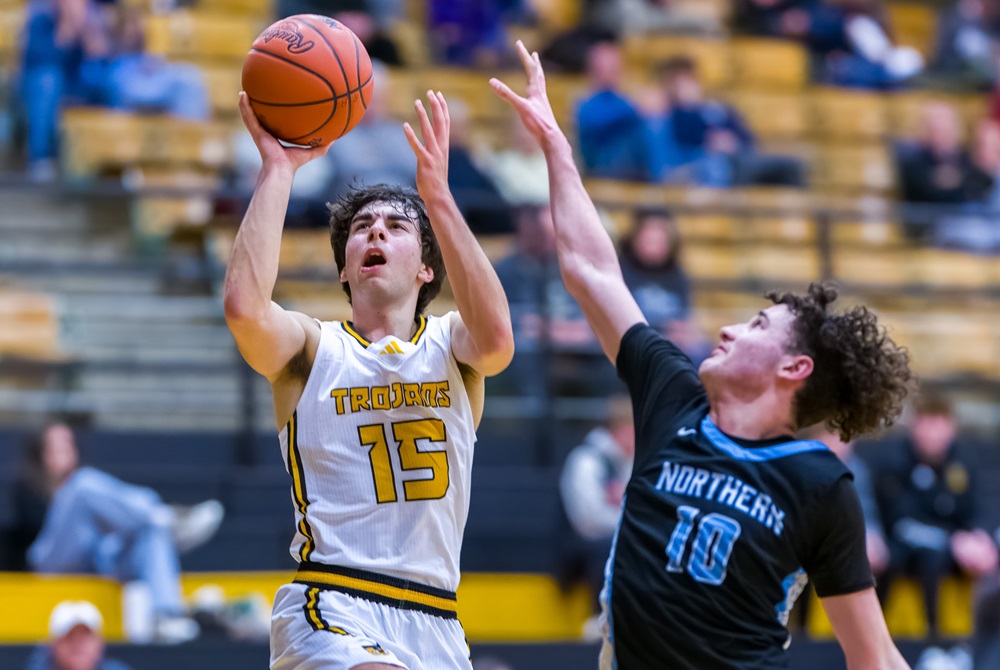
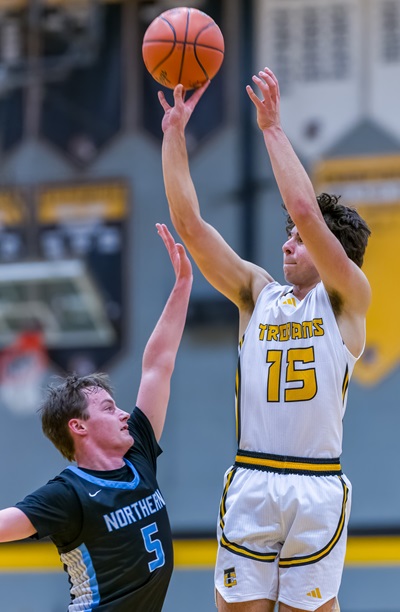
PHOTOS (Top) Traverse City Central’s Anthony Ribel, left, gets to the basket during his first game this season, against Grand Rapids Forest Hills Northern on Jan. 2. (Middle) Ribel elevates for a jumper. (Photos by Rick Sack, TC Rick Photo.)