


Consortium Closes In on Fantastic Finish
March 20, 2014
By Geoff Kimmerly
Second Half editor
EAST LANSING – The memory of coach Al Anderson is not far from Detroit Consortium as it attempts to win its first MHSAA boys basketball championship this weekend.
The Cougars just missed making it to Breslin Center in 2013, falling to eventual Class C champion Flint Beecher by two in their Quarterfinal. But Consortium is now one more win from finishing the quest it began when Anderson died unexpectedly last February.
Three players scored 18 or more points as the Cougars downed Negaunee 69-54 in Thursday’s Semifinal to advance to Saturday’s 4:30 p.m. championship game against Pewamo-Westphalia.
Consortium, ranked No. 2 at the end of the regular season, has now beaten the rest of the top three this week, having downed top-ranked Mount Clemens on Tuesday before eliminating the No. 3 Miners.
“We knew we had to win for (Anderson last year). We came back playing harder, with more intensity, just playing as a team,” Consortium senior Ronald Booth said. “We were heart-broken last year not getting it done. But we’re here this year, and we plan on finishing it.”
“We’ve been fighting for this state championship for the last four years,” senior Malik Dawson added, “and we’re going to win it.”
Although Consortium (24-2) is playing in its first MHSAA Final on Saturday, the Semifinal was its second in four seasons and followed its third Quarterfinal over the last four years.
Former Deaborn Edsel Ford standout Tobias Tuomi took over the Consortium program this winter and inherited not only arguably the state’s best player – 6-foot-8 sophomore wing Joshua Jackson – but a group of scorers around him that have made the Cougars even tougher to stop.
 Jackson had 18 points, seven rebounds, four assists and five steals Thursday. But sophomore guard Luster Johnson added 20 points and senior Rudy Smith scored a game-high 22 points with five rebounds, three assists and three steals.
“We needed to really keep the other guys down. You look at Rudy Smith, Luster Johnson, that killed us,” Negaunee coach Michael O’Donnell said. “We needed to keep everybody else (but Jackson) under 10. When they got up to 20 plus, that was a big hurt for us.”
Consortium led only 12-11 after the first quarter. But the Cougars turned that lead into nine points halfway through the second quarter and 14 by halftime.
They shot 54 percent from the floor for the game, with an incredible 65 percent success rate during the second half.
It matched with what Consortium has done all season. Booth, Smith and Johnson also average at least 10 points per game, and eight players have had high games of at least that many points.
“We’ve had six or seven guys all year, pretty consistently,” Tuomi said of his team’s scoring balance. “Josh will be up there as one of our leading scorers, but we’ve got seven or eight really talented guys, and all of them have had a game where they’ve been the leading or second-leading scorers. It’s something you expect.”
Negaunee (24-2) has been a picture of consistency as well over the last four seasons, making the Quarterfinals at the end of all of them and the Semifinals the last two.
Senior guard Tyler Jandron was a constant on those teams and finished his four-year varsity career with 12 points. Senior Eric Lori, another top scorer on the last couple Miners teams, had 11 points. Sophomore forward Jay Lori led with 14 points and seven rebounds.
“We started something. Just getting here, making it twice, is unbelievable,” Jandron said. “But it’s tough losing this. I want to push myself to the limit, and tonight we came up short.
“We talked to our underclassmen about what these seniors did for us, and we’re going to miss them,” O’Donnell added. “At the same time, we wanted to take the time to thank them and make sure they understand we appreciate what they did for us.”
Click for the full box score and video from the press conference.
PHOTO: (Top) Detroit Consortium’s Joshua Jackson (11) dunks as Negaunee’s Robert Loy gives chase Thursday. (Middle) Negaunee's Tyler Jandron looks for an opening while defended by Consortium's Rudy Smith.
HIGHLIGHTS: (1) Joshua Jackson blocks the shot, Detroit Consortium goes on the fast break and Kenneth Turner lobs to Jackson for the dunk to finish the play late in the first half. (2) Jay Lori of Negaunee takes a pass from Zane Radloff and powers to the basket for two to pull the Miners to within a point at the end of the first quarter.
Breslin Bound: Boys Report Week 6
January 15, 2013
By Geoff Kimmerly
Second Half editor
Undefeated teams quickly are becoming few as boys basketball season heads into mid-January.
But this week's list of teams making noise includes a handful that remain perfect – although a few more will face their toughest challenges soon.
Records and scores below are based on those submitted to the MHSAA.com Score Center.
1. New Haven (6-0) – Coming off 21 wins last season, the Rockets had high expectations – and made great on a good start with a 101-98 double-overtime win over Mount Clemens on Friday; Mount Clemens hadn’t lost.
2. Detroit Pershing (9-0) – The Doughboys just keep proving their status as Detroit's best, downing Detroit Martin Luther King 78-64 and then Detroit Douglass 73-67 in overtime last week.
3. Stevensville Lakeshore (7-0) – A Class B Semifinalist a year ago, Lakeshore is surging again with only one win by fewer than 11 points this season – and that was against South Bend St. Joseph of Indiana.
4. Holt (10-1) – The Rams further cemented themselves as the class of Greater Lansing this season by beating reigning Class B champion Lansing Sexton 50-46 on Friday.
5. Frankenmuth (8-0) – This week’s “Battle of the Fans” contestant will need all the support against rival and top Tri-Valley Conference East competitor Bridgeport on Friday, but the Eagles survived a 50-46 win over Essexville Garber a week ago.
6. Climax-Scotts (8-0) – The Panthers got their first test this season in a 51-42 win over Bellevue on Friday, but no other opponent has come within 14 points.
7. Muskegon Western Michigan Christian (7-3) – After opening 1-3, the Warriors have won six straight and handed Spring Lake its first loss, 49-47, on Saturday.
8. Ithaca (7-0) – The Yellowjackets know how to play football, but they’ve long had a strong hoops program as well and have an early lead in the TVC West.
9. Lake Linden-Hubbell (7-0) – The Lakes had to survive overtime against Hancock and then three more against Calumet in December, but have won four straight by at least 18 points.
10. DeWitt (6-2) – A relative newcomer to Class A, the Panthers shocked the local competition with a 56-54 win last week over Okemos, and also own a five-point victory over improved Grand Ledge.
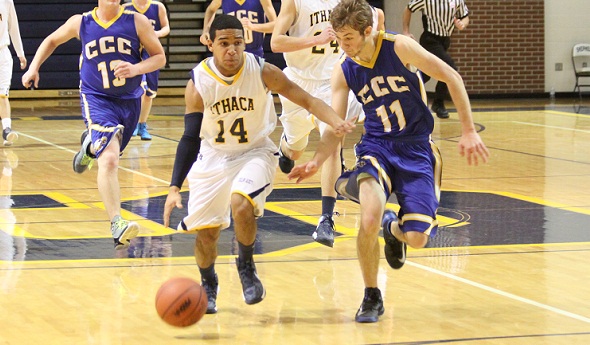
PHOTO: Ithaca's Markes Gadlen (14) pushes the ball upcourt against Carson City-Crystal this season. (Click to see more at HighSchoolSportsScene.com.)