


Consortium Proves To Be Best in Class C
March 22, 2014
By Geoff Kimmerly
Second Half editor
EAST LANSING – Detroit Consortium’s boys basketball team fell in a 2011 Semifinal to eventual Class C champion Schoolcraft. A year later, the Cougars’ season ended with a two-point Regional Final loss to eventual title winner Flint Beecher.
Joshua Jackson was watching – but couldn’t help. He was still in junior high.
But the now-sophomore decided then that when he was old enough, he’d play a part in the Cougars' first MHSAA title.
Consortium entered this postseason ranked No. 2 in the final Class C poll. With the 6-foot-8 Jackson leading and surrounded by a talented a cast, the Cougars eliminated No. 1 Mount Clements and No. 3 Negaunee this week and finished with a 61-44 championship game win over No. 10 Pewamo-Westphalia on Saturday at the Breslin Center.
“Playing with most of the guys last year, I always had trust in them,” Jackson said. “I just had something to prove, and they wanted to win just like I did.
“To prove so many people wrong, I know maybe one person picked us to win (over Mount Clemens). I guess they thought overall their team was better than ours. (But) I think we’ve proved people wrong all year winning big games.”
Consortium beat some of the best in finishing 25-2 this winter.
The Cougars also defeated No. 5 Detriot Allen in their Regional Final, plus ranked Class A Saginaw Arthur Hill, Romulus and Detroit Southeastern, ranked Class B Detroit Country Day and Detroit Douglass, an MHSAA semifinalist in that class.
And that’s some of what coach Tobias Tuomi reminded his players when Consortium led Pewamo-Westphalia only 27-25 in the championship game.
 “We just said to cherish the moment. I told them to appreciate all the work, and it is a heck of an opportunity just to be here,” Tuomi said. “But we didn’t come here to be here. We came to win a state championship. To do that, we’d have to do all the little things we do in practice, things that won us games all season.”
P-W (23-3) was doing them to keep pace during the first half and up until taking a 34-32 lead three minutes into the third quarter. Despite trailing by 11 at the end of the first period, the Pirates drew even heading into the final minute of the first half before senior guard Rudy Smith hit a go-ahead basket to give Consortium the two-point lead at the break.
But after senior Evan Fedewa’s 3-pointer gave the Pirates that third-quarter advantage, Consortium outscored them 19-3 to take a 51-37 lead with 6:50 to play.
Consortium’s defense tightened and P-W’s shooting percentage fell – from 43 percent from the floor during the first half to 32 percent in the second. Meanwhile, the Cougars upped their offensive output, improving from 42 percent from the floor to 63 over the final two quarters. Senior guard Ronald Booth, in particular, scored 12 of his 14 points during the second half to finish as one of three Consortium players in double figures.
“We just dug down, got a little more focused,” Tuomi said. “Definitely, (P-W was) taking a lot tougher shots.”
Smith also finished with 14 points for Consortium. Jackson led with 22 points on 9 of 13 shooting – including hitting all three of his 3-point attempts, and also grabbed 13 rebounds.
“For the old guys like me, I saw Earvin Johnson play here at (Lansing) Everett, and I had season tickets when he was (at Michigan State). He’s a similar type of player to him,” P-W coach Luke Pohl said of Jackson. “Whether he’s going to become that kind of player is another story, but he’s really talented. He might be the most talented person our teams have played against. He can see the court real well, passes well … and he’s a really humble kid.”
Senior center Lane Simon scored a game-high 23 points and grabbed seven rebounds for P-W, and senior guard Nick Spitzley finished a four-year varsity career with 10 points and three assists.
They and nine seniors total brought the Pirates to their first championship game since 1993. Pohl – who graduated from P-W in 1976 and has coached over two tenures since 1995 – called this the best team in school history. It definitely highlighted the Pirates a little more prominently on the statewide basketball map.
“Obviously I wanted to achieve the state championship,” Simon said. “But it feels like we got a lot of respect back."
Consortium did make the Quarterfinals with Jackson last season, again falling by two to Beecher as the Buccaneers went on to repeat as champions. But that was impressive in itself – the Cougars continued on although coach Al Anderson died unexpectedly that February.
The run also set the stage for things to come.
“We wanted to sit and sob and cry about it, but at the end of the day we knew that what he wanted was for us to win a state championship more than anything,” Jackson said. “So we knew that was something that we had to do.”
Click for a full box score and video from the press conference.
PHOTOS: (Top) Detroit Consortium’s Rudy Smith pushes down the floor as Pewamo-Westphalia’s Nick Spitzley gives chase during the Class C Final. (Middle) The Pirates’ Lane Simon goes strong to the basket for two of his game-high 23 points.
HIGHLIGHTS: (1) Joshua Jackson follows a miss with a big dunk for Detroit Consortium in the fourth quarter of its Class C championship game against Pewamo-Westphalia. Jackson finished with 22 points and 13 rebounds in leading his team to the win. (2) Some nice passing by Pewamo-Westphalia sets up Evan Fedewa for a 3-pointer to give the Pirates a 34-32 lead in the third quarter against Detroit Consortium in the Class C title game.
Breslin Bound: Boys Report Week 8
January 28, 2013
By Geoff Kimmerly
Second Half editor
Eight weeks of success is enough to expect that any team still undefeated – like our top team among last week's high performers – should keep making noise over the month and a half to come.
But there's something to be said about starting anew on Jan. 1. And we've got a few on this week's list as well that have surged since the calendar year got a new start.
Remember, results and overall records below are those listed in our MHSAA Score Center. Are either incorrect? Please help us out after filling in this brief registration.
1. Big Rapids (11-0) – The Cardinals have won 20 straight regular-season games dating back to the mid-point of last winter and lead the Central State Activities Association.
2. Rochester Adams (10-1) – The Highlanders’ lone loss came against Oxford all the way back on Dec. 14; they’ve won four straight by double figures and are just two wins from equaling last season’s total.
3. Zeeland East (10-2) – The Chix are in first place by a win over two others in the O-K Black and have won four straight including beating league favorite Muskegon 67-61 on Friday.
4. Allen Park Inter-City Baptist (10-2) – Before Saturday’s 14-point loss to Detroit Country Day, the Chargers had won three straight and earlier this month edged reigning Class D champion Southfield Christian by a point.
5. Lansing Waverly (9-2) – The Warriors opened this season with losses to Holt and Jackson Lumen Christi by a combined five points, but since have won nine straight including avenging that loss to the Titans on Friday.
6. Bessemer (10-1) – The Speedboys are undefeated in-state, with their only loss to Washburn, Wis., after winning 10 games total last season.
7. Crystal Falls Forest Park (6-3) – The Trojans opened this winter with two losses, but are on a roll and edged 2012 Class D Semifinalist Carney-Nadeau on Friday, 70-67.
8. Pittsford (9-2) – The Wildcats hit a rough patch from Jan. 11-15, when they lost two games; otherwise, they’re undefeated this season.
9. Temperance Bedford (8-1) – Despite losing to Sylvania Southview of Ohio on Saturday, the Kicking Mules opened with eight straight wins and beat Ann Arbor Pioneer 56-54 the night before.
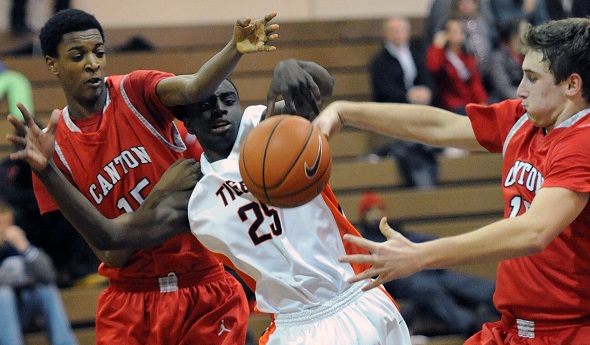
10. Canton (7-5) – The Chiefs also are running well in January with five straight wins including Friday’s 55-50 victory over Westland John Glenn which avenged their last lost before the run, 53-48 to John Glenn on Jan. 4.
PHOTO: Canton players (in red) try to gather a loose ball during a game against Cincinnati Withrow on Dec. 28 at Detroit County Day. (Click to see more at HighSchoolSportsScene.com.)