

D1 Preview: Contenders' Stories Told Through Tough Tourney Roads
By
Geoff Kimmerly
MHSAA.com senior editor
March 23, 2022
The final four teams playing in this weekend’s Division 1 boys basketball bracket at Breslin Center have certainly earned the memorable opportunity ahead.
The Detroit Catholic League Central saw all five of its teams finishing among the top six in Division 1 Michigan Power Ratings (MPR) – and No. 6 Warren De La Salle Collegiate has outlasted the rest. The I-75 corridor as always was impressive this winter – and reigning champion Grand Blanc is back.
Grand Rapids Northview has become one of the stories of the season as it’s emerged from a growing number of annual Division 1 contenders from the west side of the Lower Peninsula. And Belleville could become the headliner this weekend after emerging from a bracket that originally included the best from the Detroit Public School League and the southeastern part of the state.
DIVISON 1 Semifinals – Thursday
Warren De La Salle Collegiate (18-7) vs. Grand Rapids Northview (25-1), noon
Grand Blanc (20-5) vs. Belleville (19-6), 2 p.m.
FINAL – Saturday – 12:15 p.m.
Tickets for this weekend’s games are $12 for both Semifinals and Finals and are available via the Breslin Center ticket office. All Semifinals will be broadcast and viewable with subscription to MHSAA.tv, and all four Finals will air live Saturday on Bally Sports Detroit, with the Division 4 and 1 games on BSD EXTRA and the Division 3 and 2 games on BSD’s primary channel. All four will be broadcast live as well as on the BSD website and app. Audio broadcasts of all Semifinals and Finals will be available free of charge from the MHSAA Network.
Here’s a look at the four Division 1 semifinals (with rankings by MPR at the end of the regular season, and statistics through Regional Finals):
BELLEVILLE
Record/rank: 19-6, No. 44
League finish: First in Kensington Lakes Activities Association East
Coach: Adam Trumpour, ninth season (148-52)
Championship history: Class A runner-up 1998.
Best wins: 47-45 over No. 10 Detroit Cass Tech in Quarterfinal, 59-48 over Romulus in Regional Final, 50-47 (OT) over Ann Arbor Skyline in Regional Semifinal, 38-37, 62-45 and 63-43 over Dearborn.
Players to watch: Da’Jon Johnson, 5-10 sr. G (12.1 ppg, 3.0 apg); Mario Johnson, 6-4 sr. G (10 ppg, 5.0 rpg, 3.8 apg); Bryce Radtka, 6-8 sr. C (10.6 ppg, 8.0 rpg).
Outlook: The Tigers are headed back to the Semifinals for the first time since 2002, having won nine of their last 10 games and with five of their losses by a combined 11 points. Four seniors start, joined by sophomore guard Jalen Jenkins, another contributor to the balanced attack with 10 points per game. Trumpour, who assisted on the staff that guided Romulus to the 2013 Class A title, has led Belleville to District titles four of the last six seasons (not including COVID-abbreviated 2019-20) and also brought the Tigers to the Quarterfinals in 2017-18.
GRAND BLANC
Record/rank: 20-5, No. 8
League finish: First in Saginaw Valley League
Coach: Mike Thomas, fifth season (88-22)
Championship history: Division 1 champion 2021, Class B runner-up 1952.
Best wins: 67-60 over No. 4 Detroit Catholic Central in Quarterfinal, 65-58 (Regional Semifinal) and 64-63 over Flint Carman-Ainsworth, 80-62 over No. 20 River Rouge, 70-66 (OT) over Division 2 No. 4 Ferndale, 68-57 over Division 3 No. 2 Flint Beecher.
Players to watch: RJ Taylor, 6-0 jr. G (16.8 ppg, 51 3-pointers, 4.3 apg); Amont’e Allen-Johnson, 6-1 jr. G (13.5 ppg, 5.3 rpg, 3.2 apg); Tae Boyd, 6-3 jr. G (13.3 ppg, 6.9 rpg).
Outlook: The reigning Division 1 champ kicked off this season against some of the best teams in the state, and started 1-3 – but after catching their stride, the Bobcats have been nearly unbeatable. Grand Blanc is up to 18 wins over its last 19 games, and the defeats have no doubt been beneficial to this run too coming against Bloomfield Hills Brother Rice, Grand Rapids Catholic Central, Orchard Lake St. Mary’s, Detroit Martin Luther King and Muskegon. Something else to keep in mind: No seniors start, and eight of the team’s top nine rotation players should be back next season. Taylor made the all-state first team in 2021.
GRAND RAPIDS NORTHVIEW
Record/rank: 25-1, No. 24
League finish: First in Ottawa-Kent Conference White
Coach: David Chana, third season (47-15)
Championship history: Has never played in an MHSAA Final.
Best wins: 54-52 over Kalamazoo Central in Quarterfinal, 68-55 over No. 9 Muskegon in Regional Semifinal, 71-48 over No. 17 Rockford in District Final, 68-64 (OT) over No. 5 Bloomfield Hills Brother Rice, 64-51 over Grand Rapids Christian.
Players to watch: Kyler Vanderjagt, 6-4 sr. G (22.4 ppg, 4.6 rpg); Jalen Charity, 6-6 sr. G (13 ppg, 6.0 rpg); EJ Ryans, 6-3 soph. G (10.4 ppg, 3.3 apg).
Outlook: Northview’s buzzer-beating win over Kalamazoo Central on Tuesday added to the excitement of a run that’s landed the Wildcats in their first Semifinal since 1990. Aside from an eight-point loss to Grand Rapids Christian at the start of February, Northview is undefeated and has pulled out four victories by five points or fewer. Vanderjagt made the all-state first team last season when Northview finished 8-6, and he’s nearly equaled his scoring average from last year this winter; he will continue his career at Belmont in Tennessee. Senior guard Grant George adds 7.7 points per game off the bench.
WARREN DE LA SALLE COLLEGIATE
Record/rank: 18-7, No. 6
League finish: Fourth in the Detroit Catholic League Central
Coach: Gjon Djokaj, second season (31-11)
Championship history: Class B runner-up 1982.
Best wins: 50-48 over No. 2 Orchard Lake St. Mary’s in Quarterfinal, 68-33 over No. 11 Canton, 49-46 over No. 1 Detroit U-D Jesuit, 59-54 over No. 5 Bloomfield Hills Brother Rice, 73-51 over No. 4 Detroit Catholic Central, 91-49 over Detroit Western, 57-44 over Coldwater, 76-69 (2OT) over Division 2 No. 4 Ferndale.
Players to watch: Tamario Adley, 6-3 sr. G (11.3 ppg, 5.0 rpg); Michael Sulaka, 6-8 jr. F (10.5 ppg, 6.5 rpg); Nino Smith, 6-0 jr. G (10 ppg, 4.3 apg).
Outlook: With Tuesday’s win over St. Mary’s, De La Salle had earned a victory this season over every other highly-ranked Catholic League Central team. Defeating the Eaglets sent the Pilots back to the Semifinals for the second season in a row and third time in four seasons (not counting COVID-abbreviated 2020). Six players average at least eight points per game, and five had made 16 or more 3-pointers entering the week. Four starters are back from last season’s Semifinal team that lost 55-39 to Ann Arbor Huron, and three starters plus top-scoring sub freshman Pheonix Glassnor (8.0 ppg) should return next winter as well. Junior Triston Nichols (8.8 ppg) and senior Caleb Reese (8.0 ppg, 4.1 apg) also start.
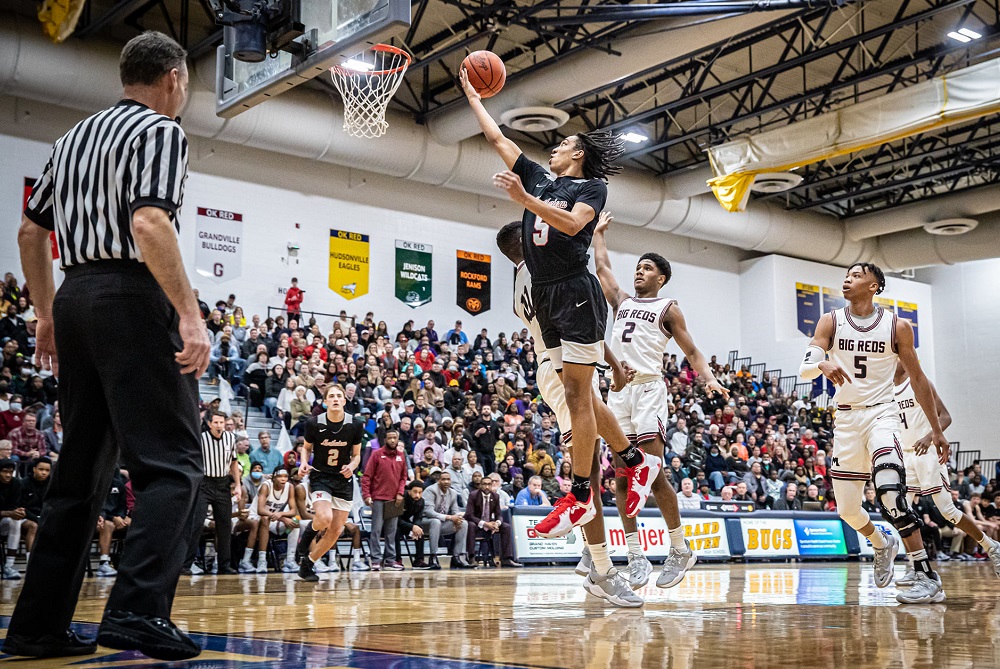
PHOTO Grand Rapids Northview’s EJ Ryans (5) lays up a shot during his team’s Regional Semifinal win over Muskegon. (Photo by Tim Reilly.)
Breslin Bound: Boys Report Week 7
January 22, 2013
By Geoff Kimmerly
Second Half editor
The fireworks flew in Michigan boys basketball last week, as three Associated Press top-ranked teams fell, albeit against others considered contenders as well.
With boys basketball season now at its midpoint, it's fair to say doors remain open for more potential contenders to step in. See this week's list of high performers for some that could be in the mix.
1. Detroit Cass Tech (10-1) – The two-time reigning football champ has owned the basketball court too since falling in December to Harper Woods Chandler Park.
2. East Kentwood (10-0) – The Falcons won 17 games two years ago and 18 last season, and will make a run next month to improve on those totals again.
3. Detroit Consortium (6-2) – Consortium is looking to be in the Class C mix and looks good to contend after knocking off Class B giant Detroit Country Day last week 68-62.
4. Wyoming Godwin Heights (9-0) – On top of being considered arguably the top team in Class B, Godwin Heights gave Class D power Wyoming Tri-unity Christian its first loss, 60-58 last week.
5. Detroit Pershing (12-0) – Pershing was here last week too, but it’s hard to not include the Doughboys again after they beat Detroit Southeastern 63-54 and handed Flint Beecher its only loss, 56-53.
6. Munising (6-1) – Since opening with a loss to Gwinn, Munising hasn’t fallen and beat 2012 Class D Semifinalist Carney-Nadeau last week 40-37; C-N knocked Munising out in the Regional Final last season.
7. Frankfort (8-0) – Just 11-12 last season, Frankfort is only a few wins from besting that mark and looks good to accomplish much more.
8. Jackson Lumen Christi (8-0) – The Titans often have contended but rarely been favored during their decade in the Capital Area Activities Conference; they are the team to beat in the CAAC Gold this time.
9. Warren Woods-Tower (7-2) – After opening 1-2, the Titans have won six straight including a big win over previously-surging New Haven, 58-54 last week.
10. Beal City (6-3) – The Aggies have won four straight after a little bit of a delayed start due to a Ford Field football run; last week’s 62-61 win over Leroy Pine River was the best win so far.
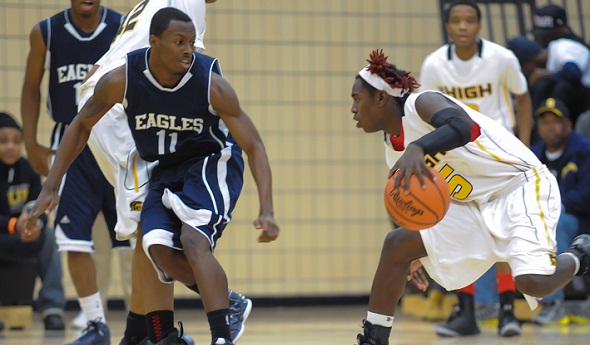
PHOTO: Saginaw (white jerseys) improved to 14-1 on Saturday with an 86-61 win over Harper Woods Chandler Park. (Click to see more at HighSchoolSportsScene.com.)