

D3 Preview: Challengers Lined Up as Beecher Seeks to Complete Repeat Run
By
Geoff Kimmerly
MHSAA.com senior editor
March 23, 2022
Flint Beecher is one of three 2021 champions returning to the Boys Basketball Finals this weekend, and the Bucs are among the most frequent visitors to Breslin Center with Thursday’s to be their eighth Semifinal appearance over the last 13 years.
That’s a pretty imposing opener for describing any bracket. But this one could be especially loaded with Schoolcraft also making a return trip and Menominee and Ecorse showing strong credentials all season long.
DIVISON 3 Semifinals – Thursday
Menominee (22-3) vs. Ecorse (9-12), Noon
Schoolcraft (23-2) vs. Flint Beecher (22-2), 2 p.m.
FINAL – Saturday – 4:30 p.m.
Tickets for this weekend’s games are $12 for both Semifinals and Finals and are available via the Breslin Center ticket office. All Semifinals will be broadcast and viewable with subscription to MHSAA.tv, and all four Finals will air live Saturday on Bally Sports Detroit, with the Division 4 and 1 games on BSD EXTRA and the Division 3 and 2 games on BSD’s primary channel. All four will be broadcast live as well as on the BSD website and app. Audio broadcasts of all Semifinals and Finals will be available free of charge from the MHSAA Network.
Here’s a look at the four Division 3 semifinals (with rankings by MPR at the end of the regular season, and statistics through Regional Finals):
ECORSE
Record/rank: 9-12, No. 148
League finish: Fourth in Michigan Metro Athletic Conference Black
Coach: Gerrod Abram, third season (39-20)
Championship history: Class B runner-up 1978, Class B Lower Peninsula runner-up 1942.
Best wins: 49-47 over Erie Mason in Regional Final, 73-71 over Riverview Gabriel Richard in District Semifinal.
Players to watch: Malik Olafioye, 6-2 jr. G; Kenneth Morrast Jr., 6-1 jr. G. (Statistics not provided.)
Outlook: Ecorse is headed to the Semifinals for the first time since 1980. It’s important to note the team’s MPR would have been much higher without 10 forfeits over the first two months of the regular season; the Raiders instead would be 16-5. And they’ve appeared to be Division 3 contenders from the start, with since-forfeited wins over Division 1 Brownstown Woodhaven (19-5) and Division 2 River Rouge (17-4). The District win over Gabriel Richard was the Pioneers’ only loss of the season. This group should continue to be strong; only one senior starts and there are only two seniors total on a roster that includes four sophomores and a freshman.
FLINT BEECHER
Record/rank: 22-2, No. 2
League finish: First in Genesee Area Conference Red
Coach: Marquise Gray, first season (22-2)
Championship history: Nine MHSAA titles (most recent 2021), four runner-up finishes.
Best wins: 72-41 over No. 5 Reese in District Final, 84-68 over Division 2 No. 12 Pontiac Notre Dame Prep, 75-69 over Division 2 No. 6 Grand Rapids Catholic Central, 63-60 over Flint Carman-Ainsworth.
Players to watch: Carmelo Harris, 6-0 sr. G; James Cummings II, 6-3 sr. F. (Statistics not provided.)
Outlook: The Bucs returned to win last season’s championship, their first since 2017, and have lost only to Division 1 Grand Blanc (20-5) and Detroit Martin Luther King (19-3) this winter while handing reigning Division 2 champion Grand Rapids Catholic Central (24-1) its lone defeat. Gray memorably starred at Beecher and Michigan State and played overseas before returning and serving as an assistant coach in advance of taking over the program. Harris and Cummings started on last season’s team, and 6-3 junior Robert Lee II was the only sub who saw more than two minutes of time in last year’s Final. Harris also is a returning all-state first-teamer.
MENOMINEE
Record/rank: 22-3, No. 1
League finish: First in Great Northern Conference
Coach: Sam Larson, fifth season (48-51)
Championship history: Class B champion 1967
Best wins: 60-56 (2OT) over No. 19 Benzie Central in Regional Final, 74-57 over Ishpeming Westwood in Regional Semifinal, 83-45 over Iron Mountain in District Final, 77-44 and 65-62 over Division 2 No. 1 Escanaba, 51-26 and 72-40 over Division 4 No. 4 Powers North Central.
Players to watch: Aidan Bellisle, 6-2 sr. G (15.4 ppg, 4.8 apg); Cooper Conway, 6-4 sr. F (12.6 ppg, 7.0 rpg); Brady Schultz, 6-6 sr. F (12 ppg, 6.2 rpg, 1.6 bpg).
Outlook: The Maroons have improved from 4-17 just three seasons ago to making the Semifinals for the first time since 2008. The only two in-state losses this winter came over the last five weeks, to Escanaba in the teams’ third meeting of the season (after Menominee won the first two, and by a point to Division 4 semifinalist Ewen-Trout Creek. Five seniors start, with three sophomores playing the most prominent roles off the bench. Larson was a sophomore on the 2008 team that lost to Lansing Catholic in Class B at Breslin.
SCHOOLCRAFT
Record/rank: 23-2, No. 6
League finish: First in Southwestern Athletic Conference Valley
Coach: Randy Small, 17th season (329-67)
Championship history: Class C champion 2011, runner-up 2009.
Best wins: 60-57 (Quarterfinal) and 61-32 over No. 17 Pewamo-Westphalia, 45-31 over No. 14 Watervliet in Regional Final, 59-31 (District Final), 51-40 and 54-41 over No. 18 Kalamazoo Christian, 49-45 over Division 2 No. 5 Parchment.
Players to watch: Tyler DeGroote, 6-7 sr. F (16.3 ppg, 10.2 rpg); Shane Rykse, 6-3 soph. G (13.1 ppg, 53 3-pointers); Ty Rykse, 6-7 sr. F (12.5 ppg, 7.9 rpg, 4.3 apg).
Outlook: Schoolcraft is making a repeat appearance at Breslin and fell by just four in overtime in last season’s Semifinal against Iron Mountain. The Golden Eagles are a combined 63-4 over the last three seasons. DeGroote and Shane Rykse were main contributors last season as well – DeGroote earned an all-state honorable mention – and Ty Rykse also started in the Semifinal. The defeats this season came to Division 1 Hudsonville and Parchment, and Schoolcraft avenged the latter. Senior point guard Asher Puhalski adds another 7.2 points, four rebounds and 3.6 assists per game.
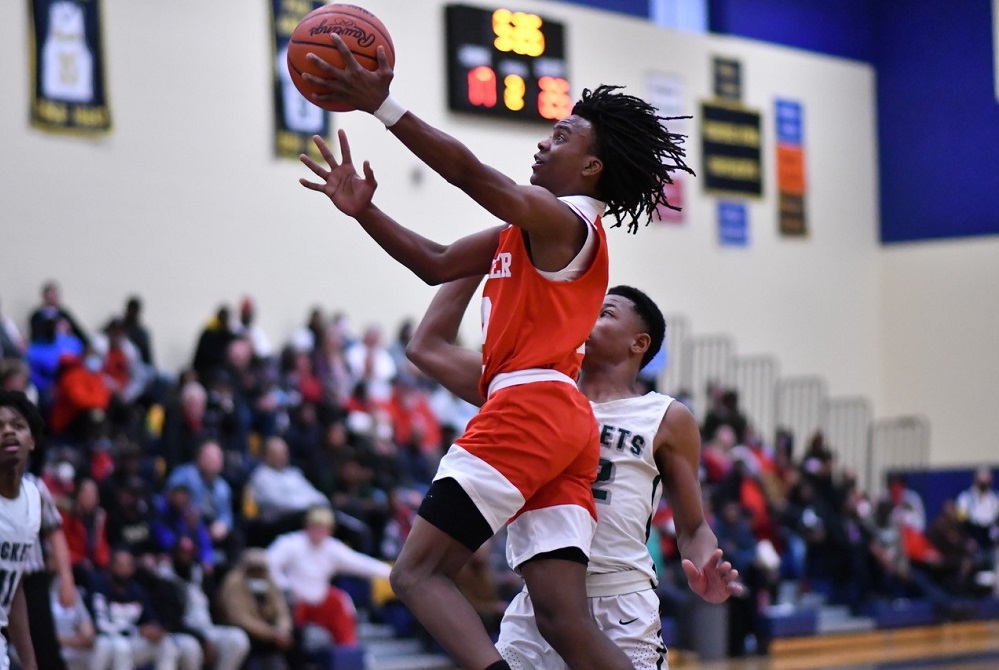
PHOTO Flint Beecher’s Keyonta Menifield goes to the basket during Tuesday’s Quarterfinal win over New Haven. (Photo by Terry Lyons.)
Breslin Bound: Boys Report Week 8
January 28, 2013
By Geoff Kimmerly
Second Half editor
Eight weeks of success is enough to expect that any team still undefeated – like our top team among last week's high performers – should keep making noise over the month and a half to come.
But there's something to be said about starting anew on Jan. 1. And we've got a few on this week's list as well that have surged since the calendar year got a new start.
Remember, results and overall records below are those listed in our MHSAA Score Center. Are either incorrect? Please help us out after filling in this brief registration.
1. Big Rapids (11-0) – The Cardinals have won 20 straight regular-season games dating back to the mid-point of last winter and lead the Central State Activities Association.
2. Rochester Adams (10-1) – The Highlanders’ lone loss came against Oxford all the way back on Dec. 14; they’ve won four straight by double figures and are just two wins from equaling last season’s total.
3. Zeeland East (10-2) – The Chix are in first place by a win over two others in the O-K Black and have won four straight including beating league favorite Muskegon 67-61 on Friday.
4. Allen Park Inter-City Baptist (10-2) – Before Saturday’s 14-point loss to Detroit Country Day, the Chargers had won three straight and earlier this month edged reigning Class D champion Southfield Christian by a point.
5. Lansing Waverly (9-2) – The Warriors opened this season with losses to Holt and Jackson Lumen Christi by a combined five points, but since have won nine straight including avenging that loss to the Titans on Friday.
6. Bessemer (10-1) – The Speedboys are undefeated in-state, with their only loss to Washburn, Wis., after winning 10 games total last season.
7. Crystal Falls Forest Park (6-3) – The Trojans opened this winter with two losses, but are on a roll and edged 2012 Class D Semifinalist Carney-Nadeau on Friday, 70-67.
8. Pittsford (9-2) – The Wildcats hit a rough patch from Jan. 11-15, when they lost two games; otherwise, they’re undefeated this season.
9. Temperance Bedford (8-1) – Despite losing to Sylvania Southview of Ohio on Saturday, the Kicking Mules opened with eight straight wins and beat Ann Arbor Pioneer 56-54 the night before.
10. Canton (7-5) – The Chiefs also are running well in January with five straight wins including Friday’s 55-50 victory over Westland John Glenn which avenged their last lost before the run, 53-48 to John Glenn on Jan. 4.
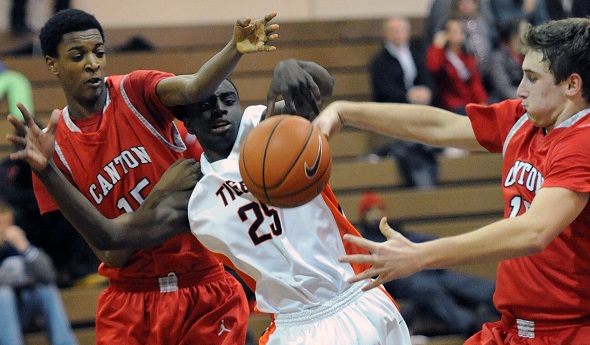
PHOTO: Canton players (in red) try to gather a loose ball during a game against Cincinnati Withrow on Dec. 28 at Detroit County Day. (Click to see more at HighSchoolSportsScene.com.)