

D4 Eagles Regain Championship Stride
March 16, 2019
By Geoff Kimmerly
Second Half editor
EAST LANSING – Southfield Christian began this winter minus two starters who left the program for other schools and with just two wins in its first seven games.
In early January, the Eagles faced a decision to guide the rest of their season.
“Our conversation repeatedly after a couple of those games was we’ve gotta choose if we’re either going to be great, of if you’re going to be OK and we’re going to be OK with being .500 and just being average,” Southfield Christian coach Josh Baker recalled Saturday. “Beat some teams, and lose to some better teams and call it a season.
“What are we going to do here? So as a team, we just collectively decided we were going to put in more work, and we were going to put in more time and … we’re just going to give extra effort. That’s the only thing we know how to do.”
Once again, Southfield Christian figured out the rest. The Eagles finished 19-1 after that opening stretch and finished Saturday as a repeat MHSAA champion with a 63-39 win over Frankfort in the Division 4 championship game at Michigan State University’s Breslin Center.
The title was Southfield Christian’s fifth this decade. In addition to last season’s, the Eagles also won Class D in 2012, 2013 and 2014.
The team’s only loss since Jan. 5 came to River Rouge, an eventual Division 2 finalist.
“This is very sweet. I’m not going to lie to you,” Eagles junior guard Da’Jion Humphrey said. “We worked hard – me, Jon (Sanders), everyone on the team, we put in countless hours. And as you can see, it pays off. Southfield Christian basketball is still here, and we’re still thriving.”
Humphrey and Sanders, a senior guard, were returning starters from last season’s team. They took on bigger roles as Harlond Beverly – the leading scorer in last year’s Class D Final – left for a prep school, and Caleb Hunter transferred to Detroit U-D Jesuit.
 On Saturday, Humphrey led with 20 points, five assists and five rebounds, and Sanders had 19 points. Junior guard Noah Rheker added 10 points.
The Eagles jumped out to a 13-2 lead over the first 3½ minutes, and pushed the advantage to 24-12 by the end of the first quarter despite Frankfort making 63 percent of its shots from the floor during the period. The Panthers’ problem was they struggled to get many off, with eight of their 16 turnovers also coming over the first eight minutes.
Rheker scored Southfield Christian’s final basket of the first quarter and five more points during the first six minutes of the second as the Eagles extended their lead to 21.
“I was really trying to bring a spark, because I knew our biggest emphasis was to try to pressure the ball and really get after it,” Rheker said. “So I just really tried to set the tone and let these guys pick it up after me.”
Senior guard Will Newbold led Frankfort with 17 points and seven rebounds. With the game decided in the fourth quarter, the coaches emptied their benches. Panthers’ freshman Blake Miller quickly became a fan favorite during his hustle-filled four minutes – he ended up the team’s second-leading scorer with seven points to go with a pair of steals.
“The moment can kinda get you, but I thought our guys did a good job,” Frankfort first-year head coach Dan Loney said. “They didn’t back down. They played to the end. And as a coach, you couldn’t be happier.
“Look at the crowd out there. You see the kind of community we come from. We’re down 30 and they’re cheering like we’re up. As a coach, I really can’t explain the feeling when you see that. … The future is going to be bright in Frankfort, and we plan on being back here.”
Loney’s team finished 21-6, and the trip to the championship game was made more impressive by the fact the Panthers had graduated all of their starters and a top sub from last season’s 20-3 run.
“The fans and the crowd, it was so much different than back home,” Frankfort senior forward Jack Reznich said. “To be able to see all our fans, come out and see the (U-D) Jesuit school, all of them cheering for us. Just having everybody here, see all the lights and noise, it was a crazy feeling. It was life-changing.”
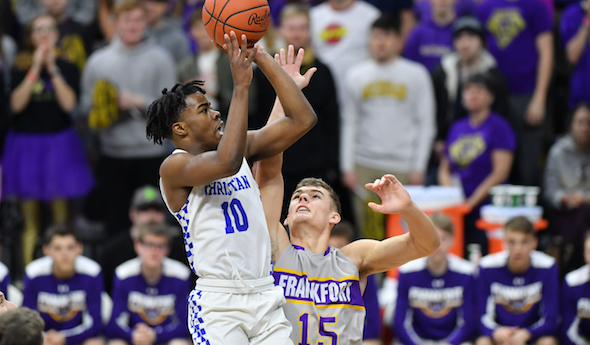
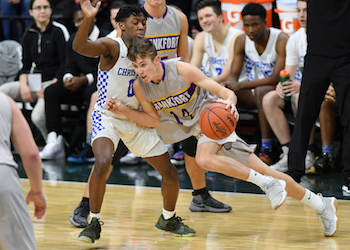
PHOTOS: (Top) Southfield Christian’s Jon Sanders (10) gets a shot up over Frankfort’s Conner Smith during Saturday’s Division 4 Final. (Middle) Will Newbold works to drive past the Eagles’ Rahmon Scruggs.
Clarkston Earns 1st Shot at Dream Finish
March 24, 2017
By Geoff Kimmerly
Second Half editor
EAST LANSING – Dan Fife dreamed of playing for an MHSAA basketball championship at Jenison Field House while a student at Clarkston 50 years ago.
Thursday afternoon, the current Wolves made similar dreams come true – and offered their coach that opportunity he never was able to achieve as a player.
Clarkston’s 78-35 win over league rival West Bloomfield in Friday’s first Class A Semifinal earned the program its first appearance in an MHSAA boys basketball championship game.
The Wolves have had piles of success under Fife, the fourth winningest coach in state hoops history with 676 wins since taking over the program before the 1982-83 season. He’s led Clarkston to 30 District and 12 Regional titles, with Friday’s Semifinal the second during his tenure.
“Coach Fife, I don’t think he’ll admit how much it means to him. But it’s everyone’s goal at the beginning of every season; your ultimate goal is to finish out with a win,” Clarkston junior guard Foster Loyer said. “For Coach Fife, and the community of Clarkston, that would just mean the world to all of us, just motivate us to keep working even more.”
Clarkston (26-1), which entered the postseason tied for No. 3 in The Associated Press’ final regular-season Class A poll, will finish this season against Grand Rapids Christian at noon Saturday at the Breslin Center.
The Semifinal was the third ever in Wolves history. And the rare opportunity to advance to Saturday came with an even rarer opportunity to face a familiar opponent in this late round of the tournament.
Clarkston had beaten West Bloomfield (17-9) by 11 and seven during the regular season on the way to winning the Oakland Activities Association Red championship; the Lakers tied for third in the league.
And they knew what to expect from Loyer, a junior already committed to play at Michigan State. But it didn’t help much this time.
 Loyer’s first shot of the game, an attempted layup, sailed over the rim. His second shot, a 3-pointer, touched nothing but net.
Making 10 of 17 shots from the floor and 5 of 8 3-pointers, Loyer finished with 32 points, to go with seven assists. Senior forward Dylan Alderson added 27 points, and sophomore center Taylor Currie had 10 points and 16 rebounds as Clarkston hit 57 percent of its shots from the floor – including an incredible 69 percent during a first quarter that ended with the Wolves carrying a 24-13 lead.
Clarkston took an 18-point advantage into halftime.
Senior guard Kevin McAdoo led the Lakers with 22 points, but as a team they made only 22 percent of their shots from the floor, and had just one steal as Clarkston had only four turnovers but 17 assists.
“It’s a tough one to swallow today, especially with the ride we were on to get here,” said seventh-year West Bloomfield coach Jeremy Denha. “What a fun, fun time to get here with the ups and downs and the way the kids battled. We hadn’t sniffed a District Final, let alone a District title, since I’d been here – we hadn’t won one since 2003. For us to make this magical run, get to Breslin, play Clarkston a third time … yeah, the outcome is disappointing, but it’s about the journey too.”
Fife has been on a lot of these trips. So he'd likely quickly agree with his OAA colleague. And especially with how this journey has a chance to end for the first time.
“I’m not worried about what it means to me. I have an expectation; I’ve always had one no matter what I’m doing. If I’m playing something, I’m going to compete,” Fife said. “The reality is, I dreamed of playing in the state championship when I was in high school. I wanted to get to Jenison. That was always my dream, and I’m just trying to instill in the kids to have the same dream – to play basketball and get to this point. They’ll remember this day the rest of their lives, and tomorrow’s game, regardless of what happens.”
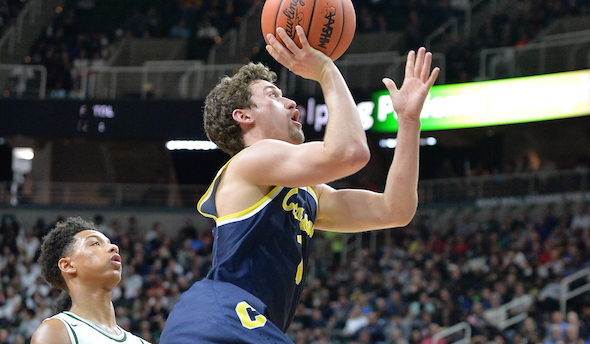
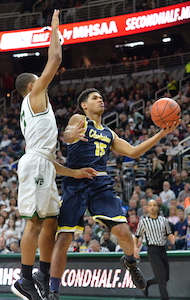
PHOTOS: (Top) Clarkston’s Foster Loyer breaks past West Bloomfield defenders to get a shot up during Friday’s first Class A Semifinal. (Middle) The Wolves’ Tieler Houston (15) gets position on West Bloomfield’s Daniel Wrack.