

D4 Preview: New Era, Familiar Contenders
March 13, 2019
By Geoff Kimmerly
Second Half editor
Division 4 has replaced Class D this year as the boys basketball tournament classification for Michigan’s smallest high schools, and some familiar teams from the previous era will return to the Breslin Center on Thursday to help usher in a new one.
Reigning Class D champion Southfield Christian and Wyoming Tri-unity Christian have won eight MHSAA Finals in this sport between them. Dollar Bay joins Southfield Christian as a returnee from last season, making the Semifinals for the second straight, and Frankfort is making the trip to East Lansing for the second time this decade.
Division 4 Semifinals – Thursday
Dollar Bay (21-4) vs. Southfield Christian (19-6), 5:30 p.m.
Frankfort (20-5) vs. Wyoming Tri-unity Christian (22-3), 7:30 p.m.
Division 4 Final – Saturday, 10 a.m.
Tickets cost $10 per pair of Semifinals and $10 per two-game Finals session (Divisions 4 and 1). All Semifinals will be streamed live on MHSAA.tv and viewable on a pay-per-view basis. The Divisions 2, 3 and 4 championship games will be broadcast live on Fox Sports Detroit’s primary channel, while the Division 1 Final will be shown live on Fox Sports Detroit PLUS. All four championship games will be streamed live on FoxSportsDetroit.com and the FOX Sports app. Free radio broadcasts of all weekend games will be available on MHSAANetwork.com.
Below is a glance at all four semifinalists. Click on the name of the school to see that team’s full schedule and results from this season. (Statistics are through teams' Regional Finals.)
DOLLAR BAY
Record/rank: 21-4, unranked
League finish: Second in Copper Mountain Conference Copper
Coach: Jason Kentala, 12th season (105-120)
Championship history: Has never appeared in an MHSAA Final.
Best wins: 67-64 over No. 6 Pellston in Quarterfinal, 65-56 over No. 10 Munising in Regional Semifinal, 70-55 over Chassell in District Semifinal.
Players to watch: Ashton Janke, 6-3 fr. F (16.4 ppg, 8.4 rpg); Connor LeClaire, 6-0 soph. F (13.5 ppg, 5.3 rpg).
Outlook: Dollar Bay graduated an all-stater and brings only one starter back this weekend from last season’s Semifinal team, but is on a roll with 14 wins over its last 15 games. The lone loss during that string came to CMC Copper champ Chassell, and Dollar Bay avenged it six nights later at the District. Senior guard Brendan LeClaire (9.6 ppg, 7.0 rpg, 3.5 apg) is that one returning starter from a year ago, and sophomore guard Davin Hill adds another 12.4 ppg. The Blue Bolts are hitting on 32 percent of their 3-point shots this winter, a big plus as some of these players get their second looks at the Breslin rims.
FRANKFORT
Record/rank: 20-5, unranked
League finish: Second in Northwest Conference
Coach: Dan Loney, first season (20-5)
Championship history: Has never appeared in an MHSAA Final.
Best wins: 53-51 (OT) over honorable mention Big Rapids Crossroads, 41-38 (Regional Final), 62-59 (OT) and 63-58 over Leland.
Players to watch: Will Newbold, 6-0 sr. G (14.1 ppg, 5.4 rpg, 4.1 apg); Jack Stefanski, 6-3 soph. G (14 ppg, 17.9 rpg).
Outlook: Frankfort is making its third trip to the Semifinals and first since 2014. This time the team is led by Loney, formerly an assistant for four seasons before taking over the program. Frankfort finished behind only Division 3 No. 4 Maple City Glen Lake in the Northwest Conference and has navigated two overtime wins and a third by three points during the postseason – the two overtime victories put the team at 4-0 this season in games that went past regulation. This is also the second straight season the Panthers have reached 20 wins, and four starters plus the top scorer off the bench are all seniors.
SOUTHFIELD CHRISTIAN
Record/rank: 19-6, No. 3
League finish: First in Michigan Independent Athletic Conference Blue
Coach: Josh Baker, eighth season (179-30)
Championship history: Class D champions 2018, 2014, 2013 and 2012.
Best wins: 55-30 over honorable mention Adrian Lenawee Christian in Regional Final, 79-53 (District Semifinal), 61-51 and 69-52 over Novi Christian.
Players to watch: Jon Sanders, 6-1 sr. G (16.5 ppg, 56 3-pointers); Da’Jion Humphrey, 6-2 jr. G (16.4 ppg, 45 3-pointers, 6.5 rpg, 1.0 bpg).
Outlook: Reigning Class D champion Southfield Christian is making its third straight appearance in the Semifinals, with Humphrey and Sanders both starters on last season’s title winner and junior forward Rahmon Scruggs (7.4 ppg) the top sub during the 2018 Final. Junior guard Noah Rheker adds another 11.6 ppg and had made 45 3-pointers heading into this week as well. The Eagles started this winter 2-5 facing mostly Division 1 and 2 schools; they also have wins this season over West Bloomfield and Detroit Country Day, and their only loss since Jan. 5 came to Division 2 contender River Rouge.
WYOMING TRI-UNITY CHRISTIAN
Record/rank: 22-3, No. 5
League finish: Second in Alliance League
Coach: Mark Keeler, 32nd season (599-188)
Championship history: Four Class D titles (most recent 2011), four runner-up finishes.
Best wins: 62-31 over No. 2 Bellevue in Quarterfinal, 68-56 over No. 4 Marcellus Howardsville Christian in Regional Semifinal, 58-40 over No. 9 Martin in District Final, 62-53 over Muskegon Heights Academy in Regional Final.
Players to watch: Bennett Sinner, 6-0 sr. F (12.4 ppg, 6.2 rpg, 3.8 spg); Brayden Ophoff, 5-10 sr. G (11.5 ppg, 42 3-3-pointers).
Outlook: Tri-unity has made at least the Quarterfinals four of the last five seasons and the Semifinals now for the first time since 2016. This Defenders team has the program’s best record since finishing Class D runner-up and going 25-3 in 2013. Tri-unity hasn’t lost since Jan. 22, and two of the defeats came to Division 3 No. 2 Pewamo-Westphalia and honorable mention Potter’s House Christian. Sinner earned an all-state honorable mention last season. Freshman guard Brady Titus adds another 12 ppg.
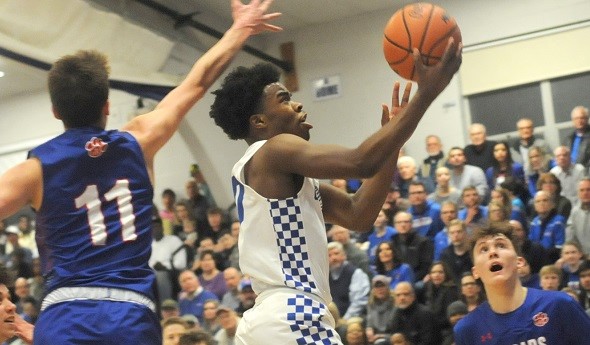
PHOTO: Southfield Christian’s Jon Sanders drives to the basket during his team’s Regional Final win over Adrian Lenawee Christian. (Photo courtesy of C&G Newspapers.)
Breslin Bound: Boys Report Week 2
December 20, 2012
By Geoff Kimmerly
Second Half editor
As with football during the fall, Second Half tries to hit all classes and all corners of the state for these weekly boys and girls basketball reports.
But sometimes, focusing on the powers in Class A and B is simply unavoidable.
Most of this week's 10 notable performances came from some of our biggest and best-known schools. (Results and records based on those reported to Score Center at MHSAA.com)
1. Warren DeLaSalle (3-0) – The Pilots have been the Detroit Catholic League team to beat for half a decade, and that could continue this winter. DeLaSalle beat Farmington Hills Harrison 64-50 before edging Class B power Grand Rapids Christian 77-76 in double overtime.
2. Gibraltar Carlson (2-0) – The Marauders’ 70-53 win over Saginaw Buena Vista might not have earned the biggest headline from Saturday’s Metro Detroit Saginaw Valley Challenge at West Bloomfield. But given Buena Vista’s rich tradition, it was still intriguing – although Carlson is coming off a run to its Regional Final too.
3. Romulus (2-1) – I hope to avoid repeating teams on this list from week to week. But Romulus beating reigning two-time Class B champion Lansing Sexton 67-52 makes the Eagles a must again.
4. Grand Rapids Christian (1-3) – It’s been a tough go for these Eagles, who are expected to contend in Class B. But despite finishing the week with that close loss to DeLaSalle, they did beat reigning Class A runner-up Rockford 48-39 earlier on.
5. Rockford (1-2) – The Rams also opened with a couple of losses, but finished the week with a 63-53 win over Muskegon – which made this list last week and is considered a possible contender this season.
6. Bessmer (5-0) – After going 10-11 in 2011-12, Bessemer is halfway to matching that win total. Last week’s were close ones – 50-48 over Hurley, Wis., and 55-51 over Ironwood.
7. Lansing Eastern (2-1) – The Quakers have had three Division I college prospects graduate or move to schools out of state over the last two years, but keep rolling. They picked up solid wins over Williamston (68-58) and East Lansing (55-50).
8. East Jackson (4-0) – The Trojans are off to another nice start coming off a 15-win season. They opened last week beating Brooklyn Columbia Central 51-45 before doubling up Manchester 102-61 – after another high-scoring 100-94 win over Manchester a year ago.
9. Saginaw (4-0) – The reigning Class A champion is on the move again. After beating Midland 86-77 and then Saginaw Heritage 81-34, the Trojans came back Saturday to beat a strong Detroit Southeastern team 57-56 in the MDSV Challenge.
10. Flint Southwestern (3-1) – The Knights are already halfway to last season’s win total, thanks in part to victories last week over Flint Northwestern (63-59) and Flint Powers Catholic (70-39).
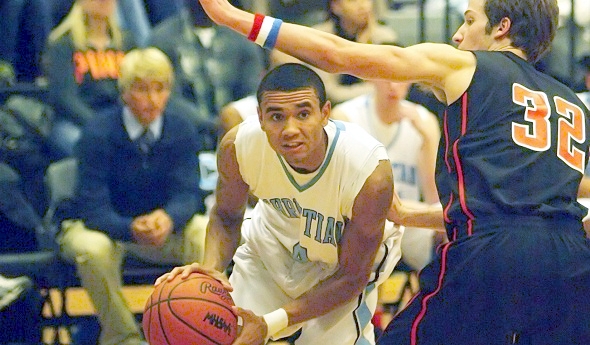
PHOTO: Grand Rapids Christian's Drake Harris attempts to drive around a Rockford defender during last week's win against the reigning Class A runner-up. (Click to see more at HighSchoolSportsScene.com.)