

Detroit 'Longtime' Boys Coaches Down to Few
By
Tom Markowski
Special for Second Half
December 14, 2016
Gary Fralick considers himself one of the fortunate ones.
 Fralick, 66, is in his 32nd season as a head boys basketball coach. He retired from his teaching position in 2013. He started coaching at Redford Thurston in 1979, went to Royal Oak Kimball in 1984 and is in 23rd season as the head coach at Troy.
Fralick might be lucky, but he is unquestionably rare. Fralick is believed to be one of three coaches in the Macomb/Oakland/Wayne area who has coached for more than 30 seasons.
There’s Dan Fife at Clarkston and Kevin Voss of Clinton Township Chippewa Valley, both of whom in their 35th seasons, all at the same school.
Another, Greg Esler at Warren DeLaSalle, is in his 30th season. He was the head coach at St. Clair Shores Lake Shore for seven seasons before going to DeLaSalle in 1994.
“We’re part of a dying breed,” Voss said.
It certainly appears so. Coaching longevity has taken on a different meaning recently. Twenty seems like a lot in these times, and in reality it is a long time. Twenty years or so ago, 20 years was normal. There’s a new normal, and 20 or 25 years isn’t it.
Many factors have contributed to this change. A person’s personal and family life often don’t coincide with the demands of coaching basketball. The responsibilities that come with coaching have increased. Some coaches say that to be an effective coach, it can be a 10- or 11-month job.
Two factors are at the forefront, and they are both financial. Coaches used to be educators as well as coaches. Yes, coaching can be viewed as teaching on the court, but at one time teaching in a classroom and coaching used to go hand in hand.
 Then there’s the subsidy coaches receive. It varies from school district to school district. Some make $4,000 a season, others can make $7,000. And it also costs money to run a program; unless the coach receives financial help from a booster club or parents, the money he or she receives begins to dwindle.
But the most important factor is time.
“A tremendous amount of time is devoted to watching DVD or tapes,” Fralick said. “I know I’m dating myself with saying that. The point is, you’re watching a lot. There’s more scouting. And you don’t get paid much. Why don’t they stay as long as they used to? They get burned out. They want to spend more time with their families.
“You don’t see as many of the young coaches stay. Coaches don’t have the ambition to coach a long time. It’s not a profitable job. I don’t know what other coaches make. We used to compare what we made. Not anymore.
“Thirty years or more? I don’t see it happening. There’s the dual job thing. Things have changed. To me, it’s been a great job.”
To compensate for being away from home, Fralick brought his family with him. Sort of. He coached his son Gary, Jr., and Tim. Gary, a 1996 Troy graduate, played for his father his junior and senior seasons and Tim, a 1999 graduate, played four seasons on varsity. Fralick said he was even more fortunate to coach both on the same team (during the 1995-96 season).
Then there’s his wife, Sharon, who remains the scorekeeper.
“I’ve always had a passion for coaching and teaching,” Fralick said. “I love the game of basketball. I love the kids. There’s never a dull moment. It’s been a great ride.”
Vito Jordan has been around basketball all of his life. His father, Venias Jordan, was the boys head varsity coach at Detroit Mackenzie and Detroit Mumford before stepping down as a head coach only to return to the bench assisting his son the last six seasons.
Vito Jordan, 31, became a head coach at Detroit Osborn when he was 24. He started his coaching career the year before as an assistant to Henry Washington at Macomb College. Jordan went to Detroit Community after one season at Osborn and guided Community to its only MHSAA Finals appearance (Class B, 2013). He’s now in his fourth season as the head coach at Detroit Renaissance.
“I followed my father all of my life,” Jordan said. “I knew what I wanted to do when I was in college (Alma College). This is what I want to do the rest of my life.”
It’s different in Detroit. Schools close. Job titles change. Jordan, for instance, teaches at the Academy of Warren, a middle school in Detroit. It’s a charter school, not within the Detroit Public School system, therefore he receives his pay from two separate school systems (Renaissance is in the DPS).
There is a distinction. In some school systems coaches will receive a percentage – let’s say for argument sake, 10 percent – of their teaching salary to coach. Let’s say a person makes $60,000 a year to teach. He or she would then receive $6,000 to coach. If you coach two sports, that’s $12,000.
 Jordan is not privy to such a contract. Each job is separate. Jordan loves to coach, and he understands he must be a teacher to earn a decent living, and he’s content to continue on the path he is following. But he also knows that to make a good salary just coaching one must move on to the collegiate level like others have done.
“When there were coaches like my dad, Perry Watson (Detroit Southwestern), Johnny Goston (Detroit Pershing) and others, they all worked in the (Detroit Public) school system. Everyone was teaching. That was your career. None of them had aspirations of being a college coach. Not even Watson. Now everyone isn’t in the teaching profession. Maybe they do have a degree and maybe they don’t. The point is, most aren’t teachers. I can count on one hand those (in Detroit) who have their teaching certificate and coach.”
Jordan noted such successful PSL coaches like Derrick McDowell, Steve Hall and Robert Murphy who left high school to pursue a coaching career in college. Murphy guided Detroit Crockett to the Class B title in 2001 and is now the head coach at Eastern Michigan. McDowell has had two stints as a collegiate assistant coach, most recently at EMU. He’s since returned to coach at Detroit Western. Hall coached Detroit Rogers to three consecutive Class D titles (2003-05) before going to Duquesne University and Youngstown State as an assistant coach. Hall returned to Detroit last season and is in his second season as head coach at Detroit Cass Tech.
Jordan said they left high school to challenge themselves professionally, among other considerations. Voss said there are variables that influence how long a person lasts, in one school district or in coaching in general, that didn’t exist 20 years ago.
“Athletics have become pervasive in high school,” he said. “The whole booster situation you find in college is here. You can be winning but not winning enough. It’s a trickle down affect.
“Coaches complain about parents. Parents complain about playing time. High school sports is not as pure as it once was. Winning is way more important now. Now a coach comes in with a three-year window. You can have one or two down years, and the third you’d better win.
“Then there’s the pressure on your family. I’ve been lucky. My wife and I have had the players over for team dinners. We create a family atmosphere. It’s a change of society. I don’t envy the young coaches coming in.”
Community involvement has always been a priority for Voss. To keep a hand on the pulse, Voss heads the elementary basketball program within the Chippewa Valley school district. Games are held on Saturdays, and approximately 750 students take part.
“You have to have the right fit,” he said. “I’m in the right spot. You coach for different reasons when you get older. I’m enjoying the game. There’s a different level of satisfaction.”
 Tom Markowski is a columnist and directs website coverage for the State Champs! Sports Network. He previously covered primarily high school sports for the The Detroit News from 1984-2014, focusing on the Detroit area and contributing to statewide coverage of football and basketball. Contact him at [email protected] with story ideas for Oakland, Macomb and Wayne counties.
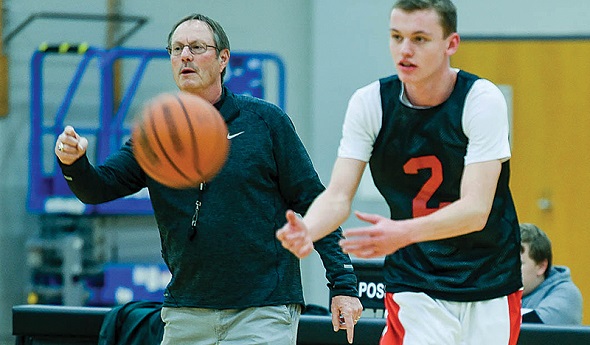
PHOTOS: (Top) Troy boys basketball coach Gary Fralick, left, is in his 32nd season coaching. (Middle) Detroit Renaissance boys coach Vito Jordan is following in the coaching footsteps of his father, Venias. (Below) Chippewa Valley boys coach Kevin Voss, left, is in his 35th season at his school. (Top and below photos courtesy of C&G Newspapers; middle photo courtesy of Detroit Public School League.)
Breslin Bound: 2025-26 Boys Quarterfinal Preview
By
Geoff Kimmerly
MHSAA.com senior editor
March 10, 2026
One. More. Win.
That’s all that’s needed as 32 boys basketball teams take the floor tonight for Quarterfinals across the state and with a trip to East Lansing and Breslin Center on the line.

Below are quick glances at all 16 matchups. Games tip off at 7 p.m. unless noted. Details on tickets, brackets and more can be found on the Boys Basketball page. To watch all 16 games online, visit the NFHS Network.
“Breslin Bound” is powered by MI Student Aid and based on results and schedules posted for each school at MHSAA.com. (Abbreviations below denote ppg - points per game, rpg - rebounds per game and apg - assists per game.)
Week in Review
The countdown of last week’s five most intriguing results:
1. Grand Rapids Northview 52, East Kentwood 50 Cam Ryans drilled a buzzer-beating 3-pointer to send Grand Rapids Northview (22-4) past East Kentwood (22-3) in a Division 1 Regional Final.
2. Harbor Beach 64, International Academy of Flint 62 (2 OT) Harbor Beach (23-3) won its first Regional title, edging IAF (19-5) in Division 4.
3. Colon 49, Battle Creek St. Philip 40 The Magi (22-4) also clinched their first Regional title, in Division 4, by adding to two regular-season wins over St. Philip (16-9).
4. Onsted 42, Ecorse 40 Onsted (24-2) clinched its first Regional title since 1983, advancing in Division 3 with a close win over Ecorse (19-6).
5. Onekama 46, Traverse City Christian 40 Onekama (17-10) handed Traverse City Christian (25-1) its only loss in a Division 4 Regional Final.
Quarterfinals at a Glance
DIVISION 1
Rockford (22-3) vs. Grand Rapids Northview (22-4) at Hudsonville
These two met Jan. 31 at the 2K26 Showcase, with Rockford winning 48-45. Senior 6-foot-6 forward Jake Bascom is a tough matchup averaging 17.7 points and 7.1 rebounds per game. But so is Northview senior guard Cam Ryans, a Mr. Basketball Award finalist averaging 24.2 points, 7.6 rebounds and 3.3 assists per contest.
Auburn Hills Avondale (25-1) vs. Roseville (19-6) at Detroit Mercy
Avondale is coming off its first Regional title since 2002 with senior forward Jakobe Liford (15.2 ppg, 7.5 rpg) leading three players averaging double-digit scoring. Roseville last won a Regional in 2019 and returns to the season’s final week with junior guard Terrell Owens (17.3 ppg, 3.5 apg, 3.9 spg) setting the pace.
East Lansing (25-1) vs. Ann Arbor Pioneer (21-4) at Lansing Eastern’s Don Johnson Fieldhouse
Reigning Division 1 champion East Lansing celebrated senior guard KJ Torbert winning the Mr. Basketball Award on Monday, and he’s an especially impressive shooter making 52 percent of his shots from the floor – including 39 percent of his 3-point tries – on the way to averaging 25 points per game. Pioneer is back at the Quarterfinals for the first time since 2007, with senior guard Jordan Harrison a potent scorer (18.1 ppg) and distributor (3.9 apg).
Wayne Memorial (23-3) vs. Bloomfield Hills Brother Rice (21-5) at Detroit Mercy, 5:30 p.m.
The Zebras are also playing for a return trip to Breslin after finishing Division 1 runner-up a year ago, and they’re also led by a Mr. Basketball Award finalist in senior guard Jaylohn Allen (23.3 ppg, 6.0 apg). Brother Rice won its second Regional title over the last three seasons, keyed by a high-powered backcourt of senior Greg Grays (14.9 ppg) and freshman Jordan McDaniel (19.3 ppg).
DIVISION 2
Ludington (24-2) vs. Freeland (23-3) at Mount Pleasant
Junior guard Taj Williams (18.8 ppg) and senior forward Cameron Gunsell (18.2 ppg) have led Ludington to the Quarterfinals for the first time since 2017, as the Orioles advanced with a Regional Final win over 2025 semifinalist Kingsford. Freeland has won nine straight games to reach the Quarterfinals for the second consecutive year. Senior guard Wilson Huckeby is making almost 39 percent of his 3-pointers, drilling 81 this season while averaging 18.9 points per game.
Chelsea (20-5) vs. Romulus Summit Academy North (25-1) at Ypsilanti Lincoln, 5:30 p.m.
Summit is one win away from returning to Breslin after finishing Division 2 runner-up a year ago, its only loss to an Ohio opponent and with three players averaging double-digit points per game led by senior guard Jordan Fuller at 15.4. Chelsea has won nine of its last 10 games, with a big one over Lansing Sexton (23-3) in a Regional Final. Freshman Drew Cabana is averaging 21.8 points per game and senior Buck Allen adds 17.4 – and both have made at least 50 3-pointers.
Detroit University Prep (16-9) vs. Detroit Country Day (19-7) at Detroit Renaissance
University Prep has won nine of its last 10 games and edged reigning champion Warren Lincoln by two points in their Regional Final to reach this week. Senior guards Chris Byrd and Maurice Jackson are a 6-5 tandem averaging 19.6 and 14.6 ppg, respectively. Country Day has made a jump from 11-12 a year ago, winning nine of its last 10 games with junior guard Christian Cast (20.9 ppg) and 6-6 junior forward Isaiah Moreno (16.5) setting the pace.
Grand Rapids Catholic Central (20-6) vs. Hudsonville Unity Christian (23-3) at Hamilton
Grand Rapids Catholic Central is playing in its third-straight Quarterfinal and reached the Semifinals a year ago, and can turn to senior guards BB Watkins (14.4 ppg) and Jordan McCoy (15.5 ppg) for scoring punch. Unity Christian has won 19 of its last 20 games, its only defeat during that time against Freeland, and has five players averaging between 7-12 ppg topped by senior guard Brogan Sherd (12.2), who also has made 61 3-pointers.
DIVISION 3
Arts & Technology Academy of Pontiac (17-3) vs. Harbor Beach (23-3) at St. Clair County Community College
ATAP is a game away from a Breslin return as well after finishing Division 3 runner-up last season, and the Lions will take on a first-time Regional champ in Harbor Beach. Sophomore point guard Lewis Lovejoy paced last year’s ATAP run and leads again at 26.5 points and 7.6 assists per game. Senior guard Benson Harper leads three Harbor Beach players scoring in double digits at 17.3 ppg, and he and senior forward Skiler Krus (13.2 ppg) were also among stars on the Pirates’ Division 8 football championship team.
Menominee (22-4) vs. Beal City (24-2) at Boyne City
After a year away, Menominee is playing in its second Quarterfinal in three seasons and third over the last five – in part thanks to avenging a regular-season loss to 2025 semifinalist Ishpeming Westwood in their Regional Semifinal. Senior forward Tanner Theuerkauf quarterbacked the Division 7 football championship team and leads at 17.8 ppg, with senior guard Darren Butler at 15.2. Beal City is playing in its first Quarterfinal since 2013 and has reached 20 wins three straight seasons. Junior guard Cuyler Smith (15 ppg) leads three players averaging at least 11 points per game.
Flint New Standard Academy (20-4) vs. Onsted (24-2) at Ypsilanti Lincoln
New Standard is playing in its second-straight Quarterfinal and with its only losses this season to teams that all reached Regional Finals. Sophomore guard AJ Smith (12.4 ppg) and senior guard Jeffery Turner (12.0) lead four players averaging at least 10 ppg. As noted above, Onsted is back in the season’s final week for the first time in more than four decades, and after just missing with some very strong teams over the last 10 years. Mason Chesser (13.9 ppg) leads four averaging at least nine points per game who have helped the Wildcats push through.
Pewamo-Westphalia (24-2) vs. Schoolcraft (16-10) at Kalamazoo Loy Norrix
These two have met two other times in Quarterfinals this decade, with P-W advancing last season with a 50-45 victory. The Pirates have been regulars at this stage with this their fourth Quarterfinal over the last five seasons. Grady Eklund sets the pace for P-W at 20.7 points and 3.5 assists per game. Senior 6-10 forward Jimmy Miller leads three Schoolcraft players scoring at least 15 ppg with 19.3, plus nine rebounds per contest, and junior guard Kodee Bienz (15.1 ppg) has drilled 68 3-pointers.
DIVISION 4
Dollar Bay (23-2) vs. Pickford (25-0) at Gladstone
These two guarantee at least one Upper Peninsula team will be heading downstate, with Pickford making the attempt after losing a Quarterfinal last year by two points and Dollar Bay seeking its first Breslin trip since 2018. Gunner Bennin averages 19.1 points, 7.4 rebounds, 3.7 steals and 3.5 assists per game for the Panthers. Senior forward Liam Tourtillott (20.2 ppg, 73 3-pointers) and junior guard Baron Colbert (16.9 ppg) are strong perimeter options for Dollar Bay.
Detroit Douglass (19-7) vs. Waterford Our Lady of the Lakes (19-6) at West Bloomfield, 6 p.m.
Douglass has made its run after tying for second in a Detroit Public School League Blue filled at the top with Division 1 teams, and defeated 2025 semifinalist Allen Park Inter-City Baptist in a Regional Semifinal last week. Freshman guard Damani Oliver averages 22.5 ppg and senior guard Jeremiah Thurman adds 16.1. Our Lady started this season 2-4 but has surged since the start of January, with senior center Jack Miller (12.4 ppg, 7.2 rpg) and senior forward Latane Ware (11.3 ppg) pacing a balanced attack.
Colon (22-4) vs. Concord (22-4) at Portage Northern
As noted above, Colon is coming off its first Regional title, and the Magi also defeated league rival Mendon (22-2) in a District Final. Seniors forwards Dalton Williams (22.1 ppg) and Quincy Blair (17.7) lead four players averaging double-digit scoring. Concord is coming off its first Regional title since 1990 and has celebrated senior guard Jett Smith and senior forward Connor Stevens both reaching 1,000 career points this winter.
Onekama (17-10) vs. Wyoming Tri-unity Christian (24-1) at Big Rapids
Onekama stunned previously-undefeated Traverse City Christian with a 46-40 Regional Final win to advance to the season’s final week for the first time since 1997, and the Portagers now get to take on the reigning Division 4 champion Defenders. Center Luke Bradford sets the pace at 15 ppg and is one of three senior starters. Tri-unity has replaced four starters from last season’s title winner, with the lone returner junior center Cody Osbun leading at 12.4 points, 7.8 rebounds and 3.2 assists per game.
MHSAA.com's weekly “Breslin Bound” reports are powered by MI Student Aid, a division within the Department of Lifelong Education, Advancement, and Potential (MiLEAP). MI Student Aid encourages students to pursue postsecondary education by providing access to student financial resources and information. MI Student Aid administers the state’s scholarship and grant programs that help make college Accessible, Affordable and Attainable for you. Click to connect with MI Student Aid and find more information on Facebook and X @mistudentaid.
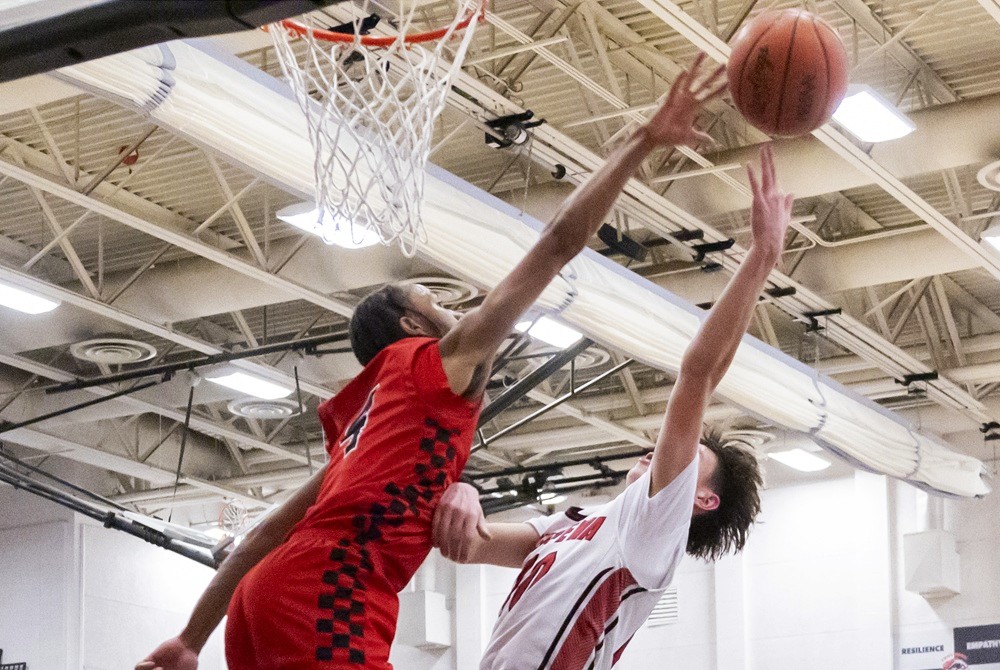
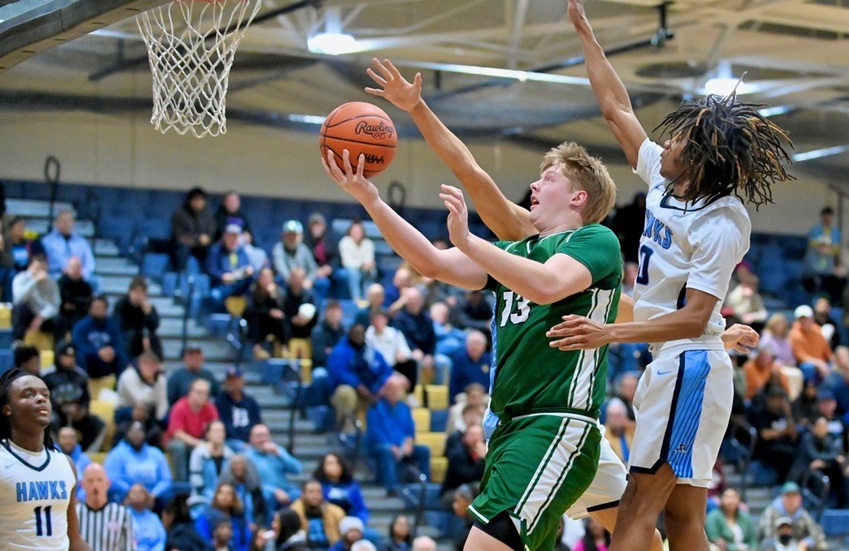
PHOTOS (Top) Roseville’s Terrell Owens (4) blocks a shot during his team’s 71-68 overtime win over Clinton Township Chippewa Valley in last week’s Regional Semifinal. (Middle) Freeland’s Tristan Comer (13) scoops a shot during the Falcons’ Regional Final win over Flint Hamady. (Roseville/Chippewa Valley photo by Adam Sheehan. Freeland/Hamady photo by Terry Lyons.)