

Detroit 'Longtime' Boys Coaches Down to Few
By
Tom Markowski
Special for Second Half
December 14, 2016
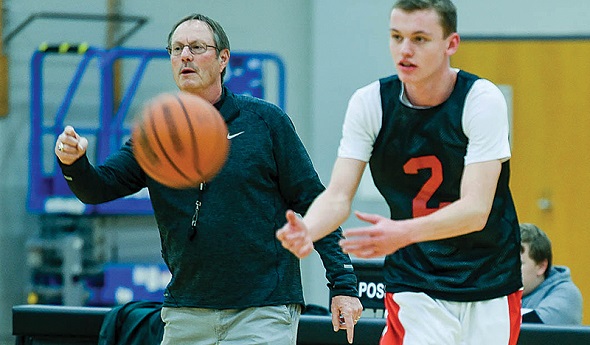
Gary Fralick considers himself one of the fortunate ones.
 Fralick, 66, is in his 32nd season as a head boys basketball coach. He retired from his teaching position in 2013. He started coaching at Redford Thurston in 1979, went to Royal Oak Kimball in 1984 and is in 23rd season as the head coach at Troy.
Fralick might be lucky, but he is unquestionably rare. Fralick is believed to be one of three coaches in the Macomb/Oakland/Wayne area who has coached for more than 30 seasons.
There’s Dan Fife at Clarkston and Kevin Voss of Clinton Township Chippewa Valley, both of whom in their 35th seasons, all at the same school.
Another, Greg Esler at Warren DeLaSalle, is in his 30th season. He was the head coach at St. Clair Shores Lake Shore for seven seasons before going to DeLaSalle in 1994.
“We’re part of a dying breed,” Voss said.
It certainly appears so. Coaching longevity has taken on a different meaning recently. Twenty seems like a lot in these times, and in reality it is a long time. Twenty years or so ago, 20 years was normal. There’s a new normal, and 20 or 25 years isn’t it.
Many factors have contributed to this change. A person’s personal and family life often don’t coincide with the demands of coaching basketball. The responsibilities that come with coaching have increased. Some coaches say that to be an effective coach, it can be a 10- or 11-month job.
Two factors are at the forefront, and they are both financial. Coaches used to be educators as well as coaches. Yes, coaching can be viewed as teaching on the court, but at one time teaching in a classroom and coaching used to go hand in hand.
 Then there’s the subsidy coaches receive. It varies from school district to school district. Some make $4,000 a season, others can make $7,000. And it also costs money to run a program; unless the coach receives financial help from a booster club or parents, the money he or she receives begins to dwindle.
But the most important factor is time.
“A tremendous amount of time is devoted to watching DVD or tapes,” Fralick said. “I know I’m dating myself with saying that. The point is, you’re watching a lot. There’s more scouting. And you don’t get paid much. Why don’t they stay as long as they used to? They get burned out. They want to spend more time with their families.
“You don’t see as many of the young coaches stay. Coaches don’t have the ambition to coach a long time. It’s not a profitable job. I don’t know what other coaches make. We used to compare what we made. Not anymore.
“Thirty years or more? I don’t see it happening. There’s the dual job thing. Things have changed. To me, it’s been a great job.”
To compensate for being away from home, Fralick brought his family with him. Sort of. He coached his son Gary, Jr., and Tim. Gary, a 1996 Troy graduate, played for his father his junior and senior seasons and Tim, a 1999 graduate, played four seasons on varsity. Fralick said he was even more fortunate to coach both on the same team (during the 1995-96 season).
Then there’s his wife, Sharon, who remains the scorekeeper.
“I’ve always had a passion for coaching and teaching,” Fralick said. “I love the game of basketball. I love the kids. There’s never a dull moment. It’s been a great ride.”
Vito Jordan has been around basketball all of his life. His father, Venias Jordan, was the boys head varsity coach at Detroit Mackenzie and Detroit Mumford before stepping down as a head coach only to return to the bench assisting his son the last six seasons.
Vito Jordan, 31, became a head coach at Detroit Osborn when he was 24. He started his coaching career the year before as an assistant to Henry Washington at Macomb College. Jordan went to Detroit Community after one season at Osborn and guided Community to its only MHSAA Finals appearance (Class B, 2013). He’s now in his fourth season as the head coach at Detroit Renaissance.
“I followed my father all of my life,” Jordan said. “I knew what I wanted to do when I was in college (Alma College). This is what I want to do the rest of my life.”
It’s different in Detroit. Schools close. Job titles change. Jordan, for instance, teaches at the Academy of Warren, a middle school in Detroit. It’s a charter school, not within the Detroit Public School system, therefore he receives his pay from two separate school systems (Renaissance is in the DPS).
There is a distinction. In some school systems coaches will receive a percentage – let’s say for argument sake, 10 percent – of their teaching salary to coach. Let’s say a person makes $60,000 a year to teach. He or she would then receive $6,000 to coach. If you coach two sports, that’s $12,000.
 Jordan is not privy to such a contract. Each job is separate. Jordan loves to coach, and he understands he must be a teacher to earn a decent living, and he’s content to continue on the path he is following. But he also knows that to make a good salary just coaching one must move on to the collegiate level like others have done.
“When there were coaches like my dad, Perry Watson (Detroit Southwestern), Johnny Goston (Detroit Pershing) and others, they all worked in the (Detroit Public) school system. Everyone was teaching. That was your career. None of them had aspirations of being a college coach. Not even Watson. Now everyone isn’t in the teaching profession. Maybe they do have a degree and maybe they don’t. The point is, most aren’t teachers. I can count on one hand those (in Detroit) who have their teaching certificate and coach.”
Jordan noted such successful PSL coaches like Derrick McDowell, Steve Hall and Robert Murphy who left high school to pursue a coaching career in college. Murphy guided Detroit Crockett to the Class B title in 2001 and is now the head coach at Eastern Michigan. McDowell has had two stints as a collegiate assistant coach, most recently at EMU. He’s since returned to coach at Detroit Western. Hall coached Detroit Rogers to three consecutive Class D titles (2003-05) before going to Duquesne University and Youngstown State as an assistant coach. Hall returned to Detroit last season and is in his second season as head coach at Detroit Cass Tech.
Jordan said they left high school to challenge themselves professionally, among other considerations. Voss said there are variables that influence how long a person lasts, in one school district or in coaching in general, that didn’t exist 20 years ago.
“Athletics have become pervasive in high school,” he said. “The whole booster situation you find in college is here. You can be winning but not winning enough. It’s a trickle down affect.
“Coaches complain about parents. Parents complain about playing time. High school sports is not as pure as it once was. Winning is way more important now. Now a coach comes in with a three-year window. You can have one or two down years, and the third you’d better win.
“Then there’s the pressure on your family. I’ve been lucky. My wife and I have had the players over for team dinners. We create a family atmosphere. It’s a change of society. I don’t envy the young coaches coming in.”
Community involvement has always been a priority for Voss. To keep a hand on the pulse, Voss heads the elementary basketball program within the Chippewa Valley school district. Games are held on Saturdays, and approximately 750 students take part.
“You have to have the right fit,” he said. “I’m in the right spot. You coach for different reasons when you get older. I’m enjoying the game. There’s a different level of satisfaction.”
 Tom Markowski is a columnist and directs website coverage for the State Champs! Sports Network. He previously covered primarily high school sports for the The Detroit News from 1984-2014, focusing on the Detroit area and contributing to statewide coverage of football and basketball. Contact him at [email protected] with story ideas for Oakland, Macomb and Wayne counties.
PHOTOS: (Top) Troy boys basketball coach Gary Fralick, left, is in his 32nd season coaching. (Middle) Detroit Renaissance boys coach Vito Jordan is following in the coaching footsteps of his father, Venias. (Below) Chippewa Valley boys coach Kevin Voss, left, is in his 35th season at his school. (Top and below photos courtesy of C&G Newspapers; middle photo courtesy of Detroit Public School League.)
Performance: Clarkston's Foster Loyer
February 5, 2017
 Foster Loyer
Clarkston junior – Basketball
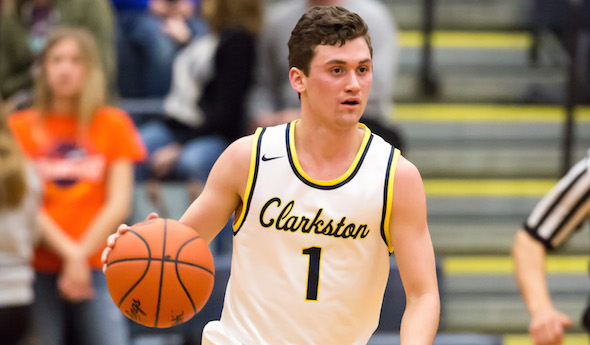
The Wolves’ junior point guard has been making good on high expectations since entering high school, and in one way he didn’t miss for nearly a year. Starting with last season’s regular-season finale against West Bloomfield, Loyer put together an MHSAA record streak of 119 straight made free throws to earn the Michigan Army National Guard “Performance of the Week” for Jan. 23-29.
Loyer’s streak came to an end when he missed his first free throw in a 59-39 win over North Farmington on Jan. 24. His record surpassed by 17 the former milestone set by Frankenmuth’s Brad Redford during the 2007-08 season and will rank second in the national record book when submitted after this season. Loyer joined the Clarkston varsity as a highly-touted freshmen two years ago and this winter has led the Wolves to a 13-0 start averaging 25.2 points, six assists and 4.4 rebounds per game, making 44 percent of his 3-point attempts and 95.6 percent of his tries from the free throw line.
 Some of the high expectations for Loyer rise from legacy; his dad John has been an assistant for four NBA teams including the Detroit Pistons, whom he led as interim head coach at the end of the 2013-14 season. Foster also has learned under the tutelage of longtime Clarkston coach Dan Fife, who took over the program in 1983 and is the fourth-winningest in MHSAA boys hoops history. Loyer – who also played baseball for a season at Clarkston – has committed to sign this fall with Michigan State University. A strong student as well, he’s looking to study business management with an eye on working in sports once his playing days are done. But first, he’ll try to lead Clarkston its first MHSAA championship after the team fell in overtime in a Class A Regional Semifinal last season to eventual semifinalist Macomb Dakota, and also by two in 2015 in a Quarterfinal to Detroit U-D Jesuit.
Coach Dan Fife said: “He shoots every day, and when he shoots, he shoots with a purpose. He’s a hard worker, he puts a lot of time in, and all the time he puts in really shows in the way he plays. … His court IQ is just incredible. He sees the game ahead of time. He has a great floor sense, where people are. As a freshman he was the same way, and one of the bigger things is when he gets upset, he doesn’t show a lot of anger when he makes a mistake. Mistakes don’t lead to two mistakes with him. He doesn’t get caught up in that stuff, he doesn’t get caught up in who he is; he just keeps his focus. And as good a player as he is, he’s just as good a kid. In the hallways, you wouldn’t know (he’s a basketball standout); he doesn’t walk like that. He’s just one of the kids.”
Performance Point: “Going into this year, I knew I’d made a bunch in a row but I had no idea what number I was at,” Loyer said of his free throws. “I didn’t pay much attention, but I think when I passed 100 some of my teammates started messing with me, letting me hear it when I missed one in practice. … I approach every free throw the same, and when the shot (that broke the streak) left my hand, I had no thought going through my mind that it wasn’t going to go in. It rolled in and out pretty bad, and when it came off the front of the rim, the thought definitely went through my head and I heard the rest of the crowd knew about it. They took a loud gasp, and that’s pretty much how I felt about it. I was definitely disappointed, but when something like that comes to an end, you move on and go on to the next play.”
Part of the arsenal: “I would consider free throw shooting a serious weapon, especially being the point guard in an end-of-game situation. At the end of the game, being able to hit free throws, especially in high school where there’s no shot clock, the game is over in my mind. I’m confident in myself and my teammates to be able to go and knock free throws down. Just being in the gym every day, it’s something you practice every day, day in and day out. It’s called a free throw for a reason; in my mind, you’re supposed to make them.”
 Thanks Dad: “If we’re watching film or being in the gym every day, my dad has been a positive influence in my life and basketball career. Just being able to take the things he says, and build off of them to make myself a better player. Every time we watch film, normally you should look not only at what you did right but also what you did wrong and can improve on. That’s been the biggest part of the game my dad has helped me improve.”
Win one for Coach: “(A Class A title) would mean the world to us guys as players, as a team, with the brotherhood we’ve built. But not only that, it would mean the world for us to win Coach Fife that state championship. Coach Fife doesn’t talk much about how much that means to him, but he’s had some difficult losses, and I think in the back of our minds it would solidify his legacy, solidify our legacy as a team, that we came in here and made our mark.”
Leading the way: “Day in and day out at practice, I pride myself in doing so, bringing leadership to the team, making sure guys are working as hard as they should be. As a leader and a point guard on a basketball team, you have to push guys not only to do what they should be doing, but it’s more than that. Going into March, we had a lot of guys in the locker room after (last season’s Regional loss), and we have a lot of guys who know what that feeling is like, and that’s a feeling we never want to go through again.”
- Geoff Kimmerly, Second Half editor
Every week during the 2016-17 school year, Second Half and the Michigan National Guard will recognize a “Performance of the Week" from among the MHSAA's 750 member high schools.
The Michigan Army National Guard provides trained and ready forces in support of the National Military Strategy, and responds as needed to state, local, and regional emergencies to ensure peace, order, and public safety. The Guard adds value to our communities through continuous interaction. National Guard soldiers are part of the local community. Guardsmen typically train one weekend per month and two weeks in the summer. This training maintains readiness when needed, be it either to defend our nation's freedom or protect lives and property of Michigan citizens during a local natural disaster.
Previous 2016-17 honorees:
Jan. 26: Nick Jenkins, Detroit Catholic Central wrestling – Read
Jan. 19: Eileene Naniseni, Mancelona basketball – Read
Jan. 12: Rory Anderson, Calumet hockey – Read
Dec. 15: Demetri Martin, Big Rapids basketball – Read
Dec. 1: Rodney Hall, Detroit Cass Tech football – Read
Nov. 24: Ally Cummings, Novi volleyball – Read
Nov. 17: Chloe Idoni, Fenton volleyball – Read
Nov. 10: Adelyn Ackley, Hart cross country – Read
Nov. 3: Casey Kirkbride, Mattawan soccer – Read
Oct. 27: Colton Yesney, Negaunee cross country – Read
Oct. 20: Varun Shanker, Midland Dow tennis – Read
Oct. 13: Anne Forsyth, Ann Arbor Pioneer cross country – Read
Oct. 6: Shuaib Aljabaly, Coldwater cross country – Read
Sept. 29: Taylor Seaman, Brighton swimming & diving – Read
Sept. 22: Maggie Farrell, Battle Creek Lakeview cross country – Read
Sept. 15: Franki Strefling, Buchanan volleyball – Read
Sept. 8: Noah Jacobs, Corunna cross country – Read
PHOTOS: (Top) Clarkston's Foster Loyer brings the ball upcourt during a game this season. (Middle) Loyer attempts a free throw; he recently capped an MHSAA record streak of 119 straight makes. (Photos by Larry Wright/WrightActionPix.com.)