

Detroit 'Longtime' Boys Coaches Down to Few
By
Tom Markowski
Special for Second Half
December 14, 2016
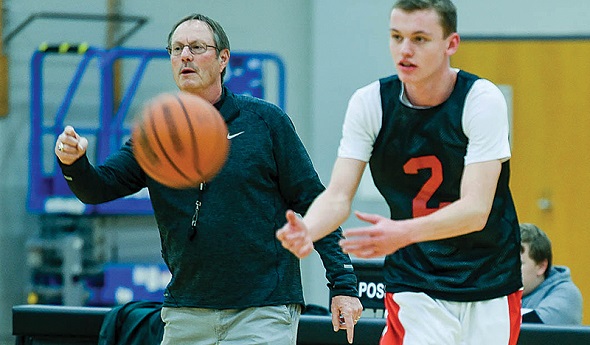
Gary Fralick considers himself one of the fortunate ones.
 Fralick, 66, is in his 32nd season as a head boys basketball coach. He retired from his teaching position in 2013. He started coaching at Redford Thurston in 1979, went to Royal Oak Kimball in 1984 and is in 23rd season as the head coach at Troy.
Fralick might be lucky, but he is unquestionably rare. Fralick is believed to be one of three coaches in the Macomb/Oakland/Wayne area who has coached for more than 30 seasons.
There’s Dan Fife at Clarkston and Kevin Voss of Clinton Township Chippewa Valley, both of whom in their 35th seasons, all at the same school.
Another, Greg Esler at Warren DeLaSalle, is in his 30th season. He was the head coach at St. Clair Shores Lake Shore for seven seasons before going to DeLaSalle in 1994.
“We’re part of a dying breed,” Voss said.
It certainly appears so. Coaching longevity has taken on a different meaning recently. Twenty seems like a lot in these times, and in reality it is a long time. Twenty years or so ago, 20 years was normal. There’s a new normal, and 20 or 25 years isn’t it.
Many factors have contributed to this change. A person’s personal and family life often don’t coincide with the demands of coaching basketball. The responsibilities that come with coaching have increased. Some coaches say that to be an effective coach, it can be a 10- or 11-month job.
Two factors are at the forefront, and they are both financial. Coaches used to be educators as well as coaches. Yes, coaching can be viewed as teaching on the court, but at one time teaching in a classroom and coaching used to go hand in hand.
 Then there’s the subsidy coaches receive. It varies from school district to school district. Some make $4,000 a season, others can make $7,000. And it also costs money to run a program; unless the coach receives financial help from a booster club or parents, the money he or she receives begins to dwindle.
But the most important factor is time.
“A tremendous amount of time is devoted to watching DVD or tapes,” Fralick said. “I know I’m dating myself with saying that. The point is, you’re watching a lot. There’s more scouting. And you don’t get paid much. Why don’t they stay as long as they used to? They get burned out. They want to spend more time with their families.
“You don’t see as many of the young coaches stay. Coaches don’t have the ambition to coach a long time. It’s not a profitable job. I don’t know what other coaches make. We used to compare what we made. Not anymore.
“Thirty years or more? I don’t see it happening. There’s the dual job thing. Things have changed. To me, it’s been a great job.”
To compensate for being away from home, Fralick brought his family with him. Sort of. He coached his son Gary, Jr., and Tim. Gary, a 1996 Troy graduate, played for his father his junior and senior seasons and Tim, a 1999 graduate, played four seasons on varsity. Fralick said he was even more fortunate to coach both on the same team (during the 1995-96 season).
Then there’s his wife, Sharon, who remains the scorekeeper.
“I’ve always had a passion for coaching and teaching,” Fralick said. “I love the game of basketball. I love the kids. There’s never a dull moment. It’s been a great ride.”
Vito Jordan has been around basketball all of his life. His father, Venias Jordan, was the boys head varsity coach at Detroit Mackenzie and Detroit Mumford before stepping down as a head coach only to return to the bench assisting his son the last six seasons.
Vito Jordan, 31, became a head coach at Detroit Osborn when he was 24. He started his coaching career the year before as an assistant to Henry Washington at Macomb College. Jordan went to Detroit Community after one season at Osborn and guided Community to its only MHSAA Finals appearance (Class B, 2013). He’s now in his fourth season as the head coach at Detroit Renaissance.
“I followed my father all of my life,” Jordan said. “I knew what I wanted to do when I was in college (Alma College). This is what I want to do the rest of my life.”
It’s different in Detroit. Schools close. Job titles change. Jordan, for instance, teaches at the Academy of Warren, a middle school in Detroit. It’s a charter school, not within the Detroit Public School system, therefore he receives his pay from two separate school systems (Renaissance is in the DPS).
There is a distinction. In some school systems coaches will receive a percentage – let’s say for argument sake, 10 percent – of their teaching salary to coach. Let’s say a person makes $60,000 a year to teach. He or she would then receive $6,000 to coach. If you coach two sports, that’s $12,000.
 Jordan is not privy to such a contract. Each job is separate. Jordan loves to coach, and he understands he must be a teacher to earn a decent living, and he’s content to continue on the path he is following. But he also knows that to make a good salary just coaching one must move on to the collegiate level like others have done.
“When there were coaches like my dad, Perry Watson (Detroit Southwestern), Johnny Goston (Detroit Pershing) and others, they all worked in the (Detroit Public) school system. Everyone was teaching. That was your career. None of them had aspirations of being a college coach. Not even Watson. Now everyone isn’t in the teaching profession. Maybe they do have a degree and maybe they don’t. The point is, most aren’t teachers. I can count on one hand those (in Detroit) who have their teaching certificate and coach.”
Jordan noted such successful PSL coaches like Derrick McDowell, Steve Hall and Robert Murphy who left high school to pursue a coaching career in college. Murphy guided Detroit Crockett to the Class B title in 2001 and is now the head coach at Eastern Michigan. McDowell has had two stints as a collegiate assistant coach, most recently at EMU. He’s since returned to coach at Detroit Western. Hall coached Detroit Rogers to three consecutive Class D titles (2003-05) before going to Duquesne University and Youngstown State as an assistant coach. Hall returned to Detroit last season and is in his second season as head coach at Detroit Cass Tech.
Jordan said they left high school to challenge themselves professionally, among other considerations. Voss said there are variables that influence how long a person lasts, in one school district or in coaching in general, that didn’t exist 20 years ago.
“Athletics have become pervasive in high school,” he said. “The whole booster situation you find in college is here. You can be winning but not winning enough. It’s a trickle down affect.
“Coaches complain about parents. Parents complain about playing time. High school sports is not as pure as it once was. Winning is way more important now. Now a coach comes in with a three-year window. You can have one or two down years, and the third you’d better win.
“Then there’s the pressure on your family. I’ve been lucky. My wife and I have had the players over for team dinners. We create a family atmosphere. It’s a change of society. I don’t envy the young coaches coming in.”
Community involvement has always been a priority for Voss. To keep a hand on the pulse, Voss heads the elementary basketball program within the Chippewa Valley school district. Games are held on Saturdays, and approximately 750 students take part.
“You have to have the right fit,” he said. “I’m in the right spot. You coach for different reasons when you get older. I’m enjoying the game. There’s a different level of satisfaction.”
 Tom Markowski is a columnist and directs website coverage for the State Champs! Sports Network. He previously covered primarily high school sports for the The Detroit News from 1984-2014, focusing on the Detroit area and contributing to statewide coverage of football and basketball. Contact him at [email protected] with story ideas for Oakland, Macomb and Wayne counties.
PHOTOS: (Top) Troy boys basketball coach Gary Fralick, left, is in his 32nd season coaching. (Middle) Detroit Renaissance boys coach Vito Jordan is following in the coaching footsteps of his father, Venias. (Below) Chippewa Valley boys coach Kevin Voss, left, is in his 35th season at his school. (Top and below photos courtesy of C&G Newspapers; middle photo courtesy of Detroit Public School League.)
Breslin Bound: 2024-25 Boys Quarterfinal Preview
By
Geoff Kimmerly
MHSAA.com senior editor
March 11, 2025
Championship week has begun as this MHSAA boys basketball season rolls toward its conclusion, and 32 teams are seeking to add to their season-long stories with tonight’s Quarterfinals.

Below are quick glances at all 16 matchups. Games tip off at 7 p.m. unless noted. Details on tickets, brackets and more can be found on the Boys Basketball page. To watch all 16 games online, visit the NFHS Network.
“Breslin Bound” is powered by MI Student Aid and based on results and schedules posted for each school at MHSAA.com. (Abbreviations below denote ppg - points per game, rpg - rebounds per game and apg - assists per game.)
Week in Review
The countdown of last week’s five most intriguing results:
1. Wayne Memorial 72, Detroit U-D Jesuit 70 Wayne (23-3) clinched its first Regional title since 1997, downing another popular Division 1 championship pick in ending the Cubs’ season at 22-4.
2. Warren Lincoln 59, Detroit Old Redford 44 Reigning Division 2 champion Lincoln (20-4) won this Regional Final matchup of teams that played at Breslin Center last season, as Old Redford (19-3) was the reigning Division 3 runner-up.
3. Flint Carman-Ainsworth 64, Rockford 60 (OT) Carman-Ainsworth (21-5) would go on to defeat Marquette two days later for a Division 1 Regional title, but this was an eye-opener among Regional Semifinals as Rockford (22-3) was considered a Finals contender.
4. Lansing Sexton 73, Chelsea 71 Sexton (19-5) claimed its first Regional title since 2012 on a buzzer beater in Division 2 that ended Chelsea’s run at 17-9.
5. Flint New Standard Academy 64, Harbor Beach 56 In Division 3, the Warriors (16-8) claimed their first Regional title by handing the Pirates (23-2) just their second defeat.
Quarterfinals at a Glance
DIVISION 1
East Lansing (25-1) vs. Ann Arbor Huron (21-4) at Mason
This is a rematch of a 2024 Quarterfinal won by Huron, 54-48. Senior guard Macari Moore remains a dominant force for the River Rats, averaging 19 points per game while making 59 percent of his shots from the floor. East Lansing is paced by a pair of standouts, junior guard KJ Torbert (20.3 ppg) and senior guard Cameron Hutson (18.5 ppg, 7.4 rebounds per game).
Orchard Lake St. Mary’s (19-6) vs. Macomb L’Anse Creuse North (19-8) at University of Detroit Mercy, 5:30 p.m.
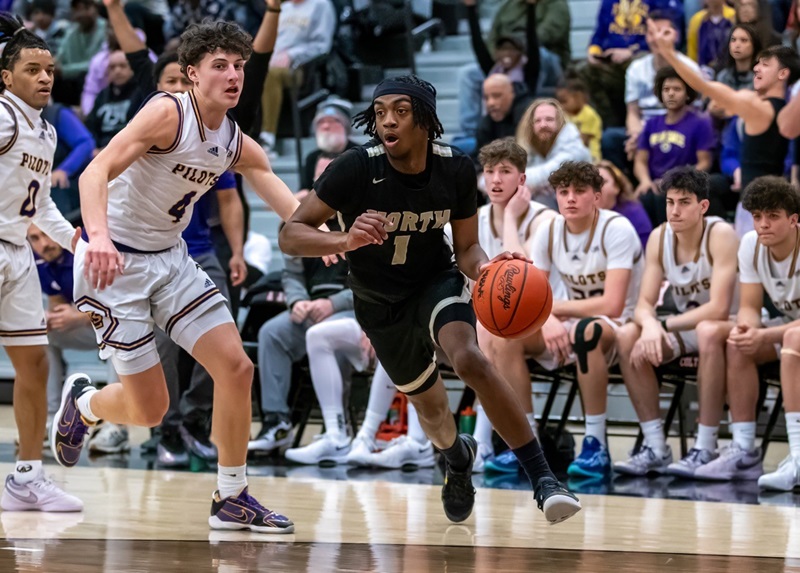
The reigning Division 1 champion Eaglets continued to build through a stretch without senior wing Trey McKenney (22.9 ppg, 10.1 rpg) during the regular season but are back at full strength – and McKenney received the Mr. Basketball Award on Monday. Junior guard Julius Wilson paces a balanced LCN team scoring 16 points per game.
Detroit Martin Luther King (21-5) vs. Wayne Memorial (23-3) at University of Detroit Mercy
Wayne edged Detroit U-D Jesuit 72-70 in their Regional Final last week and can turn to multiple scoring options led by junior guard Carlos Medlock Jr. (24.9 ppg, 4.8 assists per game) among three starters averaging double-digit scoring. Three King starters also average at least 10 points per game, led by Steven Jones (15.6 ppg).
Flint Carman-Ainsworth (21-5) vs. Byron Center (20-6) at DeWitt
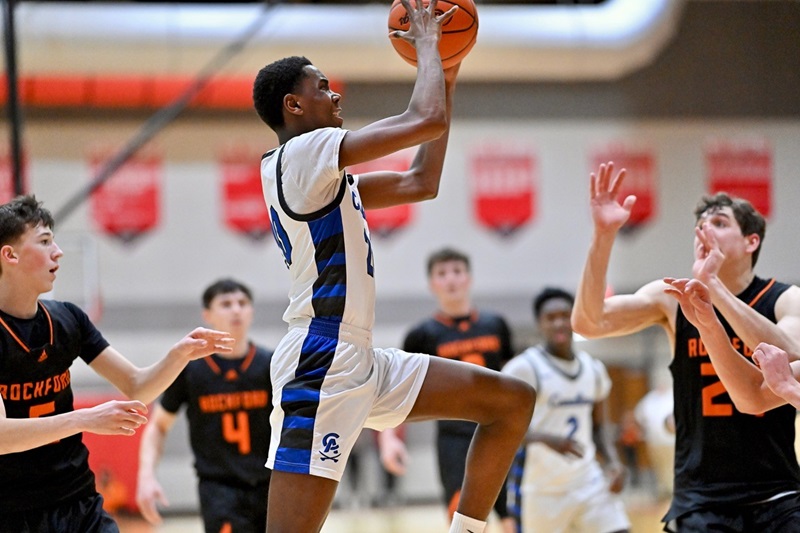
Carman-Ainsworth also defeated a much-anticipated contender last week, defeating Rockford 64-60 in overtime in their Regional Semifinal. Seniors Donovan Hamlin (14.8 ppg) and MarQuinn Weston II (14.5) give the Cavaliers multiple go-to options. Senior guard Keane Hinkle is Byron Center’s leading scorer at 16 points per game, with 76 3-pointers while making more than 45 percent of his tries beyond the arc.
DIVISION 2
Kingsford (21-3) vs. Freeland (22-3) at Gaylord
Kingsford is playing in a Quarterfinal for the second-straight season and can turn to Gavin Grondin, who averages 24.3 ppg and has made 79 3-pointers. Freeland also has a long-range shooting standout in junior guard Wilson Huckeby, who is averaging a team-high 20.2 ppg and has connected on 87 shots from 3-point range.
Lansing Sexton (19-5) vs. Romulus Summit Academy North (22-3) at Jackson
Sexton junior guard Keyshawn Summerville sent his team to this week with a longer-than-halfcourt buzzer-beater to get past Chelsea 73-71 in their Regional Final, and he’s averaging a team-best 19.6 ppg. Summit has four players scoring between 10-14 points per game – led by junior wing Chance Houser (14.3 ppg) – as it seeks a second trip to Breslin over the last three seasons.
Grand Rapids Catholic Central (20-7) vs. Marshall (20-6) at Hamilton
Catholic Central graduated last season’s Mr. Basketball but is another returning quarterfinalist with junior forward Izaya Larthridge (15.5 ppg, 61 3-pointers) leading the way. Marshall has emerged from a three-way title share in the Interstate 8 Athletic Conference paced by senior forward Austin Miller (15.4 ppg, 54 3-pointers).
Warren Lincoln (20-4) vs. Pontiac Notre Dame Prep (14-10) at St. Clair County Community College
Reigning Division 2 champion Warren Lincoln has won 15 straight games and brings a starting lineup of all seniors into championship week. Notre Dame Prep will play in its second Quarterfinal over the last four seasons, led by stars from the Division 5 champion football team including senior guard Joey DeCasas (19 ppg).
DIVISION 3
Ishpeming Westwood (21-5) vs. McBain (23-2) at Boyne City
McBain is on another run after reaching the Semifinals last year and falling to eventual champion Niles Brandywine in overtime at Breslin. Sophomore Clayton Heuker has taken on a starring role at 19.7 ppg and can play all over the lineup. Westwood defeated teams last week that finished with a combined 44-6 record and is led by junior guard Ethan Marta (27 ppg, 50 3-pointers).
Arts & Technology Academy of Pontiac (19-1) vs. Flint New Standard Academy (16-8) at St. Clair County Community College, 5:30 p.m.
ATAP has jumped from 8-7 last season to the Quarterfinals, with the lone loss to Division 1 Hamtramck and freshman guard Lewis Lovejoy (17.9 ppg) leading four players scoring at least 12 points per game. New standard has followed previously-longtime Saginaw Arthur Hill coach Greg McMath to this week, with junior guard Jeffrey Turner (15.8 ppg) and senior forward Jhirnea Harris (13.6) leading a lineup that includes two freshmen.
Jackson Lumen Christi (23-3) vs. Riverview Gabriel Richard (22-2) at Ypsilanti Lincoln
This is another Quarterfinal rematch from last season, and will even be played on the same floor. Gabriel Richard won last year’s meeting 58-44 and then its two with Lumen this winter 88-65 and 82-48 on the way to claiming Catholic High School League AA and Cardinal Tournament championships.
Pewamo-Westphalia (23-3) vs. Schoolcraft (20-6) at Kalamazoo Loy Norrix
After missing out on the Quarterfinals with a one-point Regional Final loss last season, P-W has advanced to championship week for the third time over the last four seasons. Junior guard Grady Eklund leads at 17.5 ppg. Schoolcraft is making its third Quarterfinal trip in five seasons with senior guard Tucker Walther (16 ppg, 5.0 apg) guiding a balanced attack.
DIVISION 4
Crystal Falls Forest Park (24-2) vs. Pickford (23-2) at Gladstone
Forest Park will play in a Quarterfinal for the second-straight season and is led by the Giuliani brothers – senior forward Kevin (14.6 ppg) and sophomore forward Vic (22 ppg) – among standouts from the 8-player Division 2 football champion in the fall. Pickford was the 8-player Division 1 football runner-up and several of those playmakers are driving this run as well with senior forward Eli MacDonald the lead scorer at 16.6 ppg.
Wyoming Tri-unity Christian (24-2) vs. Adrian Lenawee Christian (22-4) at Richland Gull Lake
The reigning Division 4 champion Tri-unity will attempt to send out retiring coach Mark Keeler with one more title this week. Senior 6-foot-7 center Joey Mellon leads another balanced lineup at 13 ppg. Junior forward Jaxon Salenbien is the latest high-scoring talent from his school and family, averaging 24.3 ppg with 52 3-pointers as he attempts to follow his two older sisters’ previous paths to Finals weekend.
Bellaire (22-4) vs. Fowler (23-3) at Houghton Lake
A pair of senior standouts has Bellaire playing in its first Quarterfinal since 2016, as Drake Koepke (16.8 ppg) and Jayden Hanson (16.1) are setting the pace. Fowler is making its first trip to this round since 2017 with two of its losses this season to Pewamo-Westphalia, playing tonight in Division 3.
Allen Park Inter-City Baptist (23-3) vs. Kingston (18-6) at West Bloomfield, 6 p.m.
This is one more rematch from last year’s Quarterfinals, which Inter-City Baptist won 58-46. Junior guard Ethan Esse is starring again for Inter-City, averaging 22.3 ppg with 64 3-pointers, and senior center Austin DeRoseau also is back among Kingston’s leaders with a team-high 18.6 ppg and three blocked shots as well per contest.
MHSAA.com's weekly “Breslin Bound” previews and reviews are powered by MI Student Aid, a division within the Department of Lifelong Education, Advancement, and Potential (MiLEAP). MI Student Aid encourages students to pursue postsecondary education by providing access to student financial resources and information. MI Student Aid administers the state’s scholarship and grant programs that help make college Accessible, Affordable and Attainable for you. Connect with MI Student Aid at www.michigan.gov/mistudentaid and find more information on Facebook and Twitter @mistudentaid.
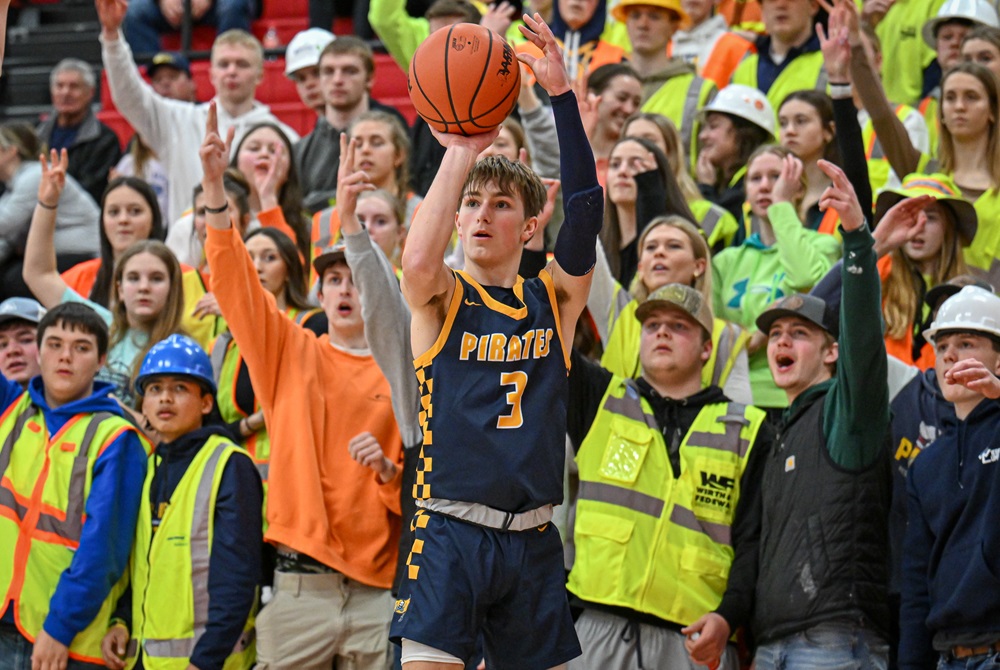
PHOTOS (Top) Pewamo-Westphalia’s Reece Thelen (3) launches a 3-pointer this season. (Middle) Macomb L'Anse Creuse North's Julius Wilson (1) drives during his team's 68-65 Regional Final win over Warren De La Salle Collegiate. (Below) Carman-Ainsworth’s Anthony Mull (20) drives during last week’s win over Rockford. (P-W photo by Jim Pivarnik. LCN/De La Salle photo by Adam Sheehan. Carman-Ainsworth/Rockford photo by Terry Lyons.)