

Detroit 'Longtime' Boys Coaches Down to Few
By
Tom Markowski
Special for Second Half
December 14, 2016
Gary Fralick considers himself one of the fortunate ones.
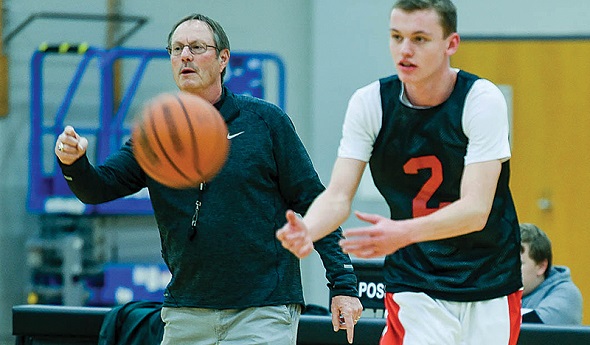
 Fralick, 66, is in his 32nd season as a head boys basketball coach. He retired from his teaching position in 2013. He started coaching at Redford Thurston in 1979, went to Royal Oak Kimball in 1984 and is in 23rd season as the head coach at Troy.
Fralick might be lucky, but he is unquestionably rare. Fralick is believed to be one of three coaches in the Macomb/Oakland/Wayne area who has coached for more than 30 seasons.
There’s Dan Fife at Clarkston and Kevin Voss of Clinton Township Chippewa Valley, both of whom in their 35th seasons, all at the same school.
Another, Greg Esler at Warren DeLaSalle, is in his 30th season. He was the head coach at St. Clair Shores Lake Shore for seven seasons before going to DeLaSalle in 1994.
“We’re part of a dying breed,” Voss said.
It certainly appears so. Coaching longevity has taken on a different meaning recently. Twenty seems like a lot in these times, and in reality it is a long time. Twenty years or so ago, 20 years was normal. There’s a new normal, and 20 or 25 years isn’t it.
Many factors have contributed to this change. A person’s personal and family life often don’t coincide with the demands of coaching basketball. The responsibilities that come with coaching have increased. Some coaches say that to be an effective coach, it can be a 10- or 11-month job.
Two factors are at the forefront, and they are both financial. Coaches used to be educators as well as coaches. Yes, coaching can be viewed as teaching on the court, but at one time teaching in a classroom and coaching used to go hand in hand.
 Then there’s the subsidy coaches receive. It varies from school district to school district. Some make $4,000 a season, others can make $7,000. And it also costs money to run a program; unless the coach receives financial help from a booster club or parents, the money he or she receives begins to dwindle.
But the most important factor is time.
“A tremendous amount of time is devoted to watching DVD or tapes,” Fralick said. “I know I’m dating myself with saying that. The point is, you’re watching a lot. There’s more scouting. And you don’t get paid much. Why don’t they stay as long as they used to? They get burned out. They want to spend more time with their families.
“You don’t see as many of the young coaches stay. Coaches don’t have the ambition to coach a long time. It’s not a profitable job. I don’t know what other coaches make. We used to compare what we made. Not anymore.
“Thirty years or more? I don’t see it happening. There’s the dual job thing. Things have changed. To me, it’s been a great job.”
To compensate for being away from home, Fralick brought his family with him. Sort of. He coached his son Gary, Jr., and Tim. Gary, a 1996 Troy graduate, played for his father his junior and senior seasons and Tim, a 1999 graduate, played four seasons on varsity. Fralick said he was even more fortunate to coach both on the same team (during the 1995-96 season).
Then there’s his wife, Sharon, who remains the scorekeeper.
“I’ve always had a passion for coaching and teaching,” Fralick said. “I love the game of basketball. I love the kids. There’s never a dull moment. It’s been a great ride.”
Vito Jordan has been around basketball all of his life. His father, Venias Jordan, was the boys head varsity coach at Detroit Mackenzie and Detroit Mumford before stepping down as a head coach only to return to the bench assisting his son the last six seasons.
Vito Jordan, 31, became a head coach at Detroit Osborn when he was 24. He started his coaching career the year before as an assistant to Henry Washington at Macomb College. Jordan went to Detroit Community after one season at Osborn and guided Community to its only MHSAA Finals appearance (Class B, 2013). He’s now in his fourth season as the head coach at Detroit Renaissance.
“I followed my father all of my life,” Jordan said. “I knew what I wanted to do when I was in college (Alma College). This is what I want to do the rest of my life.”
It’s different in Detroit. Schools close. Job titles change. Jordan, for instance, teaches at the Academy of Warren, a middle school in Detroit. It’s a charter school, not within the Detroit Public School system, therefore he receives his pay from two separate school systems (Renaissance is in the DPS).
There is a distinction. In some school systems coaches will receive a percentage – let’s say for argument sake, 10 percent – of their teaching salary to coach. Let’s say a person makes $60,000 a year to teach. He or she would then receive $6,000 to coach. If you coach two sports, that’s $12,000.
 Jordan is not privy to such a contract. Each job is separate. Jordan loves to coach, and he understands he must be a teacher to earn a decent living, and he’s content to continue on the path he is following. But he also knows that to make a good salary just coaching one must move on to the collegiate level like others have done.
“When there were coaches like my dad, Perry Watson (Detroit Southwestern), Johnny Goston (Detroit Pershing) and others, they all worked in the (Detroit Public) school system. Everyone was teaching. That was your career. None of them had aspirations of being a college coach. Not even Watson. Now everyone isn’t in the teaching profession. Maybe they do have a degree and maybe they don’t. The point is, most aren’t teachers. I can count on one hand those (in Detroit) who have their teaching certificate and coach.”
Jordan noted such successful PSL coaches like Derrick McDowell, Steve Hall and Robert Murphy who left high school to pursue a coaching career in college. Murphy guided Detroit Crockett to the Class B title in 2001 and is now the head coach at Eastern Michigan. McDowell has had two stints as a collegiate assistant coach, most recently at EMU. He’s since returned to coach at Detroit Western. Hall coached Detroit Rogers to three consecutive Class D titles (2003-05) before going to Duquesne University and Youngstown State as an assistant coach. Hall returned to Detroit last season and is in his second season as head coach at Detroit Cass Tech.
Jordan said they left high school to challenge themselves professionally, among other considerations. Voss said there are variables that influence how long a person lasts, in one school district or in coaching in general, that didn’t exist 20 years ago.
“Athletics have become pervasive in high school,” he said. “The whole booster situation you find in college is here. You can be winning but not winning enough. It’s a trickle down affect.
“Coaches complain about parents. Parents complain about playing time. High school sports is not as pure as it once was. Winning is way more important now. Now a coach comes in with a three-year window. You can have one or two down years, and the third you’d better win.
“Then there’s the pressure on your family. I’ve been lucky. My wife and I have had the players over for team dinners. We create a family atmosphere. It’s a change of society. I don’t envy the young coaches coming in.”
Community involvement has always been a priority for Voss. To keep a hand on the pulse, Voss heads the elementary basketball program within the Chippewa Valley school district. Games are held on Saturdays, and approximately 750 students take part.
“You have to have the right fit,” he said. “I’m in the right spot. You coach for different reasons when you get older. I’m enjoying the game. There’s a different level of satisfaction.”
 Tom Markowski is a columnist and directs website coverage for the State Champs! Sports Network. He previously covered primarily high school sports for the The Detroit News from 1984-2014, focusing on the Detroit area and contributing to statewide coverage of football and basketball. Contact him at [email protected] with story ideas for Oakland, Macomb and Wayne counties.
PHOTOS: (Top) Troy boys basketball coach Gary Fralick, left, is in his 32nd season coaching. (Middle) Detroit Renaissance boys coach Vito Jordan is following in the coaching footsteps of his father, Venias. (Below) Chippewa Valley boys coach Kevin Voss, left, is in his 35th season at his school. (Top and below photos courtesy of C&G Newspapers; middle photo courtesy of Detroit Public School League.)
TC Christian's Broderick Sets Standard for Boys Hoops 3-Point Shooting
By
Geoff Kimmerly
MHSAA.com senior editor
April 2, 2026
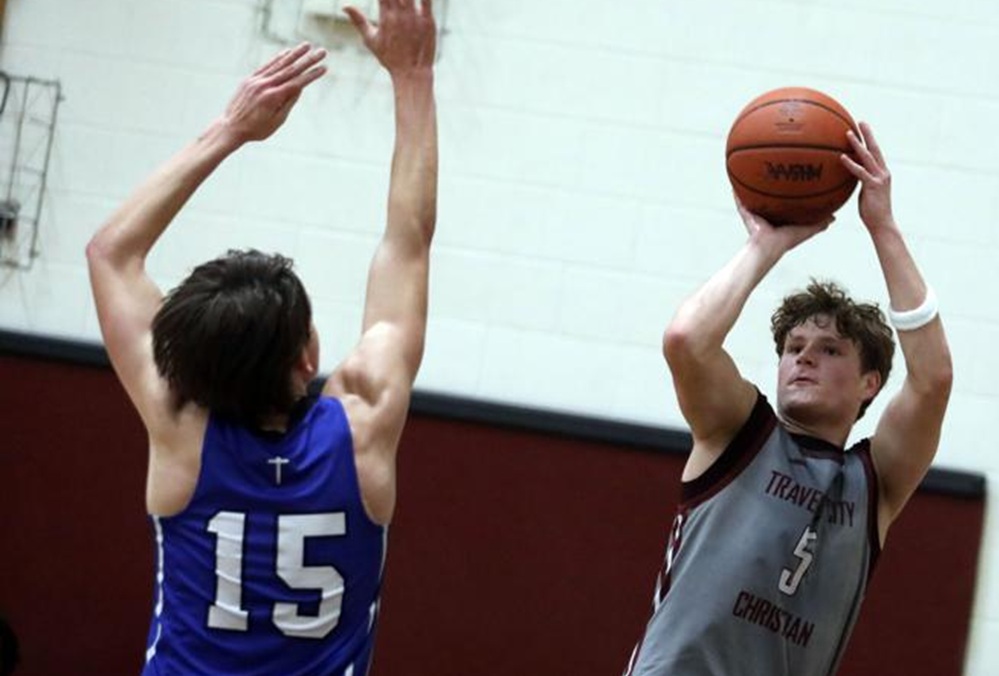
Traverse City Christian’s Reece Broderick tied an MHSAA record on Jan. 24, 2025, when he drilled 15 3-pointers during an 85-36 win over Grand Traverse Academy. He finished with 45 points total, with a high of six 3-pointers during the first quarter.
Those 15 contributed to his season total of 108 – which ranks fourth all-time – and he closed his four-year, 89-game varsity run that winter as the MHSAA career record holder with 368 3-pointers.
Total, he has five listings in the MHSAA boys basketball record book, with his 104 3-pointers as a junior continuing to rank fifth for a single season and just behind his senior-year performance.
See below for several recently-added listings to the boys basketball record book, and click the heading to see the record book in full. Several more applications have been received and are in the process of being confirmed.
Boys Basketball
Austin Cole played his roles well on both ends of the court in Burr Oak’s Jan. 10, 2023, win over Athens, and magnificently on the defense end. The sophomore had 15 steals in the 55-33 victory, setting a new single-game record, to go with his 11 points.
Eight days after Cole’s 15-steal game, senior Cody Boling tied the record with 15 steals in Center Line’s 79-54 win over Hazel Park – during which Boling also scored 31 points.
Five days after Boling’s 15-steal game, Crystal Falls Forest Park’s Felix Quevedo also totaled 15 steals, on Jan. 23, 2023, against Gwinn. Quevedo finished that season with 134 steals – fifth-most all-time – over 24 games.
Ben Miller finished his three-season varsity career at Dundee in 2018 with 316 rebounds over 24 games that winter to make the single-season list and 700 rebounds to make the career list in that category.
Saginaw Nouvel’s MJ Yeager added two more record book entries during a brilliant junior season in 2022-23. His 118 3-pointers over 26 games rank second on that list, and his 90-percent free-throw shooting success rate tied for 13th-highest for one season. He’s now playing at Oakland.
Mesick’s 2022-23 success included a District championship and a series of record book entries, especially for 3-point shooting. The Bulldogs were added three times for single-game 3-pointers, with a high of 18, and their 231 over 25 games rank sixth all-time. Carter Simmer was added for 88 3-pointers for the season and 195 over his four-season career. Teammate Ashtyn Simerson was added for 107 steals over 25 games.
Brandon Johns enjoyed a decorated four-season career at East Lansing from 2015-18 that saw him score 1,753 points and make the MHSAA record book with 378 free throws, 891 rebounds and 270 blocked shots – all over 89 games. He went on to play at University of Michigan and Virginia Commonwealth.
David Shillinger provided a record book-worthy defensive boost to Ludington during the 2022-23 season with 87 steals over 23 games as the Orioles finished 20-3.
Cooper Whipkey capped his Mackinaw City career in 2022-23 on three record book lists – for 93 3-pointers as a senior, 214 over his four-season varsity career, and also for 81 steals as a senior. Teammate Lucas Bergstrom made the single-season rebounds list with 331, and 2021 graduate Kal O’Brien was added for 708 rebounds over his four seasons. Lars Huffman made the single-season steals list in 2022-23 with 81 as well and the career list with 245 over four seasons. He's continuing his track career at St. Norbert (Wis.).
On Feb. 14, 2006, Benzie Central’s Tyler Moss totaled 14 steals in a game when he did so during a 71-63 win over Elk Rapids. Moss was a senior that season. Jaxon Childers made his presence known on both ends of the court throughout his four-year Benzie Central career, and defensively he made state history. Childers finished 2023-24 with 305 steals over 91 career games, good for 11th on that all-time list. He also made the single-season list with 98 as a sophomore and 93 as a junior. He played football at Northern Michigan.
Trent Hopkins made the list for most 3-pointers in one season in 2022-23, draining 81 in 223 attempts over 23 games for Auburn Hills Oakland Christian.
Cameron Peterson’s junior season at Rudyard in 2022-23 included a historic highlight, and he’s been added for his 20 points during the second quarter of a Jan. 21 game against Brimley. Peterson made six 3-pointers and another field goal over those eight minutes.
Carson Knoll undoubtedly found the zone Jan. 6, 2023, when he scored 21 points during the second quarter of Frankenmuth’s 68-28 win over Saginaw Swan Valley. Frankenmuth as a team also was added for making 16 3-pointers in a 75-45 win over New Lothrop that Jan. 18 and 15 against Standish-Sterling during the 2018-19 season.
Parker Hovey’s 217 assists over 24 games as a senior in 2022-23 are ranked 10th on that single-season list. The Hart graduate is continuing at Hope College.
Adrian Lenawee Christian’s 88-38 win over Britton Deerfield on Feb. 2, 2024, got off to a fast start – fast enough to make the record book. Lenawee Christian was added for points scored in one quarter after taking a 41-9 lead by the end of the first. Lenawee Christian also was added for making 216 3-pointers in 2024-25 and 196 in 2023-24.
Posen senior Logan Timm contributed plenty all over the floor in 2023-24, but most memorably on defense with 176 steals over 24 games. He also made the single-game steals list four times, with a high of 14 twice.
Senior Zander Smith drilled 12 3-pointers in a Feb. 2, 2024, New Haven win over Detroit Universal Academy, tying for fifth on the single-game list in that category. New Haven also made the team list with 19 total.
Among Cory Coe’s accomplishments as a senior in 2001-02, the Williamston senior made 90 percent of his free-throw attempts to make that record book list. He went on to play at Hillsdale College.
The 22 made free throws by Steve Balza on Feb. 14, 1989, ranked sixth-most in one game in MHSAA history at the time and remain tied for 10th-most 35 years later. He was a senior that season at St. Joseph Michigan Lutheran and attempted 30 total that game against Covert.
Bronson then-junior Kamron Brackett reached the record book for the first time in 2023-24 with 103 steals over 23 games, and he just missed the single-game steals list with 10 in two contests.
A little more than a decade later, LeRoy Pine River’s Tyler Lewis has reached the record book for his outstanding perimeter shooting as a senior in 2012-13. He was added to the season 3-pointers list with 84 after making nearly half his shots from beyond the arc. He went on to play at Lansing Community College.
After already earning a single-season steals listing as a junior, Grand Rapids Wellspring’s Zeekeal Jackson finished his career in 2023-24 with 267 steals over four seasons and 74 games. Grand Rapids Wellspring also was added to the records for making 206 3-pointers that winter, and 15 in a game.
Layk Woodruff and Reese Longstreth helped Beaverton coach Roy Johnston finish his career in 2023-24 as the all-time winningest in Michigan boys basketball history. Woodruff made the single-season 3-pointers list with 91 over 24 games, while Longstreth made the rebounds list with 310.
Austin Vang was like a wall on Suttons Bay’s side of the floor during a Feb. 18, 2025, win over Boyne Falls. The Norsemen then-senior set an MHSAA record with 16 steals.
Grand Rapids Forest Hills Central’s Jonas VanderWoude finished his high school career in 2024 making the record book for the first time with a .901 free-throw percentage over 26 games. He’s playing now at Davenport.
On Feb. 4, 2025, Hannahville Nah Tah Wahsh made a state-record 32 3-pointers in a 96-50 win over Wetmore Munising Baptist; all of the team’s points were scored from beyond the arc. Senior Jayden Sagataw tied for the fifth-most on the single-game individual list with 13.
Jalen Kampen capped his Parchment career in 2024-25 as one of the top free throw shooters in state history, connecting on 87 percent of his attempts as a senior to tie for 17th on the career list with a .807 percentage. He also made the single-season free throws made list with 162. As a team, Parchment made the single-game 3-pointers list with 15 and combined with opponent Delton Kellogg to make the list for two teams in one game as they had 24 together Jan. 7, 2025 – which tied for ninth-most on that list. Kampen is continuing at Central Michigan.
Carson Ososki earned an entry in the MHSAA record book in 2024-25 as a junior with his defensive work. He totaled 94 steals in 21 games played for Au Gres-Sims.
Shane Rykse finished his four-year Schoolcraft career in 2024 with 261 3-pointers, ranking 13th all-time, and with a career free-throw percentage of .852 that ranks fifth on that list. Additionally, Schoolcraft as a team was added multiple times including for 215 3-pointers (tied for 12th) during the 2023-24 season. Rykse plays at Spring Arbor. Tucker Walther capped his four-season Schoolcraft career in 2024-25 tied for fourth all-time having played in 104 varsity games. He helped his team to an 83-21 record and is continuing at Hope College.
Ewen-Trout Creek’s Jaden Borseth finished his four-year varsity career in 2022 with 2,073 points, one of only 47 players to reach 2,000. He continued at Gogebic Community College.
Austin Long finished his four-season varsity career at Vassar in 2024-25 on the all-time free throw list with 315 made in 420 attempts over four seasons and 91 games. He’s now playing football at Elmhurst (Ill.).
Cooper Wagner earned Saginaw Swan Valley’s first record book listing in this sport as a junior in 2024-25, with 112 steals in 24 games played.
Buckley’s Landon Kulawiak capped his four-season varsity career in 2024-25 on three career lists reflecting his scoring talents. He made the career points list with 2,034 over 91 games, the career 3-pointers list with 261 and career free throws list with 333. His 3-pointers total is tied for 13th.
Oskar Kangas finished his four-season varsity career at Iron Mountain in 2024-25 on the career rebounds list with 978 over 94 games. He also fell only 26 points shy of scoring 2,000. He’s playing at Wisconsin-Oshkosh.
Gregory Grays’ 60-point game for Southfield-Lathrup against Toledo Scott (Ohio) in 1997 already was in the record book, but a few more listings have been added. Grays scored 25 points during the fourth quarter of that game, and he also made 20 of 21 free throws – including 20 straight. He went on to play at Penn State and Detroit Mercy.
Landen Reister earned his school’s first boys basketball record book entry in 2024-25, when he made the steals list with 83 over 25 games. He was a senior and is playing now at Grand Rapids Community College.
Trey Lynn became the second player in Brimley history to reach the record book in this sport, doing so for single-season steals three times including with 111 as a senior in 2024-25, and for his 299 steals over 87 games and four seasons. Lynn is playing baseball at Bay College.
Brad Coleman finished his Millington career in 2025 as one of an elite group who have scored at least 2,000 varsity points – but also is listed in multiple other categories. Coleman finished with 2,058 points over 96 games and four seasons, and he also ranks in career steals and four times in free-throw categories, including eighth all-time with 523 made in 670 attempts. He’s continuing his career at Grace Christian.
More than 40 years after graduating from Melvindale, Paul Bargardi was added for his 367 rebounds as a senior in 1982-83. He went on to play at Saginaw Valley State.
Luke Tropea earned multiple 3-pointers listings during his career at Chelsea as a freshman and Jackson Lumen Christi over his final three seasons before graduating in 2025. He made the single-season list as a senior with 90, and the career list with 233.
Onsted’s Ayden Davis finished his impressive four-year run in 2024 on single-season and career lists for rebounds and blocks. He ranks fifth all-time with 1,222 career rebounds over 90 games, and second on the blocks career list with 479 – with a fourth-best single-season listing of 161 blocks as a sophomore. He’s playing at Wright State.
PHOTO Traverse City Christian’s Reece Broderick shoots a 3-pointer against Gaylord St. Mary during his senior season. (Photo courtesy of Traverse City Record-Eagle.)