

Father & Son Seidl Have Much to Discuss, Notes to Compare From Perfect Starts
By
Doug Donnelly
Special for MHSAA.com
February 7, 2023
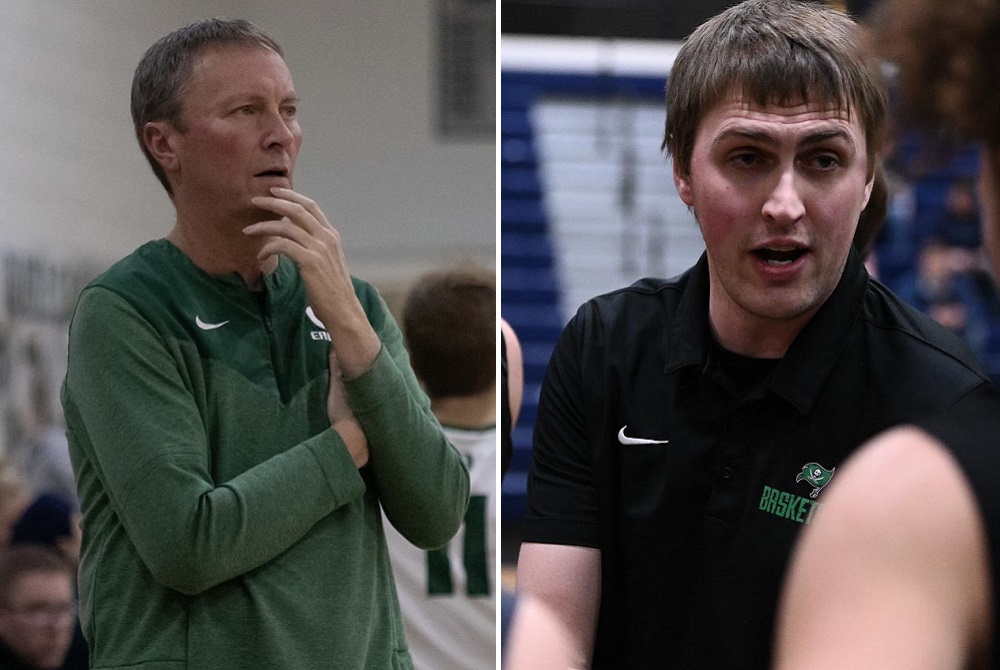
Matt and Derek Seidl have a lot to talk about these days.
 The father and son duo both have highly-ranked, undefeated basketball teams going into the first full week of February, something neither of them saw coming.
“We were hoping for a season like this, but you never think about winning this many in a row,” said Matt Seidl, the father and head coach of the 15-0 Olivet Eagles. “When our season ended last year, we knew our top seven players would all be returning.”
About 50 miles south of Olivet, in Jackson County, Derek Seidl has the Napoleon Pirates off to a 14-0 start. They are sitting on top of the Cascades Conference.
“We have a really talented group right now,” Derek said. “We were 19-3 last year and brought six guys back. Having that experience has been very valuable.”
Olivet is ranked No. 2 in MPR in Division 2 while Napoleon is No. 9 in Division 3. Both are top-10 teams in the latest Associated Press polls as well.
Matt Seidl, 60, graduated from Ypsilanti Lincoln High School in 1981 and went to Eastern Michigan University to become a sportswriter. He didn’t begin teaching until he was in his early 30s, but, by then, was already a veteran coach.
“It was getting difficult because I was always leaving my job to go coach,” he said. “I decided to go and get my teaching degree.”
He wound up in the classroom, which enabled him to dive deeper into coaching. He spent several years coaching at the middle school and high school levels, boys and girls, with stops at places like Pinckney, Ypsilanti, Manchester, Willow Run and Romulus. He was the JV boys basketball coach at Dexter when his son, Derek, made the team as a freshman.
 By then, Derek already knew he would be on the bench one day as a coach.
“I played for my dad in youth travel stuff, and he was on staff for one year my freshmen year of high school,” Derek said. “He was a varsity coach all growing up. I was always at games. I loved talking to him about the game, the strategy of it, the Xs and Os. Even when I was younger, I thought about coaching someday. Growing up if you would have asked me what my dream job was, it would have been a teacher and coach.”
Derek, 27, graduated from Dexter in 2014. He played four years of college basketball at Lawrence Tech University. After getting his master’s degree and teaching degree, he got his first coaching job as an assistant coach at Chelsea, under Josh Tropea, who also had coached with Matt.
Derek’s first teaching and head coaching job came at Springport in 2019-20. This is his third year at Napoleon.
“It’s been a really good fit here,” Derek said. “Before I started looking into the job, I barely knew anything about Napoleon. It has worked out well.”
Matt is also the athletic director at Olivet. If he would have had his way, Derek would be coaching at Olivet.
“Derek did a really good job at Springport, and we had an opening and he interviewed and was recommended for the job, but before they offered it to him, Napoleon hired him,” Matt said. “He would have been the perfect choice to teach math and coach basketball.”
With Derek no longer in the running, Matt came out of coaching retirement and was named head coach.
“It was going to be a one-year deal, sort of a band-aid to get us to the next year,” he said.
Instead, Matt’s stayed on and put together quite a successful team. The Eagles have gone 47-6 since the start of the 2020-21 season. This year’s team has taken a big step.
Junior Bo Lincoln, a 5-foot-11 junior point guard, leads the team in scoring (17.1 points per game), assists (3.6 per game), steals (3.0 per game) and free throw percentage at 78 percent.
Drew Priddy, a 6-5 senior center, is averaging about eight points and seven rebounds a game, and junior guard Bryce Wine is averaging nine points a game and leads the team in 3-pointers.
“We had quite the youth movement a few years ago,” Matt said. “We go 8-9 deep now and have a lot of experience. Having those young guys play a couple years ago is paying off.
“We are a good team, but we’re not a 70-possessions-a-game type of team. We know who we are.”
 Derek also knows plenty about his dad’s team.
“I definitely keep track of them,” he said. “We talk on the phone on a daily basis – 30 minutes about Napoleon and 30 minutes about Olivet. We bounce things off each other. We run a lot of the same stuff as far as systems. We’re very connected on things.”
Matt and Derek’s teams tried to have a good old-fashioned scrimmage, or exhibition, last year but – with Derek’s team ahead – Matt received two technicals and got kicked out of the game. It’s a fun story for both to tell now.
“That was wild,” Derek said. “It was a cool thing we had going. We were winning so I was enjoying it, but that put a whole different spin on the situation.”
Matt said they probably won’t do that again. Probably.
“My wife said no,” he said. “Derek and I have talked about it, but I don’t know that it would ever happen.”
Derek said one day he’d like to coach with his father.
“I’m very energetic and into it, just like he is,” Derek said. “There are some similarities. I played for him and watched him a lot. I try and pull some of the things he does, being prepared. We get along super well. I don’t know if I could trust him to not get technical fouls.”
He’s kidding, of course.
Napoleon has a core group of four players with a ton of experience.
Devonta Habern is a 5-11 junior who is on the varsity for the third year and runs the show at point guard. Six-foot-5 senior Trent Jester is one of the best big men in the conference. University of Michigan baseball commit Grant Bradley is a three-year varsity starter and outstanding athlete. Holden Vanpoppel is an all-state track athlete who has turned into a pretty good basketball player.
“Grant is super steady and having a great year,” Derek said. “He looks like he’s been in the weight room since he was 5 years old. He can guard anybody. Vanpoppel is an unbelievable run and jump athlete. All four of these guys are averaging in double figures. They are really good athletes who have invested in the program and put the time in.”
“We’ve got a very talented group,” Derek said. “They are a little looser than I am. I tend to be very calculated, kind of analytical and serious. They like to goof around a little bit. They keep me even-keeled. They know when to get serious. It’s good for me to have a group like that.”
Derek said his squad wants to exceed expectations this year.
“We talk about that after every game – don’t be satisfied just because we are undefeated,” Derek said. “There is plenty more to accomplish. Last year we went 18-2 in the regular season and 19-3 overall, but we didn’t win a league or a District. Our guys have bought into that mindset. That’s helped us get to where we are.”
Matt is keeping a close eye on not only his team, but Derek’s as well.
“I probably get more stressed watching his games,” he said. “I’m really proud of what he has been able to do.”
 Doug Donnelly has served as a sports and news reporter and city editor over 25 years, writing for the Daily Chief-Union in Upper Sandusky, Ohio from 1992-1995, the Monroe Evening News from 1995-2012 and the Adrian Daily Telegram since 2013. He's also written a book on high school basketball in Monroe County and compiles record books for various schools in southeast Michigan. E-mail him at [email protected] with story ideas for Jackson, Washtenaw, Hillsdale, Lenawee and Monroe counties.
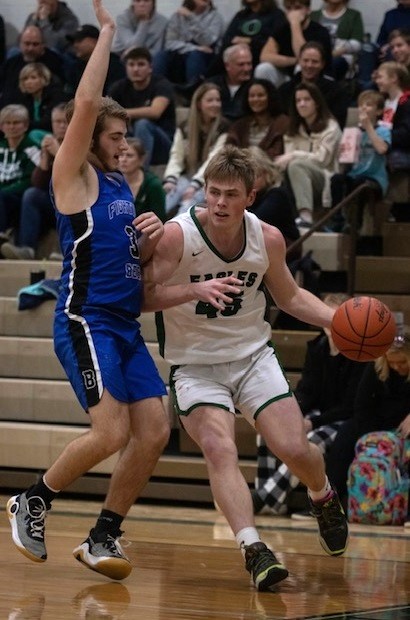
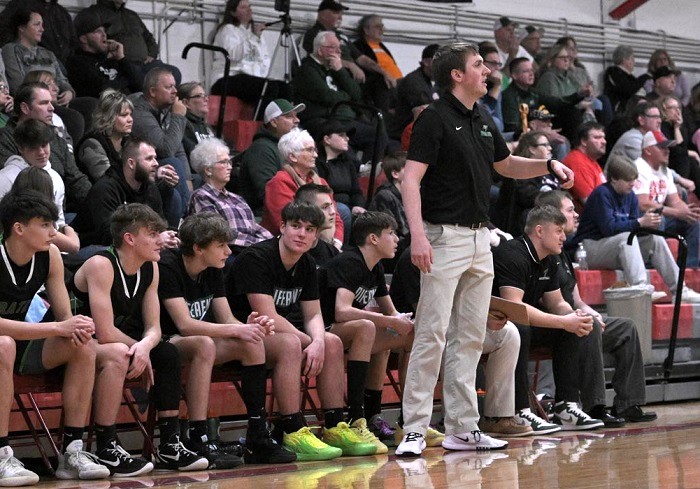
PHOTOS (Top) Father Matt, left, and son Derek Seidl are leading undefeated boys basketball teams this season at Olivet and Napoleon, respectively. (Middle) Senior Brayden Wine makes a move toward the basket for the Eagles. (Below) Derek Seidl instructs his players. (Olivet photos courtesy of Olivet High School; Napoleon photos by Jeff Steers/JTV.)
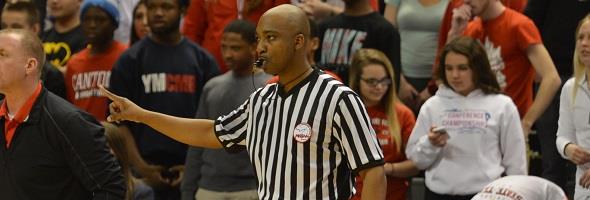
Be the Referee: Hoops Officials Manual
February 20, 2020
This week, MHSAA officials coordinator Sam Davis announces the addition of a new resource to assist basketball officials across the state.
Be The Referee is a series of short messages designed to help educate people on the rules of different sports, to help them better understand the art of officiating, and to recruit officials.
Below is this week's segment - Basketball Officials Manual - Listen
High School basketball officials in Michigan have a new resource to help them better understand all aspects of their role.
The new Basketball Officials Manual is available in a hard copy format from the MHSAA Office, and can also be downloaded from the MHSAA Website for handheld device use.
The book emphasizes and promotes consistency in rules knowledge and application, theory and philosophy and mechanics and signals.
This uniform approach will help assure MHSAA member schools and teams they can rely on the same approach to officiating, regardless of where they are located in our great state.
The basketball book is the first in a series of such sports-specific manuals. A hard copy can be ordered for $10, and the PDF download is free.
Past editions
Feb. 13: Held Ball or Traveling - Listen
Feb. 6: Hockey Rules Chart - Listen
Jan. 30: Cheer Safety - Listen
Jan. 23: Goaltending - Listen
Jan. 16: Wrestling Tie-Breaker - Listen
Jan. 9: Pregame Meeting - Listen
Dec. 19: Alternating Possession - Listen
Dec. 12: Ratings - Listen
Dec. 5: Video Review Success - Listen
Nov. 28: More Injury Time - Listen
Nov. 21: Football Review - Listen
Nov. 14: Sideline Safety - Listen
Nov. 7: Officials Playlist - Listen
Oct. 31: Most Important Line - Listen
Oct. 24: Automatic 1st Downs - Listen
Oct. 17: Catch Momentum - Listen
Oct. 10: Golf Rules Changes - Listen
Oct. 3: No Tackle Box - Listen
Sept. 26: You Make the Overtime Call - Listen
Sept. 19: Swimming Finishing Touch - Listen
Sept. 12: Curbing Gamesmanship By Substitution - Listen
Sept. 5: Football Safety Rules Changes - Listen
Aug. 29: 40-Second Play Clock - Listen