

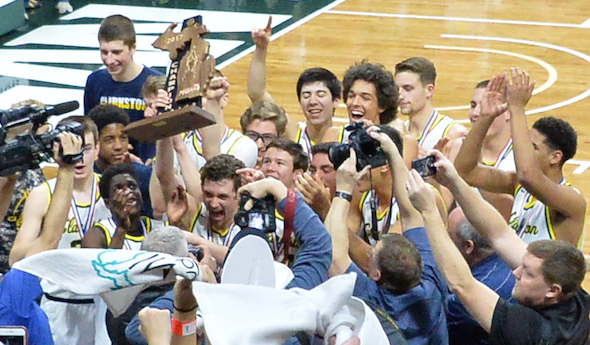
Finally, Clarkston Celebrates in Class A
By
Paul Costanzo
Special for MHSAA.com
March 25, 2017
EAST LANSING – After 35 years, nearly 700 wins and three high school gyms, Dan Fife has brought an MHSAA title to his alma mater.
Fife’s Clarkston boys basketball team defeated Grand Rapids Christian 75-69 on Saturday in the Class A Final at the Breslin Center for the first boys basketball title in program history.
“It’s really unexplainable right now,” Fife said. “I really don’t know how to put it. All I know is I’ve been through three high school gyms at Clarkston during my tenure. I’ve said this before, but I really truly meant it: Clarkston’s a special place, I think one because we have one public school in our district. We have great support from our administration, our teachers and our families. I don’t think you can be successful in athletics, especially in today’s world of athletics, if you don’t have that support.”
Fife, who has a 677-169 record at Clarkston, is a 1967 graduate of the school. He took over the program 1982, and in his 35 seasons, only one has ended without a winning record. Even that season included a District title.
 “This whole season has been a group journey,” Clarkston all-state junior guard Foster Loyer said. “For my teammates and myself to come out here and win this state championship tonight, it not only means everything to us as players, as a team, as a family; but just knowing we were able to get that done for Coach Fife, it’s what we’ve been dreaming about since we started playing basketball here in Clarkston. It’s just been a phenomenal experience, and we’re loving life right now.”
Loyer, a Michigan State recruit, led all scorers with 29 points on his future home court, shooting 50 percent from the field (8 of 16) and from 3-point range (4 of 8). His future MSU teammate, senior Xavier Tillman, led Grand Rapids Christian with 25 points on 12 of 15 (80 percent) shooting, and grabbed seven rebounds.
“(Loyer) can shoot the ball, he can handle the ball, he can pass the ball, so it’s kind of like pick your poison when it comes to Foster,” Tillman said. “When we tried to step up, he would drive by, give a pump fake, get the foul, two free throws. It was hard to stop him, and he’s going to be a great player for us later on when it comes to Michigan State.”
Clarkston sophomore Taylor Currie added 16 points and 10 rebounds, while junior C.J. Robinson had 14 points, and senior Dylan Alderson had 12. Grand Rapids Christian juniors Duane Washington, Jr., and Setrick Millner, Jr., added 16 and 11 points, respectively.
“I give Clarkston a lot of credit – they’re well coached, their kids played great, they played hard, and they responded and made shots,” Grand Rapids Christian coach Mark Warners said. “The ball didn’t always go our way, but that’s the way the game goes. They were awesome tonight. We were good, but we weren’t awesome.”
Fife lauded his team’s overall effort in the game, as Robinson’s secondary scoring – specifically 12 second-half points – and ballhandling were able to take pressure off Loyer, and Currie was able to hold his own at times and stay out of foul trouble against Tillman despite giving up more than 50 pounds.
“We knew that (Tillman) is a great force in the paint,” Currie said. “My main focus going into the game was just try to stay in front, knowing I had help in the back. If I could force a pass over the top, it could be a steal. Then when he got the ball, trying to stay straight up and avoid getting into foul trouble. And keeping him off the glass, that was something we really keyed in on because he’s a great rebounder, especially on offense. He uses his body really well, so I was trying to box out as soon as I could.”
 Clarkston (27-1) gained the game’s first bit of separation with 3-pointers on four straight possessions to close out the first quarter. Loyer hit three in a row, while Alderson added one at the buzzer to give the Wolves a 20-12 lead.
They led by as many as 11 points in the second quarter, as Loyer opened it with another 3. Grand Rapids Christian (27-1) pulled to within three on a 3-pointer from Tre Vallar in the final minute of the half, but an acrobatic buzzer beater from Robinson gave Clarkston a 34-29 lead heading into the break.
Grand Rapids Christian had a better half from the field, shooting 57.1 percent compared to Clarkston’s 40 percent, but the Wolves held an 8-0 edge in points off turnovers and an 11-2 edge in second-chance points, as they pulled down nine offensive rebounds during the opening 16 minutes.
The hot shooting continued for the Eagles into the third quarter, but they weren’t able to close the gap, as Clarkston was just as hot, hitting 75 percent of its shots in the third quarter and 60 percent in the fourth. The Wolves also shot 14 of 17 from the free throw line (82.4 percent) in the fourth quarter.
“We scored 69 points, so offensively we were fine,” Warners said. “The problem is we gave up 75. The credit goes to, like I said, to Clarkston. We just didn’t have an answer consistently. We’d get a good defensive possession and then we’d come down and not capitalize on it, miss a shot. Then they’d come down and make a shot.”
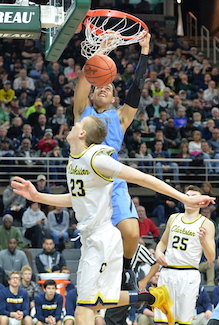
PHOTOS: (Top) Clarkston holds up its Class A championship trophy in celebration after Saturday’s Final. (Middle) Clarkston coach Dan Fife. (Below) Grand Rapids Christian’s Duane Washington, Jr., throws down a dunk.
Starkey's Petoskey Ready to Shine Again
December 15, 2017
By Dennis Chase
Special for Second Half
PETOSKEY – Dennis Starkey remembers it like it happened yesterday.
Thirty-five years ago, at the age of 23, Starkey made his varsity head coaching debut with the Boyne City Ramblers.
 “The first game I coached was against the legendary Charlie Paige (Harbor Springs),” Starkey recalled. “I got it handed to me pretty good. I knew I had a long way to go after that ballgame.”
Starkey learned quickly. Now, starting his 31st season as coach of the Petoskey Northmen, the 58-year-old is among the winningest coaches in MHSAA history. His 536 career wins rank 18th all-time among boys coaches – with an average of nearly 16 wins a season.
Starkey should move up that list in the coming weeks as the Northmen appear poised for a promising winter.
Petoskey opened the campaign by capturing its Tip-Off Classic last weekend, beating Marquette 55-38 and Manton 66-57. Marquette won 20 games a year ago, while Manton was a Class C semifinalist.
“It’s a great start,” Starkey said. “We played two good teams. We have a lot of work to do, but we’re excited. This is a good group. These guys were really committed during the offseason. Hopefully, that will pay dividends.”
Petoskey was an uncharacteristic 12-8 a year ago. That squad was comprised of three seniors and nine juniors – and one of the key juniors, 6-foot-9 center Danny Kolp, was recovering from knee surgery.
“I’ve always said you win and lose with seniors,” Starkey said. “Our inexperience really showed last year. Luckily, we’re loaded with seniors this year. We’re hoping to get back to where we were before.”
The Northmen were 20-2 two years ago.
Motivation should not be a problem.
“We were pretty unhappy with how we did last year,” senior Joel Wilson, a two-year starter, said. “I expect a lot from this team.”
So does Kolp.
“(High school) memories last forever, and we want to make this a memorable senior season,” he said. “We want to reach our full potential. We have a high ceiling.
“We have the athleticism and skills to make a run in the tournament,” he added. “That’s our goal. Petoskey hasn’t been to a Regional (since 2012). We have a good chance to do it this year if we keep playing as a team.”
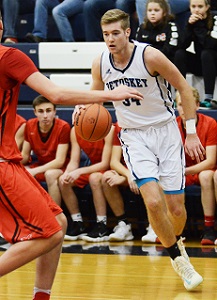
Petoskey, which returns four starters, put its size and balance on display last weekend. Seth Mann, a 6-5 guard, averaged 17 points in the two wins. Kolp, who has signed with Northwood University, came up big in the paint, averaging 16 points, six rebounds and two blocks. The athletic 6-4 Wilson contributed 13 points a game, and 6-5 Jake Lee 9.5 points. All are seniors, as is starting point guard Collin Kingma.
Petoskey not only used its length to its advantage – especially defensively and on the boards – but played with a focus.
“I think the biggest improvement thus far is mental,” assistant coach Kevin Starkey, Dennis’s son, said. “Even coach Hiller (Ryan Hiller at Manton) told me after watching the Marquette game that the guys looked locked in, ready to go. It’s visibly noticeable.”
Dennis Starkey started this season much like he has the previous 34, preaching a “team first” approach. From there, he addressed the standards his program is built on.
“It starts with being good students, good citizens,” he said. “If you have to fight issues that do not involve basketball, then you’re never going to be successful (on the court). Our guys have bought into a system that starts with everyone playing together, playing the way we expect and acting the way we expect.”
Starkey asks that his players, especially his seniors, take ownership of the team. As a reminder, after each practice, the coaches step away as the players huddle on the court to dissect that day’s effort.
“The one thing I’ve always enjoyed about coach Starkey is that he emphasizes it’s our team and we can make it how we want to make it,” Kolp, a three-year varsity veteran, said. “We’re not going to be as good if he’s the only one barking at us. He holds us accountable, and we enjoy that challenge.”
“He likes to say we’re all coaches on the court, that we should be coaching and learning from each other,” Wilson added. “He stresses that every day.”
It helps, of course, to have a team that’s already tightly woven. The seniors on this team have been playing basketball together since fifth grade and are “buddies” off the court.
 On the court, Starkey clearly sets the tone, though.
“He’s not afraid to get in your face,” Wilson said. “He pushes you hard. But it’s all for the better.”
Petoskey has long been noted for producing disciplined, fundamentally-sound teams. That’s Starkey’s style.
“We try to play up-tempo as much as we can,” he said. “But we really rely on executing offensively and defensively in the half court.”
It’s an approach that runs deep in the system. Sean Pollion, Matt Tamm and Jason Miller all have 20-plus years coaching high school basketball at the school. Pollion is an assistant to Starkey, Tamm is now the JV coach while Miller just moved over to the girls program. In addition, Kevin Starkey and Jon Flynn, a star on the school’s two Class B Semifinal teams in the late 1990s, are assisting.
“That continuity means so much in high school basketball,” Dennis Starkey said. “Some programs have a hard time keeping coaches for extended periods. It’s been an advantage for us. It’s paid dividends.”
Starkey started honing his skills at Boyne City, serving a one-year apprenticeship under Bob Taylor, who went on to coach in the Great Lakes Intercollegiate Athletic Conference. He replaced Taylor, who took the Lake Superior State women’s job, and then left Boyne City after a season to accept a head coach/athletic director position at Vanderbilt. It was there he met his wife, Karen. After three years, Starkey moved on to Petoskey. To this day, former longtime Petoskey athletic director Gary Hice calls it one of the best decisions he ever made.
Inducted into the Basketball Coaches Association of Michigan Hall of Fame in 2014, Starkey has coached teams that have won 17 Districts and four Regionals.
His 1996-98 squads featured guards Trevor Huffman, who later led Kent State to an Elite 8 NCAA Tournament appearance in 2002, and Flynn, Grand Valley State’s all-time leading scorer (2,220 points).
Starkey would later coach his sons, Kevin and Cory. Cory, who went on to earn all-state honors, played at Bucknell and then a year professionally in Ireland. After earning his master’s degree in international finance, Cory accepted a job with an investment company in Chicago. His boss? Former Charlevoix basketball standout Scott Friske, now a senior vice president at First Trust. Friske and Petoskey’s Damon Huffman, Trevor’s younger brother, were teammates at Brown. Another former Charlevoix Rayder, Jared Hunt, also works at First Trust.
“Basketball opened a door for (Cory) in the business world,” Dennis Starkey said. “He’s been blessed. When you’re involved in this sport, you have so many contacts. And a lot of the northern Michigan guys look after each other. It’s a real special bond they create, all because of high school basketball.”
But the story is not over. Trevor Huffman is also in Chicago and lives with Cory. Huffman is still involved in basketball.
“He’s using basketball as an adult workout platform,” Starkey said. “He has guys come in and they do drills, much like we do in practice. So instead of going to the gym and lifting weights and doing cross-training, his clients, most of them former players, use basketball as a form of exercise to become more fit.”
After graduating from University of Michigan, Kevin Starkey headed back north and took a teaching/coaching job at Manton, serving as an assistant to Hiller. The Rangers first game that season? Petoskey.
“That was bizarre, coaching against my dad,” Kevin admitted.
When Dennis Starkey retired as a physical education teacher, Kevin Starkey was hired to replace him. He’s now in his third year at the school.
It’s given Kevin a unique perspective on his dad. He played two years for him on varsity (2007-08 and 2008-09) and has now coached with him three years. When asked if he has a favorite story that encapsulates the type of person his father is, Kevin doesn’t have to think long.
“My senior year we were playing Charlevoix and I had just recently broken my hand,” he said. “It was my first game back. We didn’t know what to expect. When the game started, they were sagging off me because (the injury) was to my shooting hand. When I put up that first shot, I hit it. Then, all of a sudden, I hit five 3s in the first half. He never lets it go. It’s something I remember because he was so proud of me. It was my last (home) game and I was just trying not to air-ball it. Somehow, a few of them went in.
“Well, the next year when I came home from college – we sometimes watched old game films, or films of us growing up – he puts that game in first. He was like, ‘Man, that was so cool.’ I say that not because I need credit, but it was one of those things where he was more excited than I was for myself.”
 That, Kevin added, is how Dennis is with his players. He wants the best for them.
This team is no exception.
Kolp, who has had two knee operations, is finally healthy. His last surgery was in June of 2016, and he missed the first six games a year ago.
“He really wasn’t himself - until now, to be honest,” Starkey said.
In eighth grade, Kolp landed awkwardly on his right leg, tore a ligament and dislocated his kneecap.
“They couldn’t do the full operation because I was still growing,” he explained. “Two years later I blew it out again.”
Kolp, who plans to go into an entrepreneurial program at Northwood, spent this past offseason working hard in the weight room.
“I was in there five days a week, lifting to improve my upper and lower body,” he said. “Now, during the season, I’m in there two to three times a week to maintain my strength. I feel good. Everything is coming together.”
Wilson, all agree, is the most athletic player on the squad. He was a first-team all-Big North Conference pick as a quarterback and outside linebacker in football. Several colleges have expressed interest, and he is visiting Central Michigan this weekend and will miss Saturday’s game with Zeeland East. Central Michigan is recruiting him as a preferred walk-on with plans to use him at tight end.
“It’s (disappointing) to miss the game, but I have a decision to make that will (affect) the next four years of my life,” he said.
Mann is the team’s top perimeter shooter.
“Seth is a skilled shooter,” Starkey said. “He has good size and length. I think he’s going to have a great year.”
Kolp agrees.
“With our size, if we get it into the post, and (opponents are) starting to play help defense from the backside, and Seth is in the corner, he’ll punish them for it,” he said.
It could be a special season.
Starkey, though, is not one to think too far ahead. He said the best advice he ever received was to “live in the moment, coach in the moment.”
And he knows there will be challenges ahead. There are no guarantees.
“As excited as I am with all the guys we have back, every coach in the league feels the same way,” he said. “Last year there was only one senior on the first and second all-conference team. It’s going to be a very good race.”
As for the future, Starkey, who credits a strong support system at home for his success, is not saying how much longer he’ll coach.
Kevin has an opinion, however.
“It’s something he’s really good at,” Kevin said. “I look at it like this: Don’t throw it away if you’ve still got it.”
 Dennis Chase worked 32 years as a sportswriter at the Traverse City Record-Eagle, including as sports editor from 2000-14. He can be reached at [email protected] with story ideas for Manistee, Wexford, Missaukee, Roscommon, Ogemaw, Iosco, Alcona, Oscoda, Crawford, Kalkaska, Grand Traverse, Benzie, Leelanau, Antrim, Otsego, Montmorency, Alpena, Presque Isle, Cheboygan, Charlevoix and Emmet counties.
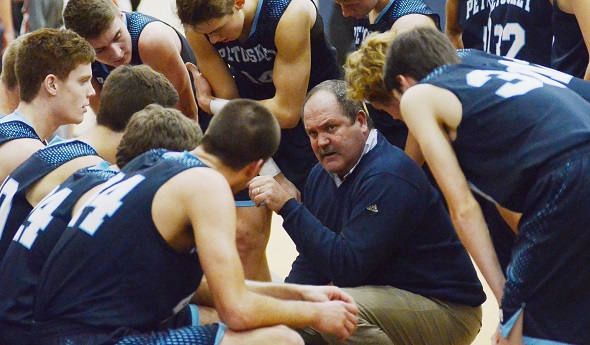
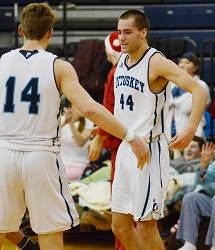
PHOTOS: (Top) Petoskey coach Dennis Starkey huddles with his team during the season-opening Tip-Off Classic. (Middle) Joel Wilson (14) and Jake Lee share a celebratory moment. (Below) Senior Danny Kolp pushes the ball upcourt during the event. (Photos courtesy of the Petoskey News-Review.)