

'Football Guys' Play Big Roles for Big Reds
February 6, 2020
By Tom Kendra
Special for Second Half
Cameron Martinez is not done having fun in high school.
 Martinez, MLive’s two-time Michigan High School Football Player of the Year, signed his national letter of intent to play football at Ohio State during a midday event Wednesday at Muskegon High School.
But unlike the rest of the Buckeyes’ incoming class, who are either specializing in only football or have already left their high schools and early-enrolled in Columbus, Martinez is playing a key role for the Big Reds’ state-ranked basketball team.
“I want to enjoy being a high school kid as long as I can,” said Martinez, who rushed for 6,491 yards and 145 touchdowns during his four-year varsity football career, with his first two years at Muskegon Catholic Central and the last two at Muskegon High.
“I really do enjoy playing basketball, and we want to make a long run. We still haven’t played our best game yet.”
Martinez is not the only Division I football signee who chose to honor his commitment on the hardcourt for Muskegon.
Billie Roberts and Jordan Porter, who both will play defensive line at Bowling Green, provide valuable muscle inside for the Big Reds, who are ranked No. 7 in Division 1 in the latest Associated Press poll.
Muskegon is 10-1, with its only loss coming Jan. 4 against visiting Chicago Curie, the top-ranked team in Illinois. In addition to being perfect in Ottawa-Kent Conference Black play, the Big Reds have pulled out tight nonleague wins over Rockford, East Kentwood, Ferndale and, most recently, Saginaw on Saturday at the Redhawk Showcase in Grand Rapids.
 Muskegon coach Keith Guy, who also happens to be the stepfather of Martinez, shudders at the thought of not having the three Division I football recruits on his team.
“We do things a little different around here,” said Guy, explaining the symbiotic relationship between the Big Reds’ football and basketball programs. “I am thankful that these guys play football. They bring physical toughness, leadership and just an expectation of winning.”
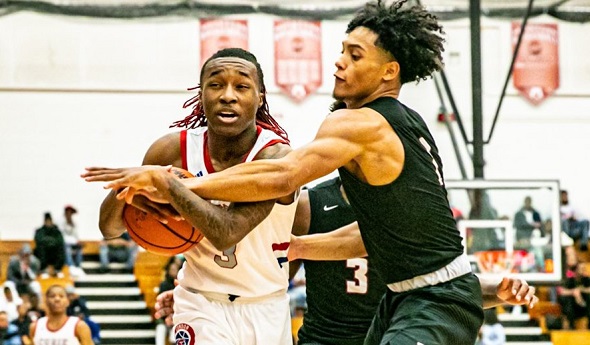
Martinez, a 5-foot-11, 190-pound guard, averages 3.2 points and 2.3 rebounds per game, but his big contribution is as the team’s defensive stopper. While in football he electrified the crowd with his offense (Exhibit A: His seven rushing touchdowns in this year’s playoff opener against Marquette), in basketball he brings the fans to their feet by locking down on the opponent’s best player.
“It’s a lot like playing defensive back, where you are guarding someone 1-on-1,” explained Martinez, who is projected as a defensive back and kick returner at Ohio State.
Roberts, a 6-5, 270-pound post player, has been slowed and often sidelined by a lingering stress reaction in his fibula, and is averaging just one point and one rebound per game.
Guy, who led Muskegon to the Class A championship in 2014, said his big man is starting to get healthier, which will be critical as the team chases its ultimate goal of another Finals title.
Porter, a 6-4, 240-pound forward, brings size and versatility off the bench. He averages 2.5 points and four rebounds per game.
“Basketball helps me so much,” said Porter, who is projected as a defensive end and hybrid lineman/linebacker at Bowling Green. “Obviously, it helps me conditioning-wise. But it really helps with footwork and moves.”
Muskegon High School gets more than its fair share of visits from college football coaches, and many ask to watch basketball practice to get better looks at their prospects’ athletic abilities. Those coaches especially like to see how well linemen prospects like Roberts and Porter can move.
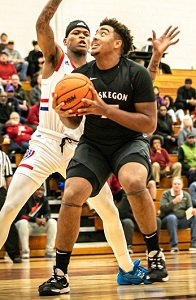 “I got my first offer from Indiana in my sophomore year because of basketball,” said Roberts, who went 52-4 during his four-year varsity football career and played in four MHSAA championship games at Ford Field. “They knew I had good size, but they saw that I could run and move and I think that’s why they offered me.”
Roberts is starting to move better every day, according to Guy, and Guy said that’s a big reason for his team’s improved play of late. After a narrow win at Ferndale on Jan. 20, the Big Reds blew out four straight conference opponents before Saturday’s dramatic win over Saginaw.
Guy sported an Ohio State football T-shirt during Wednesday’s signing event, but his mind was on this weekend’s big back-to-back games – Friday at Grand Rapids Union and Saturday at home against Grand Blanc.
He expects Muskegon’s historic Redmond-Potter Gymnasium to be rocking and rolling Saturday, when Grand Blanc, 10-3 and an honorable mention in Division 1, rolls in with standout 6-5 sophomore Ty Rodgers.
Muskegon will counter Rodgers with a veteran team, including five senior starters and one of the state’s best backcourt duos in Jarvis Walker and Vernon Nash III. Walker, a Mr. Basketball candidate, averages 21.5 points, 5.5 rebounds and 2.1 assists per game, while Nash averages 14.8 points.
The X-factor in Saturday’s showdown might be the Big Reds’ “football guys,” who Guy hopes will give his team a physical and mental edge.
Roberts can’t wait.
“There’s nothing like high school,” explained Roberts, flashing a big grin. “I could have early enrolled, but I didn’t want to miss my senior basketball season and prom and all that. I want to stay a kid a little bit longer.”
 Tom Kendra worked 23 years at The Muskegon Chronicle, including five as assistant sports editor and the final six as sports editor through 2011. E-mail him at [email protected] with story ideas for Muskegon, Oceana, Mason, Lake, Oceola, Mecosta and Newaygo counties.
PHOTOS: (Top) Muskegon’s Cameron Martinez, right, walls off a Chicago Curie ball handler during their teams’ Jan. 4 matchup. (Middle) The Big Reds’ Billie Roberts works to gather a loose ball. (Below) Jordan Porter makes a move to the basket. (Photos by Tim Reilly.)
Clarkston Earns 1st Shot at Dream Finish
March 24, 2017
By Geoff Kimmerly
Second Half editor
EAST LANSING – Dan Fife dreamed of playing for an MHSAA basketball championship at Jenison Field House while a student at Clarkston 50 years ago.
Thursday afternoon, the current Wolves made similar dreams come true – and offered their coach that opportunity he never was able to achieve as a player.
Clarkston’s 78-35 win over league rival West Bloomfield in Friday’s first Class A Semifinal earned the program its first appearance in an MHSAA boys basketball championship game.
The Wolves have had piles of success under Fife, the fourth winningest coach in state hoops history with 676 wins since taking over the program before the 1982-83 season. He’s led Clarkston to 30 District and 12 Regional titles, with Friday’s Semifinal the second during his tenure.
“Coach Fife, I don’t think he’ll admit how much it means to him. But it’s everyone’s goal at the beginning of every season; your ultimate goal is to finish out with a win,” Clarkston junior guard Foster Loyer said. “For Coach Fife, and the community of Clarkston, that would just mean the world to all of us, just motivate us to keep working even more.”
Clarkston (26-1), which entered the postseason tied for No. 3 in The Associated Press’ final regular-season Class A poll, will finish this season against Grand Rapids Christian at noon Saturday at the Breslin Center.
The Semifinal was the third ever in Wolves history. And the rare opportunity to advance to Saturday came with an even rarer opportunity to face a familiar opponent in this late round of the tournament.
Clarkston had beaten West Bloomfield (17-9) by 11 and seven during the regular season on the way to winning the Oakland Activities Association Red championship; the Lakers tied for third in the league.
And they knew what to expect from Loyer, a junior already committed to play at Michigan State. But it didn’t help much this time.
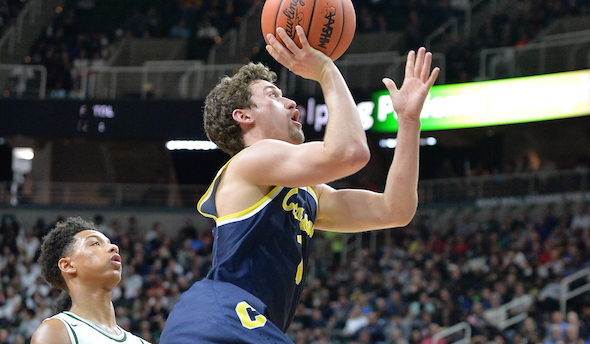
 Loyer’s first shot of the game, an attempted layup, sailed over the rim. His second shot, a 3-pointer, touched nothing but net.
Making 10 of 17 shots from the floor and 5 of 8 3-pointers, Loyer finished with 32 points, to go with seven assists. Senior forward Dylan Alderson added 27 points, and sophomore center Taylor Currie had 10 points and 16 rebounds as Clarkston hit 57 percent of its shots from the floor – including an incredible 69 percent during a first quarter that ended with the Wolves carrying a 24-13 lead.
Clarkston took an 18-point advantage into halftime.
Senior guard Kevin McAdoo led the Lakers with 22 points, but as a team they made only 22 percent of their shots from the floor, and had just one steal as Clarkston had only four turnovers but 17 assists.
“It’s a tough one to swallow today, especially with the ride we were on to get here,” said seventh-year West Bloomfield coach Jeremy Denha. “What a fun, fun time to get here with the ups and downs and the way the kids battled. We hadn’t sniffed a District Final, let alone a District title, since I’d been here – we hadn’t won one since 2003. For us to make this magical run, get to Breslin, play Clarkston a third time … yeah, the outcome is disappointing, but it’s about the journey too.”
Fife has been on a lot of these trips. So he'd likely quickly agree with his OAA colleague. And especially with how this journey has a chance to end for the first time.
“I’m not worried about what it means to me. I have an expectation; I’ve always had one no matter what I’m doing. If I’m playing something, I’m going to compete,” Fife said. “The reality is, I dreamed of playing in the state championship when I was in high school. I wanted to get to Jenison. That was always my dream, and I’m just trying to instill in the kids to have the same dream – to play basketball and get to this point. They’ll remember this day the rest of their lives, and tomorrow’s game, regardless of what happens.”
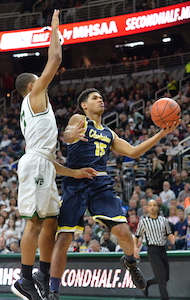
PHOTOS: (Top) Clarkston’s Foster Loyer breaks past West Bloomfield defenders to get a shot up during Friday’s first Class A Semifinal. (Middle) The Wolves’ Tieler Houston (15) gets position on West Bloomfield’s Daniel Wrack.