

Freshman Shines As Eagles Repeat in D
March 23, 2013
By Bill Khan
Special for Second Half
EAST LANSING — There was no need for Eugene Brown to sit quietly in the background and ease his way into a prominent role on Southfield Christian's basketball team.
One game was all it took for the freshman guard to prove he belonged on the defending MHSAA Class D Finals champion.
When Brown scored 17 points and grabbed 10 rebounds in a season-opening overtime victory over traditional Class A power Orchard Lake St. Mary's, it justified coach Josh Baker's decision to put a ninth-grader in the starting lineup of a team with Breslin-or-bust aspirations.
"To come in as a freshman, that's a pretty good first game against a great team," Baker said.
Brown was a mere spectator at the Breslin Center when the Eagles won their first championship last season. He thrived under the bright\ lights on Saturday as Southfield Christian repeated as Class D
champion with a 65-46 victory over Wyoming Tri-unity Christian.
He jump-started the Eagles' championship victory, scoring 11 of his 13 points in the first half and helping Southfield Christian build a 16-point second-quarter lead. Brown shot 5 for 8 from the field,
3 for 3 from the line, grabbed nine rebounds, dished out four assists and had three steals.
 Freshman jitters? Not in this kid.
"I just tried to come out and not be nervous," Brown said. "Just play the game like you know how, just go out and do your best."
Baker wasn't concerned how his freshman phenom would respond on the big stage, just as he was confident that Brown could handle making his high school debut against a team like St. Mary's in early December.
"He's usually pretty cool and casual under pressure," Baker said. "Part of that is his problem, because he's not aggressive enough all the time. We wanted him to be aggressive. We've been on him all year to be aggressive. He did it tonight, and he showed he can make plays. He's so skilled as a freshman. When he's aggressive and he keeps the ball low, he's really good."
As Brown started sinking shots during a decisive second quarter, the Southfield Christian student section chanted, "He's a fresh-man!" It was a warning to the rest of Class D that Brown will have to be reckoned with for three more seasons. For that matter, the entire program could dominate Class D for years to come.
It's not too early to begin speculation that Southfield Christian is a dynasty in the making. Winning back-to-back championships is an excellent start. All 65 of the Eagles' points against Tri-unity were scored by players who are eligible to return next season.
The team's only two seniors didn't play until a 58-40 lead had been built midway through the fourth quarter. The Eagles started a freshman, two sophomores and two juniors.
"We can only get better," said 6-7 junior Damarco White, who had 15 points and five blocks.
"The sky's the limit," added junior guard Lindsey Hunter IV, who scored 11 points.
A man who is an expert on Class D dynasties is Mark Keeler, who has coached four MHSAA Finals champions and four runners-up in his 26 seasons at Tri-unity.
"Seeing how young their team is, they're definitely going to be a force in Class D," said Keeler (499-142), who was trying to celebrate a Finals championship and his 500th victory on the same day.
The Eagles rebuilt on the fly after winning the title last year. Their returning players combined for only 12 points in last year's MHSAA Final, with Hunter scoring eight of them.
After a 3-4 start, Southfield Christian won its final 20 games.
"We knew we had the potential. It's just that early on we struggled with understanding the work ethic you have to put in," Baker said. "It's not just handed to you. Every game you play, every team is going to come after you. That's why we started off 3-4. We just got drilled by some guys. When they understood the work ethic and what it takes every game, we started to go on a nice run."
Tri-unity (25-3) got out to an 8-6 lead, but Southfield Christian took the lead for good by scoring the next nine points to ignite a 26-8 run. The lead reached 34-18 with 3:48 left in the second quarter. The Eagles didn't score the rest of the half, while the Defenders cut the margin to 34-23 at the intermission.
Matt Wachter's basket with 7:04 left in the third quarter trimmed the deficit to single digits at 34-25, but Tri-unity didn't put together consecutive scores again until Southfield Christian was comfortably ahead, 56-34.
Tri-unity forward Joey Blauwkamp, The Associated Press' Class D Player of the Year, was held to seven points on 2 for 9 shooting before fouling out with 2:38 left in the game.
"For us coming into halftime, being down only 11, I wasn't too concerned," Keeler said. "But when Joey picked up three and four (fouls) so quickly, it definitely messes with you."
Sophomore Bakari Evelyn scored 11 points for Southfield Christian, which shot 22 for 42 from the field and 17 for 21 from the line.
Daniel Cole scored 21 points and Wachter 11 for Tri-unity.
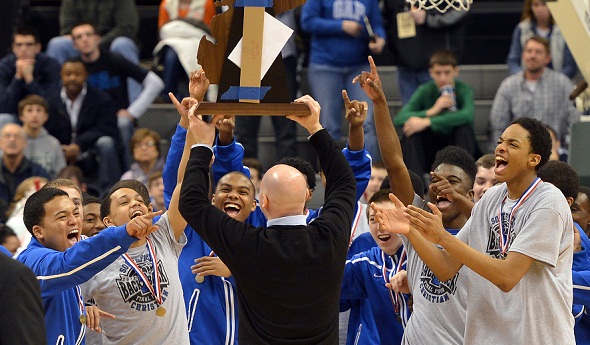
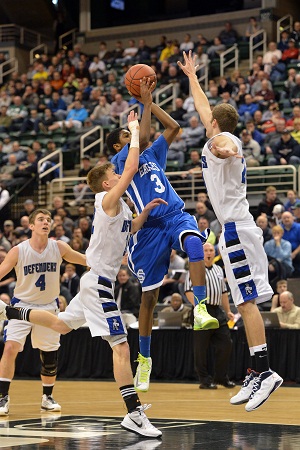
PHOTOS: (Top) Southfield Christian coach Josh Baker presents the championship trophy to his team Saturday at the Breslin Center. (Middle) Eagles freshman Eugene Brown goes up for a shot against Wyoming Tri-unity Christian's Joey Blauwkamp (4) and others. (Click to see more at HighSchoolSportsScene.com.)
Breslin Bound: Boys District Preview
March 3, 2014
By Geoff Kimmerly
Second Half editor
Picking the teams to beat in the MHSAA Boys Basketball Tournament has been particularly difficult this winter. It appears there are plenty of favorites to go around.
We’ll begin to find out if that’s true when Districts begin tonight all over the state – and know for sure when we see which teams end up at Michigan State’s Breslin Center for Finals weekend on March 20.
Follow as the teams advance on MHSAA.com. Below are some that could reach the final 16 lines of those brackets.
Class A
Detroit Pershing (18-2) – It’s hard to believe Pershing hasn’t won Class A since 2009 since the Doughboys always seem to be in the mix. They came back from a two-point loss to Detroit Southeastern at the end of January to beat Southeastern – the reigning Class A runner-up – 57-56 in the Detroit Public School League Tournament Final. Pershing also has impressive wins over Ypsilanti, Detroit Douglass (twice) and Illinois’ Chicago Orr and Morgan Park. Center Justin Tillman, a 6-foot-7 force in the paint, is a Mr. Basketball candidate.
Detroit U-D Jesuit (17-2) – The Cubs tied for the Detroit Catholic League regular-season championship but cruised through the tournament with wins of 50, 28 and 16 points, respectively. They followed with a 10-point win over reigning Class A champion Romulus. U-D Jesuit would win its first Regional title and Quarterfinal on the way if it makes it to Breslin. Considering that could mean defeating both Pershing and Southeastern, it's a tall task that would be considered an even more impressive accomplishment.
Muskegon (20-0) – This is a football school, right? Not entirely anymore given the Big Reds’ basketball success over the last two seasons. Muskegon has improved from 11-11 in 2011-12 in 19-7 and a Quarterfinal run last season to perfection heading into this tournament. Guard Deshaun Thrower, the quarterback that led the football team back to Ford Field this fall, is a Mr. Basketball candidate. Teammate Deyonta Davis could be in 2015. Aside from winning the O-K Black title, the Big Reds have impressive wins over Saginaw Arthur Hill, Mount Clemens and Illinois’ Chicago Curie among others.
Ypsilanti (18-2) – The Grizzlies' only Southeastern Conference loss came to rival Ypsilanti Lincoln in mid-January and was avenged with a 12-point win a month later. Ypsilanti also fell to Pershing by three in December, but owns an eight-point win over a strong Detroit Southeastern team. Ypsilanti won its first Regional title last winter since 1981, but looks to have a good shot at making it two in a row, although the road could include Lincoln again plus Romulus and tough Westland John Glenn among others. Senior center Jaylen Johnson is a mobile 6-9 force and Mr. Basketball candidate.
Class B
Detroit Country Day (13-7) – It’s nearly impossible to not mention the reigning Class B champion, even if the Yellowjackets’ record is a bit down from the usual at the end of the regular season. But consider that Country Day is on an 8-1 run, its losses are against some strong opponents including Detroit Consortium and Class A Romulus and Walled Lake Western, and it features Mr. Basketball candidate Edmond Sumner, a 6-5 guard and scorer. Oh, and Country Day avenged that Consortium loss with a one-point win three weeks later.
Grand Rapids South Christian (19-1) – The Sailors have been MHSAA title contenders in seemingly every sport lately, and that’s grown to include boys hoops. After finishing 13-9 a year ago, South Christian fell this year only once, by three points, to O-K Gold runner-up Wayland. South Christian then won the rematch by 10 and also owns nice wins over Holland Christian and East Kentwood – although undefeated Wyoming Godwin Heights (see below) is a likely District opponent this week.
Jackson Lumen Christi (19-1) – The Titans have been building toward a run at their first Semifinals appearance since 1975 after reaching the Quarterfinal last season and falling in that game by only three points. Their only loss this winter was by five two weeks ago to Class A Lansing Waverly, a team Lumen Christi beat by seven earlier this season. The Titans also this season avenged 2012-13 losses to Flint Powers Catholic and rival Jackson, beating the latter twice.
Wyoming Godwin Heights (20-0) – The Wolverines haven’t lost since last season’s Class B Semifinals at Breslin Center. They beat solid Holland to cap the regular season after romping through the O-K Silver with only three of 14 games decided by single digits. But any potential run will have to go through Grand Rapids South Christian (see above) in the District.
Class C
Boyne City (18-1) – The Ramblers haven’t advanced to the season’s final week since 1990, but have looked up the challenge cruising through the Lake Michigan Conference undefeated after finishing 11-11 overall a year ago. The tough part this week likely will come in leading off the District tonight against league rival Elk Rapids, which Boyne City beat by three and then 12 earlier this season. Charlevoix also could be a tough out despite its 6-13 record – the Ramblers beat the Rayders by only four and six (in overtime) during the regular season.
Detroit Consortium (16-2) – Consortium has won Regional titles two of the last three seasons and just missed making it farther a year ago, falling by two in the Quarterfinal to eventual Class C champion Flint Beecher. The Cougars’ slate of wins this season includes many of the best from the Detroit PSL, including Southeastern and Douglass, plus wins over Class A Saginaw, Romulus, Saginaw Arthur Hill, and Class B Country Day. The lone losses were in a rematch against Country Day, by a point, and by two to Class A contender Pershing.
Mount Clemens (19-1) – It’s fair to call the Battling Bathers the favorites since the start of this season, or at least one of a few, and they haven’t fallen below that expectation. Mount Clemens won the Macomb Area Conference Gold title by four games after taking on a number of Class A schools including Detroit Martin Luther King and Grand Rapids Ottawa Hills during the season's first month. Only undefeated Class A Muskegon was able to give the Bathers a loss this winter.
Negaunee (19-1) – The Miners have reached at least the Quarterfinals the last three seasons and fell to Laingsburg in last season’s Semifinal by only two points. The only loss this season came in December to Class A Marquette, and was avenged with a six-point win three weeks ago. Negaunee played the biggest and many of the best in the Upper Peninsula and handed rival Ishpeming its only two losses in the Mid-Peninsula Athletic Conference – which Negaunee won.
Class D
Bellaire (20-0) – The Eagles faced only a few bumps in rolling to a flawless regular season record, needing a two-point win over second-place Mancelona and a three-pointer over third-place Onaway on Thursday to claim the Ski Valley Conference title outright. But perfection is nothing new to this bunch; Bellaire’s only loss last season came to Frankfort in the Regional Final, and the Eagles were perfect until the Quarterfinal in 2011-12.
Peck (18-0) – The Pirates’ success during their 8-player football championship run apparently is carrying over to basketball. Or maybe it was the basketball team’s success that carried over to football – the Pirates’ hoops team made its Regional Final last season before falling to eventual MHSAA Semifinalist Lansing Christian. Peck’s three single-digit games this winter came against rival Kingston and Class B Armada and Richmond.
Powers North Central (20-0) – Coming off its first MHSAA Semifinal appearance since 1985, North Central has crushed most of its competition this winter with 11 wins by 30 or more points. Only Skyline Conference foe Carney-Nadeau and Munising got within single digits of the Jets, and no opponent did so before February. Carney-Nadeau does also play in the same District, however, after falling to North Central by only a point in their rematch.
Southfield Christian (19-1) – The back-to-back reigning champion looks good to go for three, losing only to Class A contender Saginaw Arthur Hill this season while beating Walled Lake Western and Detroit Community among solid bigger opponents. The Eagles haven’t allowed an opponent within single digits since Allen Park Inter-City Baptist (14-6) on Jan. 10.
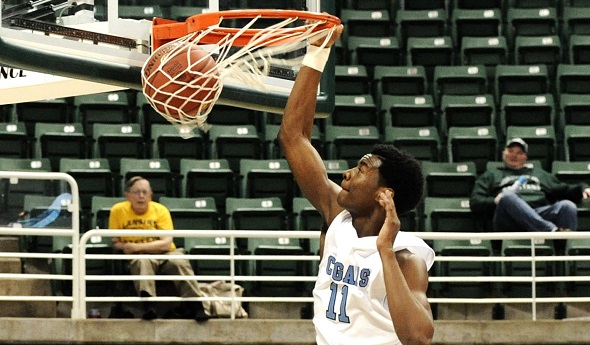
PHOTO: Detroit Consortium found the rim plenty during a 66-38 win over Jenison at the Breslin Center in December, and hopes to return to East Lansing at the end of this month. (Click to see more fromHigh School Sports Scene.)