

Future Becomes Now as Freshman Oliver Pulls Douglass Past Dollar Bay
By
Keith Dunlap
Special for MHSAA.com
March 12, 2026
EAST LANSING — Judging by the Detroit Douglass and Dollar Bay rosters Thursday, one thing is for certain:
The day’s first Division 4 Semifinal might not be the last time those two schools – located 553 miles apart on opposite ends of the state – hook up at the Breslin Center over the next few seasons.
In a matchup between teams with rosters dominated by underclassmen, Douglass had a little too much on this occasion, advancing to the Division 4 championship game for the first time since winning it all in 2021 with a 58-47 win.
Douglass head coach Pierre Brooks had high praise after the game for Dollar Bay head coach Jesse Kentala and how he prepared his team, and knows the Hurricanes could be running into the Blue Bolts again.
“I heard about the young guys they have on their team,” Brooks said. “I think Coach told me they were here in 18 or 19. So hey, I wouldn’t mind seeing them again.”
One advantage Douglass had Thursday – and will if they meet again in the near future – is freshman Damani Oliver.
Entering the game leading his team in scoring at over 22 points a game, Oliver played like someone beyond his years, scoring 17 of his 21 points during the second half to help Douglass pull away.
 “I (didn’t) see too many (Detroit) Lions games this year because every Sunday, he’s calling me to get into the gym,” Brooks said. “He’s definitely put in the work and I’m glad in the second half he decided to really pick it up.”
Holding a 22-17 lead at halftime, Oliver started the third quarter with a four-point play and finished the third with 10 points to help Douglass take a 40-35 lead into the fourth.
The Hurricanes put the game away from there, going up 51-38 with 3:44 remaining on a basket by sophomore Quinn Davis.
He also scored 14 points for Douglass, which didn’t shoot the ball well from the perimeter. Douglass was just 4 of 20 from 3-point range, but made that up a bit with a 30-22 rebounding advantage.
Junior Baron Colbert scored a game-high 23 points for Dollar Bay (24-3), which was making its first Semifinal appearance since 2019. With just three seniors, three freshmen and two eighth graders on the roster, Dollar Bay should be heard from again.
Kentala just hopes that if his team returns next year or beyond, the weather will be a little better.
Many of the school and community’s fans couldn’t make it down to the game as expected because the Mackinac Bridge was closed due to a winter storm.
“It’s been a great ride,” Kentala said, talking about his team’s tournament run. “I thought our plan was right. I thought these guys executed it just beautifully. I thought we did everything in our power. I thought we kept them guessing. We mixed up our zone and man pressure. I thought we attacked, I thought we were fearless, I thought we were tough. Sometimes the shots don’t fall, and (Oliver) really stuck a few key shots. A really nice player.”
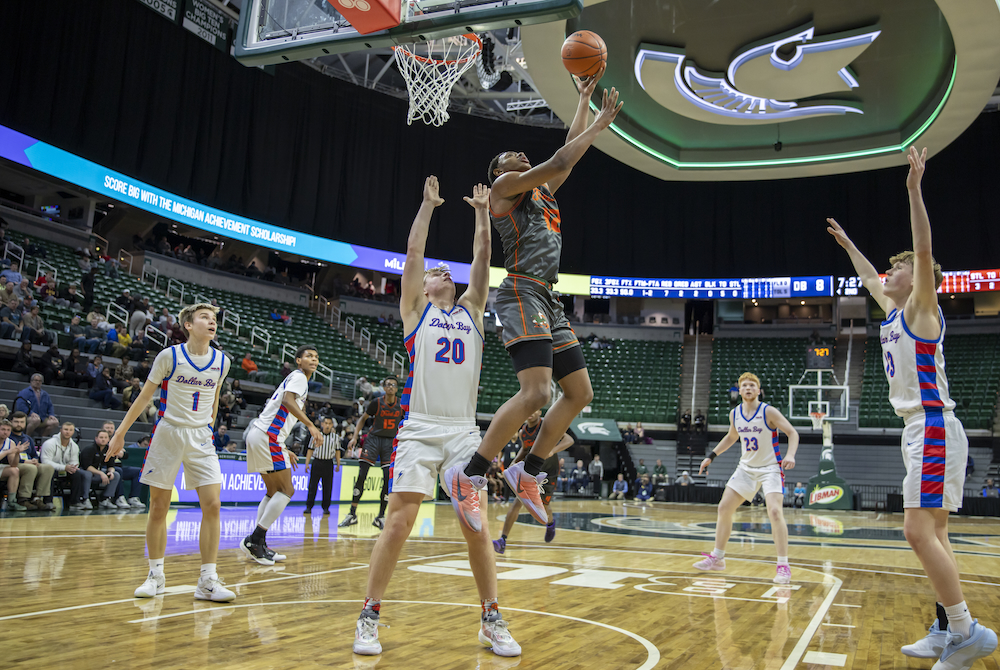
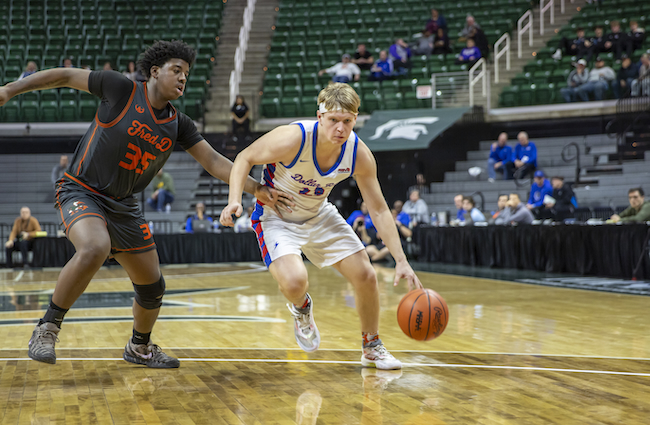
PHOTOS (Top) Detroit Douglass’ Kamari Howard (12) gets a shot up over Dollar Bay’s Liam Tourtillott (20) during Thursday’s first Division 4 Semifinal at Breslin Center. (Middle) Tourtillot makes a move into the lane while guarded by Douglass’ Dimauvion Smith-Powe (35). (Photos by Adam Sheehan/Hockey Weekly Action Photos.)
Breslin Bound: Boys Report Week 6
January 15, 2018
By Geoff Kimmerly
Second Half editor
We’re heading into the midpoint of this boys basketball season, and the surprises keep coming.
 Detroit Henry Ford and Grand Ledge were full of them last week, and Berkley has been one of the state’s most intriguing all season. We touch on those a little bit below, along with a number of others that most recently caught our attention.
Breslin Bound is powered by MI Student Aid and based on results and schedules posted for each school at MHSAA.com. To offer corrections or fill in scores we’re missing, email me at [email protected].
Week in Review
The countdown of last week’s five most intriguing results:
1. Detroit Henry Ford 63, Detroit Cass Tech 60 – The Trojans should be back in the Class B title talk after handing a first loss to one of the major favorites in Class A.
2. Grand Ledge 59, East Lansing 53 – The Comets are 6-1 but weren’t getting much attention until this upset broke East Lansing’s 45-game regular-season winning streak.
3. Frankfort 69, Buckley 53 – The Panthers handed the reigning Class D runner-up this defeat after falling to Buckley by 39 and then only three last season.
4. Detroit Cass Tech 85, Muskegon 78 (OT) – The Technicians did not waste time bouncing back from the Henry Ford loss, downing Muskegon in overtime the next day at Grand Rapids Ottawa Hills.
5. Macomb Dakota 64, Clinton Township Chippewa Valley 62 – The Cougars took big losses early to Detroit U-D Jesuit and New Haven, but are undefeated in the Macomb Area Conference Red after handing Chippewa Valley its first defeat in the league and overall this winter.
Watch List
With an eye toward March, here are two teams in each class making sparks:
CLASS A
Ann Arbor Skyline (7-0) – The Eagles have been building toward a start like this, even winning the Southeastern Conference Red title a year ago. They started the new year with a 20-point win over second-place Ann Arbor Pioneer on Saturday and have impressive wins by 14 over Belleville, one over Detroit Pershing and 20 over frequent nemesis Ann Arbor Huron.
Berkley (8-0) – The Bears have doubled their win total from last season after going 4-17, and they’re only a few more from guaranteeing a first winning season since 2010-11. They’ve pulled off a few close ones including a two-point victory over MAC Bronze leader Madison Heights Madison a month ago. Next up is Rochester with first place in the Oakland Activities Association Blue on the line.
CLASS B
Detroit Henry Ford (7-2) – The 2015-16 Class B champion still made the Regional last season despite finishing 13-11 overall, and another big run could be on the way. Ford opened this season with a two-point win over 2017 Class A semifinalist West Bloomfield, and has beaten a series of Class A teams including Cass Tech (see above). The losses came to Class A powers Grand Rapids Ottawa Hills and Hazel Park, the latter in overtime.
Ovid-Elsie (5-1) – The Marauders have hovered around .500 the last few seasons, but might have something more in store over the next two months after a fast start. Ovid-Elsie sits atop the Tri-Valley Conference West standings and hasn’t lost since its opener (to still-undefeated Fowler). Coming up Friday is a matchup with second-place Hemlock.
CLASS C
Norway (5-2) – The Knights moved over to the Skyline Central Conference after sharing the Mid-Peninsula Conference title last season and finishing 18-3 overall. They’ve won four straight and hold a half-game lead in the SCC’s Large School division. The two losses came in December in overtime to Powers North Central and by eight to nemesis Iron Mountain, which knocked Norway out of the tournament last season. Those two will face off again Feb. 9.
Sanford Meridian (7-1) – The Mustangs are playing for a second straight Jack Pine Conference championship and already have wins against usual annual contenders Beaverton and Clare. Meridian’s only loss was by 10 in early December to Class A Saginaw Heritage, and it’s got another similar test coming up against Midland Dow in two weeks.
CLASS D
Cedarville (7-2) – The Trojans are approaching the season’s midpoint in position to take back the Eastern Upper Peninsula Athletic Conference title after tying for second a year ago. Cedarville got past reigning champion Pickford 67-59 last week and has lost only to undefeated Hillman and Class B Boyne City.
Frankfort (6-0) – The Northwest Conference sent Buckley all the way to the Class D title game last year, and early this winter it’s Frankfort that could be setting up for a run. The Panthers held onto first place all alone in the league last week with a win over the Bears, and now face the other two teams with only one conference loss – Kingsley on Tuesday and Maple City Glen Lake on Thursday.
Can't-Miss Contests
Be on the lookout for results of these games coming up:
Tuesday – Rapid River (7-0) at Powers North Central (6-1) – The Rockets ended North Central’s record 84-game winning streak Dec. 7, but the Jets can make it six straight by taking the rematch.
Tuesday – Orchard Lake St. Mary’s (7-2) at Warren DeLaSalle (6-2) – In a strong Detroit Catholic League Central, these are two of the best; DeLaSalle leads and St. Mary’s is third after falling to second-place U-D Jesuit by a point last week.
Thursday – Bellevue (8-0) at Camden-Frontier (8-2) – Both are pushing for Southern Central Athletic Association titles; Bellevue is tied for first in the West and Camden-Frontier is second in the East, and this game counts in the standings for both.
Thursday – Maple City Glen Lake (5-1) at Frankfort (6-0) – The Panthers also must survive Kingsley on Tuesday to keep their perfect start going, and Glen Lake is aiming to gain a share of first place in the Northwest Conference too.
Friday – Hazel Park (8-0) at West Bloomfield (3-3) – Hazel Park and reigning Class A champion Clarkston have been the talk of a strong OAA Red, but West Bloomfield also is undefeated in league play after opening with three tough nonleague losses including two by only two points apiece.
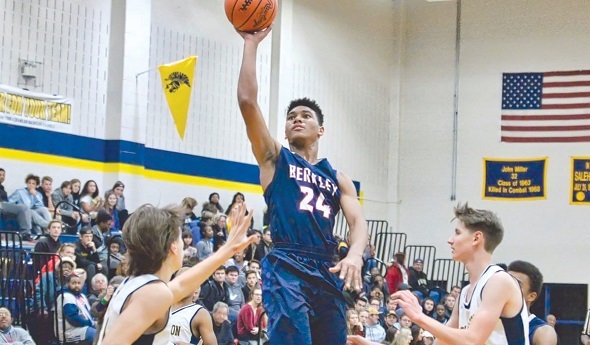
PHOTO: Berkley, here against Clawson in December, is one of this season’s biggest surprises. (Photo courtesy of C&G Newspapers.)