

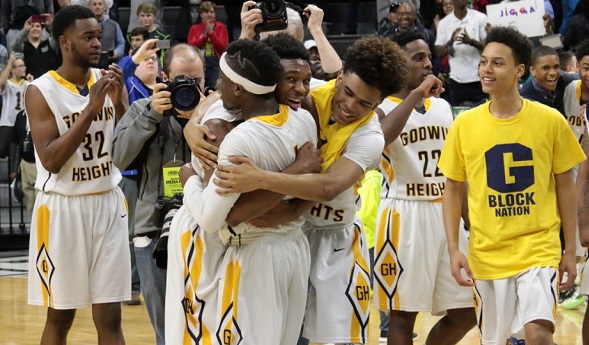
Godwin Heights Caps Long Trip to Top
March 28, 2015
By Geoff Kimmerly
Second Half editor
EAST LANSING – The final seconds of Friday night at the Breslin Center were about relief for Wyoming Godwin Heights senior Delaney Blaylock, after he led the Wolverines to their first MHSAA championship game berth.
Relief turned into disbelief Saturday – and satisfaction for a community that started this trip nearly 90 years ago.
Godwin Heights defeated Detroit Henry Ford 85-68 in the final game of this season to earn its first MHSAA title, 86 years after its first trip to the final week.
Grand Rapids Godwin made its first MHSAA Quarterfinal in 1929 and finished runner-up in 1950 and then as Wyoming Godwin in 1960. The Wolverines played in four more Semifinals – including in 2013 – and then fell in the Quarterfinals again in 2014.
“I was just thinking I can’t believe we’re here,” Blaylock said Saturday night. “I just didn’t want to be comfortable being in the state championship, but (wanted) to win the state championship.”
Like Powers North Central did in winning Class D earlier Saturday, Godwin Heights (26-1) capped a three-year run that will go down among the most successful in MHSAA history.
The Wolverines were a combined 74-5 over the last three seasons, which tied them for the ninth-most wins over a period of that length.
And the last of those wins was more or less decided by halftime.
Henry Ford scored the first basket of the game and never led again, as Godwin Heights build a lead as large as 23 points during the second quarter while shooting 55 percent from the field and making 8 of 11 3-point shots during the first 16 minutes.
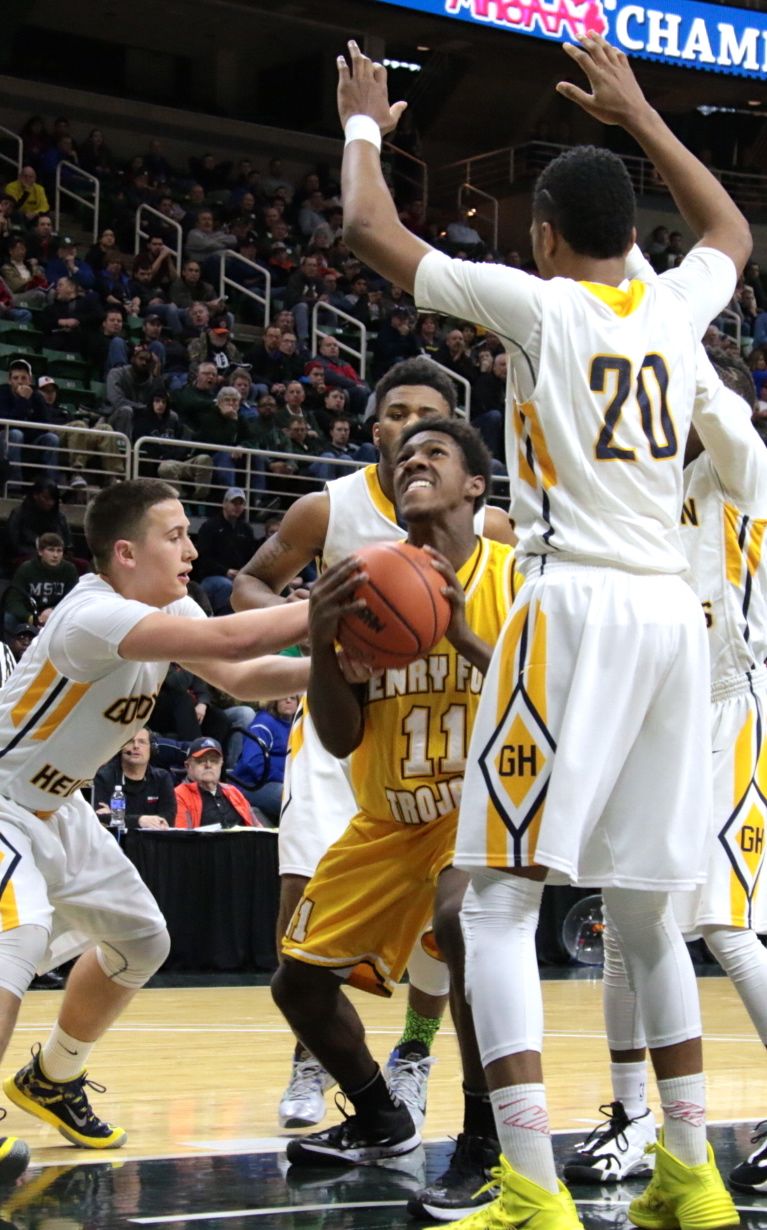 The Wolverines led 50-29 at the break and never by fewer than 14 points during the final two quarters.
“I don’t think I ever saw a team shoot like that in the Breslin,” Henry Ford coach Kenneth Flowers said. “The craziest part about it, they didn’t shoot the ball well yesterday (33 percent from the floor, 26 from 3-point range). They came out today on fire. … They played like state champions.”
The Godwin Heights basketball community had to struggle through sadness at the end of summer. Junior-to-be Ta’Carhri Richardson – who played for first-year Wolverines coach Tyler Whittemore on the junior varsity in 2013-14 – was shot and died Aug. 3.
Whittemore, a 2005 graduate, was promoted to the varsity job after coaching in the program at various levels for eight seasons.
“Toughness is what defines them,” Whittemore said of his players. “It’s tough to go through what they did, have that tragedy happen (during) the summer before the basketball season was going to start. We had one of our games on his birthday, the second game against Holland (on Dec. 16). The guys rallied around each other. They were playing hard for one another, getting loose balls for one another … not for themselves.”
Blaylock led five scorers in double figures Saturday, with 19 points, and he also grabbed 10 rebounds. Freshman guard Lamar Norman came off the bench for 17 points, while senior forward Michael Williams and junior guard Leon Redd both scored 13 and junior forward Richard Major had 12. Williams also grabbed nine rebounds and had four assists.
Detroit Henry Ford, playing in its first Final after also playing in and winning its first Semifinal on Friday, finished 21-6.
Senior forward Joshua Davis had 16 points and 11 rebounds and junior point guard James Towns had 15 points and six assists. They were the leading scorers this season as the Trojans bounced back from two straight sub-.500 seasons to also make their first Quarterfinal since 1984.
“I was telling them I know it hurts, and they’re crying their eyes out right now too,” Flowers said. “But they took Henry Ford High School to a place it’s never been before. These guys are the foundation of good things to come.”
Click for the full box score and video from the postgame press conference.
PHOTOS: (Top) Godwin Heights players celebrate the first MHSAA title in program history. (Middle) Henry Ford guard Antaun Carter is surrounded by Wolverines defenders in the lane.
Breslin Bound: Boys Report Post-Break
January 8, 2013
By Geoff Kimmerly
Second Half editor
Holiday break and all that comes with it – no school, but plenty of "classics" and "showcases" – has come to an end. But in its wake, we see a little better how some of the state's best stack up heading into league play that will dominate the next two months.
Here are 10 teams that made some of the biggest waves over the last few weeks. Records and scores are based on those submitted to the MHSAA.com Score Center.
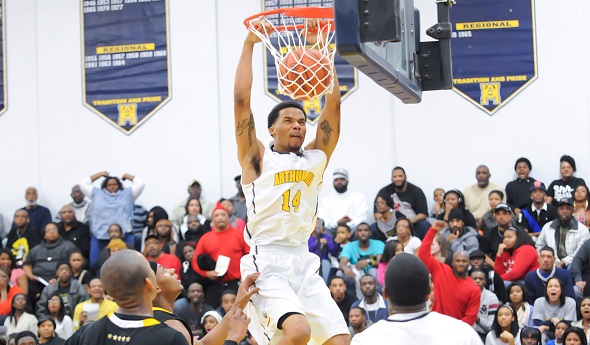
1. Saginaw Arthur Hill (7-0) – This is shaping up as the Lumberjacks’ season among powers in the Saginaw Valley Association. Its best win of break definitely came Friday, 75-54 over rival and reigning Class A champion Saginaw High.
2. East Kentwood (6-0) – The Falcons’ run at the Muskegon Hall of Fame Classic was the most impressive among those that played in a holiday event. East Kentwood beat two teams considered elite – Grand Rapids Christian 52-48 and then Muskegon 85-77.
3. Ann Arbor Pioneer (5-2) – The Pioneers have played a nicely-loaded schedule and opened with losses to Detroit Country Day and Holt. But a 62-60 win over Detroit Southeastern highlights a 5-0 run since that also has included two more victories by four points or fewer.
4. Wayland (7-1) – The Wildcats’ turnaround this winter has been a speedy one. They won only six games all of 2011-12 – but have fallen this season only to Wyoming Godwin Heights and by just a point, 72-71.
5. Harbor Beach (6-1) – The bounce-back after winning the Division 8 football title might’ve been too quick for the Pirates, who fell on opening night. But they haven’t lost since, and handed previously-perfect Reese a 58-44 defeat on Thursday.
6. Detroit U-D Jesuit (5-1) – The Cubs appear to be a contender in the Detroit Catholic League Central after beating Warren DeLaSalle 73-62 on Friday. Jesuit’s only loss was by three to Cleveland St. Ignatius earlier last week.
7. Ypsilanti (4-1) – After opening this season with a one-point loss to Wyandotte Roosevelt, the Phoenix have been tough. Best wins were by two in overtime over a solid Saline team and by seven over emerging Detroit Denby.
8. Decatur (7-0) – The Raiders ended last season losing four of their final five games. But they've rebounded nicely, and handed Eau Claire its first loss, 57-54.
9. Hemlock (5-1) – The Huskies look to be back in the hunt in the Tri-Valley Conference Central despite an early loss to Shepherd. Friday’s 49-44 win over Saginaw Nouvel avenged one of their few during last season’s 19-5 run.
10. Sparta (5-2) – The Spartans are riding a four-game winning streak that included one-point wins over Grand Rapids Creston and Muskegon Oakridge. The latter is Oakridge’s lone loss this winter.
PHOTO: Saginaw Arthur Hill's Jalen Adams (14) finishes a powerful slam in his team's win over rival Saginaw High on Friday. (Click to see more at HighSchoolSportsScene.com.)