

GR Christian Ends 80-year Finals Wait
March 24, 2017
By Geoff Kimmerly
Second Half editor
EAST LANSING – Xavier Tillman stood taller, literally, than anyone else on the court during his team’s Class A Semifinal on Friday at the Breslin Center.
Figuratively as well, the Grand Rapids Christian senior has stood as tall as any of the giants who have dominated the floor in Michigan this season.
But if Christian wins its first MHSAA championship Saturday since 1938, just as much credit will belong to his supporting cast – even as he called himself not the star, but rather the distributor after they beat Romulus 74-52 to advance to the Final.
Five teammates scored more than Tillman on Friday. But that doesn’t mean the 6-foot-8 forward’s presence was negligible. He took only three shots, scored only five points, but also had eight rebounds, six assists and seven blocks and drew plenty of attention from Romulus to help Christian make its first championship game in 80 years.
“I have a team full of scorers,” Tillman said, “so my job is to facilitate on my team.”
“We’ve always said we have to get the ball in to Xavier and let him make a play, whether it’s for himself or his teammates, or at least draw attention,” Grand Rapids Christian coach Mark Warners added. “Xavier said it; you don’t know who is going to score, and with these guys what’s been great all year is they don’t care.”
Grand Rapids Christian (27-0), No. 1 in Class A at the end of the regular season, will face No. 3 Clarkston at noon Saturday for its first MHSAA title since winning the Lower Peninsula Class B championship in 1938 (from 1932-47, one champion was awarded from each peninsula in Classes B, C and D; in 1943 no statewide champions were awarded).
Romulus (21-5) last had been to Breslin much more recently, winning Class A in 2013. But although it gave a strong challenge into the third quarter this time, no one has stood in Christian’s way for the entirety this season.
Christian opened the third quarter on a 15-3 run over five minutes, as senior James Beck II had six of his game-high 24 points.
“He did keep us in it,” Warners said. “He gets the points where it’s off a rebound or putback, or he gets an and-one on the break and makes the free throw, or he gets the dump down from a guard or Xavier and can score around the rim in so many ways. It’s a really nice thing to have.”
 For the game, Beck connected on 11 of 17 shots from the field as Christian made 54 percent as a team.
Romulus hit only 35 percent of its shots from the floor and 31 percent from 3-point range, hindering a team that already had a tough time matching up with more sizable Christian.
“It’s kind’ve a shock. We’ve never gone 8 for 26 from the 3-point line,” Romulus coach Jerret Smith said. “We prided ourselves on hitting shots this year, and when you can’t hit shots it’s hard – especially when you have the kid who’s 6-8, 260 in the lane. It’s very hard to get him out of the lane if you’re not hitting shots.”
Junior guards Duane Washington, Jr., and Setrick Millner, Jr., added 15 and 11 points, respectively, and senior guard Thad Shymanski had 10 for Grand Rapids Christian. Washington also had six assists and senior guard Emmett Warners had five.
Junior Kaevon Merriweather had 18 points to lead Romulus, and senior forward Jaren English had 17 points and eight rebounds. Senior forward Dylan Price added 12 points and nine boards.
Three starters and the top-playing sub from Friday should be back for Romulus next season. Romulus entered the postseason an honorable mention in the Class A poll, but eliminated reigning champion Detroit U-D Jesuit in the Quarterfinal.
“The good thing about this is the foundation has been laid,” Smith said. “We hadn’t been here in four years, and that was a long time for us. I’m so proud of these seniors; all around, they put a lot of work in. … When you get tough losses, you’ve gotta except those too. Grand Rapids Christian was a better team today. We’re not going to make excuses. We’ll just come back and get in the gym, and hopefully next year will be our year.”
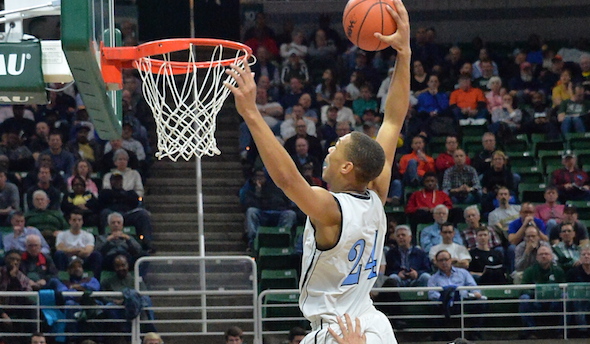
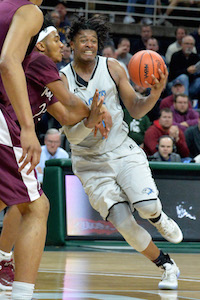
PHOTOS: (Top) Grand Rapids Christian’s Setrick Millner, Jr., goes in for a dunk during Friday’s Class A Semifinal win. (Middle) Christian’s Xavier Tillman works for position against a pair of Romulus defenders.
Breslin Bound: Boys Report Week 6
January 16, 2017
By Geoff Kimmerly
Second Half editor
As conference races begin to heat up on both peninsulas, the best of the best are starting to show it against arguably their toughest opponents – those most familiar.
 Our top game from last week in this week's Breslin Bound report – powered by MI Student Aid – features two such neighbors facing off again as they have for decades, while a number of rivals also saw each other for the first of two meetings this season.
Week in Review
The countdown of last week’s five most intriguing results:
1. Saginaw 62, Saginaw Arthur Hill 49 – This annually is one of the state’s best rivalries, and the Trojans have the edge in the Saginaw Valley League North with the rematch coming Feb. 3.
2. Detroit East English 73, Kalamazoo Central 63 – After being stunned by Detroit Osborn on Friday, East English came back to win the premier game of the Floyd Mayweather Classic at Grand Rapids Ottawa Hills on Saturday.
3. Wyoming Godwin Heights 114, Wyoming Kelloggsville 75 – The Ottawa-Kent Conference Silver includes three teams from Wyoming that are a combined 20-2, but Godwin Heights remains the leader at 8-0.
4. East Lansing 70, Holt 66 – The undefeated Trojans should be contenders in Class A, and now have survived a second challenge in the strong Capital Area Activities Conference Blue.
5. St. Clair Shores Lake Shore 56, St. Clair 38 – Lake Shore, sitting in first place in the Macomb Area Conference Silver, handed then-MAC Gold leader St. Clair its first loss.
Watch List
With an eye toward March, here are two teams in each class making sparks:
CLASS A
Saginaw (7-1) – The Trojans opted up to play in Class A again despite an enrollment of just fewer than 600. And they’ll again be in the mix, judging from last week’s 62-49 win over Arthur Hill; the lone loss was to Chicago Orr, which also has wins over Detroit Martin Luther King and Pershing.
Wayne Memorial (7-1) – After finishing 8-14 only a season ago, Wayne has asserted itself atop the Kensington Lakes Activities Association South. Friday’s one-point win over Canton put the Zebras in first alone and the Chiefs in second.
CLASS B
Benton Harbor (9-0) – The Tigers are looking like a challenger in Class B again after a step back, relatively speaking, to 15-6 last season. Last week showed plenty – a 55-45 win over Class A Battle Creek Central and an overtime win over struggling but recently successful Stevensville Lakeshore.
Richmond (7-1) – Better known for football and wrestling, Richmond finished third in the Blue Water Area Conference last season but has an early leg up with a win over co-champion Imlay City and that other co-champ, Yale, coming up Tuesday.
CLASS C
Gobles (8-2) – The Tigers’ defeats have come to Class B one-loss teams Fennville and Wyoming Lee, and they are closing in on last season’s 12-win total. The rematch with Fennville comes Jan. 31 and could end up deciding the champion in the Southwestern Athletic Conference Lakeshore.
Negaunee (7-0) – The Miners have won all of their games by at least 16 and six by at least 21 points to keep pace with also-undefeated Norway in the Mid-Peninsula Athletic Conference. Negaunee split the league title last year with Iron Mountain, winning its first 19 before losing its final two games.
CLASS D
Fowler (6-1) – The Eagles took a mid-December loss to Bath, but remain the mix in the Central Michigan Athletic Conference after last week’s 63-56 win over rival and 2016 Class D semifinalist Fulton.
Deckerville (6-2) – These Eagles are looking to challenge Dryden again after splitting the North Central Thumb League title last season, and will circle the March 2 rematch with the Class C Cardinals after falling to them Dec. 12.
Can't-Miss Contests
Be on the lookout for results of these games coming up:
Monday – Negaunee (7-0) at Marquette (7-1) – Two Upper Peninsula league leaders will face off in one of the north’s top nonleague matchups this season.
Tuesday – Detroit Martin Luther King (6-1) at Detroit East English (7-1) – First place in the Detroit Public School League East Division 1, and superiority in the league as a whole, could be at stake.
Tuesday – Buckley (5-0) at Frankfort (5-0) – The Northwest Conference co-leaders are also potentially two of the best in all of Class D.
Tuesday – Dundee (9-0) at Hillsdale (8-0) – These two lead the Lenawee County Athletic Association and also are rising up the ranks in Class B.
Tuesday – Orchard Lake St. Mary’s (7-1) at Detroit U-D Jesuit (6-2) – The Eaglets are in the Detroit Catholic League Central conversation again, and can take a commanding step against the reigning Class A champion.
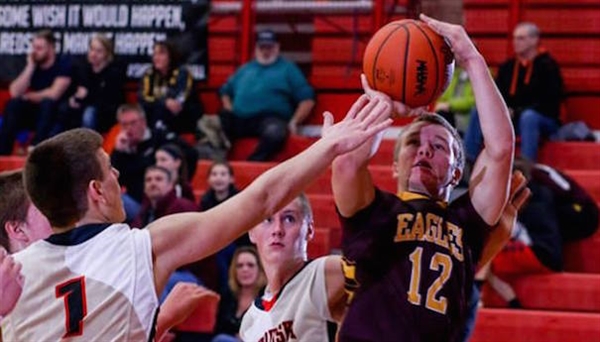
PHOTO: Deckerville, attempting a shot, earned a win over Sandusky earlier this season and sit 6-2. (Click to see more from Varsity Monthly.)