

Guards Answer Call for Country Day

March 23, 2013

By Geoff Kimmerly
Second Half editor

EAST LANSING – Before Saturday’s MHSAA Class B Final, Kurt Keener challenged guards Edmond Sumner, Mory Diane and Austin Price to carry Detroit Country Day to one more win.

In the recent past, Keener might’ve asked something similar of guys like 6-foot-11 Amir Williams or 7-0 Da’Shonte Riley. But this was not like most teams Keener has coached to 678 wins over the last 35 seasons.

Of course, Country Day has had outstanding guards lately as well – Ray McCallum and Kenny Knight keyed the 2010 title run – but it’s been a while since a Yellowjackets team has been this guard-driven.

But as they’ve done all season, the trio was ready to answer. Price had 15 points, Sumner 13 and an ill Diane seven in just 16 minutes as Country Day survived its closest game of the tournament to defeat Detroit Community 57-49 and earn its ninth MHSAA championship.

“We’re used to it. With our hard work in practice, we knew what to do when we came down the stretch,” Edmond said. “It was nothing new to us.”

But a title is to this group. Although Price played in Semifinals the last two seasons and Diane joined him in the starting lineup in 2012, none had played in a championship game before facing Community, located just 10 miles south of the Yellowjackets’ campus.

Country Day (25-3) was the favorite coming in to the tournament as the top-ranked team in the final Associated Press poll. But Community (18-10) proved to be much closer in ability than the teams’ records indicated.
Much has been mentioned during the tournament of the tough schedules both played during the regular season, and particularly of the ranked Class A teams that handed Community a few losses but also pointed the Hurricanes down the path toward their first championship game.

Although Country Day led by a handful of points for most of the final three quarters, Community tied the score 36 seconds into the fourth.

“Sports at times, you’ve got to just dig deep and make a stop. I just kept saying, ‘one more,’” Keener said. “I asked Mory at one point at halftime, ‘Can you give us one or two plays?’ One or two plays in a game like this make all the difference in the world.”

Diane made the jumper that put Country Day back ahead 46-44 with 7:09 to play. Price hit six free throws and Sumner a pair down the stretch as the Yellowjackets finally pulled away for good.

But not until the final minute did it feel like Community had run out of comeback opportunities.

Country Day broke 100 points twice but scored fewer than 62 points only once before Saturday. The Hurricanes outshot the Yellowjackets 41 percent to 39 and had only one fewer rebound. The difference came in part at the free throw line, where Country Day made 20 of 26 tries and Community made only 9 of 16.

“The pressure bothered us a little bit. … If we made some free throws and layups, I think we’re right there,” Community coach Venias Jordan, Jr., said. “This is right where we wanted it. Going into the game, I told (my players) if we keep them 55ish, we had a chance to win.”

But Country Day and especially 6-foot-4 sophomore Deshawn Thomas also did well in limiting South Florida recruit Byron Zeigler. The 6-6 senior had 17 points Friday, but only nine on five shots in the Final.

“They made it pretty hard for us to get in our spots on offense, made it tough for us in the post,” Zeigler said. “They fronted us, double-teamed us, trapped us. They did everything possible to make us uncomfortable so we couldn’t get into our sweet spots.”

Senior forward Jerrell Martin led Community with 13 points and eight rebounds.

Thomas had six points and eight rebounds in 18 minutes off the bench for the Yellowjackets.

Click for a full box score. 

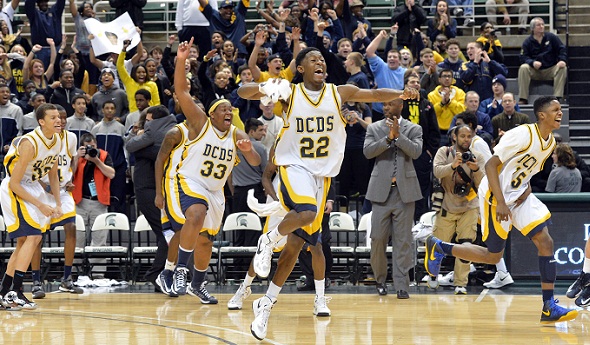
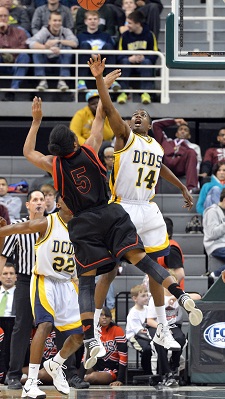
PHOTOS: (Top) Detroit Country Day's Maurice Ways (22) and his teammates rush the floor after the Yellowjackets clinched the Class B title Saturday. (Middle) Country Day's Austin Price (14) and Community's Landie Davis go for a loose ball during the championship game. (Click to see more at HighSchoolSportsScene.com.)

Film Fills In Picture of 'Fennville Flash'

By Ron Pesch
MHSAA historian

December 28, 2017

We’ve been here before, but not in this way.

The last time was for a retrospective, covering one of the most impressive and awe-inspiring prep careers in Michigan high school history. That time was in print, and included a handful of still images that tried to illustrate the unbelievable.

But this time, the story is in documentary form. It’s woven together from grainy, scratched, faded silent film, a format of capturing memories familiar to thousands of people from generations past, as well as a series of modern-day high-resolution interviews. 

Here, the basketball life of the athlete known as the “Fennville Flash” delivers on many levels. Yes, there is a Richie Jordan.

JordanVille, a documentary by John Mooy & Anne Colton, recalls a time when legend spread via word of mouth, newsprint and AM radio.

While it’s hard to comprehend for many today, the exploits of our athletic heroes were formed by “poets in the press box” who sat with pencil and paper, a typewriter, a microphone or a telephone, and described to their audience what they witnessed. On the receiving end, readers and listeners conjured up visualizations based on the facts, phrases and superlatives designed to create an image.

“Traveling left to right on your radio dial” helped listeners feel they were a member of the crowd, seated in the stands, in on the action and a witness to the mayhem. “Packed to the rafters,” reminded fans the importance of what was happening. An exciting game, presented by those with skill, created an event you longed to see. If a broadcast couldn’t be picked up on a transistor or tube radio, the final result might not be known, at the earliest, until the following day’s newspaper arrived.

I’ve told Jordan’s story via the MHSAA before; how he latched on to athletic training, weights and repetition to mold himself into a well-rounded athlete, able to leap to heights unexpected for a kid with a 5-foot-7 frame. The tales of his unfathomable accomplishments slowly leaked beyond the city limits of Fennville into Kalamazoo and greater Southwestern Michigan, then to Detroit. When Detroit Free Press writer Hal Schram relayed Jordan’s feats, the secret traveled across the state and beyond its drawn borders.

From there the legend of Jordan’s accomplishments grew. In Fennville, as in many small towns across the country, the city shut down when a game was played. The Jordan story was so enticing that thousands would travel vast distances to see him play with their own eyes. Today, his single season scoring average of 44.4 points per game during the 1964-65 campaign still remains the top mark in the MHSAA record book.

JordanVille runs just shy of a half hour. Contained within is insight into the athlete that is challenging to relay in print form. Thanks to access to home movies and a series of interviews with Jordan, former teammates, past opponents and his high school coach, the determination, dedication and drive of a kid who wouldn’t let physical size be a deterrent from achievement radiates from the screen. On display is small town America at its finest, and perspective formed over 50+ years.

For Mooy, it completes a filmmaking journey started six years ago. But the story of Jordan, in his eyes, date back to his school days. Mooy first heard about Jordan as a 7th-grader from a math teacher. A second-team all-St. Joseph Valley League selection, Mooy played at Marcellus High School and scrimmaged against Jordan and the Fennville Blackhawks.

He couldn’t believe his eyes.

“Everyone wanted to see this kid play,” said Mooy in 2011. “He was the first high school player I saw sign an autograph.

Today, with the interviews complete, and the film ready for viewing, Mooy sees more than just a sports story:

“With the benefit of years now passed, I look at the Rich Jordan story with a new respect. JordanVille created a place that was welcoming no matter who you were, or what color your skin happened to be. It was the 1960s. Rich was growing up Jewish, the Civil Rights Movement was in full swing, and the Vietnam War was on everyone's mind. And in Fennville, Michigan, from 1961 to 1965, the Jordan high school years, there were lessons beyond sports being learned by everyone that would last a lifetime. The Jordan household, under the guidance of (his parents) Tuffy and Sylvia Jordan, is where the story begins."

The film speaks of a time that has departed. Competition for our attention was less focused; phones hung on walls or sat on tabletops, communities were tighter, the training table featured peanut butter and chocolate milk instead of protein powder. A city could easily be renamed for a day.

The film also reminds us that those days were far from perfect.

If all goes as planned, the public will see the finished product come the flip of the calendar. In West Michigan, JordanVille is scheduled to show on New Year’s Day at 6 p.m. on WGVU, and will repeat on WGVU-Life at 7:30 p.m., Friday, Jan. 5.

Seek it out, and spread the word, just like in days of old.

Ron Pesch has taken an active role in researching the history of MHSAA events since 1985 and began writing for MHSAA Finals programs in 1986, adding additional features and "flashbacks" in 1992. He inherited the title of MHSAA historian from the late Dick Kishpaugh following the 1993-94 school year, and resides in Muskegon. Contact him at [email protected] with ideas for historical articles.

PHOTOS: (Top) Richie Jordan runs Fennville's offense during his thrilling high school career in the 1960s. (Middle) Jordan memorabilia, as captured by Bill Williams.