

Guy Guides Muskegon Hoops Rise
December 8, 2015
By Tom Kendra
Special for Second Half
For many years, basketball was a letdown at Muskegon High School.
 The Big Reds have been known for football ever since their first victory in 1895, racking up 806 more wins since then (most in the state), along with eight MHSAA championships – including recent titles in 2004, 2006 and 2008.
But as the snow slowly blanketed Hackley Stadium’s hallowed turf on an annual basis, Muskegon was never consistently able to transfer the energy, focus and success from the gridiron to the hardwood of Redmond-Potter Gymnasium.
That all changed in 2012, when nearby Muskegon Heights went through a period of upheaval, before eventually reconstituting itself as Muskegon Heights Public School Academy. During that time of uncertainty about the school’s athletic future, boys basketball coach Keith Guy made the move down Sanford Street to Muskegon High, and suddenly football was no longer the only show in town.
“I’ve always thought that there are enough great athletes and enough potential at city schools that they could be great in both football and basketball,” said Guy, who starts his fourth season as Muskegon’s basketball coach Friday night against visiting Rockford.
“I know we won’t ever be what the football program is here at Muskegon, but I feel like we now have a little identity of our own.”
That’s an understatement.
In the past two years, the Muskegon boys basketball program has won two Ottawa-Kent Conference Black titles, two Class A Districts, two Regionals, one MHSAA Finals title in an undefeated 2014 season, 51 of 53 games overall and produced back-to-back Mr. Basketball winners with DeShaun Thrower in 2014 and Deyonta Davis last year.
Thrower, as his name suggests, was a star quarterback for Muskegon coach Shane Fairfield in the fall and the star point guard for Guy in the winter. Thrower is now a sophomore guard for Stony Brook, a Division I school in New York which narrowly missed qualifying for the NCAA Tournament last year.
Guy’s handling of Thrower’s situation, essentially staying out of the way while football season was still going on, set the tone for Big Reds football and basketball programs that continue to encourage each other and push each other higher. While basketball has elevated itself among the state’s elite programs, Muskegon football has kept pace, advancing to MHSAA championship games three straight years in 2012, 2013 and 2014.
Guy, 40, a former standout point guard at Muskegon Heights, Muskegon Community College and Ferris State University, explained that situation after basketball practice on Nov. 30, after quickly changing from his sweat suit into formal attire to help run that night’s end-of-year football banquet as the athletic director.
“When one succeeds, all of us succeed,” said Guy, whose son, Christian Martinez, was the star quarterback of Muskegon Catholic Central’s Division 8 football championship team this fall. “Shane has gone and filmed games for me on the east side of the state before, and he knows that he’s got my support during football season.”
 While this year’s Muskegon basketball team may lack the star power of the past two years, it hopes to make up for it with depth. At a recent practice, it was difficult to decipher the starting five from the reserves.
“Last year, we ran a lot more set plays with DD (Davis) in there,” said Michael Littlejohn, a 5-11 senior guard who is the lone returning starter off last year’s team, which was stopped a game short of returning to the Breslin Center by Lansing Everett in the Class A Quarterfinals. “This year, it’s going to be more running, more showtime.”
Littlejohn will start at point guard and will be joined in the backcourt by smooth-shooting senior Linwood Lee and defensive stopper Jacarius Scott. The leaders up front are versatile juniors Jermayne Golidy (6-3) and Anthony Bethea (6-5), along with senior Desi Stephens (6-4).
The Big Reds also will get a boost of muscle and toughness from a couple of college football prospects in senior Terrion Hill-McKay and junior Jacorey Sullivan.
Guy also has three sophomores – Chris Murry, Willie Shanks Jr. and Antwan Reed – on the varsity roster, along with freshman DeAndre Carter. Reed (6-7, 286 pounds), considered one of the nation’s top sophomore offensive tackles, is improving his conditioning and footwork for football and could develop into a basketball force as well.
Muskegon’s playing rotation and style of play will take shape during back-to-back blockbuster tournaments over holiday break, when Muskegon will be the focus of prep basketball interest statewide – and give Guy an indication of whether this year’s group has the makings of another 20-plus win team.
“I won’t ever shy away from playing the best,” said Guy, who is assisted on the varsity level by his brother and former Muskegon Heights teammate, Maurice Sain, along with Louis Murray and Josh Wall. “I would rather find out the truth about my players in December and January than in March.”
The truth will start to be told Dec. 29 and Dec. 30, when Muskegon takes on Detroit Consortium and East Kentwood on back-to-back nights at the Meijer Hall of Fame Classic at Reeths-Puffer High School, a tournament which also features Lansing Sexton and Grand Rapids Ottawa Hills.
The challenge then gets ratcheted up later that same week, when Illinois power Chicago Whitney Young comes to Redmond-Potter on Jan. 2 for the featured event in the three-game Muskegon Basketball Showcase.
“Our goal at Muskegon now is to win a state championship in football and basketball every year – it doesn’t always happen, obviously, but that’s always our goal,” explained Hill-McKay, who is a rare Class A three-sport athlete, playing baseball as well. “We’re not going to lower our expectations just because we don’t have a 7-footer.”
 Tom Kendra worked 23 years at The Muskegon Chronicle, including five as assistant sports editor and the final six as sports editor through 2011. E-mail him at [email protected] with story ideas for Muskegon, Oceana, Mason, Lake, Oceola, Mecosta and Newaygo counties.
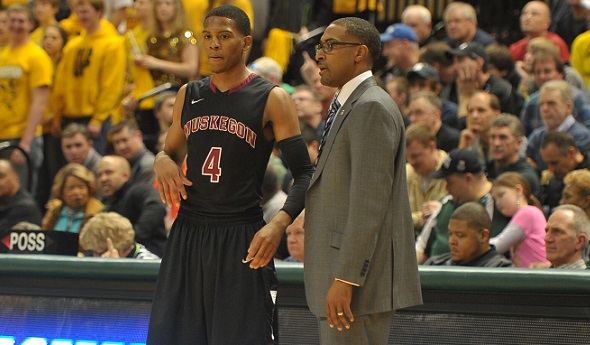
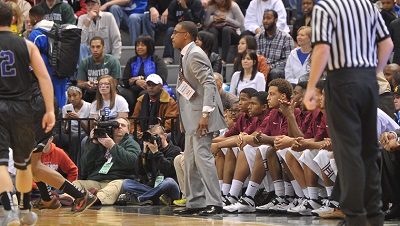
PHOTOS: (Top) Muskegon boys basketball coach Keith Guy, right, confers with Jordan Waire during the Class A Semifinal in 2014. (Middle) Guy works to get the attention of his players during the championship game win that season.
Clarkston, Loyer Dazzle at Breslin Again
By
Paul Costanzo
Special for MHSAA.com
March 24, 2018
EAST LANSING – Foster Loyer hasn’t enrolled yet at Michigan State University, but it’s safe to say he’s already plenty comfortable on his future school’s basketball court.
A day after torching the Breslin Center nets for 42 points in a Semifinal, Loyer poured in 40 more Saturday to lead Clarkston to an 81-38 win against Holland West Ottawa in the MHSAA Class A championship game.
“To be honest, I think playing in front of this atmosphere and this stage, I think it definitely helped being here last year,” Loyer said. “For me there were no nerves coming in. I thought our team, honestly, when we came in we weren’t bright-eyed or scared of playing in a big place. Having been here that helped me, and coming into the game I had the mindset to attack. I’ve been working on my shot quite a bit, so I was happy a few of them went down.”
It was the second straight title for the Wolves (26-1), who gave longtime coach Dan Fife the first of his storied career a year ago.
“The first one was pretty special for me, but this one here really was special,” Fife said. “From the day we left this building (a year ago) everybody started talking about back-to-back, and I know how hard that is because it took me so long to get the first one. To think that these kids could look up to that, it’s just a tremendous challenge. I can’t say enough about these kids.”
Saturday’s game marked the end of an amazing four-year run for Loyer and his classmates, as the Wolves were 97-6 during the Class of 2018’s tenure. It’s the best four-year run in Fife’s 36 seasons as Clarkston coach.
“These kids have been fun to work with,” Fife said. “I don’t know how it started last year – I’m sure Foster had something to do with it – but we started getting in the huddle and leaving the huddle with ‘Family,’ and these kids are extremely close. They have a good relationship on and off the floor, and I’ve gotta believe that’s going to carry on forever. This kind of moment, back-to-back, is incredible. These kids have played with a bulls-eye for four years, and to continue to play like they have and meet every challenge is really a tremendous success story about who they were as kids, and how they went about business.”
 Fittingly, the final shot of Loyer’s career was a 3-pointer to put him at 40 points and tied for the seventh-best scoring performance in an MHSAA Finals game. The 2018 Mr. Basketball winner finished 14 of 19 (73 percent) from the field and 6 of 11 (54 percent) from 3-point range in the game, and was 26 of 36 (72 percent) from the floor on the weekend.
He left the court he’ll play his college basketball on to a standing ovation, and he leaves Clarkston as the program’s all-time leading scorer.
“Foster Loyer is a pretty darn good player,” Holland West Ottawa coach Steve Windemuller said. “To see him in person is really special, because he is a special player. What he did today, it looked it was pretty effortless at times. I wish him all the best at Michigan State. Coach (Tom) Izzo’s got a good one.”
Loyer, who also had seven assists, was far from alone in his hot shooting, as the Wolves were 29 of 49 (59.2 percent) from the field, and 13 of 22 (59.1 percent) from 3. C.J. Robinson scored 18 points, while Taylor Currie had 13 points to go with 10 rebounds.
And it all started quickly, as Clarkston’s first four makes were from 3-point range, helping it to a 19-6 lead after one quarter, and a 49-20 lead at halftime. Holland West Ottawa (25-3), meanwhile, struggled from the jump, shooting 2 of 13 (15.4 percent) from the field in the opening quarter.
“Clarkston is really good,” Windemuller said. “If that’s any news to anybody, you’ve been living under a rock or in a cave. They were obviously really, really good today. It’s just one of those things, we get to play them one time, and I’m not sure us playing them 10 times was going to make a difference. Today wasn’t quite the way we wanted to end it, the way we wanted to play, for sure. But congratulations to them; they’re one heck of a team.”
Xavier Wade led West Ottawa with 13 points, while Liam Cavanaugh had 10. It was a rough ending, but the Panthers won’t let that take away from the deepest postseason run in program history.
“We’re thankful for the opportunity to be here,” West Ottawa senior Tyler Bosma said. “Obviously it’s not the way we wanted to go out, but I was very lucky to be part of the biggest run in West Ottawa history. I’m very thankful for that. I’m thankful for my teammates, coaches, our students, everybody that came out and supported us today and throughout the whole season. It’s really special to see and to be a part of that.”
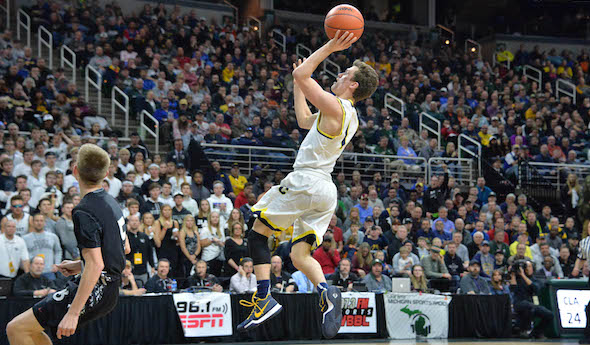
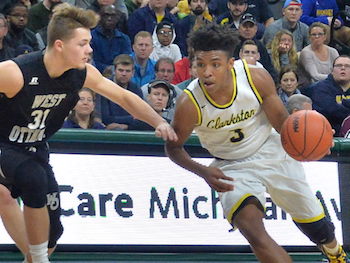
PHOTOS: (Top) Clarkston’s Foster Loyer drives to the basket during Saturday’s Class A Final. (Middle) The Wolves’ C.J. Robinson works to get past Holland West Ottawa’s Jason Fairfield.