

Hoopfest Returns for Boys Hoops Finals
March 24, 2015
By Geoff Kimmerly
Second Half editor
March Magic Hoopfest will return to Jenison Field House for this weekend’s Michigan High School Athletic Association Boys Basketball Finals, marking the sixth championship weekend the event has run concurrent with the games being played at Michigan State University’s Breslin Center.
A number of favorite attractions will return including slam dunk (on lowered rims), 3-point shootout and half-court rainbow shot areas where fans can come at any time and participate. Also returning is the Walk of History, showcasing championship games, life-size photos and display boards from throughout the MHSAA Finals’ near century-long run.
Two Hoopfest center courts will host a number of games throughout the event, including the “JumpBall Jamboree” made up of teams of boys and girls in grades 3-8, a wheelchair basketball tournament and a series of games between Special Olympics Project UNIFY high school teams.
Admission to the March Magic Hoopfest is $2 per person, and fans attending the MHSAA Boys Basketball Semifinals and Finals will be admitted free with their game tickets. Hours on March 26 and 27 will be 2 p.m. to 7 p.m.; the event is open from 10 a.m. to 6 p.m. on March 28. Jenison Field House, site of Hoopfest, also was the site of the MHSAA Boys Basketball Finals for 31 years. To find out more general information about the event, visit the March Magic Hoopfest Website.
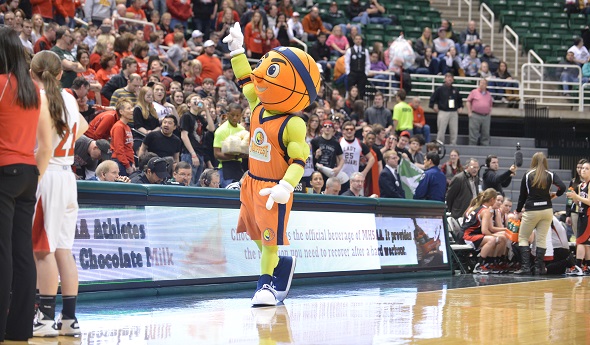
Hoopfest also will be home to Hoopie, the event’s mascot who made his first public appearances last season. Click for video of Hoopie preparing for this weekend’s event.
The March Magic Hoopfest is being conducted in partnership between the Greater Lansing Sports Authority (GLSA), a division of the Greater Lansing Convention and Visitors Bureau, and the MHSAA, with vital support coming from the Department of Intercollegiate Athletics at Michigan State University.
“My kids always look forward to going to Hoopfest. They love running around Jenison, playing the different basketball games and being with all the kids,” MHSAA Director of Brand Management Andy Frushour said. “This event has turned into a ‘must do’ every spring.”
The Greater Lansing Sports Authority’s mission is to be the leading voice of sports tourism in the Greater Lansing area and to promote economic growth by attracting a diverse range of sporting events to the region. The GLSA strives to enhance the quality of life for area residents through the development of local sports and fitness programs for all ages and supports the continued development and maintenance of safe, high-quality athletic facilities.
“The March Magic Hoopfest sets off a great weekend of MHSAA tournament games and helps create a multi-day event which will involve the Lansing area and thousands of visitors from across the state,” GLSA Executive Director Mike Price said. “If you’re coming to the championships, Hoopfest is a destination to visit before and after the games; and if you’re not coming to the games, Hoopfest is a fun, wholesome, inexpensive, family activity.”
Clarkston, Loyer Dazzle at Breslin Again
By
Paul Costanzo
Special for MHSAA.com
March 24, 2018
EAST LANSING – Foster Loyer hasn’t enrolled yet at Michigan State University, but it’s safe to say he’s already plenty comfortable on his future school’s basketball court.
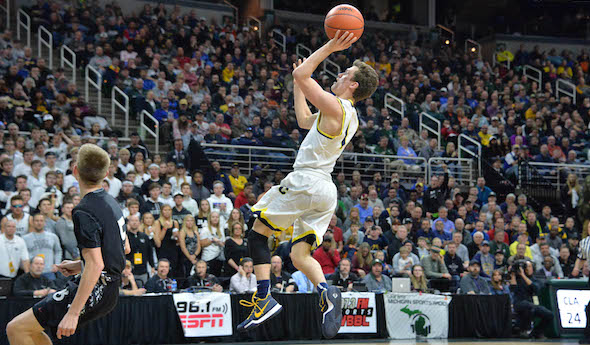
A day after torching the Breslin Center nets for 42 points in a Semifinal, Loyer poured in 40 more Saturday to lead Clarkston to an 81-38 win against Holland West Ottawa in the MHSAA Class A championship game.
“To be honest, I think playing in front of this atmosphere and this stage, I think it definitely helped being here last year,” Loyer said. “For me there were no nerves coming in. I thought our team, honestly, when we came in we weren’t bright-eyed or scared of playing in a big place. Having been here that helped me, and coming into the game I had the mindset to attack. I’ve been working on my shot quite a bit, so I was happy a few of them went down.”
It was the second straight title for the Wolves (26-1), who gave longtime coach Dan Fife the first of his storied career a year ago.
“The first one was pretty special for me, but this one here really was special,” Fife said. “From the day we left this building (a year ago) everybody started talking about back-to-back, and I know how hard that is because it took me so long to get the first one. To think that these kids could look up to that, it’s just a tremendous challenge. I can’t say enough about these kids.”
Saturday’s game marked the end of an amazing four-year run for Loyer and his classmates, as the Wolves were 97-6 during the Class of 2018’s tenure. It’s the best four-year run in Fife’s 36 seasons as Clarkston coach.
“These kids have been fun to work with,” Fife said. “I don’t know how it started last year – I’m sure Foster had something to do with it – but we started getting in the huddle and leaving the huddle with ‘Family,’ and these kids are extremely close. They have a good relationship on and off the floor, and I’ve gotta believe that’s going to carry on forever. This kind of moment, back-to-back, is incredible. These kids have played with a bulls-eye for four years, and to continue to play like they have and meet every challenge is really a tremendous success story about who they were as kids, and how they went about business.”
 Fittingly, the final shot of Loyer’s career was a 3-pointer to put him at 40 points and tied for the seventh-best scoring performance in an MHSAA Finals game. The 2018 Mr. Basketball winner finished 14 of 19 (73 percent) from the field and 6 of 11 (54 percent) from 3-point range in the game, and was 26 of 36 (72 percent) from the floor on the weekend.
He left the court he’ll play his college basketball on to a standing ovation, and he leaves Clarkston as the program’s all-time leading scorer.
“Foster Loyer is a pretty darn good player,” Holland West Ottawa coach Steve Windemuller said. “To see him in person is really special, because he is a special player. What he did today, it looked it was pretty effortless at times. I wish him all the best at Michigan State. Coach (Tom) Izzo’s got a good one.”
Loyer, who also had seven assists, was far from alone in his hot shooting, as the Wolves were 29 of 49 (59.2 percent) from the field, and 13 of 22 (59.1 percent) from 3. C.J. Robinson scored 18 points, while Taylor Currie had 13 points to go with 10 rebounds.
And it all started quickly, as Clarkston’s first four makes were from 3-point range, helping it to a 19-6 lead after one quarter, and a 49-20 lead at halftime. Holland West Ottawa (25-3), meanwhile, struggled from the jump, shooting 2 of 13 (15.4 percent) from the field in the opening quarter.
“Clarkston is really good,” Windemuller said. “If that’s any news to anybody, you’ve been living under a rock or in a cave. They were obviously really, really good today. It’s just one of those things, we get to play them one time, and I’m not sure us playing them 10 times was going to make a difference. Today wasn’t quite the way we wanted to end it, the way we wanted to play, for sure. But congratulations to them; they’re one heck of a team.”
Xavier Wade led West Ottawa with 13 points, while Liam Cavanaugh had 10. It was a rough ending, but the Panthers won’t let that take away from the deepest postseason run in program history.
“We’re thankful for the opportunity to be here,” West Ottawa senior Tyler Bosma said. “Obviously it’s not the way we wanted to go out, but I was very lucky to be part of the biggest run in West Ottawa history. I’m very thankful for that. I’m thankful for my teammates, coaches, our students, everybody that came out and supported us today and throughout the whole season. It’s really special to see and to be a part of that.”
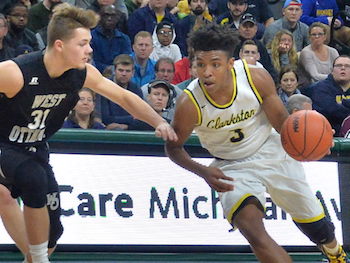
PHOTOS: (Top) Clarkston’s Foster Loyer drives to the basket during Saturday’s Class A Final. (Middle) The Wolves’ C.J. Robinson works to get past Holland West Ottawa’s Jason Fairfield.