

Improved Dundee Enjoys Memorable Start
By
Geoff Kimmerly
MHSAA.com senior editor
January 12, 2017
By Geoff Kimmerly
Second Half editor
The Dundee boys basketball team has stacked up a pair of accomplishments already this winter – one to enjoy right now, and another to take pride in for years to come.
 The Vikings, after finishing last season 10-11, are off to an 8-0 start this winter. The early run has included a 67-64 win on Dec. 15 over Onsted, last year’s Lenawee County Athletic Association champion.
The significance of that accomplishment is easy for players to get, especially since the majority of this year’s rotation went through the growing pains of last season. But the historic meaning of the win that came after Onsted probably will take some more time to sink in – even as it’s bound to be one of the most lasting achievements of these players’ careers.
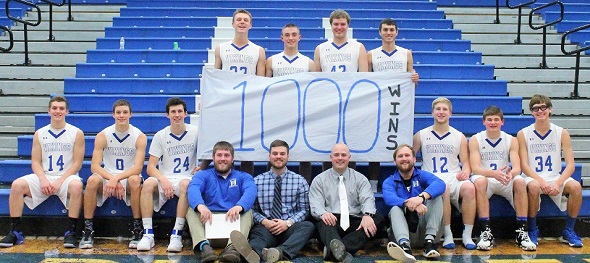
Dundee’s 60-50 win over Carleton Airport on Dec. 20 was the 1,000th victory in program history, making the Vikings one of at least 12 in Michigan high school history to have reached that milestone and the first from Monroe County.
“I don’t think at their age they understand how big of an accomplishment that is – that you’d basically have to go undefeated 50 straight years to get to 1,000,” said second-year coach Jordan Bollin, who is in his 11th season total as a coach in the southeast part of the state. “We tried to explain it to them, and I think they do (get it more) now.”
Dundee is the Applebee’s “Team of the Month” for December in part for both headlining moments this season, pulling off its first five wins during that first month and seven of eight so far by double figures.
The Vikings are paced by six seniors, including four who start alongside junior Ben Miller, who also started last season as a sophomore and leads with team with 12.6 points and 10.1 rebounds per game. To make this season's jump, they put in the necessary time; Bollin said he held four-player workouts three times a week during the offseason, in addition to the players honing their skills during open gyms and over a busy summer.
Bollin also emphasized that while the program has undergone a system change – introducing a more free-flowing offense and shorter practices this winter – it’s maintained the same culture of toughness that exists throughout the community and is often most recognizable with the school’s best-known team – a wrestling program that has won three of the last four MHSAA Division 3 championships.
“I’ve coached at a couple places, and the kids at Dundee are tougher bred,” said Bollin, who graduated from Temperance Bedford, then assisted there and at Blissfield before coming to Dundee as an assistant three seasons ago. “I don’t know how to explain it. The parents do a great job of raising them. A lot of the parents played at Dundee, and it’s a well-versed culture there. It’s a very tough community … and it’s always ‘Yes coach. No coach,’ very respectful kids.
“The wrestling program sets the tone, and if our kids ever get tired or feel that our practice is tough, we ask, ‘Do you want to go wrestle?’ Tim (Roberts) is one of the best coaches probably in the nation, and they probably outwork any team in any sport in the state, and I can say that in confidence.”
It’s certainly worth noting that Dundee’s basketball program also is making this impressive run sharing winter athletes with that wrestling program in a school of just under 500 students. That might make the Vikings’ basketball depth notable as well; Bollin said in 11 seasons he’s never had a team with this many contributors, as six players have scored at least 13 points in a game. Senior guard Brayden Federer is another top scorer, pouring in 12 points per game while also serving as the leading lockdown defender.
For Dundee’s next game after winning 1,000, against Flat Rock on Dec. 22, the Vikings welcomed the school’s 1987-88 team that advanced to the Class C Semifinals and is considered the program’s best of all-time (Dundee’s 1937-38 team also made the Class C Semifinals, but no team has won a Regional title since 1988). Those past players were recognized with an on-court ceremony and visited the locker room before the game to meet the current players before these Vikings went on to a 44-30 win to close the month.
Bollin had an idea before this season that this team might be lined up for a special run too. So far it’s included a couple of meaningful accomplishments, and the Vikings hope they’re just getting started.
“We’re a starless team … and even in my second year, I’m improved as a coach. We’re prepared for anything they see, but a lot of it is on them,” Bollin said of his players. “People take it for granted, that experience, but it’s a big deal. These guys don’t get rattled much this year. Last year if a team switched defenses on them, it would set them back a couple of plays.
“(And) we’re a really close-knit unit, and they don’t let each other slack. It’s easy to coach when you have a team like that.”
Past Teams of the Month, 2016-17
November: Rockford girls swimming & diving - Report
October: Rochester girls golf - Report
September: Breckenridge football - Report
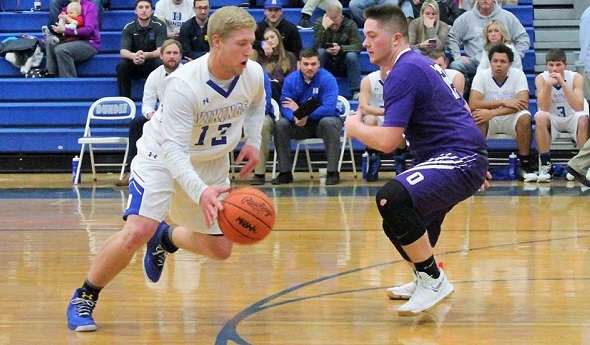
PHOTOS: (Top) Dundee’s Tyler Turner looks to get past an Onsted defender during the Vikings’ three-point win last month. (Middle) Dundee players and coaches commemorate the program’s 1,000th win after defeating Carleton Airport. (Photos courtesy of the Dundee boys basketball program.)
Edison Hangs On, Moves On to 1st Final
March 22, 2018
By Geoff Kimmerly
Second Half editor
EAST LANSING – Detroit Edison saw its 16-point lead disappear by the middle of the fourth quarter of Thursday’s Class C Semifinal against Grand Rapids Covenant Christian.
The Pioneers weren’t worried.
“I wasn’t really concerned at all,” Edison senior guard Pierre Mitchell, Jr., said. “We’ve been through this the whole season. We play in the PSL. It’s a whole bunch of tough battles every Tuesday and Friday.
In fact, the Pioneers won the Detroit Public School League tournament this season. And that experience no doubt helped them earn the chance to play for their first MHSAA boys basketball championship.
Edison broke away over the final four minutes Thursday for a 55-43 win, launching a 14-1 game-ending run after the Chargers had come all the way back from the earlier double-digit deficit.
“I have seniors here, and these guys do a pretty good job of keeping guys focused on what we need to do and when we need to do it,” Edison coach Brandon Neely said. “I had confidence these guys were going to rise to the occasion.
“We were going to just maintain composure. We’ve been in a lot of tough battles this year, but we’re battle-tested. We’ve had teams come back on us before. We’ve lost some games that way. We’ve lost a game just about any way you could imagine. … (but) we always competed.”
Edison (16-10) will face Maple City Glen Lake in Saturday’s 4:30 p.m. championship game.
The Pioneers have won 10 of their last 11 games, which means they started 6-9 – and they finished fourth in their PSL division, which also included two Class A, a Class B and another Class C school.
But lessons learned from those defeats helped Edison weather Covenant Christian’s comeback and the momentum shift that could’ve come with it.
 The Pioneers moved on with senior center Deante Johnson playing only 20 minutes because of foul trouble. They held on despite hitting only 35 percent of their shots for the game.
Instead of folding during Covenant’s comeback, Edison got help in the post from senior guard Gary Solomon, who finished with team highs of 15 points and 10 rebounds. And they climbed out of their cold shooting to make 5 of 11 tries from the perimeter during the fourth quarter, including 4 of 5 during the run to close out the game. Johnson came back to score the first five points of that final stretch.
“I work on (shooting) every day, and I had to come up big for my team,” Johnson said. “I was in foul trouble all throughout the game. I wasn’t the presence in the middle that I’d usually be. So I had to make it up somehow, some way in the fourth quarter for my team.”
As a team, Covenant Christian (22-5) shot a nearly identical 35 percent to the Pioneers, but made 9 of 13 attempts to knock down the 16-point deficit over the first 12 minutes of the second half.
But as the Pioneers closed on a roll, the Chargers finished making just 1 of 6 shots and turning the ball over twice.
“We knew we had to shoot it well today, and we didn’t in the first half and I thought that cost us,” Covenant Christian coach Tyler Schimmel said. “In the second half, we started playing Charger basketball.
“We changed a few things defensively (at halftime), but not many. For some reason, we were timid early on. We thought we were just as good as Edison, and they’re a good team. The shots just didn’t fall for us.”
Senior forward Carson Meulenberg led Covenant Christian with 12 points and 12 rebounds, and senior forward Trenton Koole also scored 12 points.
Mitchell added 13 points for Edison, and senior guard Keith Johnson was key off the bench with 10 points on 4 of 8 shooting over 14 minutes.
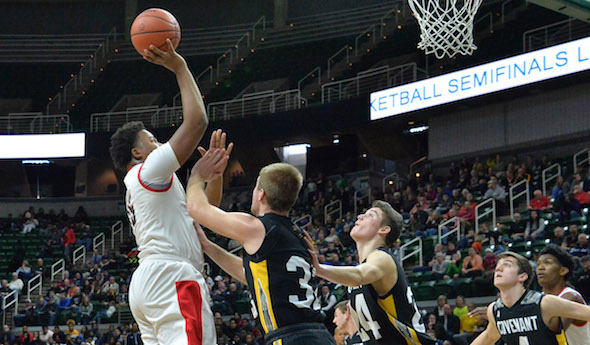
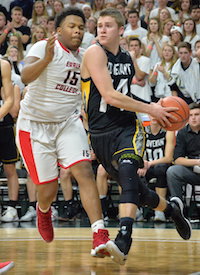
PHOTOS: (Top) Detroit Edison’s Keith Johnson puts up a jumper during Thursday’s Class C Semifinal against Grand Rapids Covenant Christian. (Middle) The Chargers’ Nathan Minderhoud drives the baseline with Johnson defending.