

Johnston Retires as Winningest Coach, Much More to Beaverton Dream He Built
By
Paul Costanzo
Special for MHSAA.com
March 15, 2024
Before Roy Johnston left the court that bears his name for the final time as Beaverton head boys basketball coach on Feb. 23, 1,500-plus fans, family and current and former players had one more chant.
 It wasn’t the name of the coach they all adored after he wrapped up the winningest career in MHSAA basketball history. It wasn’t even the school song, or a slogan.
With Johnston pumping a raised fist, the community chanted “Judy” to honor his wife, who could not be at the game or celebration as she was battling cancer.
It was a fitting tribute to the woman behind the coach who became more than the face of the community, and one last opportunity for those fans to say thank you to her for her own efforts and sacrifices in helping the Beaverton become something pulled straight from the movie screen – the small-town sports tale complete with the iconic coach in the lead role and generations of locals living their dedication by filling the stands for every game.
Judy Johnston passed away this past Saturday, a little more than two weeks after the ceremony that honored her husband. She was 81.
All interviews for this story were completed prior to her passing, but a common theme when talking about Johnston’s 50-year career and importance to Beaverton was that the entire family, specifically Judy, had played a big role.
“His family has put forth an incredible amount of effort into our community,” said former player Brent Mishler. “In basketball and in general.”
Family is at the center of Johnston and Beaverton’s immense success over his 50 years. Not only has he coached multiple generations of several Beaverton families – including three generations of Mishlers – but he’s coached his own children, and grandchildren.
Small town programs often rely on players who have grown up around them and together, and Beaverton has that in spades.
“It was a dream,” former player and Johnston’s co-coach, Shad Woodruff, said of having his son Layk play for Johnston. “I got to play for Roy and be part of all that Beaverton basketball is – it’s not just a sport around here. We have video of (Layk) dribbling a basketball in the gym literally before he could walk. He’s been the little guy that always looked up to (Roy’s grandsons) Spencer Johnston and Carter Johnston, so just to be a part of Beaverton basketball is special.
 “It’s like when your kid gets there, you’re giving your kid to the community for a while and saying, ‘Here you go.’ It’s amazing to watch your son out there, especially in a community like ours. Roy has created this thing with Beaverton basketball where every Friday night, it’s like church. Everybody’s there.”
The numbers behind Johnston’s career, which started in 1966 in Yale, are remarkable. He holds the MHSAA record for wins by a boys basketball coach at 833, the vast majority coming at Beaverton, the program he took over in 1974.
The Beavers won 21 conference titles, 17 District titles and five Regional titles during Johnston’s 50 years, adding a run to the MHSAA Semifinals in 1984.
Just six of Johnston’s seasons ended in records below .500, and in a fitting tribute to their coach, this year’s Beavers scratched and clawed their way to a five-game win streak at the end of the season to ensure his last wouldn’t be No. 7, finishing the year 12-12 with a loss to Beal City in the District Final.
Included in that streak was a 54-45 victory over rival Gladwin on the night Johnston was honored. The Beavers trailed by as many as nine during the second half before rallying to win, led by a 26-rebound performance from 6-foot, 1½-inch senior Reese Longstreth, who Woodruff called the epitome of a Beaverton basketball player.
“I’ve been fortunate to be around Roy for 40 years, and I’ve seen a lot of great wins, especially in that gym,” Woodruff said. “I can’t put anything above that one.”
Layk Woodruff made the final basket in the game, which will forever be the final basket made in Roy F. Johnston Gymnasium during the Johnston era.
“It was super emotional, I’d say, for a bunch of reasons,” Layk Woodruff said of the game. “We felt like it was our responsibility, we had to that game for Roy. It was a rivalry game, last home game of the year – there were a lot of emotions when that game ended. I didn’t even think about (hitting the final shot) until a couple days later. Now that I get to think about it, it’s pretty cool to say that was me. I’ll always remember that.”
One celebration led to another, as Johnston’s retirement ceremony followed the game. A tribute video created by Beaverton graduate Jason Brown, who owns a digital media company, and narrated by longtime Beaverton public address announcer Scott Govitz was played. Govitz admitted to getting choked up at times while recording the video.
“There were a couple times where I did more than one take,” he said.
Govitz was at the center of a massive effort to create the ceremony, with support from athletic director Will Gaudard, school staff and members of the community, including multiple businesses and organizations. Govitz had arranged for special lighting and video screens for the presentation. Special tickets were printed for the night – which also happened to be Beaverton’s Hall of Fame night. Following the video, a spotlight was shone on center court, where a single chair sat, one of Johnston’s vintage red blazers draped over its back.
The more than 100 former players who had come to celebrate their coach each had a glow stick they cracked on, and walked through the darkness to surround the chair.
Then Johnston walked the red carpet – much like his starters have for years when being introduced prior to games – and addressed the crowd.
He didn’t speak for long, but as Johnston so often does, he hit all the right notes, mixing gratitude with humor.
“Gladwin County is a great place to raise a good family,” Johnston said after thanking the traveling contingent from Gladwin.
“I want to thank everyone for a great run. Fifty years. A great run.”
For outsiders, it was a chance to see the softer side of Johnston rather than the man intensely patrolling the sidelines during games. It was a glimpse at the man that handed out suckers before games to every kid in attendance.
 “He belonged on an episode of ‘Grumpy Old Men,’ and he still could play the role,” Govitz said with a laugh. “He would always say, ‘Don’t listen to the way I say it, listen to what I say.’ He just wants you to do things correctly. His players, maybe they didn’t adore it at the time, but they adore it now. Being a part of that program taught them more than basketball skills. … What will happen, once they leave, they find that great respect for it. And, he does things quietly that no one ever knows or sees – helping someone in need, especially the ones in college, checking up on them or sending them some money. That helps build a program and build relationships. He said in his last speech that it’s about getting along with others. If you can’t get along well with others, you can’t get along. That’s what it’s about.”
Mishler echoed that sentiment, and some of the memories that stick out most to the 2002 graduate were when Johnston got after him in his own special way.
“Playing for him was a privilege,” said Mishler, whose father Steve played for Johnston in the ’70s, and his son Cameron played through 2021. “The life lessons he taught set you up for success in life for the future. ‘You need to hear what I’m saying, not the method I’m saying it.’ That’s so true. Being honest and having expectations, and expecting people to hit those expectations, is not a bad thing.”
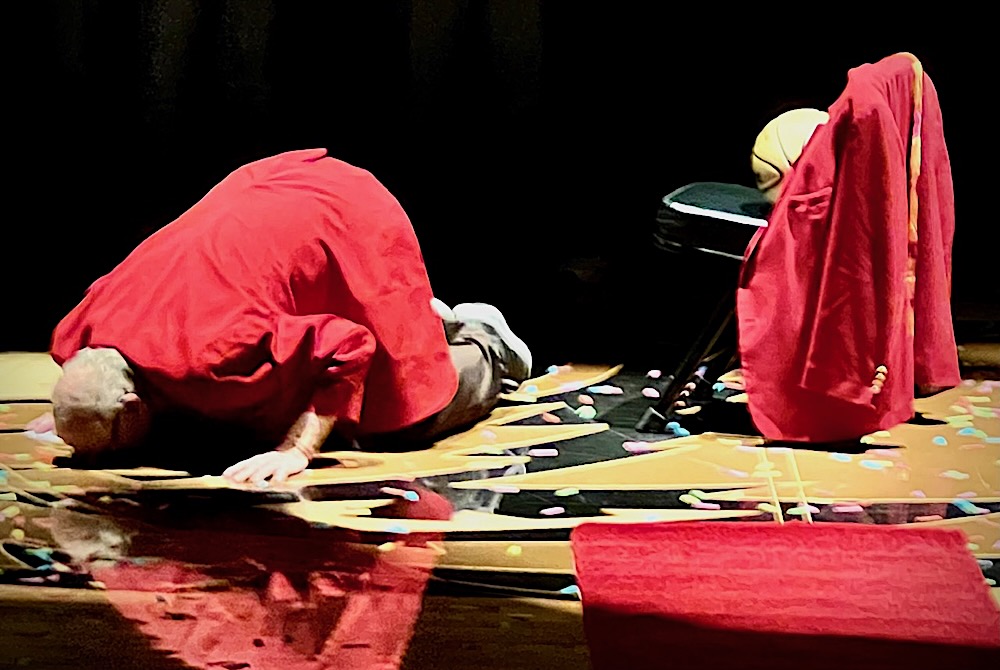
After Johnston was done speaking, he knelt down and kissed the floor to say goodbye to the job he’s done for most of his life, and in a way, thank you, to the community he helped create and that he’ll now need more than ever.
“Roy’s good at making you feel like he’s not big on that stuff (being recognized), and he isn’t, but he definitely does appreciate it,” Shad Woodruff said. “He understands how important he is to the community, and that he’s done something really special. He understands what he’s done is a pretty big feat, but he doesn’t talk about it. He doesn’t brag about it.”
 Paul Costanzo served as a sportswriter at The Port Huron Times Herald from 2006-15, including three years as lead sportswriter, and prior to that as sports editor at the Hillsdale Daily News from 2005-06. He can be reached at [email protected] with story ideas for Genesee, Lapeer, St. Clair, Sanilac, Huron, Tuscola, Saginaw, Bay, Arenac, Midland and Gladwin counties.
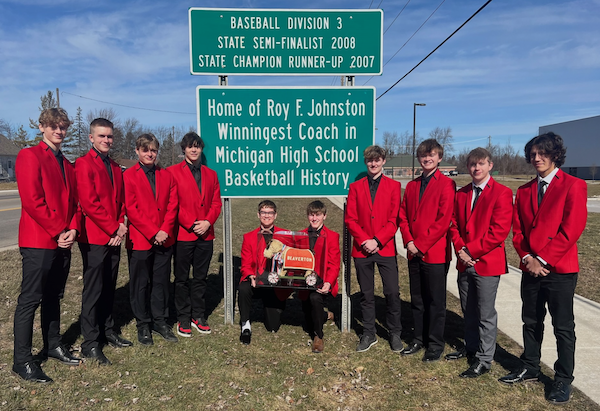
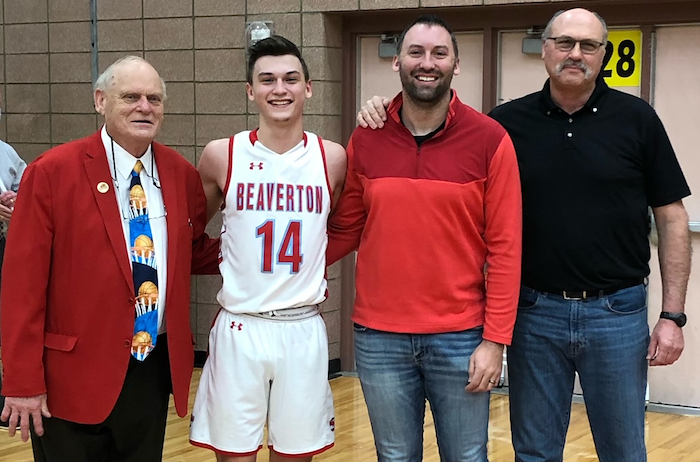
PHOTOS (Top) Beaverton boys basketball coach Roy Johnston kisses the court that bears his name during a celebration of his retirement Feb. 23. (Middle) This season’s team stands at the entrance to town with signs announcing the program and coach’s successes. (Below) Johnston takes a photo with three generations of Mishlers – Cameron, Brent and Steve. (Top photo by Stephanie Johnston.)
South Lyon United's Radcliffe Approaching Milestone Win, Another History-Making Moment
By
Keith Dunlap
Special for MHSAA.com
May 7, 2026
Originally, Deanna Radcliffe got into coaching lacrosse simply because it was a nice summer job.
 From that simple beginning, Radcliffe is now on the verge of making high school sports history within the state of Michigan.
No girls or boys lacrosse coach has reached 300 career victories since the sport became MHSAA-sponsored in 2005. But Radcliffe is oh-so-close. Following a win over Haslett on Wednesday, Radcliffe has 299 career victories.
The milestone 300th win likely will come Saturday when South Lyon United plays in a tournament at Saline.
In order to get their names etched in the record book, any high school coach in Michigan has had to reach at least 300 wins since the MHSAA brought the sport into its championship lineup. So Radcliffe is literally about to become the first and only coach in the MHSAA coaching records for lacrosse.
Radcliffe is in her 10th season coaching for South Lyon Unified and also coached at Hartland from 2013 to 2022. This is actually her second stint at South Lyon, where she spent seven years as head coach before taking the Hartland job.
“It just means I’ve been doing this for a long time,” Radcliffe said. “What it really represents to me is all the players, coaches and families I’ve had the opportunity to coach. I’ve been fortunate to coach in an area that was willing to embrace the sport. I have been able to catch some really great teams and athletes across all levels from youth to high school and even collegiately. That’s the part that means the most, those relationships and experiences. The wins are just a byproduct of that.”
Radcliffe got her start in lacrosse very young, saying she picked up the game at 3-4 years old while growing up in Pennsylvania. She was introduced to the game by her aunt.
 “It just became part of my life early on,” she said.
Radcliffe eventually became good enough as a player to earn a college opportunity, ultimately being named the Atlantic 10 Offensive Player of the Year in 2003 while playing for Temple.
Radcliffe eventually started a career as a special education teacher and was a high school coach in Pennsylvania before moving to Michigan in 2006, where she has coached club, high school and even college lacrosse as she spent time as an assistant at Cleary University.
“I just enjoyed being around the game and the competitive environment, so I kept doing it,” Radcliffe said of what has kept her coaching. “Over time, it stopped being something I was just doing in the summers and became something I really valued and stayed connected to. It’s grown naturally from there, and I’ve been fortunate to continue coaching while also working in education.”
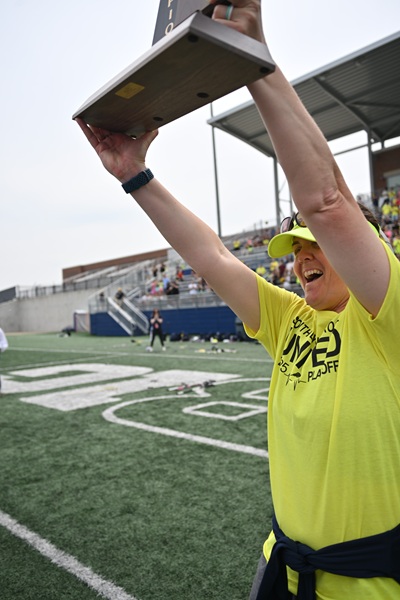
The most noteworthy win of her career came last June, when South Lyon Unified earned a 6-3 Division 1-clinching victory over Hartland to give Radcliffe her first MHSAA Finals championship as head coach in a matchup between the two programs she built up.
South Lyon Unified is 18-0 this season and has won 39 straight games going back to last spring's opener.
“She has so much knowledge of the sport and really cares for each and every one of us,” said South Lyon United senior captain Teagan Wesner. “Deanna has been one of the best coaches I have ever had, and I am extremely grateful to have had the opportunity to play for her. I am very happy for Deanna, and I am excited to be a part of the team who helped her reach 300 wins.”
When Radcliffe first arrived in Michigan, lacrosse was in its first years as a sanctioned sport by the MHSAA. Now, she has seen it grow by leaps and bounds.
“One of the most rewarding parts has been seeing the long-term impact,” she said. “Many of the players I once coached are now youth, high school or college coaches themselves. Some are officials, and some I’m even coaching against or alongside now. That’s been incredibly meaningful and really speaks to the strength of the community the sport has built.”
 Keith Dunlap has served in Detroit-area sports media for more than two decades, including as a sportswriter at the Oakland Press from 2001-16 primarily covering high school sports but also college and professional teams. His bylines also have appeared in USA Today, the Washington Post, the Detroit Free Press, the Houston Chronicle and the Boston Globe. He served as the administrator for the Oakland Activities Association’s website from 2017-2020. Contact him at [email protected] with story ideas for Oakland, Macomb and Wayne counties.
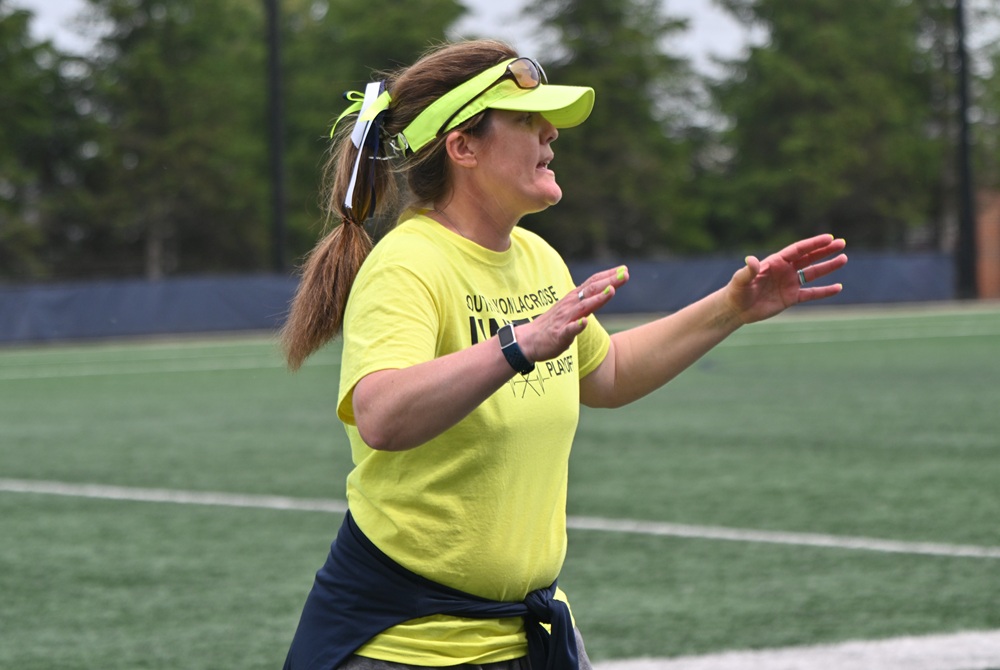
PHOTOS (Top) Deanna Radcliffe, here during the 2025 Division 1 Final, has reached 299 career coaching wins. (Middle) Radcliffe raises the championship trophy after last season’s clincher.