

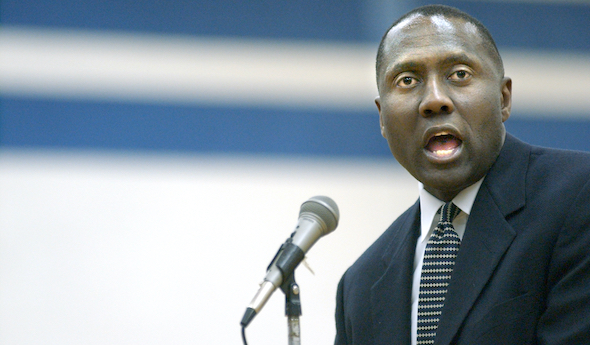
Joplin Always Has Known Value of Home
By
Doug Donnelly
Special for MHSAA.com
July 9, 2020
It is no accident that Stan Joplin has never ventured too far from his hometown of Milan on the border of Monroe and Washtenaw Counties in extreme southeast Michigan.
 In fact, that has been by design.
“Mr. (Phil) Barnes once told me that you never want to get too far from home,” Joplin said recently, recalling one of his high school administrators. “If you are close by your home, people will remember you.”
It has been more than 40 years since Joplin played basketball at Milan, and no one is forgetting him anytime soon.
A coach at the high school and Division I collegiate levels and then high school again over nearly 40 years, the 63-year-old Joplin is two seasons removed from his last tenure leading the program at Sylvania Southview. But those decades of wisdom continue to be passed on to Southview students as Joplin serves as an assistant principal at the high school.
“The farthest I ever lived from Milan was when I was coaching at Kent State,” he said. “I’ve remained in southeast Michigan or northwest Ohio all of these years. I have been very fortunate to have the opportunity to stay close to home and receive a good education. You can’t put a price on education. Sooner or later, basketball was going to come to an end.”
It gave him a running start at the beginning.
One of the first four-year starters in Monroe County Region history, Joplin grew up around the game. People like Barnes, coach Ron Dingman and Ann Arbor’s Sandy Sanders all played key roles in Joplin’s early success.
Barnes was a mentor, offering advice and some key life lessons. Dingman was the coach who inserted Joplin into the starting lineup as soon as he could and kept him there as he led the Big Reds in scoring and was named team MVP four consecutive seasons. Sanders was a local basketball guru with connections from Ann Arbor to Detroit.
“Mr. Sanders was umpiring a baseball game and saw me shooting over at the elementary school,” Joplin said. “He invited me to come up to Ann Arbor to play.”
Sanders saw the basketball talent in Joplin and put him on the court in Ann Arbor with other prep talent and some University of Michigan players.
“That’s where I met guys like Campy Russell and Joe Johnson,” Joplin said.
Sanders took area players – including Joplin – to Detroit to play at the famed St. Cecilia Gym. St. Cecilia is well-known in basketball circles for hosting standouts like George Gervin, Magic Johnson and, more recently, Jalen Rose.
“You can imagine what kind of eye-opening experience that was,” Joplin said. “It showed me how hard I had to work. That was huge for me. That really exposed me to basketball.”
Growing up, his neighbor played basketball at Milan, and Joplin would get to go to all the games to watch him. Joplin read about Milan and other local basketball players in the Ypsilanti Press, Ann Arbor News and Monroe News, soaking up everything he could about the game.
“I just wanted to be an athlete,” he said.
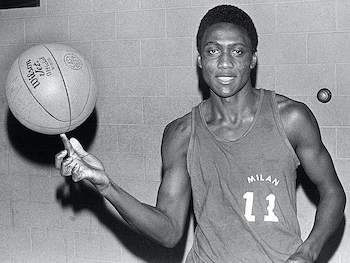
He was more than just an athlete. An all-stater, he scored more than 1,500 career points – still a Milan record – and was recruited to play at the University of Toledo for Bobby Nichols.
 “It was the perfect situation,” Joplin said of growing up where he did. “Milan was a small town. A lot of the students I went to elementary school with I spent my whole time in school with. I knew everyone in the city.”
At Toledo, Joplin blossomed into an all-around player with a knack for elevating his game during key moments. He was named second team all-Mid-American Conference in 1977-78 and 1978-79. The 1979 Rockets won the MAC championship and made the NCAA Tournament. It was there that Joplin had the biggest moment of his career when he knocked down a 20-foot jumper to beat Iowa, 74-72, in the first round. The Rockets would lose a close game in the second round to a Notre Dame team that included four future NBA players. During Joplin’s four years at Toledo, the Rockets went 82-27.
While making national headlines, Joplin also was earning his education, something that Barnes encouraged along the way.
“I followed in his footsteps, went to college, got my degree and went into administration,” Joplin said.
After graduating from UT’s College of Education in 1979, Joplin began coaching at the high school level and was soon head coach at Toledo Start High School. He went on to become an assistant at Kent State University then joined the Rockets’ coaching staff during which time he earned a Master of Administration degree. He would later join the Michigan State University staff with Jud Heathcote and Tom Izzo.
In 1996, Joplin was named head coach at his alma mater, where he remained for 12 years, going 203-155 overall and making the NIT field four times. After he was let go following the 2007-08 campaign, Joplin reached into his education background to become an administrator in the Toledo area. He probably could have landed an assistant coaching job somewhere because of his connections in the sport, but chose not to go that route. He remained close to home.
He coached for a few seasons at Holland (Ohio) Springfield and one year at Sylvania Southview but is enjoying being a basketball fan these days.
“Basketball is the one thing I’ve done my whole life. I miss coaching, but I don’t need it,” he said.
Joplin goes to most of the Southview games and will go on the road occasionally to watch games in which some of his former players are coaching. He gets back to Michigan State University every now and then to watch the Spartans practice and relishes friendships he’s made in the game with people like former University of Michigan head coach Tommy Amaker and former Boston College head coach Al Skinner.
“I’ve got a lot of close friends that I stay in touch with,” he said.
He is not ruling out a return to the sidelines, but is not planning on it, either.
“I watch a lot of basketball. The game has changed,” he said. “The 3-point shot has taken the center out of the game. But, the game itself, is fine.”
Joplin is in the hallways more than the gym these days at Southview. His students know more about Mr. Joplin the school administrator than Stan Joplin the legendary basketball player from Milan – and he is fine with that.
“Every once in a while, someone will say something or bring me a video and say, ‘Hey, Mr. Joplin, I didn’t know you played.’ I just tell them that’s not me, that is just some guy with a lot more hair. It’s become kind of a running joke.”
Made in Michigan 2020
June 24: Fracassa's Remarkable Records Still Rule - Read
June 16: Muskegon Grad Casts "Magic" in HBO Series - Read
 Doug Donnelly has served as a sports and news reporter and city editor over 25 years, writing for the Daily Chief-Union in Upper Sandusky, Ohio from 1992-1995, the Monroe Evening News from 1995-2012 and the Adrian Daily Telegram since 2013. He's also written a book on high school basketball in Monroe County and compiles record books for various schools in southeast Michigan. E-mail him at [email protected] with story ideas for Jackson, Washtenaw, Hillsdale, Lenawee and Monroe counties.
PHOTOS: (Top) Milan basketball legend Stan Joplin serves as an assistant principal at Sylvania Southview High School. (Middle) Joplin still owns the career scoring record at Milan.
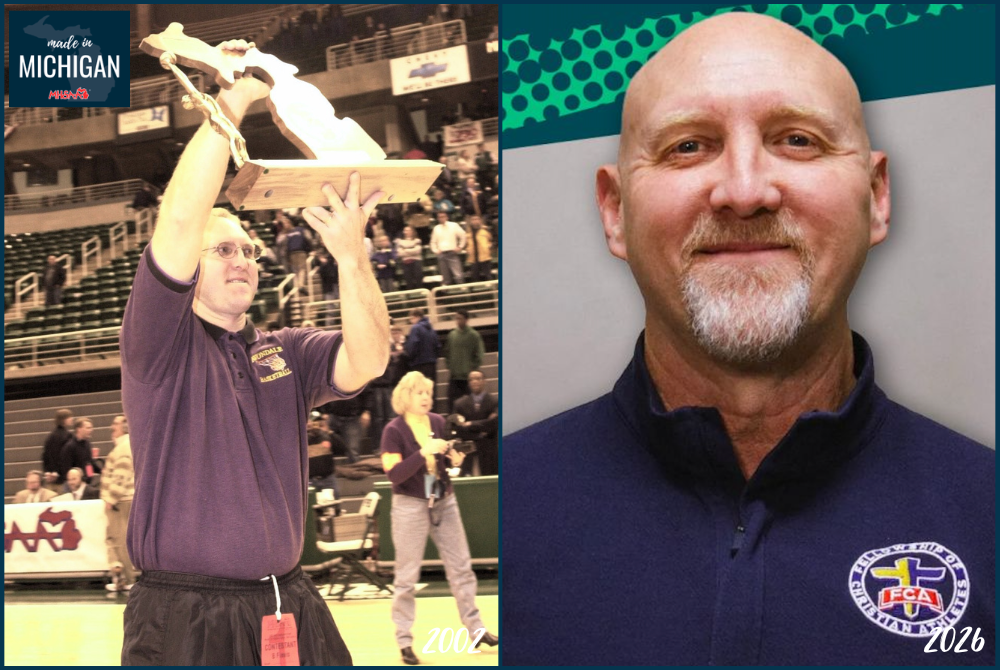
Nearly 25 Years After Leading Unexpected Run, Morton Directing Life-Changing Mission
By
Keith Dunlap
Special for MHSAA.com
August 11, 2026
Nearly a quarter century after presiding over arguably one of the most improbable boys basketball state championships in Michigan history, the same fight and underdog mentality still exists for Tim Morton.
 Back in 2002, Morton was the head boys basketball head coach at Auburn Hills Avondale, which produced a Hollywood-type run during that season’s Class B tournament.
Unranked and without a future Division I college player in the lineup, a Yellow Jackets team headlined by seven seniors went on a quest that stunned many statewide observers.
Avondale avenged the disappointment of not getting out of the District round the previous year and then recorded a stunning upset of a highly-ranked Flint Southwestern team in their Regional Final, winning in double overtime. But after squeaking out a six-point win over a solid Williamston team in a Quarterfinal and earning an 11-point win over Comstock Park in the Semifinals, surely midnight was going to strike for Cinderella in the championship game. After all, Avondale was up against a powerful Grand Rapids South Christian team which had multiple future Division I college players on its roster.
It didn’t matter as Avondale, led by tough-as-nails captains Mike Lewis and Wes Whiteside, senior Dionte Miller and sophomore Dave Holston, completed its stunning run with a 70-65 win to capture what still stands as the program’s only Finals basketball championship.
Morton said he thought his team the previous year that couldn’t make it out of Districts was more talented, but there were intangibles the 2001-02 team possessed that couldn’t be matched.
“I think that nobody really thought that they’d have a shot,” Morton said of his team. “I think that is why we were unranked, because of what had left. But you’ve got to have something to fight for, and I think the reason was the year before. We were motivated. I think playing that underdog role, we just loved it. We won games in so many different ways and got on that roll.”
This past March, Morton and other alumni of the Avondale team certainly were thrilled to see this year’s squad advance to the Semifinals for the first time since their 2001-02 team did so. This time, the Yellow Jackets suffered a three-point Semifinal loss to eventual Class A champion Rockford.
Today, Morton is also heading another team that has an underdog mentality but is motivated to fight for each other and surrounding communities.
Morton is the multi-area director for the Southeast Michigan chapter of the Fellowship of Christian Athletes, which aims to serve kids, coaches and communities by promoting through activities faith, self-esteem, serving others and being the best version of yourself.
The organization has roughly 50 student-led “huddles” that meet at high schools or middle schools, where students can have a safe haven to talk about problems, promote successes, go over scripture and bond during a challenging time of life.
Through volunteers and other staff members, the organization also conducts camps throughout the state for coaches, athletes and others to learn from each other and grow as leaders.
The chapter will have its annual golf outing Sept. 28 at Oakland University’s Sharf Golf Course.
“We just want to be really good at cultivating those relationships, making sure that we’re following up with people, and sharing what the Lord is doing so people feel like they can be connected to something bigger than themselves.”
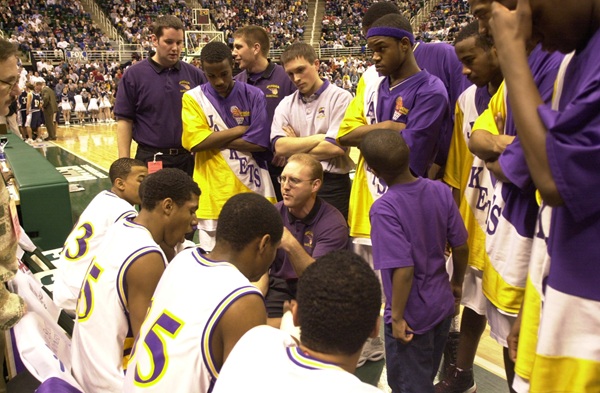 Playing for something bigger than themselves certainly worked for the 2002 team, and Morton said there is a 25th anniversary reunion in the works for next spring.
But while he nor anyone else in the Avondale community will forget that run in 2002, these days Morton is spearheading a team he said is playing for an even greater purpose, one he tried to describe to a group of youth football coaches in Flint during a recent gathering.
“I had only about 15 to 20 minutes to share with these guys,” Morton said. “I shared that we won a state title in 2002 and I was driven to be the best coach I could possibly be. A lot of great things happened, and the state championship happened. I’m on my way home from the state championship and we’re watching the video, and it’s crazy because this fear came over me. How are we going to do this again?
“Every coach that puts his or her full identity in the performance of the team, that’s scary and that’s not good. I got out six years later because of that fear. The most important relationships of my life were not good because I had to be validated by the performance of my team. That conversation kind of led into, “Why are you coaching? Why are you doing what you are doing? I wanted them to be motivated to be the best versions of themselves, for those kids, their wives and children. That’s why I’m in FCA. That’s my cause to fight for.”
2026 Made In Michigan
Aug. 7: Significance of Historic Run, Relationships Formed Live On for 1973 Unity Champs - Report
Aug. 4: Work Ethic Continues to Drive Van Dyk's Endeavors as Co-Owner of Family Farm - Report
July 24: Hackett Mentor's Care Sparked Lifetime in Hoops for BCAM President White - Report
July 24: Mackey Leaving Court with 500+ College Hoops Wins, Many More Lessons Shared - Report
July 16: Country Day Two-Time Champ Moore Building Perennial Winner at Harvard - Report
July 9: Multi-Sport Career at TC West Helps Gillis Thrive as Pro in Game She Once Left Behind - Report
July 2: Inspired by Home, Eager to Give Back, Spencer Hosts Hoop City Alumni Games - Report
PHOTOS At left, Tim Morton raises the Class B championship trophy in 2002. At right, Morton now a director for Fellowship of Christian Athletes. (Middle) Morton, kneeling, speaks to his team during the championship win at Breslin Center. (MHSAA archives)