


Kimmerer Sets Sights on Hale Record & More
December 9, 2019
By Chris Dobrowolski
Special for Second Half
HALE — Joseph Kimmerer’s heart swelled with excitement as he raced toward the basket on a fast break.
 The freshman point guard appeared to be destined to record his first points with the Hale varsity boys basketball team on a layup. Unfortunately for Kimmerer, a hard-charging player from Posen rattled him just enough to cause Kimmerer to lose focus for a split second.
“There was somebody coming up behind me and a lot bigger at the time,” said Kimmerer. “I was scared of that, and I was excited for my first points and just blew it.”
Kimmerer has not had much trouble scoring since that miss. In fact, points have come in abundance over the past three years. He finished with 14 in that first game against Posen, reached the 1,000-point club midway through last season, and with a career total of 1,228 points stands just one 3-pointer from becoming the school’s all-time leading scorer — surpassing the record set by Chad Brandt in 1992. His first chance to set the record will come tonight against Rogers City.
“It’s going to mean a lot,” said Kimmerer. “All the hard work and teammates who have helped me along the way. Coaches, family, everybody supporting. It’s going to mean a lot.”
Kimmerer’s dad, Joe, has seen Joseph’s scoring prowess up close as the head coach of the Eagles, getting a sideline perspective on his son’s physical and athletic development from being a 3-point marksman as a 5-foot-9 freshman to the complete offensive package now as a 6-foot-2 senior.
“He was a spot-up shooter,” said Joe. “Didn’t like a lot of contact. Always could make free throws but never got to the line much. Now he is a kid that goes to the rim hard, looks for contact, wants contact, wants to go make that three-point play at the free throw line. He’s also gotten to the point where his athleticism and his strength have caught up to the skills he had.”
Joe Kimmerer also understands the magnitude of what his son has done on the basketball court, having been a 1,000-point scorer during his own playing career for Hale as well as a 25-year coaching veteran for Hale’s boys or girls basketball squads since the late 1990s.
“It’s a great accomplishment,” Joe said of his son’s pending school scoring record. “But the accomplishment that I think stands out even beyond that is there has never been a player at our school that has played for four straight league championships. We’re at three in a row now. We’ve got a very good opportunity to put our fourth in the book. That accomplishment might stand out more to me, maybe because I’m the coach. To be able to say you won four league championships. That’s a pretty good honor, and he would be the only one who could say that.”
Indeed, the Eagles have had a good run in Joseph’s first three years on the varsity, winning 17, 13 and 18 games, respectively, while capturing three straight North Star League Little Dipper division titles.
Joseph is young for his grade, having turned only 17 on Oct. 10, but he’s always done things earlier than most. He got his introduction to the gymnasium as a 2-year-old while his dad conducted practice. When he got old enough to start playing, Joseph could be found shooting off to the side of the gym as Hale’s high school teams played nearby. By the time he was in fourth grade, he was on the court at Hale’s practices, getting a chance to compete against much older junior varsity or varsity players.
Joseph was ready to suit up for the varsity squad when he got to high school. Joe thought so too, but he erred on the side of caution, not wanting it to appear that favoritism was the reason his son earned a varsity roster spot. So Joseph started the year on the junior varsity.
“I thought I could (play at the varsity level) the whole time,” said Joseph. “I just had to prove myself at JV and get the call up. I just believed.”
Joseph was dazzling in his two games with the JV as overmatched opponents struggled to guard him, making it even more obvious the Eagles’ varsity could use his services.
“I knew going into that season that we needed a shooter,” said Joe. “Someone who could score for us on a kickout. We went into our first two games of the year, and we proved as a varsity team that we needed somebody like that. At the JV level he was doing things in those games that the rest of the players could look at and say, ‘We really need that.’ I look back and I wish I would’ve pulled him up and had him part of the varsity for those two games also, but it was also kind of a stepping stone for him, too, to show the guys. When he came up he was second on our team in scoring as a freshman in a year that we won the league and Districts. It kind of stated for itself right there.”
Joseph averaged 12.1 points per game as a freshman, then saw that grow to 18.6 points per game as a sophomore and 25.5 per outing last year as his game continued to blossom. He also managed to lead the Eagles in rebounding from his guard position last season with 11.9 per game and is in line to set the school’s career record in that category as well if he pulls down 125 boards this winter. He had 275 last season. Defensively, Kimmerer always draws the opponents’ top player regardless of size.
Scoring, though, is where Joseph has really left his mark. He’s done it in an efficient manner, too. Last year he shot 42 percent from beyond the arc, 53 percent from the field and 88 percent from the foul line.
“He has a possibility of being a 30-point-a-game guy,” said Joe. “It’s not because he’s going to take 35 shots. It’s just going to come because that’s his game. His speed, his size — everything has increased over this past summer. I think the game might come a little easier than it has in the past even.”
With that kind of year Joseph could reach the 2,000-point plateau, a feat reached by only 41 players in state history.
Joseph set a career high with 40 points in a game against Mio last year. However, the Thunderbolts have been a thorn in the Eagles’ side the last two postseasons, including handing Hale a 51-49 loss in last year’s District championship game.
“We split with them both years in the regular season, but once it gets District time it just doesn’t go our way,” said Joseph.
Besides being a stellar basketball player, Joseph is also a model citizen and student. He has a 3.8 grade point average, is part of the National Honor Society and can often be found in the gym mentoring kids in the Little Eagles youth program. It’s just Joseph’s way of giving back to a community that has taken a keen interest in the Eagles boys basketball team.
“We’re packing the gym every night,” said Joe. “People in the community who have no connection to the team are traveling to away games. We’ve got people in the stands at scrimmages, and it’s not just because of him. Our team is strong, and people have kind of latched on. They like the brand of basketball we’re playing. (Joseph) involves everybody in it. Guys who are on that (1,000 point) scoring list are making it back to games. They haven’t been back in the gym in 20 or 25 years or longer and they were at his game because they want to see him do it. I feel that’s going to happen here when we go to Rogers City. ... We’re going to get that group of people who really don’t have a connection, other than they played in the past, were on that list, or like basketball. They’re going to be there because of what we’re doing with three straight league championships, and he’s a big part of that.”
 Chris Dobrowolski has covered northern Lower Peninsula sports since 1999 at the Ogemaw County Herald, Alpena News, Traverse City Record-Eagle and currently as sports editor at the Antrim Kalkaska Review since 2016.
PHOTO: Hale’s Joseph Kimmerer poses with the ball he received after scoring his 1,000th career point last season. (Photo courtesy of Sports in Motion.)
Breslin Bound: Boys Report Week 7
January 27, 2020
By Geoff Kimmerly
Second Half editor
Michigan’s high school boys basketball teams are this week reaching the regular-season’s midpoint and the heart of league play from the Ohio and Indiana borders to the top tip of the Upper Peninsula.
 You’ll see that move toward emphasizing conference play reflected in much of this week’s Breslin Bound report – although it’s tough to not be most excited about another showcase coming up this weekend that will match up championship contenders from two of the MHSAA’s four divisions.
“Breslin Bound” is powered by MI Student Aid and based on results and schedules posted for each school at MHSAA.com. Send corrections or missing scores to [email protected].
Week in Review
The countdown of last week’s five most intriguing results:
1. Flint Beecher 70, Orchard Lake St. Mary’s 61 – The Bucs moved up to No. 2 in Division 3 MPR with a major win over the No. 2 team in Division 2 at the Horatio Williams Freedom Classic.
2. Clarkston 55, Detroit King 41 – The Wolves also made Freedom Classic headlines with arguably their best of a solid set of wins this winter.
3. Gaylord St. Mary 59, Pellston 54 – The Snowbirds pushed back into the Ski Valley Conference mix by handing the first loss this season to Pellston.
4. Grand Blanc 80, Kalamazoo Central 73 – The Bobcats are now 9-3 against one of the toughest schedules in the state, and followed up this Friday win with another seven-point over Ferndale on Saturday.
5. Traverse City West 47, Cadillac 46 – The Titans are only 5-6 overall but could make a move in the Big North Conference after handing co-leader Cadillac its first loss this season.
Watch List
With an eye toward March, here are two teams in each division making sparks:
DIVISION 1
Hamtramck (9-2) The Cosmos have flown a bit under the radar, but sit second in the Michigan Metro Athletic Conference Blue with an opportunity to make a loud statement. Hamtramck fell to league leader River Rouge 54-49 on Jan. 10, but a win in the rematch Tuesday arguably would be one of the program’s best in some time. The Cosmos’ only other defeat this season came to Warren De La Salle Collegiate, 65-62 in overtime Dec. 20.
Mount Pleasant (10-0) Reigning Saginaw Valley League Red champion Mount Pleasant is off to another fantastic start after winning its first 18 games last season. A 66-58 win over SVL Blue co-leader Flint Carman-Ainsworth a week ago was particularly impressive, even as the only single-digit victory surrounded by much larger margins in the Oilers’ other nine games.
DIVISION 2
Croswell-Lexington (10-1) A three point December loss to 9-1 Flint Southwestern is all that has kept Croswell-Lexington from perfection this winter – and only a few others have come close to breaking up the success. The Pioneers have nine double-digit wins and Friday against Almont can finish an unbeaten first half in the Blue Water Area Conference.
Fremont (10-0) The Packers’ 102 points last week against Howard City Tri County likely caught even casual fans’ attentions. But it was just a highlight from a greater body of work that is setting Fremont up for a run at a third straight Central State Activities Association Gold title. The Packers are perfect through the first run of the league schedule, thanks in part to a three-point win over Newaygo and four-pointer over Grant. Fremont also downed Lakes 8 Activities Conference co-leader Ludington.
DIVISION 3
Hanover-Horton (7-1) The Comets face Napoleon on Wednesday for first place in the Cascades Conference as they continue to pursue a third-straight league championship. All seven wins so far have been by 10 points or more, and the one defeat looks pretty good too – 68-66 to Division 1 one-loss Grand Rapids Union. A Feb. 10 matchup with Ypsilanti Arbor Prep could be telling of the team’s possibilities come tournament time.
Ravenna (10-0) The Bulldogs have climbed from six to 11 to 15 wins, respectively, over the last three seasons, and seem likely to continue the rise after a flawless first half. Ravenna leads the West Michigan Conference by a game over Muskegon Oakridge, which gave the Bulldogs their closest game so far – a six-point battle Jan. 16.
DIVISION 4
Alanson (8-1) Alanson improved from five wins in 2017-18 to 10 last season and could equal that latter total before the end of January. The Vikings are undefeated since falling to Bellaire 61-54 in their season opener, and they’ve hung tough in tight times with three wins by three points or fewer. That success has sent Alanson into a tie for first place in the Northern Lakes Conference with Ellsworth, which hosts the Vikings on Friday.
Hillsdale Academy (8-1) After playing in the 2018 Class D Semifinals but falling back to 9-13 last season, the Colts rank No. 5 in Division 4 MPR and sit tied for first in the Southern Central Athletic Association East despite losing Dec. 19 to co-leader Camden-Frontier. Hillsdale Academy will get another chance at C-F on Feb. 11 and also can boast a win over SCAA West co-leader Bellevue.
Can't-Miss Contests
Be on the lookout for results of these games coming up:
Tuesday – Hudsonville (9-0) at Holland West Ottawa (8-2) – The reigning Ottawa-Kent Conference Red champion Eagles will try to hold off second-place West Ottawa in the first of their two meetings.
Tuesday – Iron Mountain (9-0) at Negaunee (10-0) – The Mountaineers took three wins from the Miners last season, outpacing them to win the Western Peninsula Athletic Conference Iron and then eliminating Negaunee in a Regional Semifinal.
Friday – Oscoda (9-0) at Mio (8-1) – The two top teams in the North Star League Big Dipper again, Mio is just behind reigning champion Oscoda after the Owls won the first matchup Dec. 12.
Friday – Stevensville Lakeshore (9-0) at Portage Central (8-0) – This matchup for first place winds up the first half of the Southwestern Michigan Athletic Conference West schedule.
Saturday – Ypsilanti Lincoln (7-1) vs. Benton Harbor (9-1) at Grand Rapids City – The headlining matchup of the Redhawk Showcase Classic might be one of the most entertaining regular-season games of this entire season.
Second Half’s weekly “Breslin Bound” reports are powered by MI Student Aid, a part of the Office of Postsecondary Financial Planning located within the Michigan Department of Treasury. MI Student Aid encourages students to pursue postsecondary education by providing access to student financial resources and information. MI Student Aid administers the state’s 529 college savings programs (MET/MESP), as well as scholarship and grant programs that help make college Accessible, Affordable and Attainable for you. Connect with MI Student Aid at www.michigan.gov/mistudentaid and find more information on Facebook and Twitter @mistudentaid.
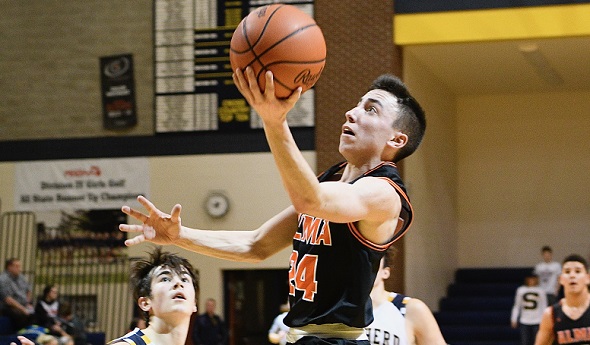
PHOTO: Alma improved to 7-3 last week with wins over Shepherd and Frankenmuth. (Click to see more from HighSchoolSportsScene.com.)