


Lake's Heroic Hurl Makes Holland History
January 20, 2016
By Dean Holzwarth
Special for Second Half
HOLLAND – With 4.5 seconds remaining and his team trailing by two points, Demetrius Lake was only trying to help force overtime in last Friday’s Ottawa-Kent Conference Green showdown against visiting Zeeland West.
 Instead, the standout junior guard from Holland High School made history with one dramatic shot.
“When they inbounded the ball to me, I was going to try and beat everybody down the floor to get a bucket and go to overtime,” Lake said. “That’s was all I was thinking. Get to the rim. Get to the rim.”
Lake altered his plan when he saw Zeeland West’s defense. He had only one option.
“They came out in a half-court trapping situation to stop me, so I push the ball down the sideline as fast as I can and I look up and there is only two seconds on the clock,” Lake recalled. “So I shoot a 3 behind the arc, and I’m watching it go in as I follow through on my shot. It was like, wow, did that really happen?”
It did happen. A stunning buzzer-beater from the right wing that not only gave the Dutch a come-from-behind victory, but it gave Lake a school-record 50 points.
“Everybody was chasing me, and the place erupted,” Lake said. “Fans were jumping out of the seats and running on the court. It was a crazy atmosphere.”
Lake said the night was memorable for more than one reason.
“It was special in a lot of different ways,” he said. “It was a conference game against a Zeeland West team that played us tough, and breaking the record on a game-winning shot was real special because it was in front of my home crowd. The whole crowd, including the principal, superintendent and the athletic director. They were all there watching me, and it was just big for me and my teammates.”
Holland third-year head coach Paul Chapman has seen clutch shots from Lake before.
“He is not afraid to take those kind of shots, so I wasn’t surprised when it went in,” Chapman said. “It was a real tough shot, and he had guys all over him. He was way out by the sideline.
“He scored 50 points, and that overshadowed some other things because he also led us in that game in steals, assists and tied for the lead in rebounds. He played pretty much an all-around great game. He put the exclamation mark on everything with the 3-pointer at the buzzer.”
The 5-foot-11 Lake, who recently turned 17, eclipsed a longstanding school record. Ron Maat owned the previous mark, scoring 49 points during a game in 1960.
Lake had his sights set on the record.
“I knew when I scored my first 40-point game against Cedar Springs that I was aiming for that record because I knew I was going to end up breaking it sometime this season,” Lake said. “It really wasn’t my main focus, but since I was playing middle school basketball one of the goals that I had was breaking records here at Holland High School.
“It’s special for me to have my name up there and in the record books. You have to work for that, and that’s what I did.”
Lake’s heroics helped improve Holland’s record to 6-3 and 2-0 in the conference. Through nine games, he’s averaging an astounding 33.3 points per game, with four games of 40 points or better.
 Lake also contributes in other ways, averaging 4.6 rebounds, 4.1 steals and 3.0 assists per game. He’s shooting 43 percent from the field and 83 percent from the free-throw line.
Last season, as a sophomore, Lake averaged 25 points per game and earned a spot on the Class A all-state team. He scored at least 30 points eight times.
While Lake has always possessed the ability to score points at a rapid pace, he improved other facets of his game during the offseason.
“He’s a better ball handler, and that’s one thing he worked on, and he’s shooting a higher percentage,” Chapman said. “He’s been very aggressive with the ball, and he has the ability at times to put us on his back and kind of carry us through.
“He’s also a tremendous competitor. He really wants to win and wants to do well. He’s a fantastic athlete and not afraid to fail. He does a lot for us.”
Lake, who was pulled up to varsity from the junior varsity 11 games into his freshmen season, has seen all types of defenses from opposing teams in an attempt to contain him.
It’s something he anticipated entering the season.
“I worked really hard this summer on being more consistent so I can be aware of teams running different defenses at me,” Lake said. “I really concentrated on my 3-pointers, lay-ups, free throws and getting other players involved. Alumni will come into practice and guard me, and we work on denying me the ball in practice.”
Lake also has stepped into a leadership role.
“He’s a much better leader,” Chapman said. “Last year he was on a senior-dominated team, but now he’s the guy with experience. He’s done a good job at getting guys in the right spots and getting them to compete and believe in themselves.”
Lake has received attention from several colleges including the likes of Purdue, Michigan State, DePaul and Youngstown State.
However, Lake has a wish list of three top programs he hopes to play for in the future.
“I really want to go to Duke because it’s a dream school for me, and number two is Michigan State, to play for Tom Izzo,” Lake said. “And then there is UCLA. Those are the top three I really want to go to.”
 Dean Holzwarth covered primarily high school sports for the Grand Rapids Press and MLive for 16 years and more recently served as sports editor of the Ionia Sentinel and as a sports photojournalist for WZZM. Contact him at [email protected] with story ideas for Allegan, Kent and Ottawa counties.
PHOTOS: (Top) Holland's Demetrius Lake gets to the basket during a game last season against Hudsonville Unity Christian. (Middle) Lake throws down a dunk against Holland Christian. (Photos courtesy of Holland High School.)
@DemetriusLake member of the @hollanddutchfb family beating ZW by droppin 50 w/ buzzer beater. #Family #schoolrecord pic.twitter.com/9l5v2dl7Df
— Andrew Pratley (@pratleyac) January 16, 2016
Jets Firing as North Central Seeks Repeat
March 21, 2016
By Dennis Grall
Special for Second Half
POWERS – A second straight Class D boys basketball championship. A third straight MHSAA title covering two sports. A 52-game winning streak.
 Toss in an approaching individual scoring record for good measure.
Talk about a massive target on the back of the North Central Jets during the final week of the high school winter sports season. Or you can talk about goals they are close to attaining.
Or talk about pressure. Not, however, for the Jets (25-0), who face Onaway (21-4) on Tuesday in a Class D Quarterfinal at Sault Ste. Marie High School.
Coach Adam Mercier said his squad is just following a game-by-game approach, with the next game always the most important. As for a target on their collective backs, Mercier said, "it is not any bigger than the one they give themselves. They have high expectations, and we expect everyone's A game.
"They treat every game the same. They don't pack it in. They play as hard as they can. They follow every game plan we have."
The Jets are also busy re-writing the MHSAA record book. They already own the mark of 82 wins over three seasons, surpassing the record 79 shared by two Flint schools, Northwestern and Beecher. If the Jets win their final three games of this season, they will tie the mark of 55 wins set over two years by those two schools and would equal Saginaw Buena Vista for fourth place with 55 straight wins. (Chassell has the state mark of 65 straight).
North Central, which has not lost since falling to Cedarville 81-79 in a Quarterfinal game on March 18, 2014, is an astounding 82-1 over the past three years. Mercier is 162-79 in 10 seasons, after starting 6-37 over the first two at his alma mater.
Outstanding team chemistry, created in part through family connections in this small Upper Peninsula community, is perhaps as important for North Central's athletic success as having outstanding talent.
Junior Jason Whitens, an all-state selection on last year's championship team, is just 10 points shy of the school's career scoring record of 1,350 points owned by his uncle, Tom Granquist. Whitens took over the helm of this year's team after the graduation of his cousin, Rob Granquist. The two Granquists and Whitens also played quarterback for the Jets, with Whitens directing North Central to the 2015 8-player title in the fall.
Mercier became head coach of the boys basketball program in 2006 after Gerald Whitens left after a four-year stint.
"They're loose and they keep everything in perspective," Mercier said of his squad. "They have fun, they don't complicate things with egos or individual accolades. It is very similar to last year (basketball) and football. They are able to joke around, and they are able to critique one another. The perspective they have on each other is neat to see."
The system has worked wonderfully for the Jets, who also won the Class D title in 1983. A member of that team was Gerald Whitens, who is Jason's father and serves as an assistant coach on this squad.
Opposing coaches have a solid perspective on the Jets. Joel Schultz of neighboring Bark River-Harris said, "they combine size and athleticism you don't see in Class D. Couple that with the fact they are gym rats, it is just a perfect storm. They are above a level that is typical in Class D. They are better than a year ago."
Rock Mid Peninsula coach Mark Branstrom, who also coached against that 1983 title team, said, "they are about the most talented group of young men I've seen. It is hard to understand who will ever beat them. They are like a college team, and we are like a high school team.
 "They have it all. They are so strong. I don't know where there weakness is."
Chris Nocerini of Crystal Falls Forest Park has been deeply frustrated by the Jets. The Trojans finished 22-3 this season, with all three losses provided by the Jets, including a 75-45 conquest Wednesday for their fourth straight Regional crown. Forest Park, always one of the peninsula's top quintets, is 0-10 against North Central the past four seasons.
"They are a good team, they are deep, they have a nice rotation," Nocerini said. "They have played together for a long time. What makes North Central good is their players understand their roles and when they get their chances, they take advantage of it."
Whitens is averaging 22 points but is also a tremendous distributor and rebounder. Teammates Dawson Bilski (15 ppg) and Bobby Kleiman (11) are also in double digit scoring, while Troy Ekberg and Morgan Cox provide excellent scoring and rebounding inside. Seth Polfus and Marcus Krachinski provide the prime bench support.
"The key for us is having guys off the bench who are willing to accept their roles. It is rare to find those kind of teams nowadays to find kids willing to take a lesser role," said Mercier, who helped out on the sidelines during the team's football playoff run last fall.
The Jets, with six juniors, are averaging 78 points a game while permitting just 41. They also boast a team grade-point average near 3.5.
North Central was seldom threatened this year, trailing at halftime in one game against Mid Peninsula, escaping Crystal Falls with a 61-57 victory March 1 and coming from behind late in the fourth quarter Feb. 9 at Class B Menominee to win 64-60.
Mercier said the game at Menominee, on one of the hardest floors for visiting teams to play, "gave us a good idea where and what we needed to improve. That was our biggest win. We had to respond and Jason Whitens took over. That was our signature win of the year."
While Whitens is the team leader, BR-H coach Schultz said, "Bilski is their best ball player. Cox may be one of the top players in the U.P. on any other team. He is a real unique piece of the team. He is a beast, strong and explosive." While Whitens is the primary focus for opponents, Schultz said if you can slow him down "you get killed by someone else."
Branstrom said of Whitens: "His first step is so quick. He has all the tools. He can hit shots from anywhere. He can do about anything he wants to do (including dunks and triples). He is long and tall and looks like a greyhound on a fast break."
Branstrom says Kleiman "is the glue of that team" and that Bilski "has all the tools. He is a natural. Cox inside is an animal and Ekberg is long and tall and can shoot from anywhere."
It is also tough to defend the Jets because Branstrom said "their passing skills are spectacular. Not just good; spectacular."
The North Central-Onaway winner advances to East Lansing and will meet the winner of Fulton (18-6) and Bellaire (24-1) in Thursday's semifinal at 7:50 p.m.
 Denny Grall retired in 2012 after 39 years at the Escanaba Daily Press and four at the Green Bay Press-Gazette, plus 15 months for WLST radio in Escanaba; he served as the Daily Press sports editor from 1970-80 and again from 1984-2012. Grall was inducted into the Upper Peninsula Sports Hall of Fame in 2002 and serves as its executive secretary. E-mail him at [email protected] with story ideas for the Upper Peninsula.
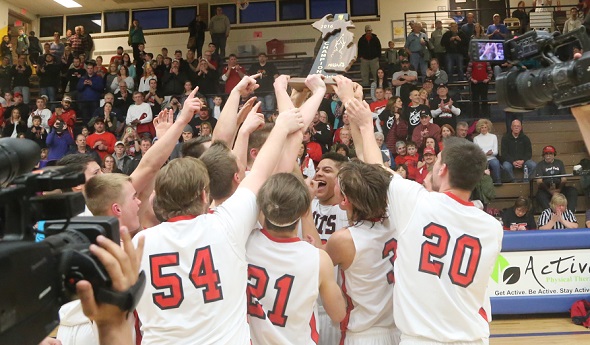
PHOTOS: (Top) Powers North Central celebrates its Class D Regional title win over Crystal Falls Forest Park on Wednesday. (Middle) The Jets downed the Trojans 75-45 in front of a packed crowd. (Photos by Paul Gerard.)