

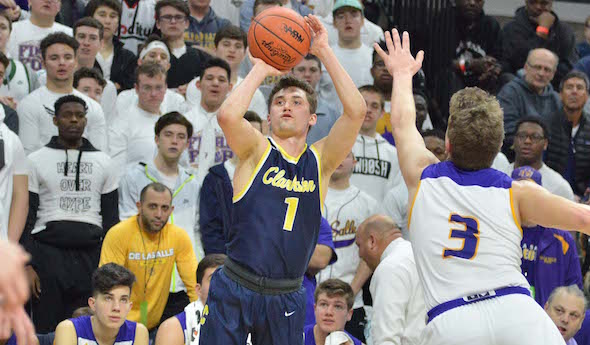
Lights-Out Loyer Leads Clarkston to Final
March 23, 2018
By Geoff Kimmerly
Second Half editor
EAST LANSING – Warm-ups don’t count, but it seemed like Foster Loyer couldn’t miss while getting ready for Friday’s first Semifinal at the Breslin Center.
The last four seasons, that’s been a good sign for Clarkston.
The Wolves’ senior point guard went on to make 12 of 17 shots from the floor and score 42 points – becoming the fifth player ever to drop at least 40 in a boys basketball Semifinal – in leading reigning champ Clarkston back to the Class A Final with a 74-49 win over Warren DeLaSalle.
Loyer scored 17 of his team’s 23 first-quarter points, on 6 for 10 shooting, as the Wolves quickly built a double-digit lead that never fell below nine points the rest of the game.
“When he gets going, there are not a lot of people who can stop him,” Clarkston senior backcourt mate CJ Robinson said. “When he gets going like that, we try to key on getting him the ball. He knocks shots down for us, and it opens things up for others, and he does a good job of finding everybody.”
Clarkston (25-1) will attempt to finish a repeat at 12:15 p.m. Saturday against Holland West Ottawa.
Loyer drained seven 3-pointers among his 12 field goals and all 11 of his free throw attempts – against a DeLaSalle defense focused on slowing down the recently-named Mr. Basketball Award winner and Michigan State recruit.
“I don’t think in 31 years of being a varsity coach that anyone has remotely scored that many points,” Pilots longtime leader Greg Esler said. “I think about when we were here in (20)07, Manny Harris had 13. But the thing about Loyer that’s so good is he’s so deceiving – he reminds you of Cassius Winston in the fact that he’s not the most athletic guy, he might not be the fastest but all of a sudden he’s shooting the 25-footer and getting to the rim and making everybody on his team better. So there’s no question, he’s a winner.”
 Those comparisons, of course, are high praise – Harris, who went on to star at Michigan, had 14 for Detroit Redford in a Semifinal win over the Pilots that season, and DeLaSalle saw its share as well of Detroit U-D Jesuit’s Winston, who’s currently running the point for MSU.
Longtime Clarkston coach Dan Fife extended the praise to include Robinson, who had nine points and five assists while sharing a game-high 31 minutes on the floor.
“When you’ve got two guards who can play like this, it makes it a lot easier to coach,” said Fife, who’s in his 36th season. “My first year coaching, we had a bunch of bigs, and our guards weren’t near like this, we played Flint Central and we just got tattooed because we couldn’t handle the pressure. These guys handle the pressure.
“The two of them feel comfortable, and it makes everybody else relax a little bit.”
As a team, it was a smooth performance. The Wolves had only 10 turnovers to 11 assists and made 53 percent of their shots from the floor.
“I think as a point guard, for both of us, it’s important that we’re in control of the pace of the game, that we play how we want to play,” Loyer said. “Just to come out and throw that first punch and get an early lead is very important for us.”
Of course, Clarkston has more than great guards – senior forward Taylor Currie, headed to Wisconsin after graduation, chipped in 16 points and 12 rebounds and had the first basket of the game. As a team, the Wolves outrebounded the Pilots 36-19.
Senior forward Luke Pfromm led DeLaSalle (19-8) with 17 points, while senior forward Jordan Winowiecki had 12 and senior forward Kole Gjonaj had 10. Senior guard Justin Fisher had nine assists.
PHOTOS: (Top) Clarkston’s Foster Loyer launches a shot during Friday’s Semifinal win over Warren DeLaSalle. (Middle) DeLaSalle’s Justin Fisher had nine assists and four points for the Pilots.
Breslin Bound: Boys Report Week 1
December 12, 2012
By Geoff Kimmerly
Second Half editor
Michigan’s top boys basketball teams traditionally waste little time each December seeing how they match up against the rest of the elite.
And last week proved no different, as major matchups and a few upsets in the Detroit and Grand Rapids areas no doubt caused some re-ranking in those regional pecking orders.
Below is a look at 10 teams who stuck out with their play last week. It isn't a state ranking – merely one of the week's notable performances.
Records and results are based on what has been reported to the MHSAA.com Score Center.
1. Detroit Pershing (2-0) – The Doughboys have been considered by most one of the top two teams heading into the season, along with Romulus. Pershing beat Romulus 83-76 and also downed River Rouge – another elite team – 68-48 during opening week.
2. Muskegon Heights (2-0) – Heights may have gone through a number of changes over the last year, but it remains elite on the court. The Tigers opened with a 74-50 win over Way Point, then defeated reigning Class A runner-up Rockford 60-59.
3. Grand Rapids South Christian (2-0) – The Sailors opened with a 54-42 win over Wyoming before notching a solid upset of 2012 Class A Quarterfinalist Grand Rapids Christian, 69-63.
4. Romulus (1-1) – The Eagles may have fallen to Pershing already. But they also opened with a 69-67 win over Dearborn Heights Robichaud – which earlier in the week beat Westland John Glenn, another considered among the elite heading into the season.
5. Holt (2-0) – The Rams have been more spoiler than contender of late in the powerful Capital Area Activities Conference Blue, but they could be back in the hunt. Holt opened with a 54-51 win over Lansing Waverly and followed by beating Lansing Eastern 69-60.
6. St. Joseph (2-0) – The Bears were a middling 11-10 last season, but opened this winter with two solid victories. They beat usual power Kalamazoo Central 73-65 and followed with a 53-37 win over Portage Northern.
7. Brown City (2-0) – Dan Blemaster was the point guard on the DeWitt team that made a surprise run to the 2004 Class B Final, and he has opened his coaching career with a pair of wins. Brown City beat Peck 37-33 and Armada 70-56.
8. Bloomfield Hills Andover (2-0) – Andover is playing its final season before merging with Lahser next fall. And after finishing 10-11 last season, the Barons got it going right last week with a 51-46 win over Farmington and a 78-48 victory over Cranbrook-Kingswood.
9. Muskegon (2-0) – The Big Reds are expected to do big things under coach Keith Guy, who came over from Heights this fall. So far, so good, with a 60-45 win over Holland West Ottawa and a 70-67 victory over Benton Harbor.
10. Grand Rapids Catholic Central (1-1) – The Eagles lost a tough one at the end of the week, 69-66 to Zeeland West. But they opened with a 77-67 win over Grand Rapids Christian.
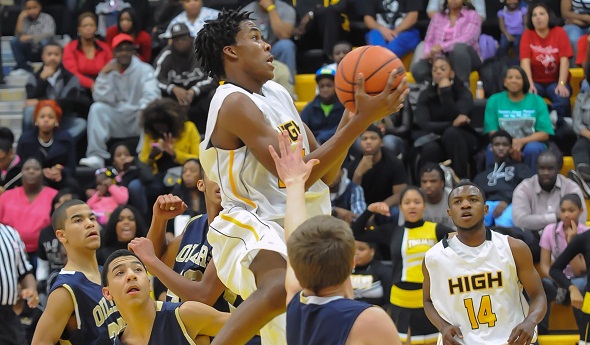
PHOTO: Saginaw, last season’s Class A champion, opened last week with a 78-60 win over Mount Pleasant. (Click to see more at HighSchoolSportsScene.com.)