

Longtime Coach Researches Photos to Tell Story of Grand Rapids Sports' Past
By
Steve Vedder
Special for MHSAA.com
September 16, 2022
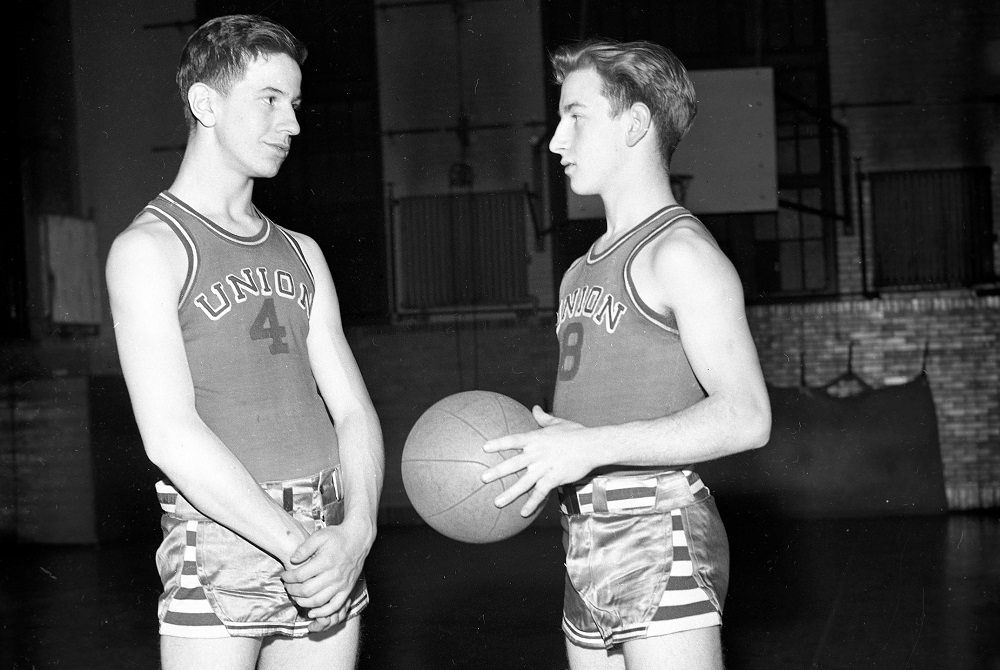
GRAND RAPIDS – Bob Schichtel always pauses when he comes across the ancient black and white photo long enough to ponder whatever became of the two youngsters adorned in Grand Rapids Union basketball uniforms.
The posed shot shows two players facing each other in a local gymnasium in a photo apparently taken four days after the Japanese surprise attack on Pearl Harbor in 1941 that launched the country into World War II. Only a handful of fans today would recognize the players' striped, ultra-short shots and simple sleeveless shirts with "Union" emblazed across the front as recognizable basketball uniforms. One holds a battered-looking basketball, while the other looks on. The two players, whose uniform numbers are "4" and "9," aren't really smiling, but still seem as close as any teammates, whether 81 years ago or today.
In fact, it's the look the youngsters share that intrigues Schichtel, whose thankless, pro bono job it is to identify the two players.
"Once you start," said Schichtel, a former longtime Grand Rapids basketball coach, "it's like looking down a deep rabbit hole."
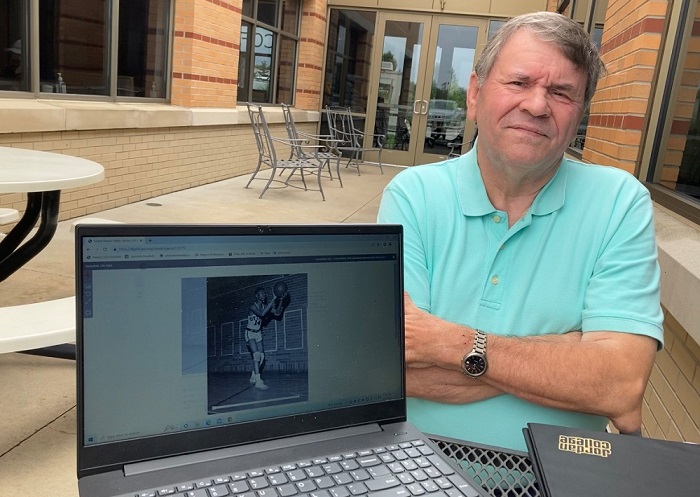 Schichtel works as a volunteer for the Grand Rapids Public Library trying to identify mostly former Grand Rapids City League basketball players from approximately 1938 through the early fifties. The online photos are mostly from the Robinson Photo Studio Collection taken in conjunction with the Grand Rapids Herald newspaper. The library says the unique collection spans some 950 basketball negatives from the entire Robinson/Herald collection that totals well over 900,000 Grand Rapids photos.
While the work – which amounts to a ton of patience combined with a detective ability – can be exhausting, it's still what Schichtel describes as a labor of love. For example, there's the shot of the two still-unidentified Union players. Schichtel looks at the photo and can't help but wonder whatever happened to the kids. Were they exceptional athletes? Did they leave their marks on Grand Rapids history, whether it was in education, politics, business, industry, the arts or another field? He doesn't even know, as in many photos from this era, whether the two entered the military and thus even survived World War II.
Schichtel has searched everywhere for the answers, but has come up short. Too many times, in fact.
Which isn't to say he'll quit looking or chalk up his research as inconsequential. Schichtel said the foremost reason he spends hours on the project is that many of the athletes he identifies deserve the recognition for achievements far beyond basketball. In many cases former City League basketball, football, baseball, track and tennis athletes became the foundation on which Grand Rapids was built. If Schichtel can uncover an old photo which depicts these youngsters during their high school careers, so much the better, he said.
"It's important to recognize Grand Rapids sports history, and I don't know if we've given enough attention to their past," Schichtel said. "They are what got us here, and I'm a firm believer they need to be recognized for it."
Figuring out that history, however, ranges from, at the least, extremely time consuming to – in too many frustrating cases – virtually impossible. The City League was formed in the late 1920s and featured original schools Grand Rapids Central, Creston, South, Union, Ottawa Hills, Catholic Central and Davis Tech. The league was eventually folded into the Ottawa-Kent Conference in 2008.
"It was a long, evolving league," Schichtel said.
 The identification tools available to Schichtel are actually more numerous than most would suspect. For starters, he's formed an impressive database of information by pouring through old City League yearbooks and programs, photos from other collections and microfilm of old newspapers, And then there's also the knowledge gathered by Schichtel himself, a 1968 Grand Rapids Catholic Central graduate. After playing in many old City League gymnasiums, Schichtel went on to compile a 389-197 record in 27 years as the Cougars girls basketball coach. He uses countless City League contacts as both a player and coach to identify athletes. In all, Schichtel taught in the Grand Rapids school system for 34 years.
He also uses the game itself to identify the photos. For instance, he can pinpoint some photos simply by the styles of the uniforms worn by players. He also figures out who is who by other clues such as what the players are doing in the photo. If a player is taking a set shot in the photo, it's likely pre-World War II. The beginnings of the jump shot, or what Schichtel calls "elevation while shooting," is probably mid-1940s. In addition, Schichtel can identify photos through pure basketball athleticism. Players can look a bit awkward in shots from the thirties as compared to players from the late 1940s who were beginning to play with a more obvious flare.
Put all the information together and Schichtel, who has uncovered more than two dozen personal connections to subjects in the photos, believes he has a reasonable shot at identifying them.
Since he signed on with the project, Schichtel figures he's identified about 10 percent of the photos he's viewed. Among the City League athletes he's found shots of Central's John Lavan, who was born in 1890 and played Major League Baseball during the Babe Ruth era and became a military hero who is buried in Arlington National Cemetery; Creston basketball player Roger Wilkins, an assistant United States attorney general during the Watergate hearings; Art Spoelstra of Godwin, a former NBA player and member of the Grand Rapids Hall of Fame; and Grand Rapids native Bill Cutler, who turned a chance post-World War II meeting with then-American League president Will Harridge into a position as commissioner of the Pacific Coast League,
Schichtel said gaining information through photos on the people who became the bedrock of Grand Rapids should be celebrated.
"I think it's a great approach for the community; they shouldn't be forgotten," Schichtel said. "Who else is going to do this? Why do I do it? I see a certain, for lack of a better word, a nobility. These kids played for the love of game, and they became the “Greatest Generation.” These kids did great things. It's not just, 'Well, there's No. 58,’ in a photo.
"You want to know more about them. That's the real intrigue for me."
 Tim Gloege of the Grand Rapids Public Library said the collection of photos – and their identification – is continually growing. As more people log onto the library's website, more people want to either add to the collection or have information that leads to an identification. The library estimates about 1,200 photos are searched monthly. But as time grows, many of the original photos are disintegrating. The library is in a constant state of preservation, Gloege said.
"It's a massive project, and we're working to get as many photos online as possible," he said. "The numbers (of photos) we have are rising pretty significantly as people post them on social media.
"When you think of the past and now, you need to realize these are people, kids who used to play basketball and did other things. The work is hard and very time-intensive, but it brings a whole new dimension to history."
Schichtel said he's "kind of picked the low-hanging fruit" on many of the easy photos to identify. But the work will continue.
"Yes, it can be frustrating," he said. "There are limitations if you want it to be accurate. Sometimes you look at a photo and you know it's not going to happen, and you move on. But this a chance to learn about people who made Grand Rapids what it is. That's important to me."
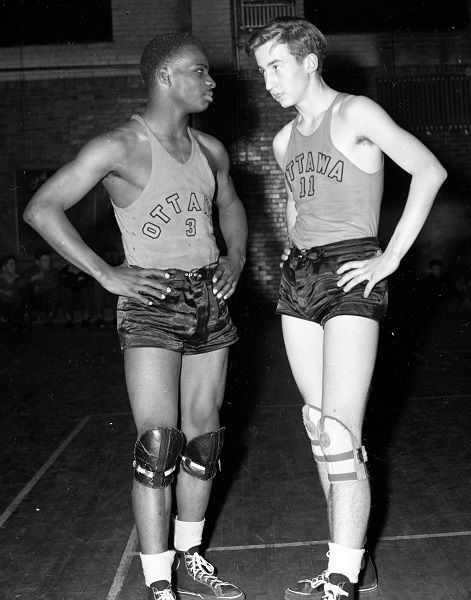
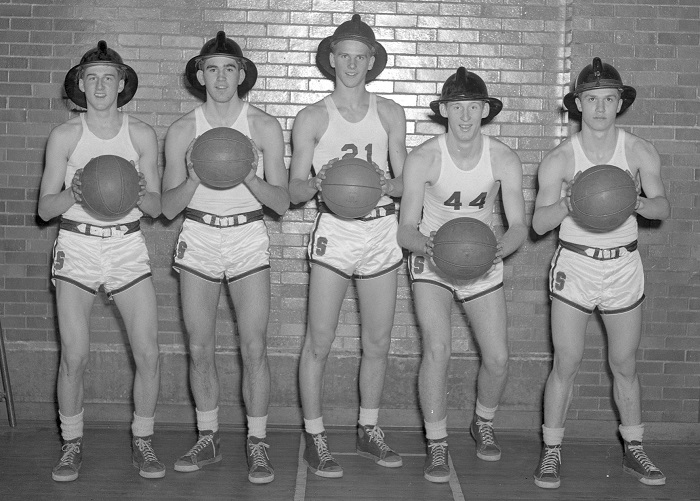
PHOTOS (Top) Two Grand Rapids Union basketball players stand for a photo taken Dec. 12, 1941. (2) Longtime area coach Bob Schichtel researches hundreds of photos that are part of the Grand Rapids Public Library archive. (3) Schichtel has identified these 1941 Grand Rapids Ottawa Hills basketball players as James Horn (left) and Chuch Reynier. (4) Schichtel identified Grand Rapids South High’s “Fireman Five” of, from left, Fred Esslair, Lee Morrow, Jack Carroll, Bob Youngberg and Bruce Bigford. (Historic photos courtesy of the Grand Rapids Public Library.)
Breslin Bound: 2025-26 Boys Finals Weekend Preview
By
Geoff Kimmerly
MHSAA.com senior editor
March 12, 2026
This weekend’s Boys Basketball Finals at Michigan State University’s Breslin Center are a lesson in playing the best competition to prepare for the most important games of the season.
 Of 16 teams still contending for championships, 11 played schedules that ranked among the 25 most difficult in their respective divisions, based on their in-state opponents’ combined winning percentage. Rockford in Division 1, Freeland in Division 2 and Menominee in Division 3 played the strongest schedules in their respective divisions, using that metric, and the Division 2 field in particular includes three teams whose schedules ranked among the top five in opponents’ success this season.
That preparation has paid off so far. But there are other factors to consider. East Lansing in Division 1 and Wyoming Tri-unity Christian in Division 4 are returning champions, and the Trojans’ KJ Torbert is the newly-crowned Mr. Basketball Award winner. Romulus Summit Academy North in Division 2 and Arts & Technology Academy of Pontiac in Division 3 also reached championship games last season and will attempt to take the final step this time.
Semifinals will be played Thursday and Friday, with all four championships games set for Saturday.
DIVISION 1 - Friday
Rockford (23-3) vs. Auburn Hills Avondale (26-1) - Noon
East Lansing (26-1) vs. Bloomfield Hills Brother Rice (22-5) - 2 p.m.
DIVISION 2 - Friday
Freeland (24-3) vs. Romulus Summit Academy North (26-1) - 5:30 p.m.
Detroit University Prep (17-9) vs. Hudsonville Unity Christian (24-3) - 7:30 p.m.
DIVISION 3 - Thursday
Arts & Technology Academy of Pontiac (18-3) vs. Menominee (23-4) - Noon
Flint Elite (21-4) vs. Pewamo-Westphalia (25-2) - 2 p.m.
DIVISION 4 - Thursday
Dollar Bay (24-2) vs. Detroit Douglass (20-7) - 5:30 p.m.
Concord (23-4) vs. Wyoming Tri-unity Christian (25-1) - 7:30 p.m.
Finals - Saturday
Division 1 - 12:15 p.m.
Division 2 - 6:45 p.m.
Division 3 - 4:30 p.m.
Division 4 - 10 a.m.
Tickets for this weekend’s games are $14 for both Semifinals and Finals and available via the Breslin Center ticket office; please note the ticket office does not accept contactless/tap-to-pay payments such as Apple Pay or Google Pay, and it is strongly recommended that tickets be purchased in advance and added to mobile wallets prior to arrival at the Breslin Center. For ticket information and links visit the Boys Basketball page.
All Semifinals and Finals will be broadcast and viewable with subscription on the NFHS Network. Audio broadcasts of all Semifinals and Finals will be available free of charge from the MHSAA Network.
The Boys Basketball Semifinals & Finals are sponsored by Michigan Achievement Scholarship/MI Student Aid.
Here’s a look at the 16 semifinalists (with rankings by regular-season Michigan Power Ratings and statistics through Regional Finals):
Division 1
AUBURN HILLS AVONDALE
Record/MPR: 26-1, No. 7
League finish: First in Oakland Activities Association Red
Coach: Aaron Fox, first season (26-1)
Championship history: Class B champion 2002.
Best wins: 57-43 (District Final), 58-44 and 43-38 over No. 28 Clarkston, 56-53 over No. 36 Hamtramck, 50-49 over No. 4 Grand Blanc, 72-28 over Division 2 No. 18 Detroit University Prep.
Players to watch: Jaidon Bourgeois, 5-11 sr. G (13.4 ppg); Maxwell Muhl, 5-10 sr. G (10.3 ppg, 69 3-pointers); Jakobe Liford, 6-4 sr. F (15.2 ppg, 7.5 rpg, 3.9 apg).
Outlook: Avondale is returning to the Semifinals for the first time since its championship season of 2002, and with its only loss this season to Freeland – which has advanced in Division 2. Fox took over the program this winter after five as an assistant and has emphasized a defensive effort that is giving up a mere 47.3 points per game while holding opponents to 38 or fewer in seven games. Senior 6-5 forward Noah Bonds stands tall averaging 7.3 rebounds and nearly a block per game, and he and the three starters listed above have all had games of at least 24 points this season.
BLOOMFIELD HILLS BROTHER RICE
Record/MPR: 22-5, No. 8
League finish: Tied for third in Catholic High School League Central
Coach: Rick Palmer, eighth season (132-51)
Championship history: Class A champion 1974, runner-up 1977.
Best wins: 88-59 over No. 15 Wayne Memorial in Quarterfinal, 59-29 over No. 23 Warren Fitzgerald in Regional Final, 87-56 over No. 25 Detroit Cass Tech in Regional Semifinal, 67-56 over No. 30 Bloomfield Hills in District Final, 88-53 over No. 5 Kalamazoo Central, 59-52 over No. 16 Grand Rapids Northview, 60-49 over No. 14 Detroit Catholic Central, 59-51 over Division 2 No. 13 Detroit Edison.
Players to watch: Greg Grays, 6-2 sr. G (14.9 ppg, 42 3-pointers); Jordan McDaniel, 5-10 fr. G (19.3 ppg, 39 3-pointers); Trevor Smith, 6-8 sr. F (7.4 ppg, 10 rpg, 1.7 bpg).
Outlook: Brother Rice is making its first trip to the Semifinals since 1984 and after winning its second Regional championship over the last three seasons. Two of the Warriors’ three in-state losses were to teams in this field – East Lansing and Rockford – and three losses overall this season were by three points or fewer. Grays made the all-state second team last winter and teams with McDaniel for an impressive scoring duo, and 6-5 senior forward Ivan Stojanovski chips in another 8.6 points per game. Grays also was a Mr. Basketball Award finalist this season and has signed with Detroit Mercy.
EAST LANSING
Record/MPR: 26-1, No. 3
League finish: First in Capital Area Activities Conference Blue
Coach: Ray Mitchell, eighth season (152-35)
Championship history: Two MHSAA titles (most recent 2025), two runner-up finishes.
Best wins: 72-60 over No. 17 Ann Arbor Pioneer in Quarterfinal, 68-39 over No. 5 Kalamazoo Central in Regional Final, 92-78 (District Final), 81-64 and 74-62 over No. 21 Lansing Waverly, 47-31 over No. 23 Warren Fitzgerald, 80-71 (OT) over No. 1 Rockford, 62-41 over No. 8 Bloomfield Hills Brother Rice, 41-40 over No. 6 Detroit Martin Luther King, 73-58 over Division 2 No. 6 Lansing Sexton.
Players to watch: KJ Torbert, 6-3 sr. G (25 ppg, 54 3-pointers, 5.4 rpg); Kingston Thomas, 6-5 jr. G (13.6 ppg); Dequarius Stewart, 6-6 sr. G (9.1 ppg).
Outlook: The Trojans last year won their first Finals championship since 1958 and have been considered a favorite to repeat all winter with Torbert and Thomas returning starters and now Torbert being named the Mr. Basketball Award winner Monday. He also made the all-state first team last year and will continue at Bowling Green. East Lansing has lost only to Grand Rapids Northview and otherwise allowed only Rockford, King and Roseville within single digits. Mitchell has led the Trojans to a combined 78-5 record over the last three seasons.
ROCKFORD
Record/MPR: 23-3, No. 1
League finish: Second in Ottawa-Kent Conference Red
Coach: Kyle Clough, 10th season (152-74)
Championship history: Class A champion 2003, runner-up 2012.
Best wins: 48-47 (Quarterfinal) and 48-45 over No. 16 Grand Rapids Northview, 58-39 over No. 10 Marquette in Regional Final, 83-70 over No. 12 Muskegon in District Final, 45-41 and 61-53 over No. 22 Grand Haven, 68-52 over No. 11 Hudsonville, 57-55 over No. 2 East Kentwood, 72-36 over No. 19 Traverse City West, 81-78 (2OT) over No. 8 Bloomfield Hills Brother Rice, 55-45 over Division 2 No. 3 Hudsonville Unity Christian.
Players to watch: Jake Bascom, 6-6 sr. F (17.3 ppg, 7.1 rpg); Eli Wolfe, 6-3 soph. G (15.1 ppg, 3.4 apg); Josh Bascom, 6-4 soph. F (8.6 ppg, 6.1 rpg).
Outlook: Rockford is back at the Semifinals for the first time since 2012 but a combined 45-6 over the last two seasons and also in an intriguing spot for the future – the Rams will graduate Jake Bascom, a second-team all-stater last season, but have sophomores Josh Bascom and Wolfe plus a freshman in the starting lineup. The losses this winter came to East Lansing (in overtime) and in league splits against Hudsonville and East Kentwood, but Rockford also has impressed in close games with six victories by three points or fewer.
Division 2
DETROIT UNIVERSITY PREP
Record/MPR: 17-9, No 18
League finish: Does not play in a conference.
Coach: Brandon Barrett, eighth season (96-89)
Championship history: Has never played in an MHSAA Final.
Best wins: 56-53 over No. 25 Harper Woods Chandler Park in Regional Semifinal, 66-57 over No. 13 Detroit Edison in District Final, 63-49 over Division 1 No. 4 Grand Blanc, 56-50 over Division 4 No. 10 Detroit Douglass.
Players to watch: Chris Byrd, 6-5 sr. G (19.6 ppg, 6.0 rpg, 3.0 apg); Maurice Jackson, 6-5 sr. G (14.6 ppg, 11.5 rpg, 4.5 apg); Tony Dent, 5-11 sr. G (8.3 ppg, 6.2 apg, 3.0 spg).
Outlook: After reaching the Quarterfinals for the second time over the last three seasons, University Prep will be making its first trip to the Semifinals – although Barrett has Breslin experience from his playing days on Southfield Lathrup’s Class A runner-up team in 1996. The Panthers started this season just 3-6 but bounced back in a big way and have won 10 of their last 11 games – with the only defeat during that time by one point in overtime to Detroit Loyola. Two more defeats came against teams also at Breslin this weekend.
FREELAND
Record/MPR: 24-3, No. 1
League finish: Second in Tri-Valley Conference Red
Coach: John Fattal, seventh season (130-33)
Championship history: Has never played in an MHSAA Final.
Best wins: 69-53 over No. 11 Ludington in Quarterfinal, 69-51 over No. 24 Flint Hamady in Regional Final, 54-48 over No. 5 Frankenmuth, 65-60 over No. 3 Hudsonville Unity Christian, 70-56 over Division 1 No. 7 Auburn Hills Avondale, 65-58 over Division 1 No. 20 Saginaw Heritage, 61-39 over Division 3 No. 1 Menominee, 68-52 over Division 3 No. 4 Harbor Beach, 75-63 over Division 3 No. 10 North Muskegon
Players to watch: Tucker Hileman, 6-2 sr. G (9.5 ppg); Tristan Comer, 6-6 sr. C (14.8 ppg, 8.1 rpg, 1.1 bpg); Wilson Huckeby, 6-4 sr. G (18.9 ppg, 81 3-pointers, 5.5 rpg).
Outlook: Freeland last reached the Semifinals in 2022 – when these seniors were in eighth grade – and just missed a year ago with a two-point Quarterfinal loss to Kingsford. But the Falcons couldn’t be more prepared – their opponents’ regular-season winning percentage of .651 (including postseason) is the highest in Division 2 and seventh overall. Huckeby will graduate as one of the most prolific 3-point shooters in MHSAA history; he has 326 for his career to rank fourth all-time. He made the all-state first team last season, and Comer earned an honorable mention.
HUDSONVILLE UNITY CHRISTIAN
Record/MPR: 24-3, No. 3
League finish: First in O-K Black
Coach: Scott Soodsma, 34th season (565-247)
Championship history: Division 2 champion 2019, two runner-up finishes.
Best wins: 50-38 over No. 12 Grand Rapids Catholic Central in Quarterfinal, 61-47 (Regional Final), 66-39 and 51-41 over No. 20 Holland Christian, 70-30 (Regional Semifinal) and 57-43 over No. 15 Paw Paw, 60-39 (District Final) and 65-48 over No. 7 Grand Rapids South Christian, 68-58 over Division 1 No. 26 Macomb Dakota.
Players to watch: Brogan Sherd, 5-11 sr. G (12.2 ppg, 61 3-pointers); Kyler Berghuis, 6-2 sr. G (10.2 ppg); Owen VanderWaal, 6-6 sr. C (11.5 ppg, 5.4 rpg, 1.1 bpg).
Outlook: Unity Christian is a combined 44-6 over the last two seasons as it makes it first trip to the Semifinals since its championship run of 2019. The Crusaders have won 10 straight games and all by double digits since taking their most recent loss, to Freeland – and the other defeats came to Division 1 Rockford and Hudsonville. Senior guard Kaden Bareman is another player to watch; he entered this week with 59 3-pointers and connecting on nearly 44 percent of his attempts from beyond the arc.
ROMULUS SUMMIT ACADEMY NORTH
Record/MPR: 26-1, No. 2
League finish: First in Charter School Conference Gold
Coach: Derek Clark, second season (50-5)
Championship history: Division 2 runner-up 2025.
Best wins: 56-44 over No. 16 Chelsea in Quarterfinal, 62-52 over No. 8 Dearborn Divine Child, 65-50 over No. 13 Detroit Edison, 35-33 and 48-44 over No. 25 Harper Woods Chandler Park, 58-50 over Division 1 No. 14 Detroit Catholic Central, 35-29 over Division 1 No. 23 Warren Fitzgerald, 71-57 and 63-44 over Division 3 No. 9 Arts & Technology Academy of Pontiac.
Players to watch: Marquan White, 6-2 sr. G (13 ppg, 48 3-pointers); Codey Bush, 6-2 fr. G (11.4 ppg, 3.2 apg); Jordan Fuller, 6-0 sr. G (15.4 ppg, 48 3-pointers).
Outlook: Summit fell just shy of a first championship a year ago, losing to Warren Lincoln 58-51 in the Division 2 championship game. But the Dragons have been nearly unstoppable this season, losing only to Columbus Bishop Hartley, which ended its playoff run Tuesday in an Ohio regional semifinal. Fuller and 6-foot-3 senior forward Demetri Campbell (8.4 ppg) are the only returning starters from last season, although White was the top sub playing 18 minutes in the Final.
Division 3
ARTS & TECHNOLOGY ACADEMY of PONTIAC
Record/MPR: 18-3, No. 9
League finish: Second in Charter School Conference Gold
Coach: Orlando Lovejoy, second season (37-4)
Championship history: Division 3 runner-up 2005.
Best wins: 67-39 over No. 4 Harbor Beach in Quarterfinal, 83-59 over No. 7 Detroit Loyola in Regional Semifinal, 81-73 (OT) over Division 2 No. 13 Detroit Edison, 94-92 (OT) over Division 2 No. 25 Harper Woods Chandler Park, 65-53 over Division 2 No. 18 Detroit University Prep.
Players to watch: Lewis Lovejoy, 5-10 soph. G (26.5 ppg, 41 3-pointers, 7.6 apg, 6.5 rpg, 4.9 spg, 2.1 bpg); Devonte Grandison, 6-3 sr. F (14.7 ppg, 9.4 rpg, 3.5 apg, 4.4 spg, 3.4 bpg); Jaiden Price, 5-9 sr. G (11 ppg, 3.6 apg).
Outlook: Lewis Lovejoy and Grandison both started last season as well, and Grandison is the only senior starter this time – so big things could be ahead over the next few seasons as well. Lovejoy made the all-state first team last season and is averaging nearly six points and two steals more per game this winter while keeping his rebounds and assists consistent with a year ago. The only losses were a pair to Summit – playing for the Division 2 title this weekend – and by six points to Division 1 Hamtramck. The Lions have won their postseason games by an average of 39.2 ppg.
FLINT ELITE
Record/MPR: 21-4, No. 18
League finish: Second in Genesee Area Conference Blue
Coach: Greg McMath, fourth season (66-27)
Championship history: Has never played in an MHSAA Final.
Best wins: 55-53 (OT) over No. 15 Onsted in Quarterfinal, 61-53 over No. 22 Springport in Regional Final, 58-54 over No. 12 Jackson Lumen Christi in Regional Semifinal, 73-63 over No. 19 International Academy of Flint, 55-51 over Division 2 No. 24 Flint Hamady.
Players to watch: Artie Smith Jr., 5-8 soph. G (12.4 ppg, 6.8 rpg, 7.2 apg, 6.5 spg); Jeffrey Turner, 6-2 sr. G (12 ppg); Razach Spillers, 6-3 sr. F (10.5 ppg, 8.8 rpg).
Outlook: Elite, a cooperative of New Standard Academy and Burton Madison Academy, has taken another step this season while building on last year’s run to the Quarterfinals. The Warriors entered the postseason off a championship in the GAC Tournament, during which they avenged two losses to Hamady and a third to IAF – and the fourth defeat this season came Avondale, playing in Division 1 this weekend. Smith and Turner earned all-state honorable mentions last season, and senior guard Dei’On Wright provides a scoring boost off the bench at 10.7 points per game.
MENOMINEE
Record/MPR: 23-4, No. 1
League finish: First in Great Northern Conference
Coach: Sam Larson, ninth season (120-87)
Championship history: Class B champion 1967, Division 3 runner-up 2022.
Best wins: 64-42 over No. 3 Beal City in Quarterfinal, 67-50 over No. 13 Elk Rapids in Regional Final, 59-46 over No. 5 Ishpeming Westwood in Regional Semifinal, 55-40 and 61-56 over Division 1 No. 10 Marquette, 54-50 over Division 2 No. 10 Kingsford, 84-52 over Division 4 No. 2 Crystal Falls Forest Park.
Players to watch: Tanner Theuerkauf, 6-3 sr. F (17.8 ppg, 49 3-pointers, 5.2 rpg); Darrent Butler, 6-2 sr. G (15.2 ppg); Talan Woods, 5-9 jr. G (9.5 ppg, 3.4 apg).
Outlook: Menominee improved from 13-12 a year ago to return to the Semifinals for the second time this decade after finishing Division 3 runner-up in 2022 – when these seniors were in eighth grade. Theuerkauf quarterbacked the Division 7 championship football team in the fall and made the all-state second team in basketball a year ago. The Maroons opened this season with a loss to Division 2 semifinalist Freeland, avenged later losses to Kingsford and Westwood, and the only other defeat was by two points to Division 1 Traverse City Central.
PEWAMO-WESTPHALIA
Record/MPR: 25-2, No. 6
League finish: First in Central Michigan Athletic Conference
Coach: Dominic Schneider, sixth season (123-24)
Championship history: Division 3 champion 2019, two runner-up finishes.
Best wins: 61-38 and 55-46 over Division 4 No. 4 Fowler, 61-30 and 58-40 over Division 4 No. 15 Portland St. Patrick, 70-46 over Division 2 No. 39 Detroit Country Day.
Players to watch: Grady Eklund, 6-3 sr. G (20.7 ppg, 5.7 rpg, 3.5 apg); Logan Farmer, 6-1 soph. F (9.8 ppg); Trent Piggott, 6-5 sr. C (10.5 ppg, 5.6 rpg).
Outlook: The Pirates will play at Breslin for the second-straight season and returning two starters and the top sub from last year’s Semifinal loss to Riverview Gabriel Richard. Eklund made the all-state first team last season and went over 2,000 career points this winter. P-W is holding opponents to only 36.4 points per game and kept teams under 30 points eight times. The lone losses came by two to Division 1 Grandville and four to Division 2 Grand Rapids Catholic Central.
Division 4
CONCORD
Record/MPR: 23-4, No. 9
League finish: Second in Big 8 Conference
Coach: Marcus Gill Sr., seventh season (102-56)
Championship history: Has never played in an MHSAA Final.
Best wins: 49-41 over No. 22 Colon in Quarterfinal, 55-39 over No. 21 Petersburg Summerfield in Regional Final, 49-40 (Regional Semifinal) and 65-42 over No. 13 Hillsdale Academy, 67-57 over No. 26 Battle Creek St. Philip.
Players to watch: Connor Stevens, 6-5 sr. G (13.9 ppg, 12.4 rpg, 1.0 bpg); Darrell Dean Jr., 6-1 jr. G (11.1 ppg); Jett Smith, 5-10 sr. G (19.9 ppg, 56 3-pointers, 3.2 apg).
Outlook: Concord will play in its first Semifinal since 1986, continuing a season that’s seen the Yellow Jackets win 11 of their last 12 games and both Stevens and Smith reach 1,000 career points. They’ll be prepared for top competition this weekend; Concord’s losses were once to Fowler, twice to Springport – which both lost in Regional Finals, Springport in Division 3 – and to Division 1 Brother Rice, mentioned above. Stevens earned an all-state honorable mention last season and he, Dean and Brady Garrett all have connected on more then 30 3-pointers, joining Smith and providing several perimeter options.
DETROIT DOUGLASS
Record/MPR: 20-7, No. 10
League finish: Tied for second in Detroit Public School League Blue
Coach: Pierre Brooks Sr., 12th season (191-74)
Championship history: Division 4 champion 2021.
Best wins: 73-37 over No. 17 Southfield Christian in Regional Final, 58-50 over No. 7 Allen Park Inter-City Baptist in Regional Semifinal, 59-52 over Division 2 No. 32 Detroit Denby, 52-50 over Division 2 No. 39 Detroit Country Day, 63-59 over Division 1 No. 43 Saginaw United, 64-55 over Division 1 No. 46 Detroit Renaissance.
Players to watch: Damani Oliver, 5-11 fr. G (22.5 ppg); Jeremiah Thurman, 5-10 sr. G (16.1 ppg); Jacodi Nathan, 5-8 jr. G (12.3 ppg).
Outlook: Detroit Douglass is also making its second Semifinal trip this decade, to go with its championship run in 2021, and has seen several much larger opponents playing in a league filled with them and filling its nonleague schedule with more. All seven losses came to Division 1 and 2 teams that finished with 16 or more victories this winter. Six players average at least nine points per game and seven players have had high games this season of at least 18 points. Sophomore 6-3 guard Dimauvion Smith-Powe (11.6 ppg) is another to watch from a starting lineup with no seniors.
DOLLAR BAY
Record/MPR: 24-2, No. 14
League finish: First in Copper Mountain Conference
Coach: Jesse Kentala, 19th season (177-201)
Championship history: Has never played in an MHSAA Final.
Best wins: 55-46 over No. 3 Pickford in Semifinal, 62-46 over No. 11 Felch North Dickinson in Regional Final, 49-45 (OT) over No. 2 Crystal Falls Forest Park, 77-61 over No. 34 L’Anse.
Players to watch: Liam Tourtillott, 6-1 sr. F (20.2 ppg, 73 3-pointers, 6.7 rpg, 3.4 apg); Baron Colbert, 6-2 jr. G (16.9 ppg, 43 3-pointers); Caleb Kentala, 5-10 sr. G (6.1 ppg, 8.2 apg, 3.8 spg).
Outlook: Dollar Bay avenged its mid-February loss to Baraga in a District Final on the way to returning to the Semifinals this week for the first time since 2019, and the win over Pickford on Tuesday was Pickford’s lone loss this winter. The story of the Blue Bolts’ return is a great one – after a stretch of five seasons with a combined 100-17 record and two Semifinals appearances to end the last decade, they finished just below .500 the last three seasons before bouncing back in a big way. Freshmen guard Noah Tourtillott (10.7 ppg) and forward Tayler Jahnig (7.4) start and could help this become the start of a longer streak as well.
WYOMING TRI-UNITY CHRISTIAN
Record/MPR: 25-1, No. 8
League finish: First in Alliance League
Coach: Brent Voorhees, first season (25-1)
Championship history: Seven MHSAA titles (most recent 2025), six runner-up finishes.
Best wins: 55-44 over No. 4 Fowler in Regional Final, 61-44 over No. 32 Saginaw Nouvel Catholic Central in Regional Semifinal, 59-57 (OT) over Division 2 No. 37 Grand Rapids NorthPointe Christian.
Players to watch: Cody Osbun, 6-3 jr. F/C (12.4 ppg, 7.8 rpg, 3.2 apg); Caleb Hofmann, 6-3 jr. F (11.2 ppg); Brayden Nelson, 6-1 sr. G/F (11.3 ppg, 6.0 rpg).
Outlook: Tri-unity is seeking a third-straight Division 4 title and fourth in five seasons. That said, the Defenders return to Breslin this week minus two graduated all-staters and the retired third-winningest coach in MHSAA boys basketball history. No matter. Voorhees was a Tri-unity all-stater as a senior in 2000 and assisted coach Mark Keeler the last five seasons. Osbun is the lone returning starter from last season’s Final but Nelson and senior Clayton Rowlader (9.8 ppg) played the most minutes off the bench.
MHSAA.com's weekly “Breslin Bound” reports are powered by MI Student Aid, a division within the Department of Lifelong Education, Advancement, and Potential (MiLEAP). MI Student Aid encourages students to pursue postsecondary education by providing access to student financial resources and information. MI Student Aid administers the state’s scholarship and grant programs that help make college Accessible, Affordable and Attainable for you. Click to connect with MI Student Aid and find more information on Facebook and X @mistudentaid.
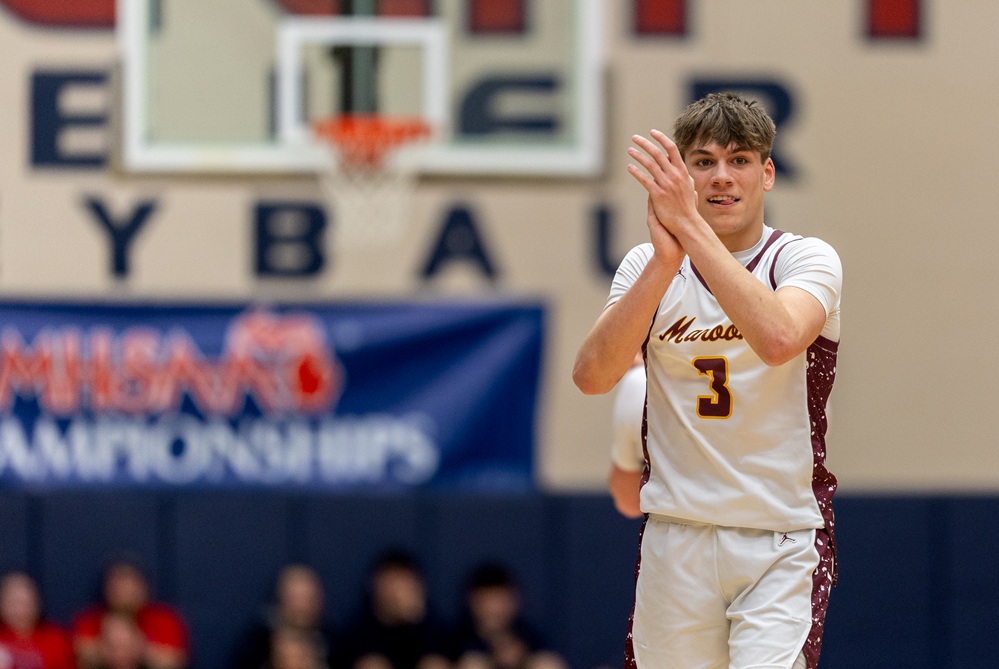
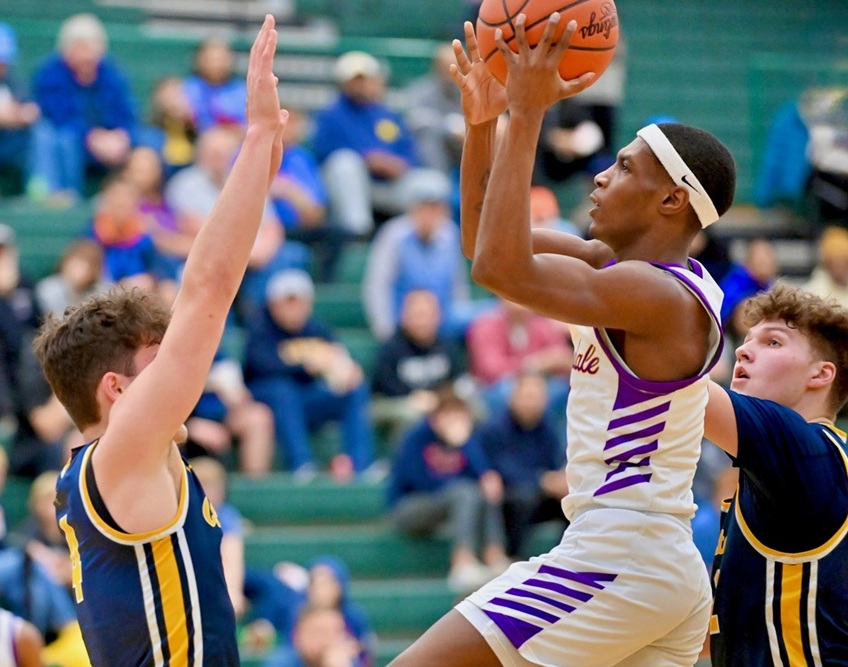
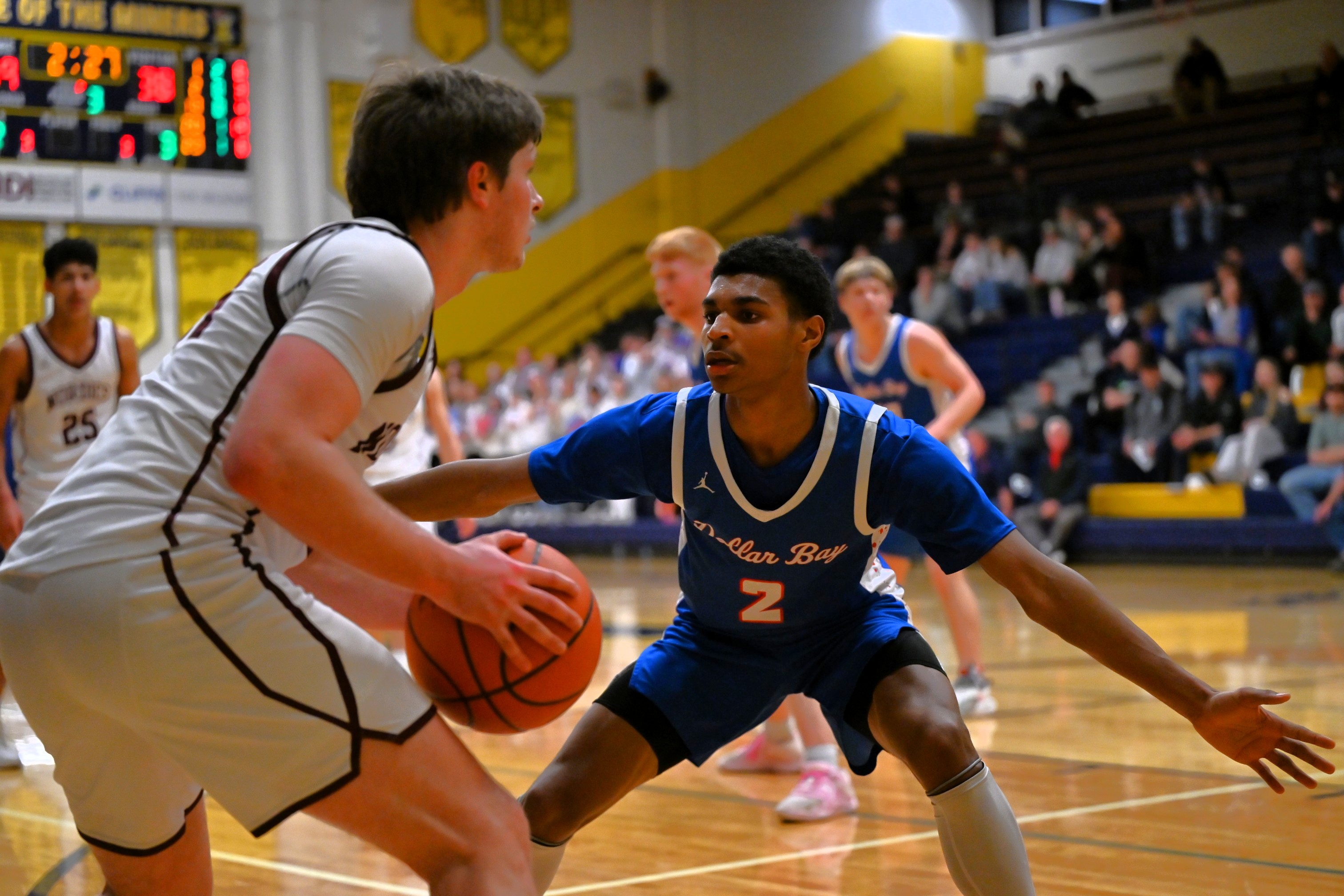
PHOTOS (Top) Menominee’s Tanner Theuerkauf (3) claps during his team’s Division 3 Quarterfinal win over Beal City on Tuesday. (Middle) Avondale’s Jaidon Bourgeois goes to the basket during a District Final win over Clarkston. (Below) Dollar Bay's Baron Colbert (2) guards Spencer Kramer during the Blue Bolts’ Regional Final win over Felch North Dickinson. (Menominee photo by Brandon Kish/kishba media. Avondale/Clarkston photo by Terry Lyons. Dollar Bay/North Dickinson photo by Cara Kamps.)