

Mackey Leaving Court with 500+ College Hoops Wins, Many More Lessons Shared
By
Jason Juno
Special for MHSAA.com
July 24, 2026
IRONWOOD — Dennis Mackey made a big impact on generations of athletes at Gogebic Community College, so much so that college officials named the basketball court after him while he was still coaching.
 Mackey retired from coaching in April after 38 years at GCC, 19 with the women and 19 with the men. Even after all of those years, and more than 500 wins, the memories and lessons from his playing days at Ewen-Trout Creek still resonate with him.
He was always doing something athletically, football in the fall, baseball in the summer, track & field in the spring. His home being basketball-centered E-TC – the tiny Upper Peninsula school with nine combined boys and girls MHSAA Finals appearances – hoops was always mixed in.
“Basketball was the winter sport, but no matter the season we always found time to get to the gym and shoot hoops,” Mackey said. “Whether it was during the lunch hour, after school, on weekends, or after practices, we seemed to gravitate to the gym for some action.”
And if they didn’t go to the gym, there were outdoor courts in Ewen, Bruce Crossing and Trout Creek to get shots up.
“Basketball was the main sport in those communities and probably is still to this day,” Mackey said. “Looking back now, I must say the experiences growing up playing basketball at E-TC was awesome.”
Mackey, a 1981 graduate, played on the varsity team all four years of high school. The Panthers lost in the Regional Final at Northern Michigan University’s Hedgcock Fieldhouse both his junior and senior seasons.
“We had deep and talented teams but fell short of our goal of reaching the state finals both years,” Mackey said.
He won the Ed Helakoski Award as the most valuable senior in the Porcupine Mountain Conference. Even though he was a 1,000-point scorer, he took pride in other aspects of the game.
“I played the forward position, oftentimes guarding the opposing team’s best inside player,” Mackey said. “I prided myself on being a hardworking and unselfish player. I really enjoyed passing the ball to teammates for their scoring opportunities.”
Mackey went on to play basketball at Gogebic. After graduating from Northern Michigan University, he eventually got a call about an opening for a part-time business instructor and women’s basketball coach at Ironwood’s college.
He was excited to take over the team heading into the 1988-89 season. Six years into his tenure, he led a balanced Samsons team to the program’s first national tournament. They won another Region 13 title three years later.
Another E-TC graduate, Deke Routheaux, retired as men’s coach after the 2005-06 season. Mackey didn’t make the switch, instead opting to coach his daughter Caitlin in her first season at Gogebic. The job opened up again a year later, and he debuted as men’s coach in for 2007-08. They men won Region 13 championships in both 2011 and 2013, just missing trips to the national tournament both years.
He said the goal was to win more games and Region titles, but his teams usually left it all on the court.
 Mackey finished his tenure with the women with a record of 256-227 and a 277-263 record with the men. “It’s often said that teams tend to take on the identity of their coach,” Mackey said. “As I walk out the door, I’ll leave knowing my teams, like their coach, were known as fierce competitors.”
His signature saying is printed on the Lindquist Center court, “Coach Mackey Court,” — ”Once a Samson, Always a Samson.”
He wants the entire college to succeed, beyond just the basketball program. He took a lot of pride in giving local players a chance to play college basketball. He still supports them after they graduate.
Players came back yearly to play in their main fundraiser, the Spring Thaw Classic.
When GCC named the court after him, many of those he left an impact on filled the Lindquist Center gym on a random Tuesday game night in November.
Many appreciate the impact he had on their lives. He knows the importance of sports, whether it’s at the college level that he’s been at the last nearly 40 years, or at E-TC, where he got his start.
“Participation allows many to express themselves in ways that open doors to other life opportunities,” Mackey said. “High school athletics provide opportunities for youth to develop individual skills while learning life lessons at the same time. No matter the sport, learning to be a great teammate is challenging for most young people. Dedicating one’s time and efforts to improving oneself while also helping the team be better can be difficult. We all strive to be the best and win games, but are we willing to do the work to achieve the desired results? Everyone enjoys receiving the accolades, but many are unwilling to sacrifice the time and energy required to improve and develop individual skills, which enables this to happen.”
All three of wife Andrea (who was a big help to the GCC program as well) and his kids, Caitlin, Jesse and Adam, played high school basketball and then for Gogebic as well. Dennis said Adam was a similar player to him but a better scorer — he’s Ironwood’s all-time leader — who also wanted to get his teammates involved. They all teach at Ironwood now; Adam is the boys varsity basketball coach and Jesse the varsity girls coach.
The Mackeys continue to pass on many life lessons via high school sports.
“The thrill of victory and the agony of defeat not only applies to the games we play but to life in general,” Dennis said. “Success in high school is often measured with wins versus losses, but in the game of life the valuable lessons learned from the sports we play provide a platform for future growth. There are many folks employed in a variety of vocations who often credit their youthful days of playing sports as the impetus for their success later in life. The bonds created with teammates and opponents often last a lifetime. These bonds are immeasurable and help many advance in all facets of life.”
2026 Made In Michigan
July 16: Country Day Two-Time Champ Moore Building Perennial Winner at Harvard - Report
July 9: Multi-Sport Career at TC West Helps Gillis Thrive as Pro in Game She Once Left Behind - Report
July 2: Inspired by Home, Eager to Give Back, Spencer Hosts Hoop City Alumni Games - Report
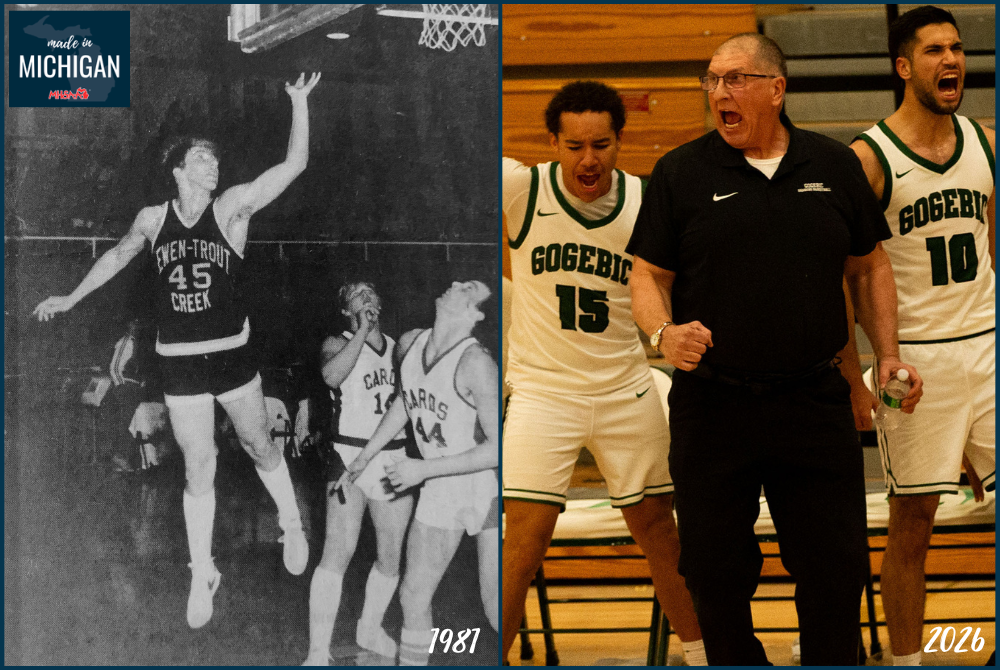
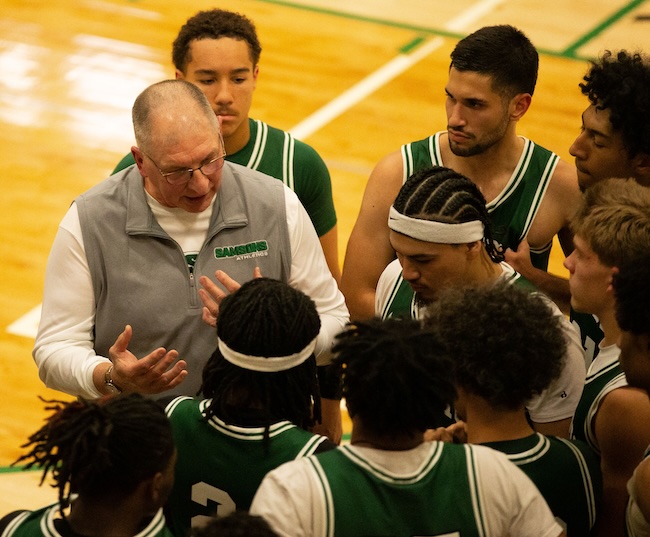
PHOTOS (Top) At left, Dennis Mackey (45) gets up a shot for Ewen-Trout Creek against Wakefield as a senior during the 1980-81 season. At right, Mackey coaches up his Gogebic Community College men’s basketball team this past summer. (Middle) Mackey huddles with his players during a break. (GCC photos by Jason Juno. Ewen-Trout Creek photo courtesy of the Ironwood Daily Globe.)
Next Play: Heart of the Matter
June 25, 2015
By Rob Kaminski
MHSAA benchmarks editor
From the retirement of NFL players in their mid-20s fearing long-term disability, to NASCAR drivers suffering injuries against concrete walls when alternative substances are available, to MLB outfielders running into barriers which place aesthetics and tradition over safety, the focus of highlight shows, apps and old-fashioned sports pages is shifting from action inside the lines to the sidelines.
As the reality of human vulnerability continues to invade our favorite escape from reality – athletics – protecting those in the spotlight needs to be Job 1.
While the quest for risk management protocols and health and safety provisions is a never-ending loop, the MHSAA bolted from the starting blocks with a 4H plan (Health Histories, Heads, Heat and Hearts) in the fall of 2009, a mission that enters the fourth turn for the 2015-16 school year.
And, as pulse quickens for the “Heart” stage in the fall, the MHSAA will continue to step up initiatives involving the other three initiatives during the next lap.Think of it as a continuous relay, where the baton is never dropped and fresh runners continue the race.
While organizations at other levels might be asking, “What to do,” the MHSAA is focusing on “What’s next?”
In this playbook the next plays are critical in allowing student-athletes to continue providing their communities with inexpensive and entertaining breaks from reality.
The Heart of the Matter
The 2015-16 school year brings with it an ambitious but paramount stage in the MHSAA’s mission to protect and promote the well being of student-athletes across the state.
Beginning in the fall, all high school varsity coaches will need to have Cardiopulmonary Resuscitation (CPR) certification by established deadlines which correspond to rules meetings.
The requirement is new, and the volume of personnel affected is vast. Yet, plans have been in place during the past few years, and schools in many communities are ahead of the curve.
“We’ve fielded some questions regarding the requirement, but I think that many of our schools already have similar protocols in place,” said MHSAA assistant director Kathy Vruggink Westdorp. “Increasingly, schools have become more prudent with regards to health and safety, and programs which emphasize these initiatives have been well received.”
Pete Ryan, MHSAA Representative Council member and athletic director for Saginaw Township Community Schools, concurs.
“The CPR requirement will not be a change for Heritage, as we have required CPR for eight years,” Ryan said. “We offer certification through our district nurse at no charge to the coaches and train about 20-30 coaches per year.”
The training vehicle might vary from district to district, but so long as the end result is certification, the coaches are free to take course by any means possible, whether online or in person.
“I think we’ll see a blend of online and classroom delivery,” Westdorp said. “And, I don’t think it will be just the coaches. At the MIAAA Conference (in March), school leaders were proactive in terms of certification for athletic directors, too.”
Mike Bakker, President of the Michigan Interscholastic Athletic Administrators Association and athletic director at Fenton High School, says CPR certification is a must in the risk management plans for all school settings.
“As an educator who has been a CPR and first aid instructor for the American Heart Association for a number of years, I am excited that the MHSAA will require CPR training for varsity coaches,” Bakker said.
“I certainly hope that in the future we will see that all coaches are trained in CPR. There might be a bit of a challenge at first to get our coaches trained, as schools look for the most economical as well as timely way to accomplish this mandate. The biggest hurdle that I can foresee is trying to find qualified trainers in all areas of the state that have multiple training dates available to fit the needs of such diverse coaching staffs.”
Ryan believes there is no substitute for the personal touch.
“We are doing in-person training which I feel is better because the individuals have to perform the procedure on the practice dummy," he said. "It’s simply more hands-on training.”
School nurses and trainers will play a substantial role in the certification process, as will community health organizations in many locales.
“In many of our schools, the health educators are certified to conduct CPR courses,” Westdorp said. “We’ve also had numerous calls from non-school entities alerting us to their availability to provide training, such as fire departments and local medical centers.”
Fenton is one such school with the luxury of on-site personnel to train its staff.
“We are fortunate in Fenton that our athletic trainer and athletic director are certified trainers so we can accomplish our training in-house, but I know that not all schools are as fortunate,” Bakker said.
Which is exactly why it’s necessary for coaches to become certified, and ideally not just the head coaches.
“It should be encouraged that all coaching staff become CPR certified so that they are able to take action, especially for schools which do not have an athletic trainer on staff and if the head coach is unavailable or present, in the unfortunate event that a potential cardiac emergency and/or sudden-death incident occurs,” said certified athletic trainer Gretchen Mohney, the Clinical Coordinator and Instructor for Western Michigan University Undergraduate Athletic Training Program.
Mark Mattson, athletic director at Traverse City Central, indicated that while not previously a requirement, the district has been proactive in prepping the coaches.
“From the moment the requirement was announced, we've been out in front of it,” Mattson said. “What’s great is, even though it hasn’t been a requirement for Traverse City Area Public Schools, many coaches are indeed already certified. The district also offers training sessions once a month and those dates are passed on to our coaches. Jason Carmien (AD at Traverse City West) and I have also had conversations about providing training at our preseason coaches meeting for those still in need prior to the start of the fall season.”
Coaches can also count on a familiar training source to come through for certification: the MHSAA Coaches Advancement Program. Westdorp, who heads up the expansive continuing education program for the state’s coaches, envisions coursework at select sites which will build CPR training into the session, giving attendees more added incentive and training opportunities.
CAP has also served as a siren to inform and remind the MHSAA’s constituents about the upcoming regulation.
“In all CAP courses this school year, we’ve been educating the coaches about the CPR requirement,” Westdorp said. “We also can format the courses to include a two-hour block for CPR certification within the CAP training. We could even do it with a league and conference group where we set up rotations, and the CPR aspect would be one of the rotations.”
Westdorp added that many athletic directors currently schedule coaches meetings and additional coursework around CAP training. It’s a perfect fit to deliver pertinent messages while all parties are in one location.
Such gatherings could also provide the opportunity for athletic leaders to share emergency action plans.
Along with the CPR component of the MHSAA’s health mission for the coming school year, schools will be asked to have in place and rehearse emergency action plans involving cardiac and other health-related emergencies.
To assist, schools will receive this summer the “Anyone Can Save a Life” program developed by the Minnesota State High School League and endorsed and delivered nationally by the National Federation of State High School Associations (check back for more on this program later this week).
“The ‘Anyone Can Save A Life’ initiative promotes the need to have and to practice planning for different kinds of emergencies; it involves students as well as adults; and it invites schools to include their previously existing plans,” said MHSAA Executive Director Jack Roberts.
“The result can be a fresh, comprehensive emphasis on preparing for emergencies well before they occur and then responding with more confidence when those emergencies inevitably happen. It is the perfect link between the last two years when we focused on heat illness and the next two years when we focus on sudden cardiac arrest,” Roberts added.
It will also be of primary concern to place automated external defibrillators (AEDs) in all schools and provide training for use of the devices.
The reasoning behind such a full-court press can be backed by simple facts.
- At any one time, an estimated 20 percent of the U.S. population congregates on school grounds, increasing the likelihood of school-based cardiac emergencies.
- Victims of SCA can be brought back to life by providing chest compressions and early defibrillation with an AED.
- Every second counts. When SCA occurs, chest compressions and the use of an AED need to start immediately.
- The AED can only help and will only deliver a shock if it is needed.
- The AED is very easy to use. Just turn it on and follow the voice prompts.
The best way to combat such situations is to create an atmosphere of preparedness; making sure all people in close proximity to potential victims can respond with quickness, confidence and precision to help reduce fatalities.
“In order for best practices to be achieved, it will require coordinated efforts to establish a quality emergency action plan among the entire athletic department staff, which should be practiced annually. This should be viewed as the first line of preparedness and defense in sports safety,” said James Lioy, an adjunct professor in athletic training at WMU who was named Michigan High School Athletic Trainer of the year in 2000-01.
That’s the goal of action plans such as those included in MHSAA CAP Levels and the Anyone Can Save A Life program.
“We've taken the ‘know-how’ out of it. You don't have to know how to perform the medical procedures to be trained and prepared as part of an effective emergency response team,” said Jody Redman, associate director of the Minnesota State High School League and one of the authors of the Anyone Can Save a Life program.
A common refrain in athletics to assign perspective on sport in society is, “It’s just a game; it’s not life or death.”
However, in the most dire of circumstances, participants indeed can be faced with life or death. Knowing how to respond can make all the difference.