

Mackey Leaving Court with 500+ College Hoops Wins, Many More Lessons Shared
By
Jason Juno
Special for MHSAA.com
July 24, 2026
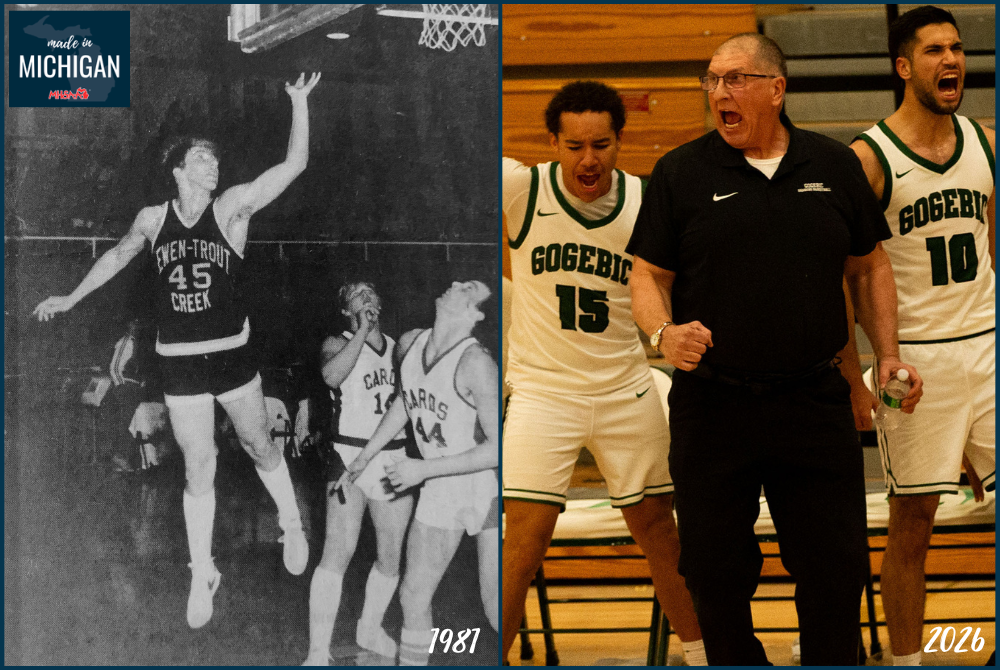
IRONWOOD — Dennis Mackey made a big impact on generations of athletes at Gogebic Community College, so much so that college officials named the basketball court after him while he was still coaching.
 Mackey retired from coaching in April after 38 years at GCC, 19 with the women and 19 with the men. Even after all of those years, and more than 500 wins, the memories and lessons from his playing days at Ewen-Trout Creek still resonate with him.
He was always doing something athletically, football in the fall, baseball in the summer, track & field in the spring. His home being basketball-centered E-TC – the tiny Upper Peninsula school with nine combined boys and girls MHSAA Finals appearances – hoops was always mixed in.
“Basketball was the winter sport, but no matter the season we always found time to get to the gym and shoot hoops,” Mackey said. “Whether it was during the lunch hour, after school, on weekends, or after practices, we seemed to gravitate to the gym for some action.”
And if they didn’t go to the gym, there were outdoor courts in Ewen, Bruce Crossing and Trout Creek to get shots up.
“Basketball was the main sport in those communities and probably is still to this day,” Mackey said. “Looking back now, I must say the experiences growing up playing basketball at E-TC was awesome.”
Mackey, a 1981 graduate, played on the varsity team all four years of high school. The Panthers lost in the Regional Final at Northern Michigan University’s Hedgcock Fieldhouse both his junior and senior seasons.
“We had deep and talented teams but fell short of our goal of reaching the state finals both years,” Mackey said.
He won the Ed Helakoski Award as the most valuable senior in the Porcupine Mountain Conference. Even though he was a 1,000-point scorer, he took pride in other aspects of the game.
“I played the forward position, oftentimes guarding the opposing team’s best inside player,” Mackey said. “I prided myself on being a hardworking and unselfish player. I really enjoyed passing the ball to teammates for their scoring opportunities.”
Mackey went on to play basketball at Gogebic. After graduating from Northern Michigan University, he eventually got a call about an opening for a part-time business instructor and women’s basketball coach at Ironwood’s college.
He was excited to take over the team heading into the 1988-89 season. Six years into his tenure, he led a balanced Samsons team to the program’s first national tournament. They won another Region 13 title three years later.
Another E-TC graduate, Deke Routheaux, retired as men’s coach after the 2005-06 season. Mackey didn’t make the switch, instead opting to coach his daughter Caitlin in her first season at Gogebic. The job opened up again a year later, and he debuted as men’s coach in for 2007-08. They men won Region 13 championships in both 2011 and 2013, just missing trips to the national tournament both years.
He said the goal was to win more games and Region titles, but his teams usually left it all on the court.
 Mackey finished his tenure with the women with a record of 256-227 and a 277-263 record with the men. “It’s often said that teams tend to take on the identity of their coach,” Mackey said. “As I walk out the door, I’ll leave knowing my teams, like their coach, were known as fierce competitors.”
His signature saying is printed on the Lindquist Center court, “Coach Mackey Court,” — ”Once a Samson, Always a Samson.”
He wants the entire college to succeed, beyond just the basketball program. He took a lot of pride in giving local players a chance to play college basketball. He still supports them after they graduate.
Players came back yearly to play in their main fundraiser, the Spring Thaw Classic.
When GCC named the court after him, many of those he left an impact on filled the Lindquist Center gym on a random Tuesday game night in November.
Many appreciate the impact he had on their lives. He knows the importance of sports, whether it’s at the college level that he’s been at the last nearly 40 years, or at E-TC, where he got his start.
“Participation allows many to express themselves in ways that open doors to other life opportunities,” Mackey said. “High school athletics provide opportunities for youth to develop individual skills while learning life lessons at the same time. No matter the sport, learning to be a great teammate is challenging for most young people. Dedicating one’s time and efforts to improving oneself while also helping the team be better can be difficult. We all strive to be the best and win games, but are we willing to do the work to achieve the desired results? Everyone enjoys receiving the accolades, but many are unwilling to sacrifice the time and energy required to improve and develop individual skills, which enables this to happen.”
All three of wife Andrea (who was a big help to the GCC program as well) and his kids, Caitlin, Jesse and Adam, played high school basketball and then for Gogebic as well. Dennis said Adam was a similar player to him but a better scorer — he’s Ironwood’s all-time leader — who also wanted to get his teammates involved. They all teach at Ironwood now; Adam is the boys varsity basketball coach and Jesse the varsity girls coach.
The Mackeys continue to pass on many life lessons via high school sports.
“The thrill of victory and the agony of defeat not only applies to the games we play but to life in general,” Dennis said. “Success in high school is often measured with wins versus losses, but in the game of life the valuable lessons learned from the sports we play provide a platform for future growth. There are many folks employed in a variety of vocations who often credit their youthful days of playing sports as the impetus for their success later in life. The bonds created with teammates and opponents often last a lifetime. These bonds are immeasurable and help many advance in all facets of life.”
2026 Made In Michigan
July 16: Country Day Two-Time Champ Moore Building Perennial Winner at Harvard - Report
July 9: Multi-Sport Career at TC West Helps Gillis Thrive as Pro in Game She Once Left Behind - Report
July 2: Inspired by Home, Eager to Give Back, Spencer Hosts Hoop City Alumni Games - Report
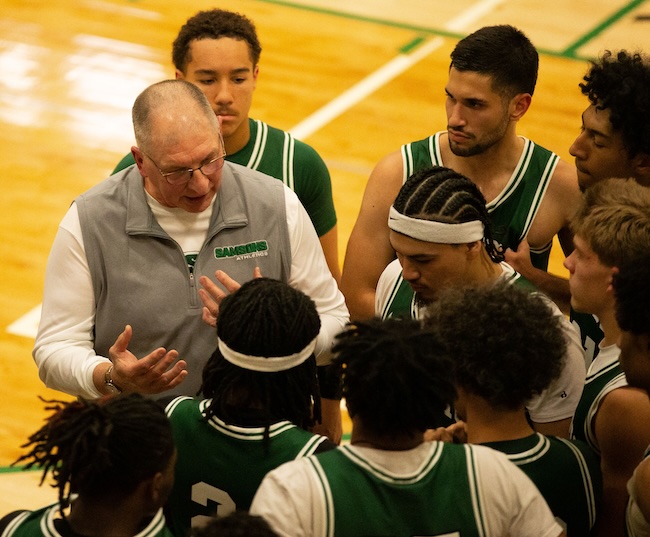
PHOTOS (Top) At left, Dennis Mackey (45) gets up a shot for Ewen-Trout Creek against Wakefield as a senior during the 1980-81 season. At right, Mackey coaches up his Gogebic Community College men’s basketball team this past summer. (Middle) Mackey huddles with his players during a break. (GCC photos by Jason Juno. Ewen-Trout Creek photo courtesy of the Ironwood Daily Globe.)

Strategize for First Parent Meeting
February 25, 2015
 By Scott Westfall
MSU Institute for the Study of Youth Sports
Coaches often cite parents as one of the most uncontrollable and frustrating aspects of coaching.
Let’s face it, when this relationship goes south, there can be pent-up frustration and hard feelings between the two parties which can result in a negative experience for everyone involved – especially the player who is often caught in the middle.
Establishing positive relationships with parents should happen from the moment you stand in front of them at your annual parent meeting.
Throughout this meeting, parents will be asking themselves: “Can I trust this coach with my child?” “Will this coach be fair in his/her decisions?” and “Will this coach always have my child’s best intentions in mind?”
In order to put them at ease, you must do everything possible to establish yourself as a person of integrity who is altruistic and 100 percent trustworthy. Below is a coaching checklist that will help you establish trust and credibility with your team’s parents:
Transparency – Do things openly and share information as much as possible. If something bad happens on your team, be sure that you do not sweep it under the rug. Be open and consistent with your decisions, and always follow through on what you say you are going to do.
Demonstrate Respect – Be polite and sincere with parents and let your actions show that you care. Sometimes the little things you do will resonate louder than the big things.
List Expectations – Have high expectations for the conduct of both the players and parents in your program. List these expectations, distribute them, and then talk about them with the parents. Meanwhile, let them know what they can expect from you in return (proper dress attire, appropriate language, great sportsmanship, impeccable conduct, proper treatment of game officials, etc.).
Express Loyalty – As often as possible, be sure to praise your players, assistants, and the people associated with your program. Be sure that you never take credit for other people’s work, and remember to use the word “we” as often as possible.
Be Accountable – This means taking the blame for bad results– even when it wasn’t necessarily your mistake. Admitting when something goes wrong on your watch doesn’t mean that you are a bad coach or you’ve lost control of your program. True leaders are accountable for the mistakes that happen in their programs.
Deliver Results – This is not necessarily wins and losses. Instead, deliver results on the things that really matter, such as developing a respectable team, coaching players with all passing grades and having players who do not get into trouble or break the law.
No parent meeting would be complete without a healthy dose of paperwork. To make it easier for parents to keep these papers organized, try to color-coordinate the forms and go over them slowly one at a time.
Below are the basic documents you should supply at the parent meeting (Note: Try to also have these documents accessible on your team’s website):
Coaching Philosophy – Drafting a coaching philosophy will allow parents to better understand who you are and the reasons you coach. In this document, be sure to include your fundamental beliefs along with your personal approach to coaching. (Note: Be honest in this section – Do not advertise yourself as one type of coach, but then act like another). Include a lot of “I statements” such as, “I coach for the purpose of teaching life lessons,” “I believe that student comes before athlete,” and, “I am demanding but never demeaning.” Developing and drafting a coaching philosophy not only gives parents insight into you and your program, but it also gives you an opportunity to reflect upon why you do things the way you do.
Team Policies – This is perhaps the most important document you will distribute to your team’s parents. It should list all team rules pertaining to player conduct, grades, eligibility, attendance, discipline, communication, and of course playing time! Include statements such as, “Playing time is earned – not given,” “All decisions will be made based on what is best for the team,” and, “If you have a problem, please talk to the coach.” Inform parents that student-athletes will receive equal opportunities but not equal things. These opportunities include instruction, off-season strength and conditioning programs, and support for their classes. How well student-athletes take advantage of these opportunities (attendance, focus, effort, attitude, and self-discipline) often dictates their levels of success. (Note: Before distributing this document, make sure your school’s administration/athletic director supports your team policies 100 percent).
Student-Athlete Character Contract – While many schools have had an athletic code of conduct in place for years, teams today are including an additional written set of norms for players to follow. A character contract outlines how players agree to conduct themselves as a person, student, and athlete. If you want to create more buy-in, consider drafting this contract each season with your players!
Parent Pledge Form – This document establishes the expectations you have for the parents in your program. Be sure that you include expectations for their conduct at games, having a positive disposition around the team, the treatment of players on your team along with the treatment of your opponents, letting the coaches coach, and how to act toward game officials.
Team Calendar – Be sure to include detailed information on the times and locations of all practices, team events, games, and places that players need to be. If changes are made to the team calendar throughout the course of the season, be sure you inform parents through several forms of communication (a printed note sent home, an announcement on the team website, email list, social media, etc.).
Athletic Physicals – While most doctors’ offices have a copy of these blank forms on hand, it is convenient for parents to have access to them through your school.
Athletic Fees (if you are a “pay for play” district) – Some districts have a mandatory athletic participation fee, while other districts do not. Some districts have a waiver form for students who are on free/reduced lunch. In any of these cases, make sure you are on top of this information so you can properly inform your team’s parents at the meeting.
Conflict Resolution – The occasional conflict is almost inevitable while working in an emotionally charged environment such as athletics. However, conflicts can often be avoided or at least more easily resolved through proper forms of communication.
- Inform parents that you are always willing to listen to their concerns; let them know that you would prefer they address an issue with you, rather than taking their frustrations to the next game and venting to anybody in the bleachers who is willing to listen.
- In your team documents consider a statement such as, “The best tool we have in our relationship is an open line of communication. My door is always open and so is my mind.”
- Finally, be sure to let them know that if they are upset about something to not send it through email. Email is good for information, but not communication. Try to communicate and resolve conflicts in person as much as possible.
Once you have established trust and credibility with your team’s parents, you can start building the relationship. Caution: Building a relationship with your team’s parents is not developing close friendships with them. Becoming close friends with parents actually can lead to bigger problems as you open yourself to criticism of playing favorites. Instead, build working relationships, generated through mutual respect and understanding for each other’s position in the quest of helping the young individual become a successful student-athlete. These working relationships help parents understand their optimal level of involvement, such as where and how they can fit into your program. Below are some tips for building working relationships with parents:
- Learn their names and where they work.
- Learn what the family likes to do when they are outside of the school setting.
- Invite them to a team event such as a team picnic, fundraiser, or team trip.
- Ask parents for help with certain jobs. Many parents appreciate being asked to help with team functions as it gives them an opportunity to get to know other parents and makes them feel like they matter.
- Call them at least once per season to say hello, report on their child’s progress, and ask if there is anything you can do to be of assistance.
- Offer additional support for their child. Helping the student-athlete outside of coaching with things such as academics and typical teen issues shows you care.
- Offer support to the parents as well. If they are struggling to get a message across to their child, oftentimes a coach sending or reinforcing the same message makes all the difference. As a coach you hold a powerful platform with your student-athletes; use it to help with their development and maturity whenever possible.
Establishing yourself as a trustworthy and credible coach is the first step in getting parents to buy into your program. Meanwhile, providing parents with sufficient information will help them feel like you are keeping them informed and want them as a partner in your program.
Creating working relationships with parents takes time, but will be the cornerstone in establishing a positive experience for the years their children are involved with your program. While some parents may have a different background or mindset, listing your expectations will help them better understand your team’s culture and how they can fit in.
If done right, these positive working relationships should alleviate much of your coaching frustration and pay tremendous dividends in the future.
Scott Westfall has spent the last 10 years as a teacher, coach, and athletic director in Fort Collins, Colo. He currently is working on his Doctorate at Michigan State University, with an emphasis in Sport Psychology and Athletic Administration, and assisting the MHSAA with its student leadership programs. Westfall is a former athlete who participated in football, wrestling, tennis and cross country at the high school level, and rugby at the collegiate level. He can be reached at [email protected].