Mackey Leaving Court with 500+ College Hoops Wins, Many More Lessons Shared
By
Jason Juno
Special for MHSAA.com
July 24, 2026
IRONWOOD — Dennis Mackey made a big impact on generations of athletes at Gogebic Community College, so much so that college officials named the basketball court after him while he was still coaching.
 Mackey retired from coaching in April after 38 years at GCC, 19 with the women and 19 with the men. Even after all of those years, and more than 500 wins, the memories and lessons from his playing days at Ewen-Trout Creek still resonate with him.
He was always doing something athletically, football in the fall, baseball in the summer, track & field in the spring. His home being basketball-centered E-TC – the tiny Upper Peninsula school with nine combined boys and girls MHSAA Finals appearances – hoops was always mixed in.
“Basketball was the winter sport, but no matter the season we always found time to get to the gym and shoot hoops,” Mackey said. “Whether it was during the lunch hour, after school, on weekends, or after practices, we seemed to gravitate to the gym for some action.”
And if they didn’t go to the gym, there were outdoor courts in Ewen, Bruce Crossing and Trout Creek to get shots up.
“Basketball was the main sport in those communities and probably is still to this day,” Mackey said. “Looking back now, I must say the experiences growing up playing basketball at E-TC was awesome.”
Mackey, a 1981 graduate, played on the varsity team all four years of high school. The Panthers lost in the Regional Final at Northern Michigan University’s Hedgcock Fieldhouse both his junior and senior seasons.
“We had deep and talented teams but fell short of our goal of reaching the state finals both years,” Mackey said.
He won the Ed Helakoski Award as the most valuable senior in the Porcupine Mountain Conference. Even though he was a 1,000-point scorer, he took pride in other aspects of the game.
“I played the forward position, oftentimes guarding the opposing team’s best inside player,” Mackey said. “I prided myself on being a hardworking and unselfish player. I really enjoyed passing the ball to teammates for their scoring opportunities.”
Mackey went on to play basketball at Gogebic. After graduating from Northern Michigan University, he eventually got a call about an opening for a part-time business instructor and women’s basketball coach at Ironwood’s college.
He was excited to take over the team heading into the 1988-89 season. Six years into his tenure, he led a balanced Samsons team to the program’s first national tournament. They won another Region 13 title three years later.
Another E-TC graduate, Deke Routheaux, retired as men’s coach after the 2005-06 season. Mackey didn’t make the switch, instead opting to coach his daughter Caitlin in her first season at Gogebic. The job opened up again a year later, and he debuted as men’s coach in for 2007-08. They men won Region 13 championships in both 2011 and 2013, just missing trips to the national tournament both years.
He said the goal was to win more games and Region titles, but his teams usually left it all on the court.
 Mackey finished his tenure with the women with a record of 256-227 and a 277-263 record with the men. “It’s often said that teams tend to take on the identity of their coach,” Mackey said. “As I walk out the door, I’ll leave knowing my teams, like their coach, were known as fierce competitors.”
His signature saying is printed on the Lindquist Center court, “Coach Mackey Court,” — ”Once a Samson, Always a Samson.”
He wants the entire college to succeed, beyond just the basketball program. He took a lot of pride in giving local players a chance to play college basketball. He still supports them after they graduate.
Players came back yearly to play in their main fundraiser, the Spring Thaw Classic.
When GCC named the court after him, many of those he left an impact on filled the Lindquist Center gym on a random Tuesday game night in November.
Many appreciate the impact he had on their lives. He knows the importance of sports, whether it’s at the college level that he’s been at the last nearly 40 years, or at E-TC, where he got his start.
“Participation allows many to express themselves in ways that open doors to other life opportunities,” Mackey said. “High school athletics provide opportunities for youth to develop individual skills while learning life lessons at the same time. No matter the sport, learning to be a great teammate is challenging for most young people. Dedicating one’s time and efforts to improving oneself while also helping the team be better can be difficult. We all strive to be the best and win games, but are we willing to do the work to achieve the desired results? Everyone enjoys receiving the accolades, but many are unwilling to sacrifice the time and energy required to improve and develop individual skills, which enables this to happen.”
All three of wife Andrea (who was a big help to the GCC program as well) and his kids, Caitlin, Jesse and Adam, played high school basketball and then for Gogebic as well. Dennis said Adam was a similar player to him but a better scorer — he’s Ironwood’s all-time leader — who also wanted to get his teammates involved. They all teach at Ironwood now; Adam is the boys varsity basketball coach and Jesse the varsity girls coach.
The Mackeys continue to pass on many life lessons via high school sports.
“The thrill of victory and the agony of defeat not only applies to the games we play but to life in general,” Dennis said. “Success in high school is often measured with wins versus losses, but in the game of life the valuable lessons learned from the sports we play provide a platform for future growth. There are many folks employed in a variety of vocations who often credit their youthful days of playing sports as the impetus for their success later in life. The bonds created with teammates and opponents often last a lifetime. These bonds are immeasurable and help many advance in all facets of life.”
2026 Made In Michigan
July 16: Country Day Two-Time Champ Moore Building Perennial Winner at Harvard - Report
July 9: Multi-Sport Career at TC West Helps Gillis Thrive as Pro in Game She Once Left Behind - Report
July 2: Inspired by Home, Eager to Give Back, Spencer Hosts Hoop City Alumni Games - Report
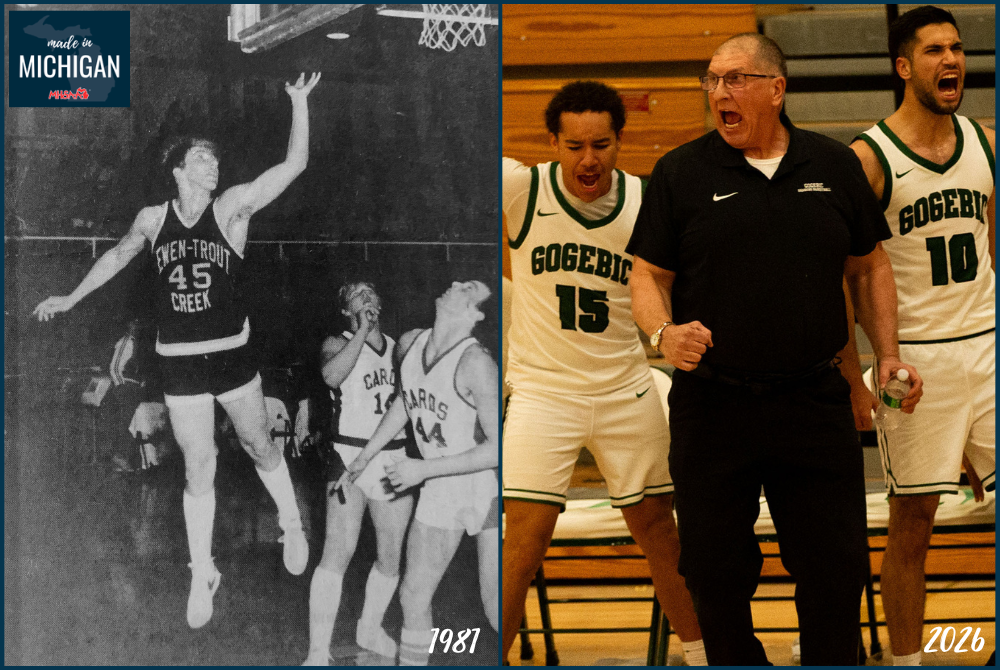
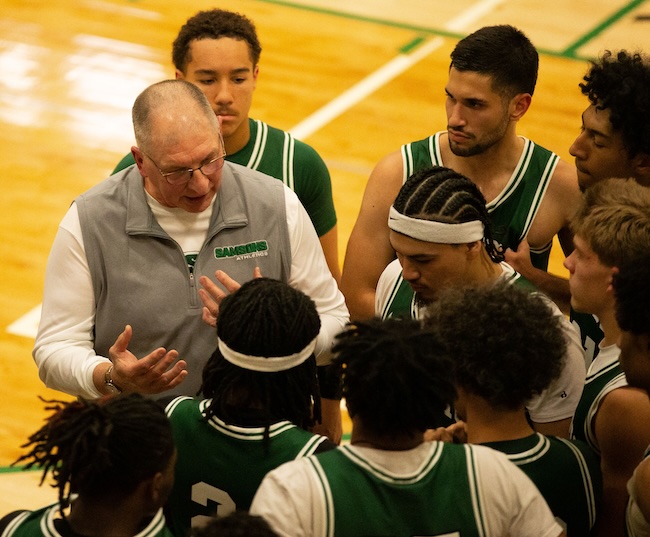
PHOTOS (Top) At left, Dennis Mackey (45) gets up a shot for Ewen-Trout Creek against Wakefield as a senior during the 1980-81 season. At right, Mackey coaches up his Gogebic Community College men’s basketball team this past summer. (Middle) Mackey huddles with his players during a break. (GCC photos by Jason Juno. Ewen-Trout Creek photo courtesy of the Ironwood Daily Globe.)

MHSA(Q&)A: Beal City volleyball coach Kelly David
October 6, 2012
By Geoff Kimmerly
Second Half editor
 When people in Michigan’s volleyball community hear the name Kelly David, they might think first of the standout from just a few seasons ago. A four-sport standout for the Aggies, she set the volleyball team into the 2009 Class D Semifinals before going on to play at St. Clair Community College.
David, 20, graduated from high school a little more than two years ago, but is continuing to have an impact on the volleyball court – although now from the sideline as coach of the No. 3-ranked team in Class D. She took over the Beal City program this fall from her former coach, Randy Gallagher and has the Aggies 26-5-1.
Coaching has come naturally for the former floor leader, who already has gained valuable experiences and knowledge to share with her players. She previously coached at the junior high and club levels, the former for her aunt Sue Frederiksen – who coaches Almont’s varsity and is a member of the Michigan Interscholastic Volleyball Coaches Association Hall of Fame.
David is majoring in elementary education at Central Michigan University and sees teaching and coaching in her future for many years to come.
Why did you decide to become a coach?
I played at St. Clair (Community College) for two years, and my aunt had always been into coaching. I ended up coaching her seventh grade volleyball team for two years, and I coached in the Skippers AAU program over there. I found out I liked coaching more than playing.
How have you approached coaching a team that includes players who were freshmen when you were a senior in high school?
Going into it, I knew I wasn’t their friend; I was their coach. I wasn’t close to any of the girls except my sister (Monica, a senior). The people who coached me or were my teachers, (who said) go to class, do this, and you knew they received ultimate respect. I had helped out in previous years, and I knew what I had to do to gain that respect. And (my players) have listened to me.
Did you anticipate questions about you taking over the program only a few years out of high school?
I knew in my head, but I didn’t think it would be a problem in people’s minds. "She’s young, her sister is on the team;" that’s the stuff people might second guess. But I knew how to control the team, and having my sister on it wasn’t a big teal. So far (issues) haven’t happened. I’ve coached teams in previous years, and I’d always been the leader when I did play. I think that helps.
What were your goals coming into the season?
I had a lot of goals. Obviously, I wanted us to go far, like in the past. The biggest thing I noticed playing college from high school, the players knew the game of volleyball. They were smart. They had the same athletic ability as those I played against in high school, but they were just smarter. Knowing how to position the ball on the court, knowing the game, and I wanted to teach (my players) the game of volleyball. It’s important to know the game, and then we can work around the obstacles.
What did you learn by watching your aunt coach?
Just how strong you have to be. When I watch her coach, she’s very enthusiastic. But when someone does something wrong, she lets them know. That’s an important thing.
When did you first know you were interested in coaching?
When I was in high school, when I played, I’d help the other players. I noticed that was something I liked to do. I’d watch someone and pick up things they could fix. I thought about it in high school, and once I actually did it with the seventh graders, it wasn’t a job for me. It’s fun. Coaching is something I want to do. They want to be playing volleyball – that’s why they’re on the team. Everyone wants to be there, and we’re trying to accomplish the same thing.
What has been the biggest challenge during your first season?
The biggest challenge is handling the pressure. I know the team can do well. We’re ranked third in the state right now. But it’s getting them to perform the way they can perform, getting them to come together at the right time.
I’d also like to mention that Beal City (already) had a great program, from (former coaches) Randy Gallagher and before I came, Kelly Knuth. I’m just happy to step in and try to continue what they did.
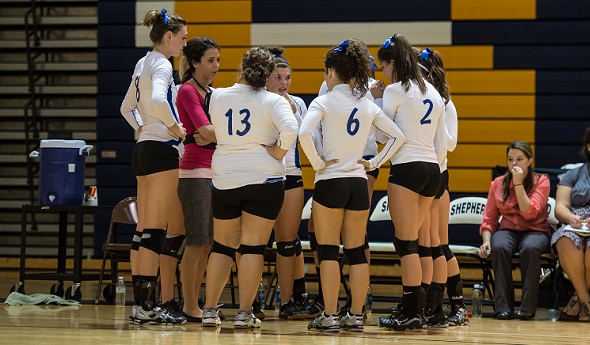
PHOTO: Beal City huddles during a break in its match against Shepherd this season. (Click to see more from HighSchoolSportsScene.com).