


MHSA(Q&)A: Historian Ron Pesch
April 16, 2012
 When we receive a question on the history of MHSAA athletics that we can't answer on the spot, Muskegon's Ron Pesch is the first person we seek out for help.
Pesch took the reins as Michigan's chief high school sports historian during the mid 1990s after the retirement of legendary MHSAA record book originator Dick Kishpaugh and has contributed to various efforts and publications across the state.
One of his latest projects is the awarding of "retro" Mr. Basketball Awards. The first Hal Schram Mr. Basketball Award was given by the Basketball Coaches Association of Michigan in 1981 to Lansing Eastern's Sam Vincent. Three seasons ago, BCAM -- with research work by Pesch -- began awarding retro winners for the previous decades beginning with the 1920s. This winter, BCAM honored retro winners from 1922, 1932, 1942, 1952, 1962 and 1972.
Click to read more about those winners and the finalists recognized last month. Also, click for links to the previous retro winners. The retro Mr. Basketball project will last seven more seasons. Pesch explains more below.
How did you come up with rewarding a “Retro” Mr. Basketball?
The project came out of a conversation I had with (BCAM executive director) Tom Hursey at the basketball finals back in '99. Together, we hatched an approach honoring the state's past basketball greats. He let me run with it, while he worked on getting a subcommittee launched to make the selection.
How do you dig up all of this nomination info?
Between votes, I work on digging out the details. My initial target list always begins with all-state teams - if, of course they exist. All-tournament teams for the early years also serve as a starting point -- if they exist. Best I can tell, the Detroit Times, the Free Press and the News have all named all-state squads, at various points, back to about 1935. The Associated Press and UPI came to the game much later - somewhere around the early to mid 1960s. I then work on creating a crosstab on the players selected, noting the "teams" on which they were named (Class A 1st team, Dream Team, Class C 3rd team), and try to find quotes detailing their games. The result is really a reflection of the times and the history of newspaper reporting.
In early years, we can struggle to uncover a player’s first name, let alone his class in school. And statistical coverage of a player's abilities was very limited. It's simply the way things were back then. Everyone in town knew King Lewis, or Red Cherry, or Young Jacks. And the final box score only contained points, fouls, substitutions, as they were all you really needed to know about the game. But by visiting the state library in Lansing, and looking at a cross-section of newspapers, you can usually dig out what you need.
Do you collect from other sources as well?
Another source is high school yearbooks. Some resources have started to emerge online. I also tap into the MHSAA site and make contact with ADs around the state, asking for their assistance on digging out details - especially class in school. Like the current program, only "seniors" are considered for the award. Mid-year graduates can create a challenge, but the rule currently in place is a player is considered a nominee in the year in which he was last eligible for the state tournament. In other words, if you graduated in January or February of 1943, you would be considered for the 1942 ballot. It appears that a similar approach was used in selecting all-state teams.
|
Year |
Player |
High School |
Age |
Height |
Weight |
Year |
DFP |
DN |
DT |
AP |
UPI |
Tourney |
|
1971 A-1 G. |
Frank Tanana, Jr. (C) |
Detroit Catholic Central |
17 |
6-3 |
170 |
Sr. |
A1 |
A1 |
A1 |
A1 |
||
|
1971 A-1 C |
Tom McGill |
Flint Northern |
17 |
6-3 |
190 |
Sr. |
A1 |
DM |
A1 |
A1 |
||
|
1971 A-1 F. |
Lindsay Hairston |
Detroit Kettering |
17 |
6-9 |
203 |
Sr. |
A1 |
DM |
A1 |
A1 |
||
|
1971 A-1 F. |
Campy Russell |
Pontiac Central |
18 |
6-7 |
190 |
Sr. |
A1 |
DM |
A1 |
A1 |
That cross-tab table will help establish a list of nominees. A consensus first-team pick is an obvious candidate. When only a single all-state team is available, I'll do what I can to look up all-conference teams or all-area teams from around the state to see who else might be considered. While life after high school is not a considered when trying to pick a winner, a player who emerges as a star in college or in the pros may emerge as a candidate when you see his details in a local paper.
Bios are assembled from the newspaper reports, detailing as much as we can find on high school player's career. I'll tap into a variety of resources including old team histories when available. When needed, I'll toss out request to reporters, old and new, around the state. Local librarians and historians are another wonderful resource.
How does voting work?
Between sessions of the Boys Finals, the committee assembles to hash out a final ballot, and to make a selection. I don't vote, but I may guide the conversation and provide any additional details when needed, reminding members that we're focusing on their high school careers. The process is certainly imperfect. But the committee approach prevents the process from becoming a popularity contest. These guys have the benefit of watching many of the players play. And, like the current Mr. Basketball program, they sometimes surprise. But that's what makes it fun. And, of course, stirs the pot. It gets people talking about the history of basketball in this state.
Is there a theme to MHSAA basketball that has remained constant over the years?
For me the greatest thing about the basketball tournament is that it assembles a wide range of folks who want to see players they've heard about in action. And the process, for the most part, hasn't change since the 1920s. While the style of the game has changed, winning a title is much the same as it was back when our great-grandfathers played: You gotta get through the tournament. And only four trophies are awarded.
These guys were the "Magic" of their day. I'm hoping we never forget that.
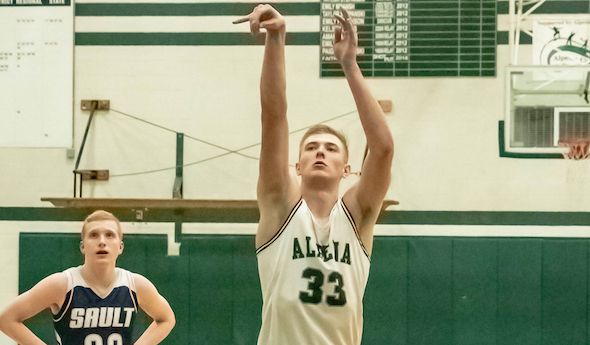
Performance: Alpena's Chris DeRocher
February 1, 2019
 Chris DeRocher
Alpena senior - Basketball
Alpena’s 6-foot-5 four-year varsity forward scored 29 points in last week’s 74-45 win over Sault Ste. Marie – and on the 29th point broke his school’s career scoring record on the way to earning the Michigan Army National Guard “Performance of the Week.”
DeRocher surpassed the record previously set in 1972 by Butch Feher, who went on to play at Vanderbilt University and for a season with the NBA’s Phoenix Suns. DeRocher sank a fourth-quarter free throw to lock up the record at 1,436 points, and he added 26 more to his running total in Thursday’s 70-55 win over Gaylord after entering the night averaging 24.3 points, 10.3 rebounds and three assists per game this season. The Gaylord victory put the Wildcats at 11-2 after the team won five games his freshman season and nine games apiece the last two winters.
 It’s been a record-setting school year for Alpena’s senior class: In addition to DeRocher’s milestone, Aidan Day set the school’s career soccer goals record, Logan Guthrie became its all-time leading career football rusher and hockey goalie Cooper Black now owns Alpena’s single-season shutout record on the ice. DeRocher also played baseball – he pitches and plays first base – and carries a 3.7 GPA. He’s unsure where he’ll attend college, but he aims to continue playing basketball and study business.
Coach John Pintar said: “I have been fortunate to have a great seat every night to watch Chris develop the last four years as both a player and a person. As a coach, you always want to see each player reach their peak potential, and Chris has certainly done that. He has started every game for us since his freshmen year. He came into the program right after we had graduated a senior class that had won two conference titles and went 41-5. There was a void in the program, and Chris was able to step right in as a freshman and instantly become a key player on the team that we could count on every night. … Any great player will tell you that winning as a team is why they play, not their statistics, and Chris has always embodied that belief. His number one goal is always the success of the team and not scoring records. The scoring has always happened within the team framework of our offense and his desire for team success. … This achievement didn't happen by accident; he has truly put in the time and effort to get to this point. He has had great support from his family and teammates along the way and I'm sure he would be the first to tell you that this couldn't have happened without them and their support. Chris has great character and is an excellent student. He has always represented himself and our school with class. I am extremely proud of what he has done and expect him to continue doing great things the rest of the season and in the future.”
Performance Point: “It was amazing, just all of the people there,” DeRocher recalled of last week’s record-setting night. “After I made that free throw, and hugging my teammates, and hugging my coaches that I've been with for four years, it was just really amazing to think about breaking a 47-year record. … Last year when I hit the 1,000-point mark, it was like, ‘All right, so if I do what I have the past two years, I should be able to do this.’ It was never something that I went out and tried to do. If it came, it came. I just went into every game trying to play the best I could for our team, and I ended up being able to do it.”
4-year varsity education: “I think I’ve just learned to not force every shot. I’ve tried to get more people more involved. Because I’ve learned if I get my teammates more involved it’s going to draw people away from me, and it’s going to be easier to get points. Just learning the game, learning defenders (and) how they play me, improving my shooting.”
 Our time to shine: “The past couple years we’ve gone through some struggles. We didn’t really have that many people ahead of us, so that wasn’t always the best thing. For two years (2015-16 and 2016-17), we only graduated two seniors. Now we’re up to our grade, and we’re showing that once you get a good group together and you have a strong core, it really does help and it really does win games. We’ve learned so much the last few years – most of our starters have started since sophomore year. It’s really showed, how well we’ve played together and how much we know each other and the chemistry we’ve had.”
Super seniors: “We have a really, really strong class, and a lot of kids are going good places. To be able to be that class that breaks all those records is really cool. You always want to win; you want to show these other schools you really are something. Our grade was always pretty good. … We’re all pretty good friends with each other, and we’re always rooting for each other.”
Putting down roots: “My family owns a couple of businesses in Alpena, so I’ll probably go into that. I’ll end up coming back home. I like it here, I like everything it has to offer. … I like the area and I want to stay here.”
- Geoff Kimmerly, Second Half editor
Every week during the 2018-19 school year, Second Half and the Michigan Army National Guard recognizes a “Performance of the Week" from among the MHSAA's 750 member high schools.
The Michigan Army National Guard provides trained and ready forces in support of the National Military Strategy, and responds as needed to state, local, and regional emergencies to ensure peace, order, and public safety. The Guard adds value to our communities through continuous interaction. National Guard soldiers are part of the local community. Guardsmen typically train one weekend per month and two weeks in the summer. This training maintains readiness when needed, be it either to defend our nation's freedom or protect lives and property of Michigan citizens during a local natural disaster.
Past 2018-19 honorees
January 24: Imari Blond, Flint Kearsley bowling - Read
January 17: William Dunn, Quincy basketball - Read
November 29: Dequan Finn, Detroit Martin Luther King football - Read
November 22: Paige Briggs, Lake Orion volleyball - Read
November 15: Hunter Nowak, Morrice football - Read
November 8: Jon Dougherty, Detroit Country Day soccer - Read
November 1: Jordan Stump, Camden-Frontier volleyball - Read
October 25: Danielle Staskowski, Pontiac Notre Dame Prep golf - Read
October 18: Adam Bruce, Gladstone cross country - Read
October 11: Ericka VanderLende, Rockford cross country - Read
October 4: Kobe Clark, Schoolcraft football - Read
September 27: Jonathan Kliewer, Grand Rapids Forest Hills Northern soccer - Read
September 20: Kiera Lasky, Bronson volleyball - Read
September 13: Judy Rector, Hanover-Horton cross country - Read
PHOTOS: (Top) Alpena's Chris DeRocher follows through on a free-throw attempt during last week's win over Sault Ste. Marie. (Middle) DeRocher controls a loose ball in the lane. (Photos by Sports in Motion.)